In 2026, the transition from passive generative AI chatbots to autonomous agentic workforces represents the definitive competitive advantage for organizations looking to drive concrete business outcomes rather than simple text answers. Building and scaling these systems at an enterprise level requires robust orchestration platforms like the Gemini Enterprise Agent Platform with Google ADK, Microsoft Agent Framework, and LangGraph, all of which are rapidly converging on open standards like Model Context Protocol (MCP) and Agent2Agent (A2A). Successfully navigating this shift demands a move toward a disciplined Cognitive CI/CD lifecycle, combining strict operational guardrails, continuous automated evaluation, and real-time observability telemetry to eliminate reasoning errors and secure unit economics.
What Is Agentic AI Development?
Agentic AI development is the advanced digital engineering discipline of building autonomous, goal-oriented systems that execute complex enterprise workflows without human intervention. While traditional AI development focused on creating passive models that required human prompting to generate a response, agentic AI constructs active digital workforces. In modern enterprise architecture, these agents serve as the intelligent orchestration layer. By combining reasoning engines with direct API access, agentic systems bridge the gap between probabilistic AI models and deterministic business outcomes, fundamentally redefining how software operates.
What Are the Key Components of AI Agent Development?
What Are the Different Architectures of AI Agents?
-
Single-agent systems:
A highly deterministic architecture designed for narrow, vertical workflows, utilizing a strict set of predefined tools.
-
Multi-agent systems:
A decentralized “swarm” approach where specialized agents communicate, debate, and delegate tasks to solve fluid, complex problems.
-
Hierarchical agents:
An enterprise-grade structure where a “supervisor” agent dictates strategy and routes sub-tasks to specialized “worker” agents.
-
Event-driven agents:
Asynchronous systems that sit dormant in the infrastructure, triggering complex workflows only when specific data anomalies or real-world events occur.
How Do AI Agents Use Memory?
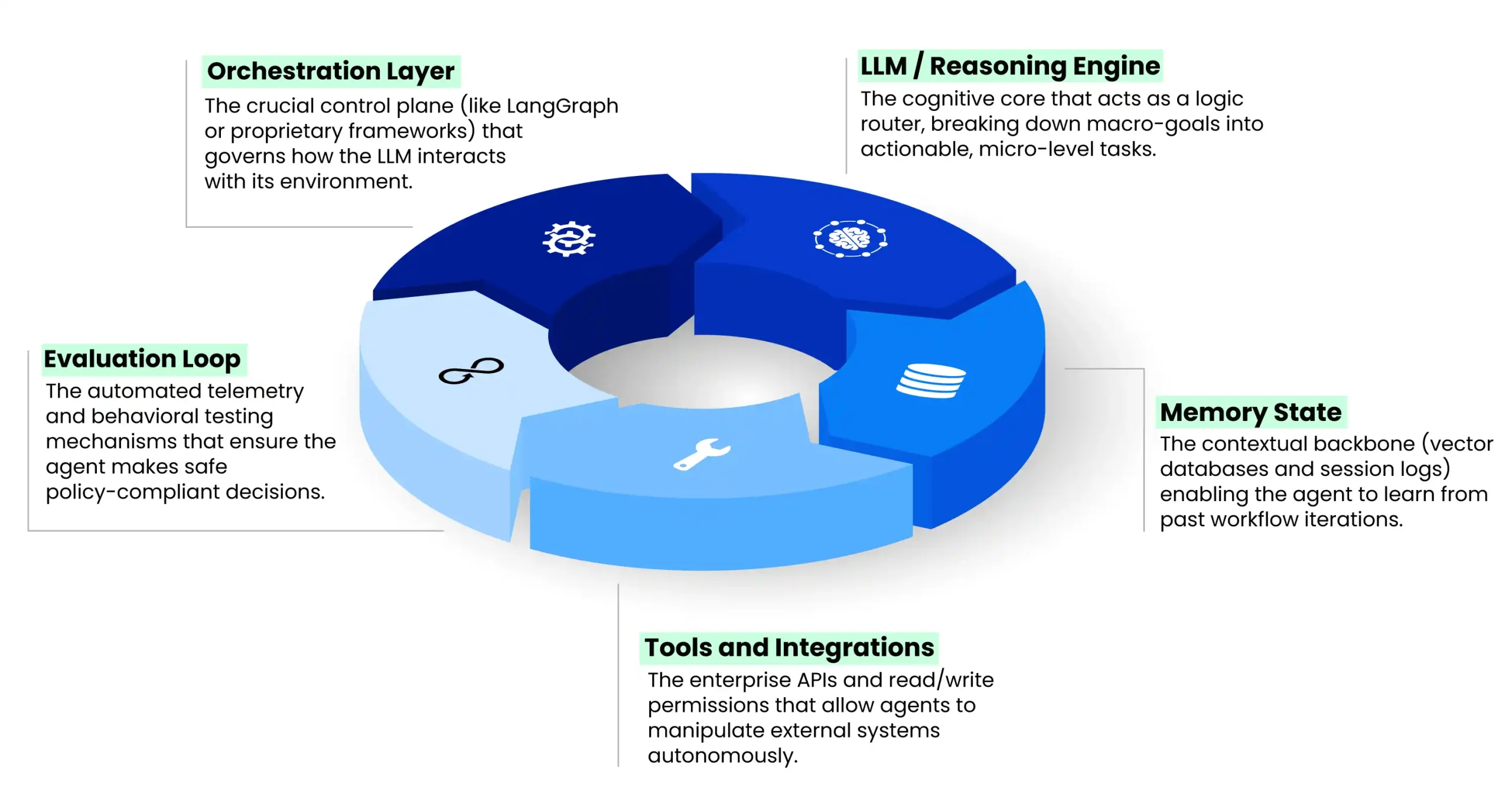
AI agents rely on short-term memory to maintain state during active sessions and long-term (semantic) memory to anchor their reasoning in historical enterprise data. This dual-layer approach transforms a generic LLM into a highly personalized, context-aware system capable of making nuanced, context-dependent decisions over time.
How Do AI Agents Use Tools & Integrations?
Agents use tools to break out of their isolated sandbox and enforce physical or digital changes in the real world. By securely integrating with enterprise APIs, agents can autonomously query live databases, execute transactions, or reconfigure cloud infrastructure based on their own reasoning logic.
What Does an AI Agent Development Lifecycle Look Like?
Building a traditional software application relies on deterministic logic where if X happens, do Y. Building an agentic system, however, means orchestrating stochastic, probabilistic models. This requires a paradigm shift from traditional DevOps to “Cognitive CI/CD” (or AgentOps), where you are deploying and managing reasoning, not just code.
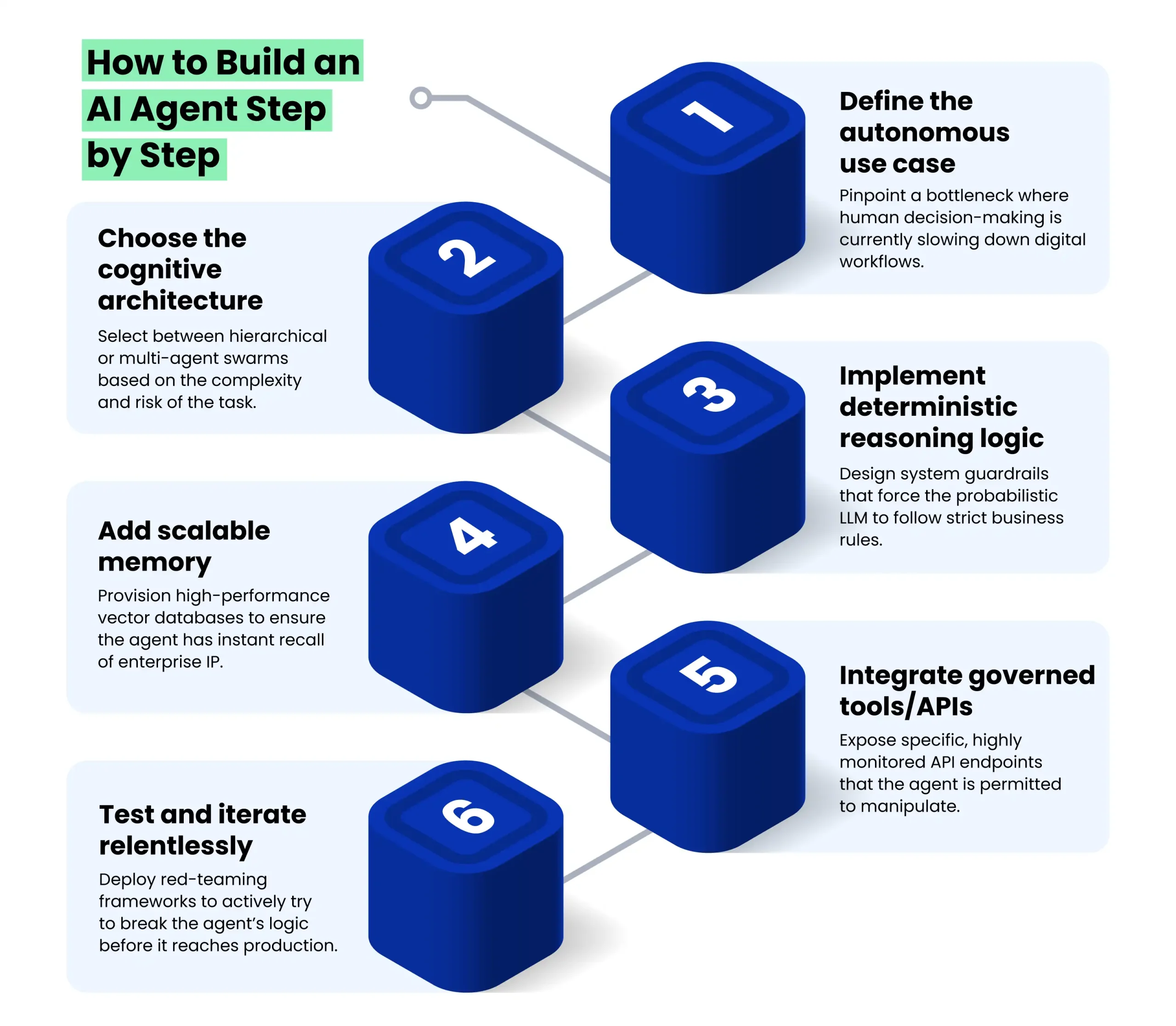
A production-grade lifecycle in 2026 follows these six critical phases:
-
Design: Scoping the Cognitive Blueprint
Before writing a single line of code, architects must define the agent’s constraints and purpose. A poorly scoped agent will burn through tokens and hallucinate.
- Define the Objective: Target a specific business KPI (e.g., “reduce Level 1 support ticket escalations by 40%”).
- Set the Boundaries: Establish strict guardrails for what the agent cannot do.
- Map the Persona: Determine if this requires a single specialized agent or a multi-agent “crew” (e.g., a ‘Researcher’ passing data to a ‘Summarizer’).
-
Build: Engineering the Cognitive Architecture
This is where the framework (like Google ADK, LangGraph, or Microsoft Agent Framework) is selected and the core logic is written.
- Flow Engineering: Moving beyond simple prompt engineering to design the actual reasoning loops (e.g., ReAct, Plan-and-Execute).
- State Management: Configuring how the agent passes information from one node to the next without losing context.
- Routing Logic: In multi-agent systems, writing the deterministic code that dictates how agents hand off tasks to one another.
-
Integrate: Grounding the Reasoning Engine
An agent is only as powerful as the systems it can securely touch.
- Memory Binding: Connecting the agent to Vector Databases (for RAG) so it can access historical enterprise knowledge.
- Tool & API Connectivity: Binding the agent to external tools (CRMs, ERPs) using open standards like the Model Context Protocol (MCP).
- Security Enforcement: Applying the Principle of Least Privilege to all tool connections to prevent destructive actions via prompt injection.
-
Evaluate: Behavioral Testing & “Evals-as-Code”
Traditional unit tests check if code compiles; Agentic Evals check if the AI thinks correctly. This is arguably the most critical phase.
- Simulate Edge Cases: Running the agent through hundreds of adversarial scenarios to measure hallucination rates and logic failures.
- LLM-as-a-Judge: Using a larger model (like Gemini 3.1 Pro) to grade the output and reasoning paths of the working agent.
- Unit Economics Testing: Ensuring the agent doesn’t get caught in “infinite loops” that silently drain API credits.
-
Deploy: Controlled Release and Governance
Agents should rarely be deployed fully autonomously on day one.
- Shadow Mode: Running the agent alongside human operators to compare its proposed actions against what the human actually did.
- Human-in-the-Loop (HITL): Releasing the agent into production but requiring explicit human approval for consequential actions (e.g., authorizing a refund).
- Gradual Autonomy: Slowly transitioning to Human-on-the-Loop (monitoring) as the agent proves its reliability over time.
-
Monitor: Observability and Continuous Improvement
Once live, an agent’s behavior can drift. The Observability layer is your diagnostic engine.
- Trace Reasoning Paths: Using telemetry tools to literally read the agent’s “mind”, understanding exactly why it chose to use a specific tool at a specific time.
- Track Tool-Failure Rates: Identifying if an API endpoint is timing out and causing the agent to fail its task.
- The Feedback Loop: Feeding production errors back into the Evaluation suite to continuously refine the agent’s prompt pipelines and routing logic.
Why Is Evaluation Important in AI Agent Development?
Evaluation is the single most critical firewall between a brittle experimental prototype and a trusted enterprise-grade solution. Because agents operate probabilistically rather than deterministically, traditional software testing (like basic unit tests) is fundamentally insufficient. You are no longer just testing code; you are testing reasoning, behavior, and decision-making.
Implementing a robust, continuous evaluation framework is essential for four reasons:
-
Preventing “Silent” Failures:
An agent might successfully complete a task, but take an illogical, biased, or non-compliant route to get there. Continuous evaluation tests the agent’s reasoning paths against ground-truth data to ensure it strictly follows enterprise standard operating procedures.
-
Mitigating Catastrophic Tool Execution:
By simulating thousands of adversarial edge cases in a sandbox, evaluation pipelines ensure the agent won’t hallucinate destructive actions, like issuing a massive unapproved refund or executing a dangerous SQL query.
-
Controlling Unit Economics:
A poorly constrained agent can get stuck in endless “Plan-and-Execute” loops, silently burning through expensive API compute credits. Evals track token efficiency and step-counts, ensuring the agent remains cost-effective.
-
Enabling “Cognitive CI/CD”:
Foundation models and enterprise APIs update constantly. Continuous evaluation acts as automated regression testing. If you upgrade to a newer model or tweak a prompt, the evaluation suite instantly grades the agent to ensure the update optimized performance without breaking existing workflows.
What Are the Challenges in Agentic AI Development?
Moving from deterministic software to probabilistic agents introduces entirely new categories of technical debt and risk:
-
“Cascading” Hallucinations:
In a multi-step workflow, a minor reasoning error at step one compounds exponentially by step ten, leading the agent to take wildly incorrect actions based on a flawed initial premise.
-
Tool Execution Brittleness:
Agents rely heavily on enterprise APIs. If a target API updates its schema or experiences downtime, an agent lacking robust error-handling will crash or stall in an infinite retry loop.
-
Latency and Context Bloat:
Managing memory at scale is computationally expensive. Shoving too much data into a context window slows down decision-making and dilutes the agent’s ability to focus on the immediate task.
-
Runaway Compute Costs:
Multi-agent systems that debate or verify each other’s work can burn through LLM tokens rapidly. Without strict iteration limits, an agent might spend $5 in compute to solve a $1 problem.
-
Weaponized Prompt Injection:
In an agentic system, prompt injection is no longer just a chatbot saying something inappropriate; it is a severe security vulnerability that can trick the agent into executing unauthorized, destructive API calls (like wiping a database or issuing fraudulent refunds).
What Are Best Practices for AI Agent Development?
To mitigate the challenges above, enterprise architects should adhere to these core principles:
-
Start with Strictly Bounded Use Cases:
Do not attempt to build “general intelligence.” Engineer agents for highly specific operational bottlenecks (e.g., “reconcile mismatching invoices”) where success is easily measured and boundaries are clear.
-
Adopt a Modular, Decoupled Architecture:
Treat the LLM as a replaceable engine. By decoupling the reasoning model from your tools and memory databases using standards like the Model Context Protocol (MCP), you avoid vendor lock-in and can upgrade models as the technology evolves.
-
Combine Semantic Memory with Rigorous Evaluation:
It is not enough for an agent to simply remember past actions via RAG. Use continuous evaluation to grade those past actions, ensuring the agent learns from its successes rather than repeating its mistakes.
-
Monitor for “Cognitive Drift”:
Unlike traditional software, agent behavior can change silently over time. Implement real-time AgentOps telemetry to catch when an agent starts taking inefficient reasoning paths or deviating from standard operating procedures.
What Is the Future of Agentic AI Development?
By the end of the decade, the architecture of enterprise software will be fundamentally reshaped by autonomy:
-
B2B Multi-Agent Ecosystems:
Using protocols like Agent2Agent (A2A), an inventory-purchasing agent from Company A will securely negotiate and execute contracts directly with a supply-chain agent from Company B, with zero human intervention.
-
Self-Improving Architecture:
Future agents will dynamically optimize their own operations, autonomously rewriting their system prompts and generating new python-based tools to become more efficient over time.
-
The Digital Workforce:
Corporate structure will shift. Managers will transition from managing human outputs to orchestrating and auditing fleets of specialized digital agents, driving unprecedented operational scale.
By 2026, the competitive advantage will no longer belong to companies with the best data, but to companies with the most robust multi-agent ecosystems. As self-improving agents evolve to negotiate and execute tasks across corporate boundaries, enterprise-scale adoption will shift digital engineering from building software to building digital workforces.
How Does Quantiphi Build Agentic AI Solutions on Google Cloud?
Quantiphi treats agentic AI development as a rigorous digital engineering discipline, guiding enterprises away from fragmented SaaS tools and toward unified, autonomous ecosystems. As a Diamond tier 21x Google Cloud Partner of the Year, we architect domain-specific autonomous systems natively within your GCP tenant. This ensures absolute data sovereignty, allowing enterprises to physically own their AI stack behind their own firewall.
At the core of our approach is baioniq, our enterprise-ready Agentic AI platform, which integrates seamlessly with Google Cloud’s most powerful infrastructure:
-
Reasoning Powered by Gemini:
We utilize Google’s Gemini Enterprise models via Vertex AI as the cognitive engine, giving our agents unparalleled multimodal reasoning capabilities to break down complex enterprise workflows.
-
Unified Agentic Memory:
A successful agent is only as smart as its data foundation. We engineer advanced RAG pipelines using BigQuery and Google Cloud Spanner, unifying fragmented enterprise data (from legacy EDWs to Google Workspace documents) into a high-speed semantic memory layer.
-
Accelerated Execution with Codeaira:
To move from pilot to production in weeks rather than months, our developers utilize Codeaira—Quantiphi’s proprietary Gemini-powered developer assistant—to rapidly modernize legacy code and orchestrate secure API tool integrations.
Through our end-to-end Agent Development Lifecycle (ADLC), we embed explainability, Vertex AI evaluations, and strict API governance directly into the orchestration layer. By prioritizing cognitive security and deterministic outcomes on Google Cloud, Quantiphi builds enterprise-grade agents that confidently execute mission-critical operations with reliability and auditable governance