Agentic AI Framework: Building Agentic Enterprise Systems

In 2026, Agentic AI Frameworks are how enterprises move from generative AI pilots to agentic systems that close tickets, reconcile invoices, accelerate decisions, and replace brittle RPA at a fraction of the cost – built on a five-pillar architecture (planner, memory, tools, reasoning loop, and observability) and delivered through production-grade platforms like Google’s ADK (Gemini Enterprise Agent Platform), Microsoft Agent Framework, LangGraph, OpenAI Agents SDK, Claude Agent SDK, CrewAI, and PydanticAI – now converging on open standards like MCP (originated by Anthropic, stewarded by the Linux Foundation) and A2A (originated by Google), with Skills and Apps emerging as the next primitive for procedural knowledge.
In the world of Generative AI, we’re seeing a huge shift from simple LLMs to agentic systems. What’s the difference? A chatbot answers; a workflow follows a script; an agent utilizes iterative loops to decide what to do next. The frameworks below are what make the third behaviour reliable enough for enterprise-grade production.
This piece is for the builders, the architects and developers. We’ll dive into the frameworks that make machine-learnt intelligence and agency for enterprise production, exploring how they handle complex reasoning, memory, and tool use to create real business value. But let’s be clear: we don’t build these architectures just for the sake of cool tech. Every agentic transformation must start with a concrete business challenge – like crushing ticket resolution times or automating supply chain forecasting-and end with a measurable business outcome.
What Is an Agentic AI Framework?
An Agentic AI framework is a structured environment comprising libraries, protocols, and tools designed to build, manage, and scale autonomous agents. Unlike traditional AI architectures that follow linear “input-output” patterns, these frameworks allow LLMs to operate as “reasoning engines” within a dynamic system. The word agent – from Latin agere, ‘to do’ – is the load-bearing distinction; the framework’s job is to let an LLM do, not just answer.
Frameworks are the essential bridge between a static model and a functional agent. They provide the scaffolding for the AI to:
- Reason through ambiguous problems.
- Select the appropriate tools for a task.
- Self-correct when an execution error occurs.
The Core Components of an Agentic AI Framework
To operate independently, an agent requires a framework that orchestrates five foundational pillars:
-
The Planner:
Decomposes high-level goals (e.g., “Run a competitive analysis”) into a sequence of actionable sub-tasks.
-
Memory:
These are of few types for distinct purposes.
- Short-term: Maintains state and context within the current session.
- Long-term: Utilizes vector databases to retrieve historical context and proprietary internal documentation.
- Procedural memory/knowledge – how to do something, mostly invoked at run-time.
-
Tools:
The agent’s interface with the physical and digital world, including APIs for CRMs (Salesforce), ERPs (SAP), and code execution environments.
-
Execution Engine:
The core “Reasoning Loop” where the agent acts, observes the outcome, and decides if the objective has been met.
-
Observability:
Is increasingly and rightfully treated as a foundational mandate rather than optional, because an agent you can’t trace is an agent you can’t trust.
How the Agentic AI Framework Works: The Reasoning Loop
An agent doesn’t work in a straight line; it works in a loop. Here’s a typical flow:
Goal → Plan → Act (tool call) → Observe → Reflect → Repeat or Exit.
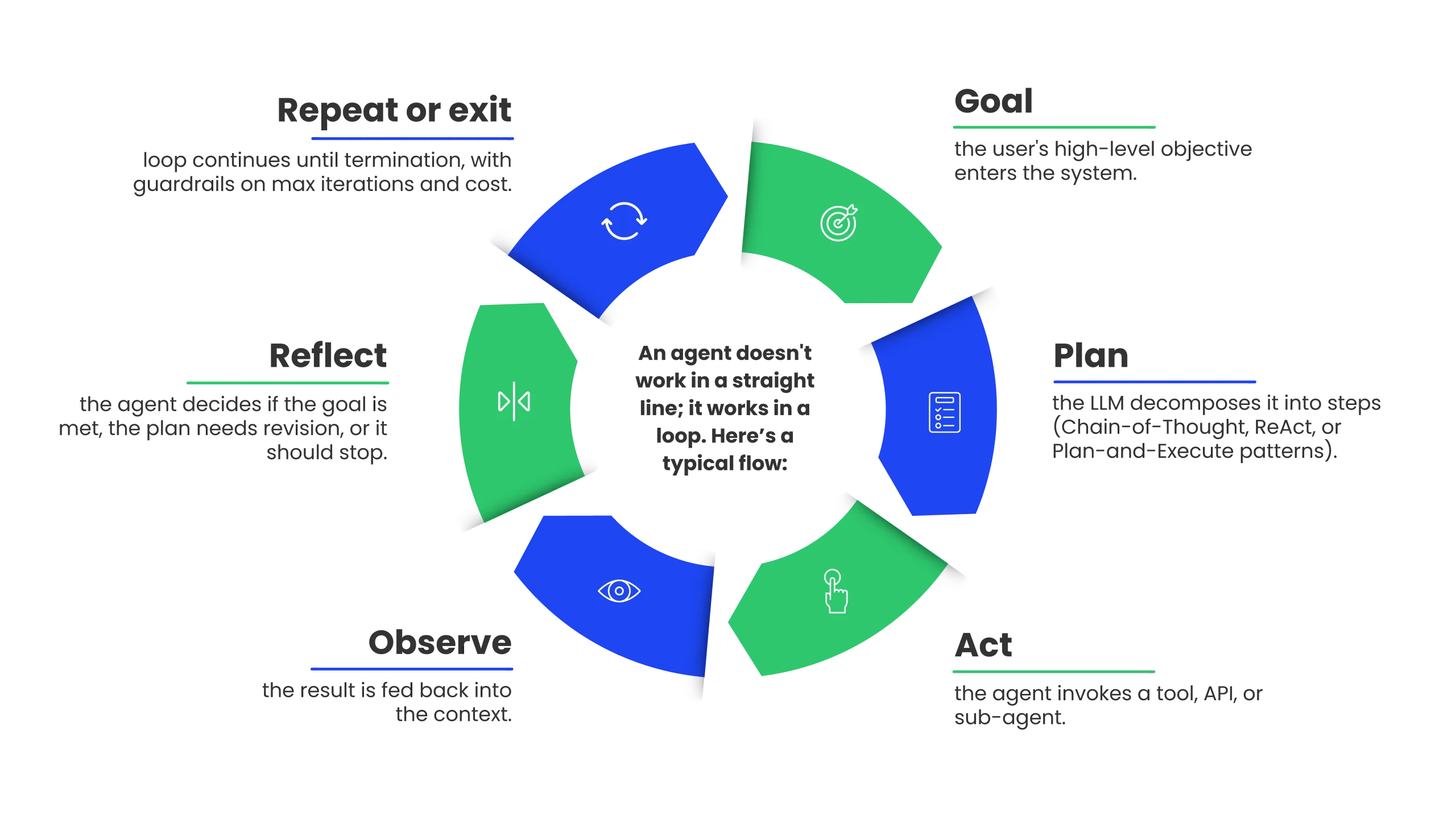
The dominant patterns are ReAct, Plan-and-Execute, and Reflexion. Needless to say that well designed production systems always cap the loop with iteration limits and cost ceilings. In practice, the second-most-common production failure (after fuzzy goals) is unbounded loops eating into unit economics – a ‘successful’ agent that costs $4 to resolve a $0.40 ticket is a failure dressed up as a win.
Popular Agentic AI Frameworks in 2026
The ecosystem has matured into a landscape of hardened, production-ready platforms. As of May 2026, these are the top contenders:
-
Gemini Enterprise Agent Platform (Google Cloud):
Google’s flagship for the agentic enterprise, and the most opinionated end-to-end stack of the lot. It features the Agent Development Kit (ADK) for code-first engineering (now multi-language – Python, Java, Go, TypeScript) and the Agent Gateway for unified governance. It provides first-class access to Gemini 3.1 Pro for complex reasoning and Gemini 3 Flash for high-velocity execution, backed by “Model Armor” for enterprise-grade security.
-
Microsoft Agent Framework:
The enterprise successor to the open-source AutoGen. It combines multi-agent conversation patterns with Semantic Kernel’s type-safety and middleware. It is the primary framework for organizations deploying graph-based multi-agent orchestration patterns (Sequential, concurrent, handoff, group-chat, Magnetic-One) natively within Azure AI Foundry.
-
LangGraph (LangChain Ecosystem):
The industry standard for stateful, cyclical orchestration. Its graph-based design allows for high-precision control over long-running agentic workflows that require persistent state and memory across multiple execution loops.
-
OpenAI & Claude Agent SDKs:
Streamlined, production-ready frameworks designed for rapid agent handoffs and task delegation. Optimized for the 2026 ‘Computer Use’ capabilities pioneered by Anthropic, allowing agents to navigate software interfaces directly, with handoffs and task delegation as first-class primitives.
-
CrewAI Enterprise:
A role-based framework that excels in complex business process automation. Its 2026 iteration features deep integration with corporate identity providers and advanced telemetry for monitoring specialized agent “crews” in real-time.
-
PydanticAI:
A high-performance, “Type-Safe” framework favored by data engineers. It ensures that agentic outputs are strictly structured and validated, providing a reliable developer experience for mission-critical system integrations.
A note on protocols, not just frameworks: Two open standards have become as important as the frameworks themselves. Model Context Protocol (MCP) – originated by Anthropic, donated to the Linux Foundation in late 2025, now supported by Google, Microsoft, OpenAI, and AWS – has become the de facto wire protocol for how agents discover and call tools. Agent2Agent (A2A), championed by Google, plays the same role for inter-agent communication across frameworks. Alongside these protocols, ‘Skills’ and ‘Apps’ are rapidly emerging as the standard primitive for procedural knowledge. If MCP is how an agent discovers a tool, a Skill dictates the hardened business logic of how to actually use it. In 2026, the procurement question has quietly shifted from ‘which framework?’ to ‘is it MCP- and A2A-compliant?’ The frameworks above all are.
Key Layers in an Agentic AI Architecture
A professional-grade agentic system is built in layers to ensure modularity and security:
-
Interface Layer:
Where the user or system triggers the agent.
-
Reasoning Layer:
The “brain” (LLM) plus the planning logic (e.g., ReAct or Chain-of-Thought).
-
Orchestration Layer:
Manages the flow between agents and ensures state management.
-
Tool Layer:
The integration point for external systems and private data, requiring strict enforcement of the Principle of Least Privilege to prevent destructive execution via prompt injection.
-
Memory Layer:
The storage and retrieval system for contextual awareness. This includes stateful memory, historical memory and procedural memory or knowledge.
-
Observability & Evaluation Layer:
The diagnostic engine that traces reasoning paths, monitors tool execution, and continuously evaluates outputs against defined metrics (commonly via tools like Langfuse, LangSmith, Arize Phoenix, or Vertex AI’s evals) to prevent hallucinations and ensure enterprise compliance.
Agentic AI Frameworks for Real-World Integration and Collaboration
In a business setting, frameworks are the connective tissue. They need to securely hook into your core systems like Salesforce, SAP, BigQuery, or Snowflake through APIs.
When you have multiple agents, the framework manages a “Shared Memory.” This lets a sales agent and a logistics agent share information without passing data back and forth, enabling complex processes like automated supply chain adjustments to run with minimal human intervention, while keeping humans in the loop on consequential actions. In modern deployments, this hookup increasingly happens through MCP servers rather than bespoke connectors.
Memory is what turns a generic LLM into a stateful collaborator. Short-term memory is handled by optimizing the context window, while long-term memory is powered by Vector Databases and Retrieval-Augmented Generation (RAG). This ensures the agent remembers key details from past interactions and your company’s knowledge base.
Agentic AI Framework Best Practices: How to Get Started
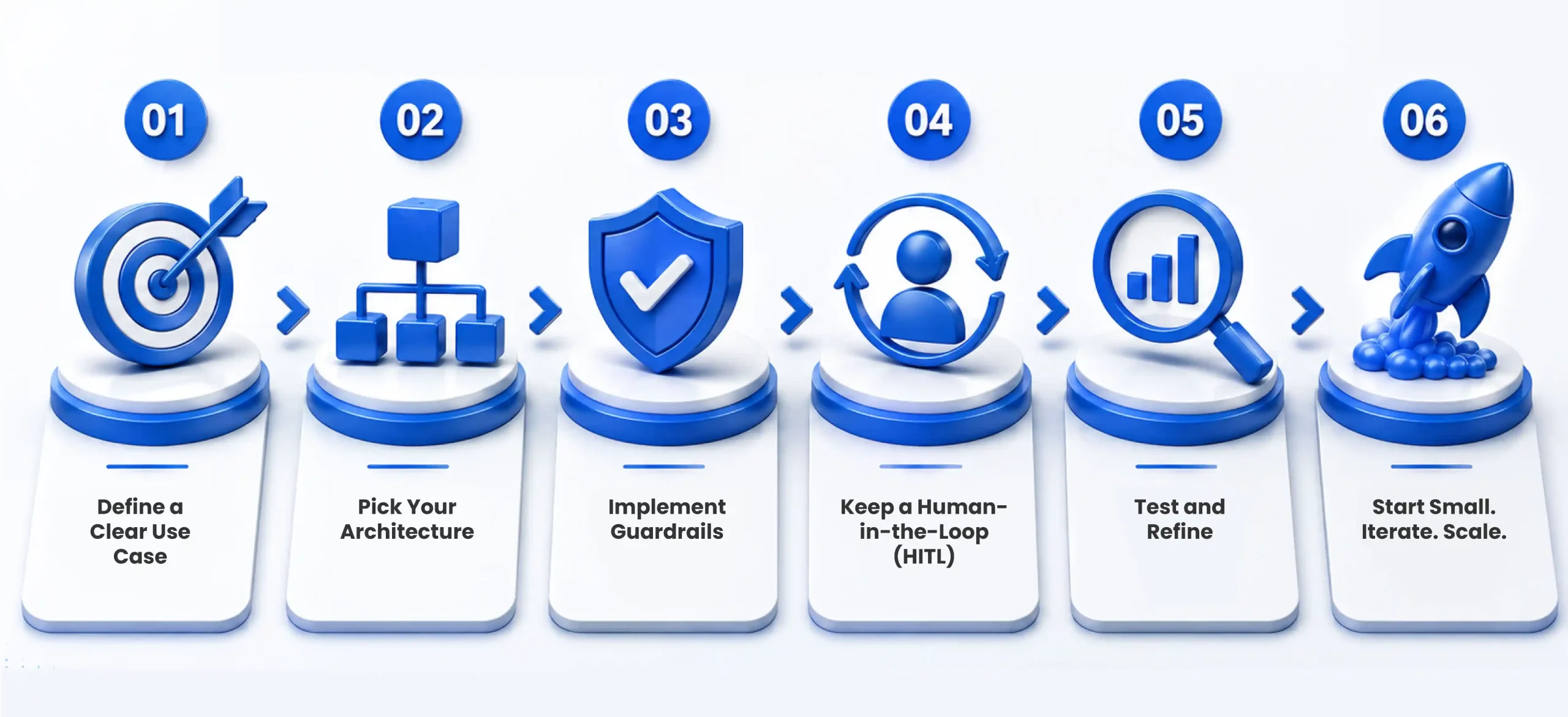
Building an agentic system isn’t just about writing code; it’s about disciplined architecture.
-
Define a Clear Use Case:
Define the Business Challenge first, the pain point. Target a high-value, well-defined workflow where agentic execution directly translates to a measurable business gain (e.g., reducing invoice processing costs by x%). In our deployments, the failure mode we see most often is not bad prompts – it’s vague objectives. An agent given a fuzzy goal will burn tokens, loops, and trust very quickly.
-
Pick Your Architecture:
Is this a job for one agent or a whole team? Choose your model accordingly.
-
Implement Guardrails:
Use the framework to set clear boundaries on what the agent can and cannot do.
-
Keep a Human-in-the-Loop (HITL):
For critical decisions, make sure a human has the final say.
-
Test and Refine:
Constantly review agent logs to fine-tune its reasoning and performance. Treat evals as code: version them, run them on every change, and grade against a representative task suite – agent behavior drifts in subtler ways than a deterministic system does.
-
Start Small, Iterate, Scale:
Don’t attempt to boil the ocean. Launch with a tightly scoped pilot to validate your reasoning loops and build internal trust. Once the agent proves reliable at handling edge cases, incrementally expand its toolset, memory access, and autonomy before rolling it out across the wider enterprise.
Building the Future of Agentic AI Frameworks with Quantiphi and Google Cloud
Navigating these frameworks, setting up robust evals, and preventing token-burn isn’t easy, but you don’t have to build the architecture from scratch. As a Diamond Tier Google Cloud Partner and a 21-time Google Cloud Award winner over the past decade, Quantiphi is uniquely positioned to help organizations move agentic AI from experimental proof of concept to hardened, production-grade reality.
Our approach leverages the power of Gemini for Google Cloud, integrating state-of-the-art long-context windows and multimodal capabilities into our custom agentic builds. By combining Gemini’s reasoning power with our deep domain expertise, we deliver:
-
End-to-End Agentic Lifecycle:
From initial architecture design to deployment and continuous observability using our AICoE model.
-
Gemini-Powered Reasoning:
Utilizing Gemini 3.1 Pro for complex orchestration and Gemini 3 Flash for high-velocity execution, allowing agents to handle massive datasets and intricate enterprise workflows with production-grade speed.
-
Responsible AI Integration:
Ensuring every agentic action is governed by strict security guardrails and ethical AI principles.
-
Scalable Multi-Agent Ecosystems:
Connecting autonomous agents directly to your Google Cloud infrastructure (BigQuery, Vertex AI, and Workspace) to ensure the power of autonomy is always driving measurable business value.
Ready to Engineer Your Agentic Enterprise?
The transition from simple automation to agentic execution is the definitive competitive advantage of 2026, but only if it solves a real business challenge. Whether you are looking to modernize your enterprise value chain or deploy a specialized digital workforce, Quantiphi’s award-winning expertise ensures your journey is scalable, secure, and value-driven.
Contact our experts today to schedule a strategy session or request a demo of our Agentic AI solutions. Let’s solve what matters, together.