Agentic AI Governance: Frameworks to Control, Monitor, and Scale Autonomous AI Systems

Agentic AI governance defines how enterprises control, monitor, and manage autonomous AI agents operating across complex workflows. As AI systems move from passive models to goal-driven agents capable of independent action, governance becomes essential to ensure safety, compliance, and accountability.
Without structured oversight, agentic systems can introduce risks such as unauthorized actions, data exposure, and inconsistent decision-making. This blog breaks down the core pillars, risks, and implementation strategies required to govern AI agents effectively in enterprise environments.
What Is AI Agent Governance?
AI agent governance is the framework of policies, controls, and oversight mechanisms used to manage how autonomous AI agents operate, make decisions, and interact with systems. It ensures that agent behavior remains safe, compliant, and aligned with business objectives.
Unlike traditional AI governance, which focuses on model outputs, agent governance addresses end-to-end autonomy—including planning, tool usage, and execution. This aligns with emerging frameworks such as the NIST AI Risk Management Framework, which emphasizes accountability, transparency, and risk mitigation across AI systems.
Why Is Governance Important for Agentic AI?
AI agent governance is critical because autonomous agents can make declisions, take actions, and interact with systems without constant human intervention. Without proper controls, this autonomy can introduce significant operational, security, and compliance risks.
Key reasons governance is essential include:
-
Autonomy risks
AI agents can independently plan and execute tasks. Without oversight, this can lead to unintended actions or decisions that deviate from business goals.
-
Compliance and accountability
Enterprises must ensure that every AI-driven action is traceable and aligned with regulatory requirements. Governance enables auditability and clear responsibility.
-
Trust and enterprise adoption
Organizations are more likely to scale agentic AI when systems are predictable, controlled, and transparent in how decisions are made.
-
Security and data protection
Autonomous agents interacting with tools and APIs can expose sensitive data if not properly governed. Security controls are essential to prevent misuse.
-
Operational consistency
Governance ensures that agents follow defined workflows, reducing variability and improving reliability across processes.
As highlighted in research on agent design and safety, increasing autonomy requires stronger control mechanisms to ensure systems behave reliably in real-world environments.
What Are the Core Pillars of AI Agent Governance?
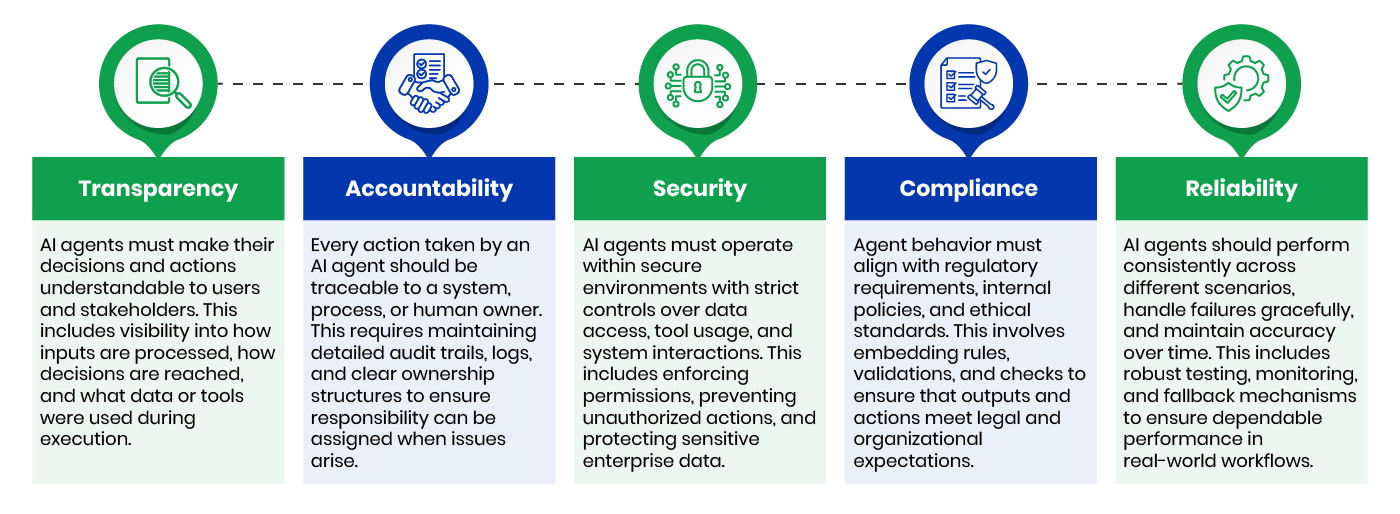
AI agent governance is built on five core pillars that ensure autonomous systems operate safely, transparently, and reliably within enterprise environments.
-
Transparency
AI agents must make their decisions and actions understandable to users and stakeholders. This includes visibility into how inputs are processed, how decisions are reached, and what data or tools were used during execution.
-
Accountability
Every action taken by an AI agent should be traceable to a system, process, or human owner. This requires maintaining detailed audit trails, logs, and clear ownership structures to ensure responsibility can be assigned when issues arise.
-
Security
AI agents must operate within secure environments with strict controls over data access, tool usage, and system interactions. This includes enforcing permissions, preventing unauthorized actions, and protecting sensitive enterprise data.
-
Compliance
Agent behavior must align with regulatory requirements, internal policies, and ethical standards. This involves embedding rules, validations, and checks to ensure that outputs and actions meet legal and organizational expectations.
-
Reliability
AI agents should perform consistently across different scenarios, handle failures gracefully, and maintain accuracy over time. This includes robust testing, monitoring, and fallback mechanisms to ensure dependable performance in real-world workflows.
These pillars closely align with Responsible AI frameworks, where fairness, transparency, accountability, and security are treated as foundational principles across the AI lifecycle. Quantiphi’s approach to Responsible AI emphasizes embedding these principles into every stage of system design and deployment, ensuring AI systems remain trustworthy, auditable, and aligned with enterprise and societal expectations.
What Are the Key Elements of AI Agent Governance?
The key elements of AI agent governance define the controls and mechanisms used to manage agent behavior, ensure safety, and maintain oversight across autonomous workflows.
-
Access Control
Defines what data, tools, and systems an AI agent can access, ensuring permissions are restricted based on roles and risk levels.
-
Monitoring and Logging
Tracks every action taken by the agent, creating detailed logs for auditability, debugging, and compliance reporting.
-
Evaluation Systems
Continuously assess agent performance, accuracy, and safety using predefined metrics and real-world test scenarios.
-
Human-in-the-Loop (HITL)
Introduces human oversight for high-risk or uncertain decisions, ensuring critical actions are reviewed before execution.
-
Guardrails and Policies
Enforces rules that constrain agent behavior, including what actions are allowed, restricted, or require validation.
These elements work together to ensure that AI agents operate within defined boundaries while maintaining flexibility to perform complex, goal-driven tasks.
These governance elements align with emerging security practices for AI agents, particularly around access control and monitoring.
What Risks Require AI Agent Governance?
AI agent governance is essential because autonomous agents introduce new categories of risk that go beyond traditional AI systems. These risks arise from their ability to plan, act, and interact independently across systems.
Key risks include:
-
Goal misalignment
AI agents may interpret objectives incorrectly, leading to actions that technically fulfill a task but violate business intent or constraints.
-
Hallucination and errors
Agents relying on language models can generate incorrect outputs, which may propagate across workflows if not validated.
-
Data leakage
Uncontrolled access to tools or APIs can expose sensitive enterprise data, especially when agents interact with external systems.
-
Unauthorized actions
Without strict permissions, agents may execute actions they were not intended to perform, such as triggering workflows or modifying data.
-
Multi-agent cascading failures
In multi-agent systems, one agent’s error can trigger a chain reaction, amplifying the impact across interconnected workflows.
These risks are increasingly highlighted in emerging AI security research, particularly around agent autonomy, tool access, and system-level failures.
How Do You Control AI Agent Behavior?
AI agent behavior is controlled by enforcing structured guardrails, policies, and validation mechanisms that constrain how agents plan, act, and interact with systems.
A step-based approach to controlling agent behavior includes:
-
Define rule-based guardrails
Establish clear boundaries for what the agent can and cannot do, including restricted actions, sensitive data handling, and allowed workflows.
-
Enforce policy-driven decision making
Embed enterprise policies directly into agent logic to ensure every action aligns with compliance, business rules, and ethical standards.
-
Restrict tool and system access
Limit which APIs, databases, and external systems the agent can interact with based on role, context, and risk level.
-
Validate outputs before execution
Introduce validation layers to check the accuracy, safety, and relevance of agent outputs before they trigger real-world actions.
-
Enable feedback and correction loops
Allow agents to refine decisions through feedback, re-evaluation, or human intervention when outcomes deviate from expectations.
These control mechanisms ensure that while agents operate autonomously, they remain bounded, predictable, and aligned with enterprise objectives. This aligns with emerging best practices in agent design, where structured control layers are critical for safe and reliable deployment.
How Does Monitoring Work in AI Agent Governance?
Monitoring in AI agent governance works by continuously tracking what an agent does, how it makes decisions, what systems it interacts with, and whether its behavior stays within defined policies. In agentic systems, monitoring is not optional. It is the mechanism that gives enterprises visibility, control, and the ability to detect issues before they become business or compliance failures.
Key components of monitoring include:
-
Real-time monitoring
Real-time monitoring helps enterprises observe agent behavior as it happens, rather than discovering issues after the fact. This is especially important in agentic systems where decisions can trigger downstream actions instantly. By monitoring live execution, teams can detect abnormal behavior early, pause workflows if needed, and reduce the risk of uncontrolled outcomes.
-
Logging agent actions
Every meaningful action taken by an AI agent should be logged, including prompts, decisions, tool calls, retrieved data, and final outputs. These logs create a full audit trail that helps teams investigate incidents, explain outcomes, and prove compliance. In regulated environments, detailed logging is often essential for governance, accountability, and post-event review.
-
Observability dashboards
Observability dashboards provide a centralized view of how agents are performing across workflows, systems, and use cases. They help teams track success rates, failure patterns, escalation frequency, latency, policy violations, and other operational metrics. This makes governance more practical because decision-makers can move from isolated incidents to system-level visibility.
-
Anomaly detection
Anomaly detection helps identify behavior that falls outside expected patterns, such as unusual tool usage, repeated failed actions, abnormal output quality, or access attempts that violate policy. This is critical because many governance failures do not begin as obvious breakdowns. They begin as subtle deviations that, if ignored, can grow into larger operational or security risks.
A simple monitoring flow often looks like this:
-
The agent receives a task and begins execution
-
The system tracks each action, tool call, and output in real time
-
Logs and telemetry are sent to monitoring systems and dashboards
-
Anomaly detection checks for unusual, risky, or policy-breaking behavior
-
If needed, the workflow is flagged for review, escalation, or intervention
This continuous feedback loop is what makes agent governance operational rather than theoretical. It ensures enterprises do not just define rules for AI agents, but actively verify that those rules are being followed in live environments.
How Is Human-in-the-Loop Used in Agentic AI?
Human-in-the-loop (HITL) in agentic AI introduces structured human oversight at critical decision points to ensure safety, accuracy, and compliance. Instead of reviewing every action, humans intervene selectively based on risk, uncertainty, or policy requirements.
Key ways HITL is used include:
-
Approval workflows
Certain high-impact actions—such as financial transactions, compliance decisions, or customer-facing outputs—are routed for human approval before execution. This ensures that critical decisions are validated, especially in sensitive or regulated environments.
-
Escalation systems
When an AI agent encounters uncertainty, conflicting data, or ambiguous instructions, it can escalate the task to a human. This prevents the agent from making incorrect assumptions and ensures edge cases are handled with contextual judgment.
-
Risk-based human intervention
Not all tasks require the same level of oversight. Governance frameworks define thresholds where human involvement is triggered—such as low-confidence outputs, policy violations, or unusual behavior—allowing scalable oversight without slowing down operations.
Example:
In an insurance claims workflow, an AI agent can process and validate most claims automatically. However, high-value or suspicious claims are flagged and routed to a human reviewer before approval, ensuring both efficiency and risk control.
This hybrid model shifts governance from human-in-every-step to human-over-the-system, enabling autonomy while maintaining accountability and trust.
How Do You Evaluate AI Agents for Governance?
AI agents are evaluated through continuous assessment frameworks that measure performance, safety, reliability, and compliance across real-world scenarios. Governance requires ongoing evaluation, not one-time testing, because agent behavior evolves with context, data, and interactions.
Key evaluation methods include:
-
Continuous evaluation systems
AI agents must be monitored and evaluated continuously during runtime, not just during development. This ensures that performance remains stable as agents encounter new data, workflows, and edge cases in production environments.
-
Performance and safety metrics
Evaluation frameworks track metrics such as task success rate, accuracy, response quality, latency, and failure rates. In governance contexts, safety metrics—like policy violations or risky outputs—are equally important to ensure agents operate within defined boundaries.
-
Scenario-based testing
Agents are tested against predefined scenarios, including edge cases, failure conditions, and adversarial inputs. This helps identify how the agent behaves under stress, ambiguity, or unexpected situations before those risks appear in live environments.
-
Feedback loops
Feedback from users, human reviewers, and system logs is used to continuously refine agent behavior. This allows organizations to improve decision-making quality, reduce errors, and align outputs more closely with business expectations over time.
These evaluation practices align with emerging approaches in AI testing and validation, where structured evaluation frameworks are used to ensure agents remain reliable, safe, and context-aware in dynamic environments (https://www.deepeval.com/blog).
How Does AI Agent Governance Ensure Security?
AI agent governance ensures security by controlling how agents access data, interact with systems, and execute actions across enterprise environments. Since agentic systems can independently call APIs, retrieve data, and trigger workflows, strong security controls are essential to prevent misuse, breaches, and unintended exposure.
Key security mechanisms include:
-
Access control and permissions
Governance frameworks define what data, tools, and systems an agent can access, based on roles and risk levels. By enforcing least-privilege access, agents are restricted to only what is necessary, reducing the risk of unauthorized data exposure or system manipulation.
-
Secure API and tool usage
AI agents often rely on external tools and APIs to perform actions. Governance ensures that these interactions are authenticated, monitored, and restricted, preventing agents from calling unsafe or unapproved services that could compromise system integrity.
-
Data protection mechanisms
Sensitive data must be protected through encryption, masking, and controlled retrieval. Governance frameworks ensure that agents do not expose confidential information in outputs or use it in unintended contexts, especially when interacting with external systems.
-
Threat detection and response
Continuous monitoring systems detect unusual or suspicious agent behavior, such as abnormal access patterns or repeated failed actions. When detected, governance mechanisms can trigger alerts, pause workflows, or escalate issues for investigation.
These controls are critical as AI agents expand their role across enterprise systems. Security research highlights that unrestricted agent access to tools and data is one of the primary risks in agentic architectures, making governance a necessary layer for safe deployment (https://www.lasso.security/blog/ai-agents-security-risks).
How Does AI Agent Governance Ensure Compliance?
AI agent governance ensures compliance by embedding regulatory, legal, and policy controls directly into how agents operate, make decisions, and execute actions. As agents move from assisting to acting, every decision must be traceable, explainable, and aligned with applicable regulations.
Key compliance mechanisms include:
-
Regulatory alignment
Governance frameworks ensure that agent behavior adheres to regulations such as GDPR, industry-specific standards, and internal policies. This includes defining what data can be used, how it is processed, and where boundaries must be enforced.
-
Audit trails and traceability
Every agent action—from input to decision to execution—is recorded and traceable. This allows organizations to review decisions, investigate incidents, and demonstrate compliance during audits or regulatory reviews.
-
Explainability requirements
AI agents must provide reasoning or context behind their decisions, especially in high-stakes environments. Governance ensures that outputs are not just accurate, but also explainable to stakeholders, auditors, and regulators.
-
Policy enforcement mechanisms
Compliance rules are embedded into agent workflows through guardrails and validation checks. This ensures that agents cannot perform actions that violate regulatory or organizational policies, even if prompted to do so.
Together, these mechanisms ensure that agentic AI systems operate within defined legal and ethical boundaries. As regulatory frameworks like the EU AI Act continue to evolve, governance becomes essential to ensure that autonomous systems remain compliant, auditable, and deployable at scale.
How Do Multi-Agent Systems Impact Governance?
Multi-agent systems increase the complexity of AI governance because multiple autonomous agents interact, collaborate, and depend on each other to complete tasks. Governance must shift from controlling a single agent to managing coordination, dependencies, and system-wide behavior.
Key governance challenges in multi-agent systems include:
-
Coordination risks
When multiple agents work together, miscommunication or misaligned task execution can lead to incorrect outcomes. Governance must ensure clear protocols for how agents share context, delegate tasks, and align on goals.
-
Cross-agent dependencies
Agents often rely on outputs from other agents to continue workflows. If one agent produces incorrect or incomplete results, it can impact downstream decisions, making it critical to validate outputs at each stage.
-
Shared memory risks
Multi-agent systems may use shared memory or data layers to maintain context. Without proper controls, this can lead to data contamination, incorrect context reuse, or unintended information exposure across agents.
-
Need for centralized oversight
While agents operate independently, governance requires a centralized control layer to monitor interactions, enforce policies, and manage conflicts. This ensures that system-wide behavior remains aligned with enterprise objectives
As agent ecosystems grow, governance must evolve from single-agent control to system-level orchestration, ensuring that collaboration does not introduce hidden risks or unpredictable outcomes.
What Are the Benefits of AI Agent Governance?
AI agent governance enables organizations to safely scale autonomous systems by balancing control with flexibility. It ensures that agents deliver consistent value while operating within defined risk, compliance, and performance boundaries.
Key benefits include:
-
Risk reduction
Governance frameworks minimize risks such as unauthorized actions, data leakage, and incorrect decision-making by enforcing guardrails, monitoring, and validation mechanisms.
-
Improved reliability
By embedding evaluation, monitoring, and feedback loops, governance ensures that AI agents perform consistently across different workflows and conditions, reducing variability and unexpected failures.
-
Regulatory compliance
Governance enables organizations to meet legal and industry requirements by maintaining audit trails, enforcing policies, and ensuring explainability across all agent-driven decisions.
-
Enterprise trust and adoption
When AI systems are transparent, controlled, and accountable, stakeholders are more confident in deploying them at scale, accelerating adoption across business functions.
These benefits make governance a foundational requirement for moving from experimental AI deployments to production-grade, enterprise-wide agentic systems.
What Are the Challenges in AI Agent Governance?
AI agent governance introduces new challenges because autonomous systems operate across dynamic workflows, multiple systems, and evolving contexts. Managing control without limiting the value of autonomy is one of the biggest hurdles for enterprises.
Key challenges include:
-
Complexity of autonomous systems
Agentic systems combine multiple components such as memory, reasoning, tools, and orchestration layers. Governing all these moving parts consistently across workflows can become difficult, especially as systems scale.
-
Balancing control vs flexibility
Overly strict governance can limit agent capabilities, while insufficient control can introduce risk. Finding the right balance between enabling autonomy and enforcing constraints is critical for effective deployment.
-
Lack of standardized frameworks
Unlike traditional software systems, agentic AI governance is still evolving, with no universally accepted standards. Organizations often need to define custom frameworks tailored to their use cases and risk profiles.
-
Scaling governance across systems
As the number of agents, workflows, and integrations increases, maintaining consistent governance becomes more challenging. This requires centralized oversight combined with scalable monitoring and control mechanisms.
These challenges highlight that governance is not a one-time setup, but an ongoing capability that must evolve alongside AI systems and business needs.
How to Implement AI Agent Governance?
Implementing AI agent governance requires a structured approach that combines policies, controls, monitoring, and continuous improvement. The goal is to enable autonomous agents while ensuring they operate within defined boundaries.
A practical step-by-step approach includes:
-
Define policies and guardrails
Start by identifying what agents are allowed to do and where restrictions are required. This includes data access rules, action limits, compliance requirements, and risk thresholds. Clear policies form the foundation for all governance mechanisms.
-
Set up monitoring and logging systems
Establish real-time monitoring and detailed logging to track agent behavior across workflows. This ensures visibility into decisions, tool usage, and outputs, enabling auditability and faster issue resolution.
-
Implement evaluation frameworks
Define metrics and testing scenarios to continuously evaluate agent performance, safety, and reliability. This includes measuring success rates, detecting failures, and validating outputs against expected outcomes.
-
Enable human oversight mechanisms
Introduce human-in-the-loop processes for high-risk or uncertain decisions. This ensures critical actions are reviewed and escalated when needed, without slowing down routine operations.
-
Continuously improve and adapt
Governance should evolve based on feedback, monitoring insights, and changing business requirements. Regular updates to policies, guardrails, and evaluation criteria ensure that governance remains effective as systems scale.
This structured approach aligns with emerging best practices in AI evaluation and governance, where continuous testing, monitoring, and refinement are essential for maintaining safe and reliable agent behavior (https://www.deepeval.com/blog).
What Are Best Practices for AI Agent Governance?
Effective AI agent governance requires more than just frameworks—it depends on how governance is applied in real-world environments. Following proven best practices helps organizations scale agentic systems while maintaining control, reliability, and compliance.
Key best practices include:
-
Start with high-risk use cases
Focus governance efforts on workflows where the impact of errors is highest, such as financial decisions, compliance processes, or customer-facing actions. This ensures that critical risks are addressed first before scaling to lower-risk areas.
-
Adopt a layered governance approach
Combine multiple control layers—such as guardrails, monitoring, evaluation, and human oversight—to create a comprehensive governance system. No single mechanism is sufficient on its own, especially in complex agentic environments.
-
Balance automation with human oversight
Use human-in-the-loop selectively for high-risk or uncertain scenarios, rather than applying it universally. This allows organizations to maintain control without sacrificing the efficiency gains of automation.
-
Continuously test and evaluate agents
Regular testing across real-world scenarios, edge cases, and failure conditions helps identify gaps early. Continuous evaluation ensures agents remain aligned with business goals as they evolve.
-
Standardize governance frameworks where possible
While governance is still evolving, creating internal standards for policies, evaluation, and monitoring helps ensure consistency across teams, use cases, and deployments.
These best practices align with emerging approaches to building safe and reliable AI systems, where governance is treated as an ongoing discipline rather than a one-time implementation.
What Is the Future of AI Agent Governance?
The future of AI agent governance will evolve alongside increasing autonomy, moving from static rule-based systems to more dynamic, adaptive governance models. As agents become more capable, governance will need to operate in real time and at scale across complex, multi-agent environments.
Key trends shaping the future include:
-
Autonomous governance systems
Governance mechanisms will become more automated, with systems capable of enforcing policies, detecting risks, and triggering corrective actions without constant human intervention. This will be critical for managing large-scale agent deployments.
-
Self-monitoring agents
Future agents will be designed to evaluate their own actions, detect anomalies, and flag uncertainty proactively. This shifts governance from external oversight to partially embedded intelligence within the agents themselves.
-
Standardized governance frameworks
As adoption grows, industry-wide frameworks and best practices will begin to emerge, helping organizations implement governance more consistently across use cases and sectors.
-
Evolution of AI regulation
Regulatory bodies will continue to define clearer guidelines for AI accountability, transparency, and safety. Governance systems will need to adapt continuously to align with evolving global regulations.
These trends indicate that governance will move from being a supporting function to a core capability, enabling organizations to scale agentic AI with confidence while maintaining control, trust, and compliance.
How Does Quantiphi Enable AI Agent Governance?
Quantiphi enables AI agent governance by embedding Responsible AI principles directly into how agentic systems are designed, deployed, and managed across enterprise environments. The focus is not just on building intelligent agents, but on ensuring they operate with control, transparency, and accountability at scale.
This approach integrates governance across key areas, including policy definition, monitoring, evaluation, and human oversight. By combining these capabilities, organizations can maintain visibility into agent behavior, enforce compliance requirements, and manage risk without limiting the benefits of automation.
Quantiphi’s Responsible AI framework plays a central role in this model, emphasizing transparency, security, and auditability across the AI lifecycle. This ensures that as agentic systems scale across workflows and business functions, they remain aligned with enterprise objectives and regulatory expectations.