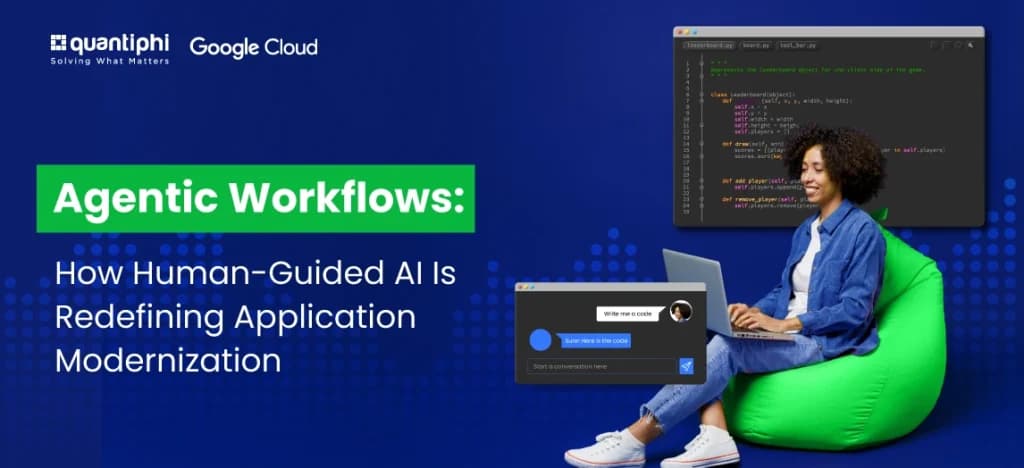
Agentic Workflows: How Human-Guided AI Is Redefining Application Modernization

The AI vs. Human debate has always been misguided. The future isn’t about machines replacing people or automation making human expertise obsolete. It’s about something far more powerful: AI and humans working together, each amplifying the other’s strengths to drive innovation and efficiency. The true game-changer lies in human-guided AI, where intelligent systems and human expertise work together to drive smarter, faster, and more adaptive outcomes.
Yet, most businesses still choose between two flawed extremes when it comes to application modernization. They either rely on slow, manual processes that can’t scale or gamble on rigid automation that removes flexibility and control—neither works.
Enter agentic workflows—a new paradigm where AI agents act as autonomous collaborators, managing complexity while humans bring strategic oversight. This isn’t just a technological upgrade; it’s a mindset shift that’s enabling enterprises to modernize applications with precision, agility, and confidence.
Agentic Workflows: The Future of Application Modernization
Agentic workflows are a step beyond traditional automation. Instead of static tools or manual processes, these workflows involve AI agents that actively collaborate with humans—learning, optimizing, and adapting in real-time. This approach empowers businesses to overcome legacy constraints and continuously evolve their systems.
How Agentic Workflows are Redefining Application Modernization
- Continuous System Intelligence
- Real-Time Monitoring: AI agents constantly analyze applications, detecting inefficiencies, outdated dependencies, and security vulnerabilities that one-time audits can miss.
- Dynamic Feedback: Continuous monitoring transforms modernization from a disruptive, one-time effort into a seamless, evolving process that adapts to changing needs
- Intelligent Code Refactoring & Optimization
- Data-Driven Improvements: Machine learning models, trained on vast codebases, propose optimizations that improve performance, reduce redundancy, and enhance maintainability.
- Strategic Execution: Instead of blindly applying updates, the system refactors code with a deep understanding of the application architecture.
- Human-Integrated Decision-Making
- Collaborative Oversight: AI suggests modernization strategies while developers validate and refine these recommendations. This ensures every update aligns with security policies, business logic, and compliance standards.
- Controlled Automation: Human experts strategically intervene at key moments, steering AI-driven processes to strike the right balance between innovation and risk management
- Adaptive Learning and Scalability
- Evolving Intelligence: The system continuously learns from new data and feedback, making it smarter and more responsive over time.
- Incremental Modernization: AI-driven workflows can identify dependencies, recommend phased upgrades, and automate testing, allowing enterprises to modernize without major operational disruptions.
The Human-AI Balance: Redefining Modernization Through Collaboration
Agentic workflows aren’t meant to replace human expertise—they’re designed to amplify it. By combining the speed and scalability of AI with the strategic insight of human oversight, this approach creates a powerful framework for application modernization, delivering:
- Faster Modernization Without Compromise:
AI-driven automation can reduce development cycles by up to 40%, enabling rapid adaptation to market changes. - Reduced Technical Debt:
Continuous, intelligent code refactoring minimizes long-term maintenance issues and prevents spiraling costs associated with legacy systems. - Smarter Risk Management:
Human oversight ensures that every AI-generated change meets stringent security, compliance, and business standards, significantly lowering failure rates. - Continuous Improvement:
Agentic workflows are not a one-time fix but a continuous, adaptive process that evolves alongside your systems—keeping you ahead of industry shifts and technological advancements.
Real-World Impact: Faster, Smarter, and More Cost-Effective Modernization
Adopting agentic workflows leads to measurable improvements in modernization projects:
- 40-50% Faster Development Cycles – AI-driven automation reduces coding and testing time while preserving critical human oversight
- 50% Reduction in System Failures – Human-guided AI minimizes errors, preventing costly downtime and enhancing system security
- 40% Lower Technical Debt Accumulation – Intelligent refactoring optimizes outdated code, ensuring long-term maintainability
These benefits not only accelerate modernization but also position enterprises to stay competitive in an ever-evolving digital landscape.
The Competitive Edge: Why Enterprises Must Act Now
Application modernization isn’t just about upgrading technology—it’s about transforming the way organizations operate. Companies that embrace agentic workflows unlock a smarter, more adaptive approach to innovation, gaining:
- Sustainable, Continuous Modernization: Modernize incrementally to reduce risks and costs without the need for disruptive, large-scale overhauls.
- Enhanced Developer Productivity: Free developers from repetitive tasks so they can focus on high-impact innovation and strategic initiatives.
- Future-Proof Technology Stacks: Ensure that modernization efforts remain relevant and adaptive as new technologies emerge.
Unlock the Future of Application Modernization
Agentic workflows are transforming the very essence of application modernization in the digital era. By harnessing human-guided AI, organizations aren’t merely upgrading their systems—they’re reshaping how they operate, innovate, and scale. This groundbreaking approach seamlessly blends AI’s limitless potential with the critical strategic insight of human expertise. As businesses navigate the complexities of digital transformation, adopting agentic workflows could be the catalyst for unprecedented growth and innovation.
Step into the future, redefine modernization, and unlock the power of human-guided AI. Contact us to learn more.