AI Agent Evaluation and Reliability: Monitoring, Testing, and Performance Optimization

A complete guide to building trust in autonomous AI systems through rigorous evaluation and performance management.
Do you Know?
The “Dial-Up Phase” of Agents: In a Q2 2026 analysis, Forrester noted that the market is currently in the “dial-up internet phase of the agentic era.” They emphasize that for enterprise adoption, “speed alone is not enough. It’s governance, trust, and accountability that determine real value.”
Continuous Runtime Inspection: Gartner notes that traditional static testing is no longer sufficient for dynamic AI. They state that meeting performance expectations requires continuous “runtime inspection and enforcement” to detect performance degradation, data drift, and unapproved agent behavior in real time.
As artificial intelligence evolves from simple prediction models to autonomous agents capable of complex decision-making, the challenge of evaluation has become exponentially more complex. Today’s AI agents don’t just process inputs and generate outputs; they reason, plan, use tools, and execute multi-step workflows that can significantly impact business operations. This fundamental shift requires a completely new approach to evaluation that goes far beyond traditional accuracy metrics.
The stakes couldn’t be higher. A poorly evaluated AI agent in healthcare could compromise patient safety, while an unreliable financial AI agent could expose organizations to regulatory violations and significant financial losses. This comprehensive guide explores everything you need to know about AI agent evaluation, from foundational concepts to enterprise-scale implementation strategies.
What Is AI Agent Evaluation and How Does It Work in Agentic AI Systems?
Definition of AI Agent Evaluation
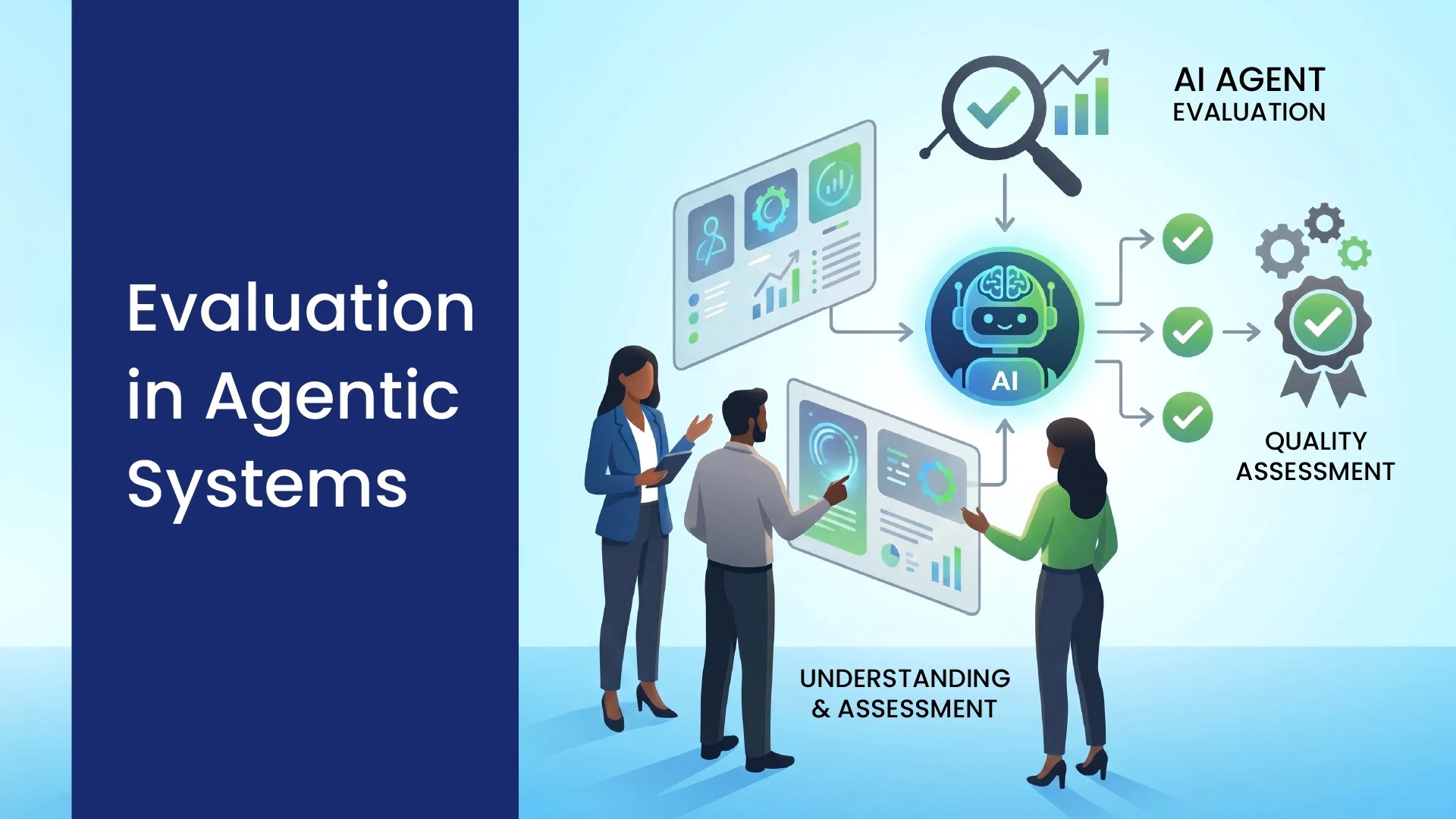
AI agent evaluation represents a fundamental paradigm shift from traditional machine learning assessment. While conventional ML models are evaluated on their ability to predict or classify static inputs, AI agents must be assessed on their capacity to reason, plan, and execute actions within dynamic environments.
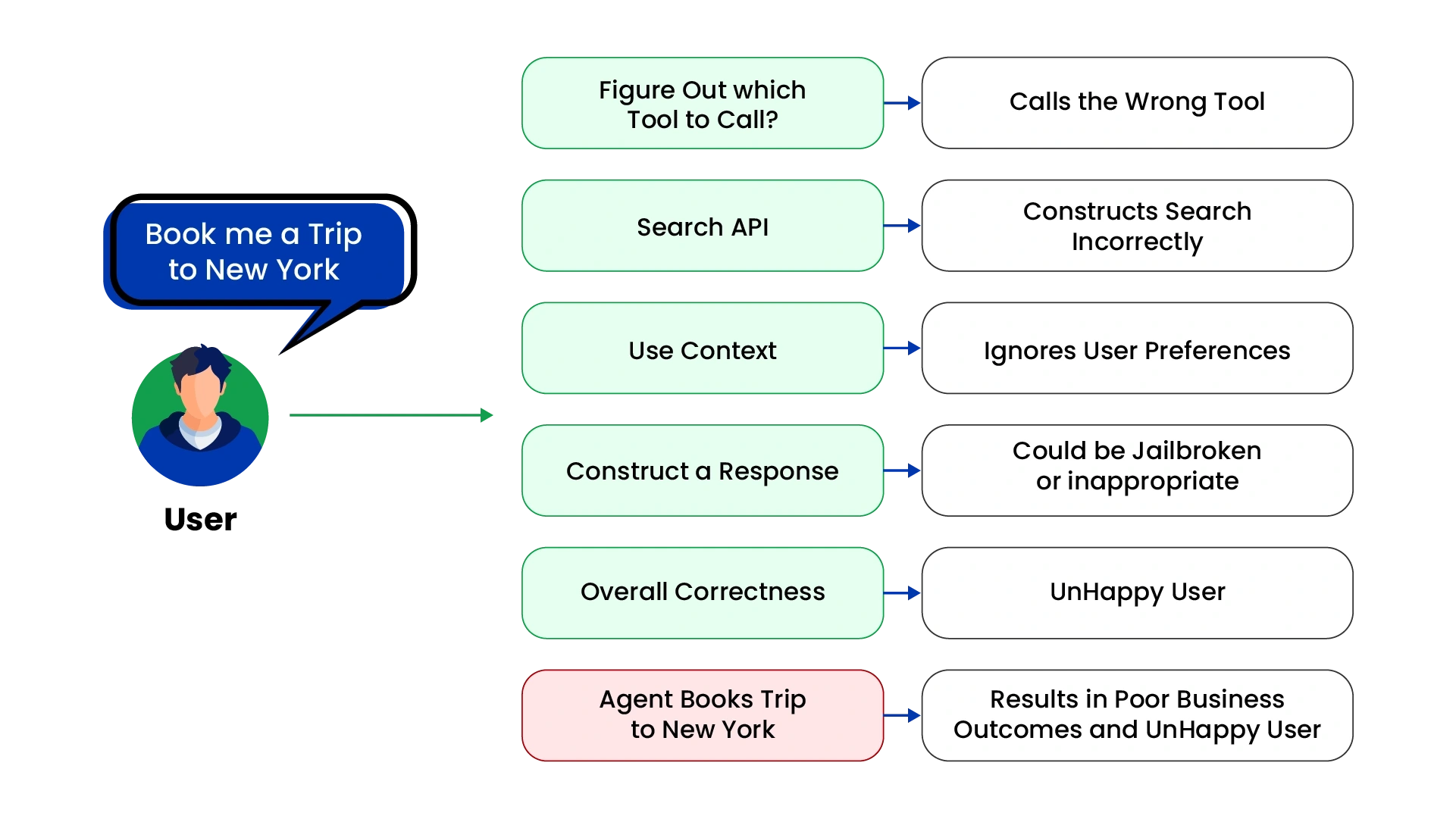
The core distinction between AI agents and LLMs lies in their operational complexity. LLMs generate text responses based on prompts, but AI agents leverage language models as reasoning engines within broader systems that include memory, tool access, planning capabilities, and environmental interaction. This architectural complexity means evaluation must consider not just response quality, but the agent’s ability to maintain context, execute plans effectively, and recover from errors.
In agentic systems, evaluation encompasses the systematic assessment of an agent’s decision-making processes, tool usage accuracy, workflow execution capabilities, and overall reliability in achieving specified objectives. The meaning of evaluation in agentic systems extends beyond correctness to include consistency, explainability, and safety across multi-step processes.
Why AI Agent Evaluation Matters
The importance of rigorous AI agent evaluation cannot be overstated in today’s enterprise environment:
-
Reliability Assurance
Ensures consistent performance across varying conditions and use cases.
-
Trust Building
Establishes confidence among stakeholders, users, and regulatory bodies.
-
Risk Mitigation
Identifies potential failure modes before they impact business operations.
-
Performance Optimization
Provides insights for continuous improvement and system enhancement.
-
Compliance Validation
Ensures adherence to industry regulations and organizational policies.
LLM vs Agent Evaluation
| Aspect | LLM Evaluation | Agent Evaluation |
| Output Type | Static text responses | Dynamic actions and decisions |
| Evaluation Scope | Single interaction | Multi-step workflows |
| Context Management | Conversation history within context window | Persistent memory across sessions, external memory stores |
| Tool Integration | Native function calling supported; evaluated per-call | Orchestrated multi-tool workflows evaluated across sequences |
| Error Impact | Isolated response | Cascading workflow failures |
| Metrics Focus | Accuracy, fluency | Success rate, efficiency, safety |
What Are the Most Common Failure Modes in AI Agent Systems?
Types of Failures
AI agent systems exhibit several characteristic failure patterns:
- Tool Misuse: Selecting inappropriate tools or using tools incorrectly.
- Infinite Loops: Getting stuck in repetitive action cycles.
- Context Loss: Forgetting important information mid-workflow.
- Hallucination: Generating false or fabricated information.
- Permission Violations: Attempting unauthorized actions.
- Resource Exhaustion: Consuming excessive computational resources.
- Integration Failures: Problems with external system connections.
- Prompt Injection: External content manipulates agent behavior (e.g., malicious instructions in retrieved documents)
- Cascading Multi-Agent Failures: Error amplification across agent boundaries in pipeline architectures
- Over-Trust in Tool Outputs: Agent accepts erroneous tool results without sanity-checking
Detection Strategies
Pattern recognition enables proactive failure detection:
Failure Detection Checklist:
- Monitor execution time for unusual delays
- Track repeated action patterns
- Validate external API response codes
- Check memory usage and resource consumption
- Analyze decision logic for inconsistencies
- Review user feedback for quality issues
- Examine error logs for recurring problems
What Are the Biggest Challenges in AI Agent Evaluation and How Can You Solve Them?

Challenges
AI agent evaluation faces several fundamental challenges:
- No Ground Truth: Many agent tasks lack definitive correct answers.
- Complexity: Multi-step workflows are difficult to evaluate comprehensively.
- Subjectivity: Quality assessment often requires human judgment.
- Scale: Evaluation must work across diverse scenarios and use cases.
- Dynamic Environments: Real-world conditions change constantly.
- Resource Intensity: Comprehensive evaluation requires significant computational resources.
Limitations
Scaling evaluation presents ongoing challenges. As organizations deploy more agents across different domains, maintaining consistent evaluation quality becomes increasingly difficult. Traditional evaluation approaches may not scale to handle hundreds or thousands of agents operating simultaneously.
Solutions
Hybrid evaluation approaches offer practical solutions:
- Automated + Human: Combine automated testing with human oversight.
- Sampling Strategies: Evaluate representative subsets rather than complete datasets.
- Tiered Evaluation: Use different evaluation depths based on risk levels.
- Collaborative Evaluation: Leverage multiple evaluators for complex assessments.
- Adaptive Metrics: Adjust evaluation criteria based on context and requirements.
Why Is AI Agent Evaluation Critical for Enterprise AI Success?
Risks of Unevaluated AI Agents
Deploying AI agents without proper evaluation exposes organizations to significant risks:
-
Wrong Actions
Agents may execute incorrect operations, leading to data corruption or system failures.
-
Hallucinations
False information generation can result in poor decision-making and lost credibility.
-
Security Vulnerabilities
Unvalidated agents may be susceptible to prompt injection or adversarial attacks
-
Compliance Violations
Failure to meet regulatory requirements can result in legal penalties.
-
Resource Waste
Inefficient agents consume computational resources without delivering value.
-
Reputation Damage
Public failures can significantly impact brand trust and customer confidence.
Business Impact
Proper AI agent evaluation directly influences critical business outcomes. Organizations with robust evaluation frameworks typically see improved ROI through reduced operational costs, enhanced customer satisfaction, and accelerated time-to-market for AI initiatives. Compliance becomes manageable when evaluation processes align with regulatory requirements, while scaling becomes feasible when organizations can confidently replicate successful agent deployments across different domains and use cases.
- Enhanced decision-making accuracy leading to better business outcomes
- Reduced operational costs through improved efficiency and error prevention
- Faster regulatory approval processes due to comprehensive documentation
- Increased stakeholder confidence enabling broader AI adoption
What Are the Best Practices for AI Agent Evaluation in Enterprises?
Enterprise Evaluation Checklist
- Multi-method evaluation combining automated and human assessment
- Risk-based evaluation prioritizing high-impact scenarios
- Stakeholder alignment ensuring evaluation meets business needs
- Documentation standards for reproducible evaluation processes
- Regular evaluation review and methodology updates
- Cross-functional collaboration between technical and business teams
- Compliance integration ensuring regulatory requirements are met
System Design
Effective enterprise evaluation requires systematic design principles:
- Continuous Evaluation: Ongoing assessment rather than point-in-time testing.
- Modular Architecture: Evaluation components that can be reused across projects.
- Scalable Infrastructure: Systems that grow with organizational needs.
- Integration Capabilities: Seamless connection with existing development workflows.
- Security Considerations: Evaluation processes that maintain data protection.
Business Alignment
KPI mapping ensures that technical evaluation metrics align with business objectives. This requires translating technical performance measures into business impact metrics that stakeholders can understand and act upon. For example, agent accuracy might translate to customer satisfaction scores, while response time might impact operational efficiency metrics.
How Do You Handle Non-Determinism in AI Agent Evaluation?
What is Non-Determinism
Non-determinism in AI agents refers to output variability when processing identical inputs. This variability stems from several sources: random sampling in language models, environmental changes, timing differences in external API calls, and stochastic elements in decision-making algorithms. Unlike traditional software that produces consistent outputs, AI agents may generate different results for the same query.
Evaluation Strategies
Handling non-determinism requires systematic multi-run testing approaches:
Step-Based Testing Approach:
- Multiple Execution Runs: Execute the same test multiple times (typically 10-50 runs).
- Statistical Analysis: Calculate mean, median, and variance across runs.
- Confidence Intervals: Establish acceptable ranges for performance metrics.
- Outlier Detection: Identify and analyze unusual results.
- Consistency Scoring: Measure how often agents produce similar outputs.
- Threshold Setting: Define acceptable levels of variability.
Measuring Consistency
Consistency measurement requires specific stability metrics:
- Output Similarity Scores: Semantic similarity between different runs.
- Decision Consistency: Frequency of identical choices across runs.
- Performance Variance: Statistical measures of metric stability.
- Behavioral Patterns: Consistency in agent reasoning approaches.
- Error Rate Stability: Consistency in failure patterns.
How Does AI Agent Evaluation Work End-to-End?
Evaluation Lifecycle
The AI agent evaluation process follows a systematic approach:
-
Define Objectives
Establish clear success criteria and performance benchmarks.
-
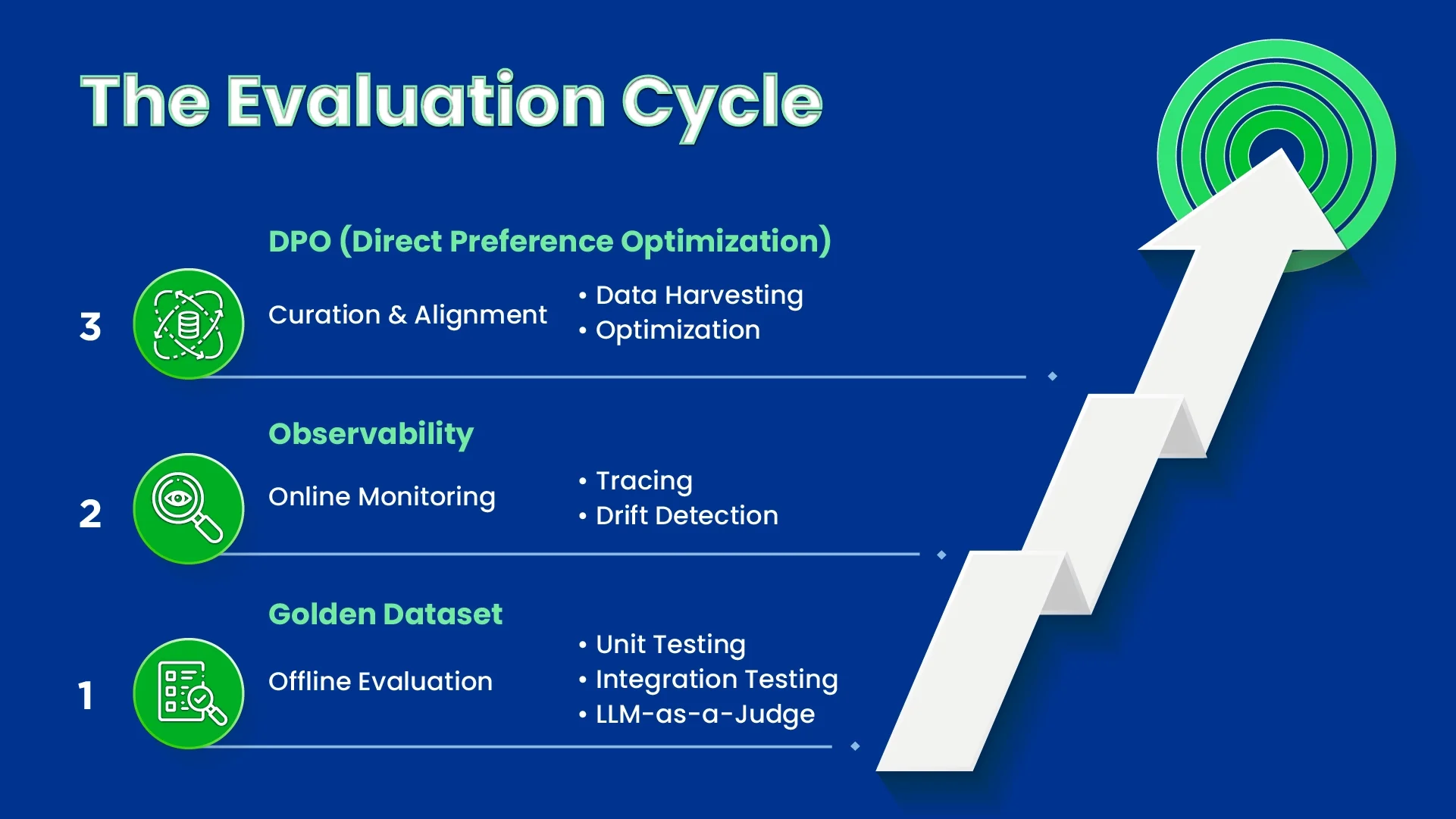
Curate Golden Datasets
Manually grade a baseline sample of interactions to establish a reliable ground truth.
-
Establish Baseline & Ground Truth
Capture initial system performance to serve as a standard for future comparisons.
-
Test Design
Create comprehensive test scenarios covering expected and edge cases.
-
Measure Performance
Execute evaluations using appropriate metrics and methodologies.
-
Regression Gate (fail/pass threshold enforcement)
Enforce strict performance thresholds to prevent deploying degraded models into production.
-
Improve Systems
Implement optimizations based on evaluation insights.
-
Monitor Continuously
Maintain ongoing assessment in production environments.
-
Iterate and Refine
Update evaluation approaches based on new requirements and learnings.
Components of Evaluation
Effective AI agent evaluation requires several key components:
-
Tasks
Well-defined objectives that agents must accomplish.
-
Datasets
Comprehensive test data covering various scenarios and edge cases.
-
Metrics
Quantitative measures for assessing agent performance.
-
Environments
Controlled settings that simulate real-world conditions.
-
Benchmarks
Standardized tests for comparing agent capabilities
Evaluation Types
| Evaluation Type | Timing | Advantages | Limitations |
Offline Evaluation | Pre-deployment | Controlled environment, repeatable | May not reflect real-world complexity |
Online Evaluation | During operation | Authentic conditions, immediate feedback | Resource intensive, potential disruption |
Hybrid Evaluation | Both phases | Comprehensive coverage | Complex implementation |
How Do AI Agent Workflows Operate and How Can You Evaluate Multi-Step Execution?

Understanding Workflows
AI agent workflows represent the sequence of actions an agent takes to accomplish complex tasks. Unlike single-step operations, these workflows involve multiple decision points, tool interactions, and state management requirements.
Single-step operations are straightforward to evaluate; you provide an input and assess the output. Multi-step workflows, however, require evaluation at each decision point, assessment of intermediate states, and validation of the overall outcome. The complexity increases exponentially as workflows become more sophisticated.
Evaluating Execution
Multi-step execution evaluation requires a systematic approach to step validation:
Step-by-Step Validation Process:
-
Input Validation
Ensure each step receives appropriate inputs from previous steps
-
Decision Logic Assessment
Evaluate the reasoning behind each action choice
-
Output Quality Check
Verify that each step produces expected results
-
State Management Review
Confirm proper maintenance of context and memory
-
Error Handling Evaluation
Test recovery mechanisms when steps fail
What Metrics Should You Use to Evaluate AI Agents Effectively?
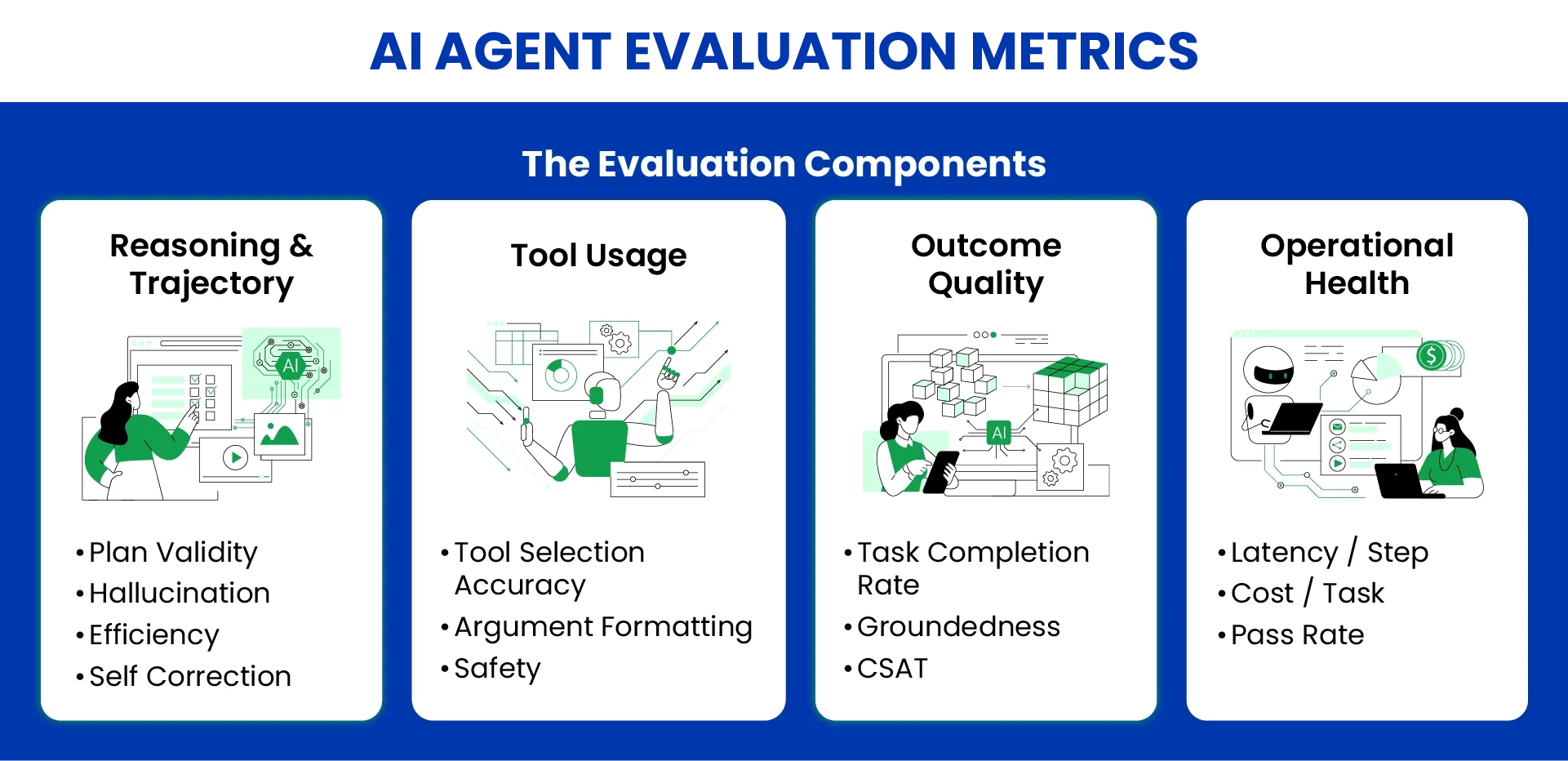
In general you should consider the following AI agent evaluation metrics. This AI Agent Evaluation framework provides structured, repeatable tests to measure performance across reasoning, tool usage, outcome quality, and operational health. This comprehensive approach mitigates risks from non-determinism and complex multi-step workflows, ensuring reliable enterprise-grade agentic systems.
Core Metrics
Fundamental metrics provide the foundation for AI agent evaluation:
-
Task Success Rate
Percentage of tasks completed successfully
-
Accuracy
Correctness of agent outputs and decisions.
-
Latency
Time required to complete tasks or respond to queries.
-
Throughput
Number of tasks processed per unit time.
-
Error Rate
Frequency of failures or incorrect outputs.
-
Availability
System uptime and accessibility.
Advanced Metrics
Sophisticated evaluation requires more nuanced measurements:
Tool and Function Metrics
- Tool Selection Accuracy: Correct choice of tools for specific tasks
- API Call Success Rate: Successful external system interactions
- Function Calling Precision: Accurate parameter passing and execution
Quality and Safety Metrics:
- Hallucination Detection Rate: Identification of false or fabricated information.
- Bias Score: Measurement of unfair or discriminatory outputs.
- Safety Compliance: Adherence to safety guidelines and constraints.
UX Metrics
User experience metrics capture the human perspective on agent performance. Helpfulness measures how well agents assist users in achieving their goals, while interaction quality assesses the naturalness and effectiveness of human-agent communication. These metrics often require human evaluation and can be more subjective than technical metrics.
-
User Satisfaction Scores
Direct feedback on agent performance.
-
Task Completion Efficiency
User effort required to achieve objectives
-
Interaction Naturalness
How human-like and intuitive agent responses feel.
How Do You Evaluate Tool Use, Function Calling, and Agent Interactions?
Tool Usage
Evaluating tool usage requires assessment across multiple dimensions:
-
Selection Accuracy
Does the agent choose the right tool for each task?
-
Parameter Correctness
Are tool inputs properly formatted and complete?
-
Execution Timing
Is tool usage appropriately sequenced within workflows?
-
Error Handling
How does the agent respond when tools fail or return errors?
-
Efficiency
Does the agent use tools optimally without unnecessary calls?
Function Calling
Function calling evaluation follows a systematic checklist approach:
API Correctness Checklist:
- Correct API endpoint selection
- Proper authentication and authorization
- Accurate parameter mapping and formatting
- Appropriate error handling and retry logic
- Response parsing and validation
- State management after function execution
Agent Interactions
Multi-agent coordination presents unique evaluation challenges. Consider a customer service scenario where multiple agents handle different aspects of a customer inquiry; one for account verification, another for technical support, and a third for billing issues. Evaluating this system requires assessing not just individual agent performance, but coordination efficiency, information sharing accuracy, and overall customer experience.
Effective multi-agent evaluation examines communication protocols, task handoff procedures, conflict resolution mechanisms, and collaborative problem-solving capabilities.
What Are the Best Methods and Systems for AI Agent Evaluation?
Evaluation Approaches
| Method | Strengths | Weaknesses | Best Use Cases |
| Rule-Based | Consistent, explainable | Limited flexibility | Compliance checking |
| LLM-as-Judge | Nuanced assessment | Potential bias | Content quality evaluation |
Rule-Based
Rule-based evaluation provides consistent, automated assessment through predefined criteria and logical constraints. This approach excels in scenarios where success criteria can be clearly defined and measured objectively, making it particularly valuable for compliance checking and operational consistency. The strength lies in its deterministic nature and explainability. Rule-based systems provide consistent results that can be easily understood, audited, and validated by stakeholders across technical and business teams.
LLM-as-Judge
LLM-as-judge evaluation leverages sophisticated reasoning capabilities of large language models to assess complex, nuanced aspects of agent performance that traditional rule-based systems cannot capture effectively. This approach is valuable for evaluating content quality, reasoning coherence, and subjective qualities requiring human-like judgment. The power lies in understanding context, assessing semantic meaning, and evaluating complex criteria.
Human Evaluation
Human evaluation remains crucial for assessing subjective qualities like helpfulness, appropriateness, and user satisfaction. Effective human evaluation requires well-designed feedback loops that capture both quantitative ratings and qualitative insights.
Implementing feedback loops involves creating structured processes for collecting human input, analyzing patterns in feedback, and translating insights into actionable improvements. This might include regular expert reviews, user surveys, and structured annotation tasks.
- Expert Review Panels: Domain specialists assess agent performance in specific contexts
- User Feedback Systems: Direct input from end users about agent effectiveness
- Annotation Tasks: Structured evaluation of agent outputs by trained evaluators
Observability
Observability in AI agent systems relies heavily on traces and spans in detailed records of agent actions and decision-making processes. Traces provide end-to-end visibility into agent workflows, while spans capture individual operations within those workflows.
Effective observability enables teams to understand not just what agents did, but why they made specific decisions, how long each operation took, and where potential improvements might be made.
Key Implementation Components:
- Distributed Tracing: OpenTelemetry-compatible trace collection (LangSmith, Arize Phoenix, Weights & Biases Weave)
- Structured Logging: Every tool call, prompt, and completion
- Metrics: Token consumption, cost-per-task, latency-per-step
- Alerting: Threshold-based alerts on hallucination rate, tool failure rate, latency P95/P99
Debugging Systems
Systematic debugging requires a structured approach to identifying failures:
Failure Identification Checklist:
- Log analysis for error patterns
- Performance bottleneck identification
- Decision tree validation
- Input/output correlation analysis
- State management verification
- External dependency assessment
What Is the Difference Between End-to-End and Component-Level AI Agent Evaluation?
End-to-End Evaluation
| Aspect | End-to-End | Component-Level |
| Scope | Complete workflow success | Individual component performance |
| Complexity | High – multiple variables | Low – isolated testing |
| Real-world Relevance | High – authentic scenarios | Medium – simplified conditions |
| Debugging Difficulty | High – multiple failure points | Low – clear attribution |
| Resource Requirements | High – full system deployment | Low – isolated testing |
Component-Level Evaluation
Component-level evaluation focuses on individual system elements:
- Tool Performance: Individual tool accuracy and reliability.
- Retriever Effectiveness: Information retrieval quality and relevance.
- Memory Management: Context retention and recall capabilities.
- Decision Logic: Reasoning accuracy in isolation.
- Interface Components: User interaction element performance.
Why Both Matter
Holistic evaluation requires both approaches because they serve different purposes. Component-level evaluation enables precise debugging and optimization of individual elements, while end-to-end evaluation validates overall system performance in realistic conditions. Organizations need both perspectives to build reliable, effective AI agents.
How Do You Build AI Agent Evaluation Datasets and Benchmarks?
Dataset Creation: Step-by-Step Dataset Creation Guide
-
Define Use Cases
Identify specific scenarios agents must handle.
-
Collect Real Data
Gather authentic examples from actual usage.
-
Create Synthetic Data
Generate additional examples to fill gaps
-
Establish Ground Truth
Define correct answers or expected behaviors.
-
Validate Quality
Review data for accuracy and completeness.
-
Version Control
Maintain dataset versions for reproducible testing.
-
Regular Updates
Refresh datasets based on new requirements
Golden datasets represent high-quality, manually curated examples that serve as definitive benchmarks for agent performance. These datasets require significant investment but provide reliable evaluation foundations.
Benchmarking
| Benchmark Type | Advantages | Disadvantages | When to Use |
| Standard Benchmarks | Industry comparison, established metrics | May not reflect specific needs | Initial assessment |
| Custom Benchmarks | Tailored to specific requirements | Development overhead | Domain-specific evaluation |
| Hybrid Approaches | Balanced coverage | Complex maintenance | Comprehensive evaluation |
Improvement
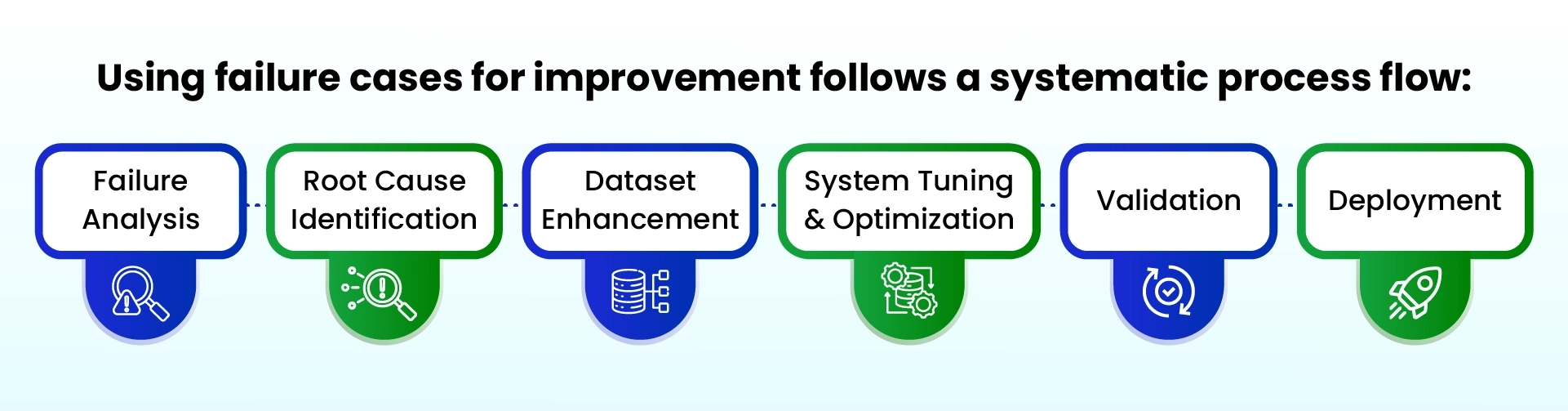
This iterative process ensures that evaluation datasets evolve with agent capabilities and real-world requirements.
How Do You Evaluate Multi-Agent Systems and Complex Agent Architectures?
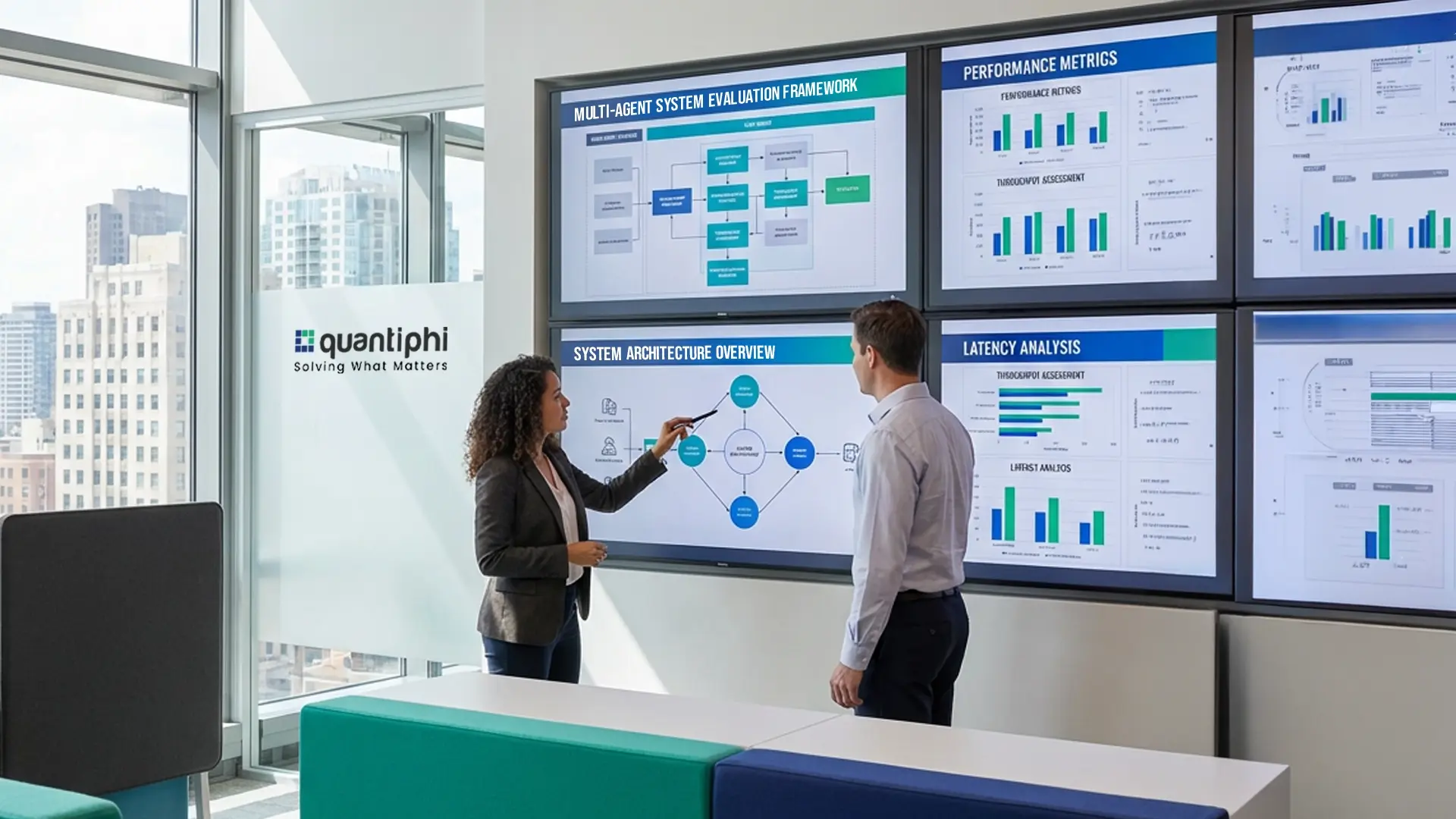
Multi-Agent Overview
Multi-agent systems involve coordinated agents working together to accomplish complex objectives. These systems require evaluation approaches that assess both individual agent performance and collective effectiveness.
Coordinated agents must communicate effectively, share information appropriately, avoid conflicts, and optimize overall system performance rather than individual metrics.
Challenges
Multi-agent evaluation presents unique challenges:
- Dependencies: Agent performance depends on other agents’ actions.
- Communication Overhead: Inter-agent communication affects system efficiency.
- Conflict Resolution: Agents may have competing objectives or resource needs.
- Scalability: Performance may degrade as more agents are added.
- Synchronization: Timing coordination becomes critical.
- Fault Tolerance: System resilience when individual agents fail.
Evaluation Strategy
Collaboration efficiency requires comprehensive assessment of how well agents work together. Consider a document processing system where one agent extracts text, another analyzes content, and a third generates summaries. Evaluation must assess not just individual accuracy, but workflow efficiency, error propagation, and overall output quality.
Effective multi-agent evaluation examines task distribution, communication protocols, resource utilization, and collective problem-solving capabilities.
How Do You Evaluate AI Agents in Production Environments?
Monitoring
Production evaluation requires comprehensive real-time tracking:
-
Performance Metrics
Continuous monitoring of key performance indicators.
-
Error Tracking
Real-time detection and analysis of failures.
-
Resource Utilization
CPU, memory, and network usage monitoring.
-
User Behavior
Analysis of how users interact with agents.
-
Business Metrics
Impact on key business outcomes.
-
Security Events
Detection of potential security issues
CI/CD
Integrating evaluations as tests within CI/CD pipelines ensures consistent quality:
Evaluation-Driven CI/CD Workflow:
-
Code Commit
Developer submits agent updates.
-
Automated Testing
Evaluation suite runs automatically.
-
Performance Validation
Metrics must meet defined thresholds
-
Staging Deployment
Successful builds deploy to staging environments
-
Production Testing
Limited production testing with monitoring.
-
Full Deployment
Complete rollout after validation.
-
Continuous Monitoring
Ongoing evaluation in production.
Continuous Improvement
Continuous improvement relies on feedback loops that connect production performance data with development processes. This creates a cycle where real-world performance insights drive ongoing optimization efforts.
What Is the Future of AI Agent Evaluation in Autonomous AI Systems?
Automation
Continuous evaluation loops represent the future of agent assessment. These systems automatically generate test cases, execute evaluations, analyze results, and implement improvements without human intervention. This automation enables real-time optimization and ensures that agents continuously improve their performance.
Standardization
Industry standardization efforts are developing common benchmarks and evaluation frameworks:
-
Universal Metrics
Standardized measurements across different agent types
-
Interoperability Standards
Common interfaces for evaluation tools.
-
Certification Programs
Industry-recognized agent quality certifications.
-
Regulatory Frameworks
Government standards for AI agent evaluation.
-
Open Source Tools
Community-developed evaluation platforms.
How Can Enterprises Scale AI Agent Evaluation Successfully?

Strategic Importance
Scaling AI agent adoption across enterprise environments requires sophisticated evaluation frameworks that can handle diverse use cases, varying risk profiles, and complex organizational requirements. Organizations that successfully scale agent evaluation typically see accelerated AI adoption, reduced deployment risks, and improved ROI from AI investments.
The strategic importance of scalable evaluation cannot be overstated. As enterprises move from pilot projects to production deployments, evaluation becomes the critical enabler that allows organizations to confidently expand AI agent usage across different departments, geographies, and business functions.
Enterprise Frameworks
Successful enterprise scaling requires domain-specific evaluation approaches:
-
Telecom
Network performance optimization, customer service automation, predictive maintenance.
-
Healthcare
Patient safety validation, clinical decision support, regulatory compliance verification.
-
Financial Services
Risk assessment accuracy, fraud detection effectiveness, regulatory adherence
-
Manufacturing
Safety system validation, quality control optimization, predictive maintenance accuracy.
-
Retail
Customer experience enhancement, inventory optimization, personalization effectiveness.
-
Technology
Development workflow optimization, security assessment, performance monitoring.
Conclusion: Building the Foundation for Reliable AI Agents Through Strategic Partnerships
AI agent evaluation represents one of the most critical capabilities for organizations seeking to harness autonomous AI systems. Effective evaluation requires a multifaceted approach combining technical rigor with business pragmatism.
Implementing comprehensive evaluation at enterprise scale often requires specialized expertise and proven methodologies. Organizations benefit from partnering with experienced AI consultancies that bring deep technical knowledge, industry-specific frameworks, and implementation best practices. Strategic partnerships provide access to cutting-edge capabilities while helping design evaluation frameworks that align with business objectives and regulatory requirements.
Quantiphi’s approach to AI agent evaluation combines cutting-edge technical capabilities with practical enterprise experience. Our teams work closely with organizations to design evaluation frameworks that align with business objectives, regulatory requirements, and operational constraints. Through comprehensive assessment methodologies, continuous monitoring systems, and optimization strategies, we help enterprises build confidence in their AI agent deployments while maximizing business value.