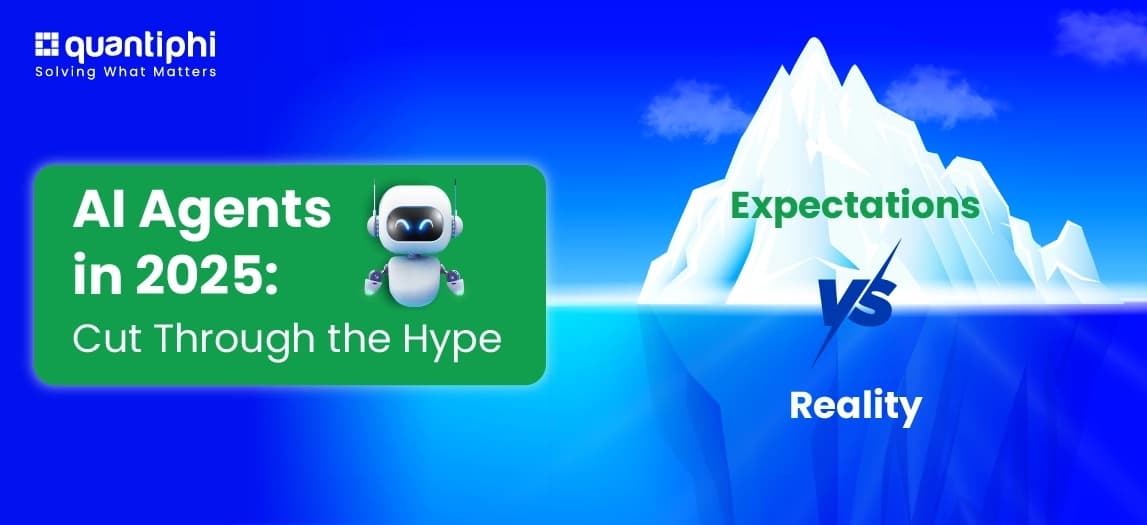
AI Agents in 2025: Expectations vs. Reality

As we approach the end of 2025, AI agents have captured the imagination of business leaders worldwide. This year brought us the dream of an autonomous enterprise; a dream where AI agents would finally take over workflows, make decisions, and operate seamlessly across systems. Analysts forecasted trillion-dollar productivity gains, and organizations rushed to build or buy “agentic” solutions.
The promise is irresistible, yet beneath the glossy marketing presentations and conference keynotes lies a sobering truth — the gap between the hype and operational reality is much wider than expected.
- Gain complimentary access to Gartner report
Click here to read the latest Gartner® research Answering the Top Trending AI Agent Questions. Cut through the hype, explore what Agentic AI is and why it matters and build a strong foundation with this report.
The Hype: A New Frontier of Autonomy
The hype isn’t entirely unfounded. AI agents have demonstrated remarkable capabilities in controlled environments. In theory, these agents could manage claims, onboard employees, write code, design marketing plans, and even make procurement decisions, all without human supervision.
Leaders envisioned a future where manual intervention was obsolete, where departments would be staffed by “agent swarms” collaborating in real time. Yet behind this surge of excitement lies a quieter reality: most organizations are still struggling to operationalize even basic generative AI pilots, let alone fully autonomous agents.
The Reality: A 95% Miss Rate
Recent research from MIT underscores the gap between ambition and outcome — 95% of generative AI projects fail to deliver measurable business impact. It’s not because AI agents don’t work; it’s because their success depends on the frameworks, data, and governance supporting them.
The promise of agents is real. The challenge is turning prototypes into production-grade systems that deliver sustained value. Let’s look at what enterprises expected, what they’re actually seeing, and how to close the gap between the two.
Expectation #1: AI Agents Will Replace Teams
- Reality: Agents amplify, not replace, human capability.
Many enterprises envisioned a workforce where agents handled end-to-end operations autonomously. In practice, most successful deployments use agents to augment teams — automating repetitive tasks, accelerating analysis, and freeing humans for higher judgment and creativity.
Bridging the gap: Reframe agents as collaborators, not substitutes. Begin by mapping workflows where agents can eliminate friction — information retrieval, validation, coordination — and integrate human checkpoints for oversight and refinement.
Expectation #2: Plug-and-Play Autonomy
- Reality: Integration, not intelligence, is the real challenge.
The dream of plug-and-play agents often collides with legacy realities — fragmented APIs, inconsistent data formats, and siloed systems. The smartest agent still struggles without seamless access to clean, connected data.
Bridging the gap: Invest in strong data foundations and interoperability. Standardize APIs, build unified data pipelines, and start small, integrating one high-impact workflow end-to-end before expanding to others. Scalable autonomy depends on scalable architecture.
Expectation #3: Immediate ROI
- Reality: Sustainable value comes from augmentation, not automation.
Some leaders expected immediate cost savings or headcount reduction. The real value, however, comes from improved accuracy, faster decision-making, and reduced rework — benefits that compound over time.
Bridging the gap: Measure ROI beyond cost; include time saved, quality improvements, and customer satisfaction. Pilot agents in processes with measurable baselines and scale gradually as performance stabilizes. Think iterative, not instantaneous.
Expectation #4: Agents Will Mature on Their Own
- Reality: They need governance, feedback, and iteration.
Many organizations treat agentic systems as set-and-forget deployments. In reality, they evolve only through structured monitoring, testing, and learning. Without governance, even promising agents degrade over time.
Bridging the gap: Adopt continuous evaluation. Track metrics like goal-completion rate, reasoning accuracy, and exception resolution time. Implement governance frameworks for ethical, transparent, and auditable agent behavior. Maturity comes from iteration, not inertia.
Where the Opportunity Lies
The reality of AI agents in 2025 isn’t disillusionment — it’s course correction. The hype cycle is giving way to a more grounded, system-level understanding of how autonomy actually works. Organizations that thrive in this new phase are those treating AI agents as systems that learn, adapt, and collaborate within governed architectures.
At Quantiphi, we see this shift unfolding daily. Recognized as an Emerging Leader in the Emerging Market Quadrant for Generative AI Consulting and Implementation Services in the 2025 Gartner® Innovation Guide, we are ideally positioned to help enterprises navigate their journey toward agentic AI adoption.
Partner with Quantiphi to begin your AI transformation, securely, responsibly, and at scale.