From Dashboards to Decisions: The AI Agent Shift in Enterprise BI Migration

Introduction: Why BI Migration Needs a Rethink
Enterprise Business Intelligence (BI) landscapes are undergoing a massive transformation. Organizations that once relied on static dashboards, manual reporting cycles, and rigid data pipelines are migrating toward modern, cloud-native BI ecosystems. However, traditional BI migration—whether moving from legacy tools like Tableau Server, QlikView, or on-premise data warehouses to modern stacks—remains a complex, labor-intensive, and error-prone process.
Historically, migrations have relied on a lift-and-shift approach: replicate dashboards, rebuild data models, and validate reports manually. This mechanical approach is slow, expensive, and fails to scale across thousands of enterprise assets.
Enter Agentic AI—a paradigm shift that moves BI migration from a manual engineering exercise to an autonomous, intelligent, and continuously optimizing workflow. By integrating agentic capabilities with Amazon Quick (AWS’s AI assistant for work) through Quantiphi’s Quick to Quick (Q2Q) accelerator, enterprises can now compress migration timelines from months to weeks, turning a technical migration chore into a strategic leap toward decision intelligence.
In this blog, we talk about how Quantiphi’s Q2Q framework replaces manual migration processes with an intelligent, agentic workflow. Designed for CDOs, Heads of Analytics, and business unit leaders, it breaks down not just how this automated transition works, but the measurable impact it delivers across the business.
Why Traditional BI Modernization Programs Underdeliver
The promise of BI modernization is straightforward: move to a modern cloud-native platform, reduce reporting costs, improve data trust, and give business users faster access to insight. The reality, however, is rarely that clean. In practice, analytics leaders encounter a predictable set of structural obstacles:
-
Complex and Fragmented BI Ecosystems
Enterprises accumulate thousands of redundant dashboards, overlapping data models, and inconsistently defined KPIs over decades. A pre-migration audit typically reveals two to three times more assets than anticipated.
-
Custom Implementations
Legacy reports are filled with custom components like filters, actions, and tooltips that demand heavy manual efforts for reconstruction.
-
Business Logic that Lives Nowhere
Subtle business rules and calculations are often embedded directly in legacy dashboard formulas or ETL scripts with zero authoritative documentation. When they break in migration, finding the root cause is incredibly difficult.
-
The Endless Validation Bottleneck
Proving that a migrated report produces the same output as its predecessor requires business users to compare numbers line by line. This is an expensive, slow, and manual testing process that delays cutover.
-
Adoption Deficits
Moving assets to a new platform does not automatically change behavior. Without shifting the paradigm of how users consume data, organizations find themselves maintaining two parallel environments indefinitely.
The Dilemma
The average enterprise BI migration takes 6 to 9 months, costs significantly more than planned, and still leaves the organization dependent on the same analysts to answer the same questions.
The root cause is not a lack of talent or effort. It is a structural mismatch: the complexity of enterprise BI estates has grown far beyond what manual migration processes can handle efficiently.
The Paradigm Shift: Understanding Agentic AI in BI
Agentic AI refers to systems capable of planning, reasoning, and executing multi-step tasks autonomously while interacting with complex data tools and environments. Unlike traditional LLM prompts that simply answer a question, agentic systems can break down complex migration objectives, map out dependencies, collaborate across specialized sub-agents, and learn continuously from human-in-the-loop feedback.
In a migration framework, AI is no longer a passive assistant for developers—it actively drives metadata discovery, schema translation, visualization mapping, and automated validation.
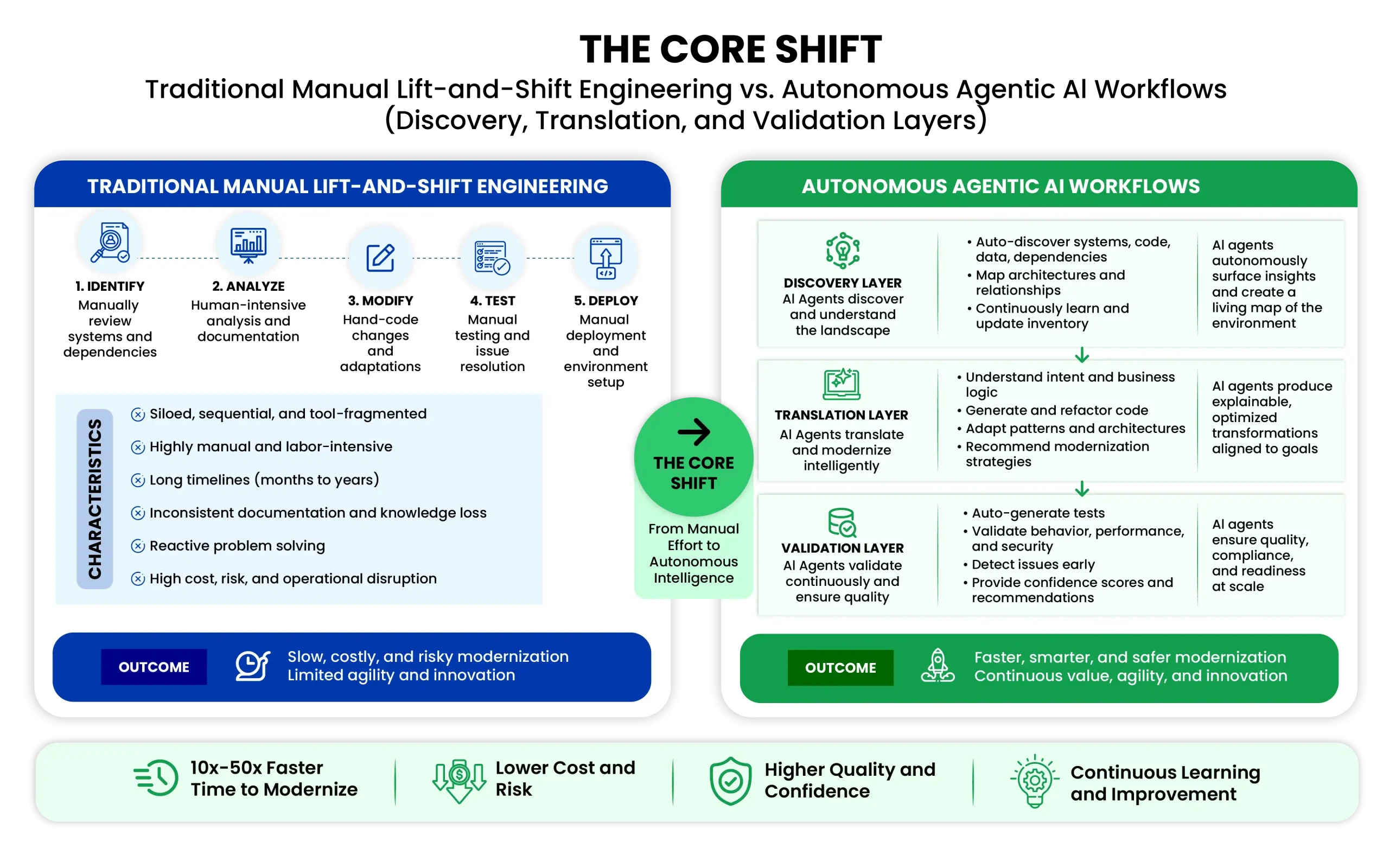
The Shift from Traditional BI Migration Approach to Agentic AI-Led Migration Approach
Q2Q: Quantiphi’s Agentic Migration Accelerator
Q2Q is Quantiphi’s proprietary accelerator for migrating enterprise BI environments to Amazon Quick. It replaces the manual, sequential, error-prone process of traditional migration with a coordinated system of AI agents — each specialized for a different phase of the migration lifecycle.
The result is a migration that is faster by design, more accurate than human-led approaches, and structured to deliver value beyond the go-live date.
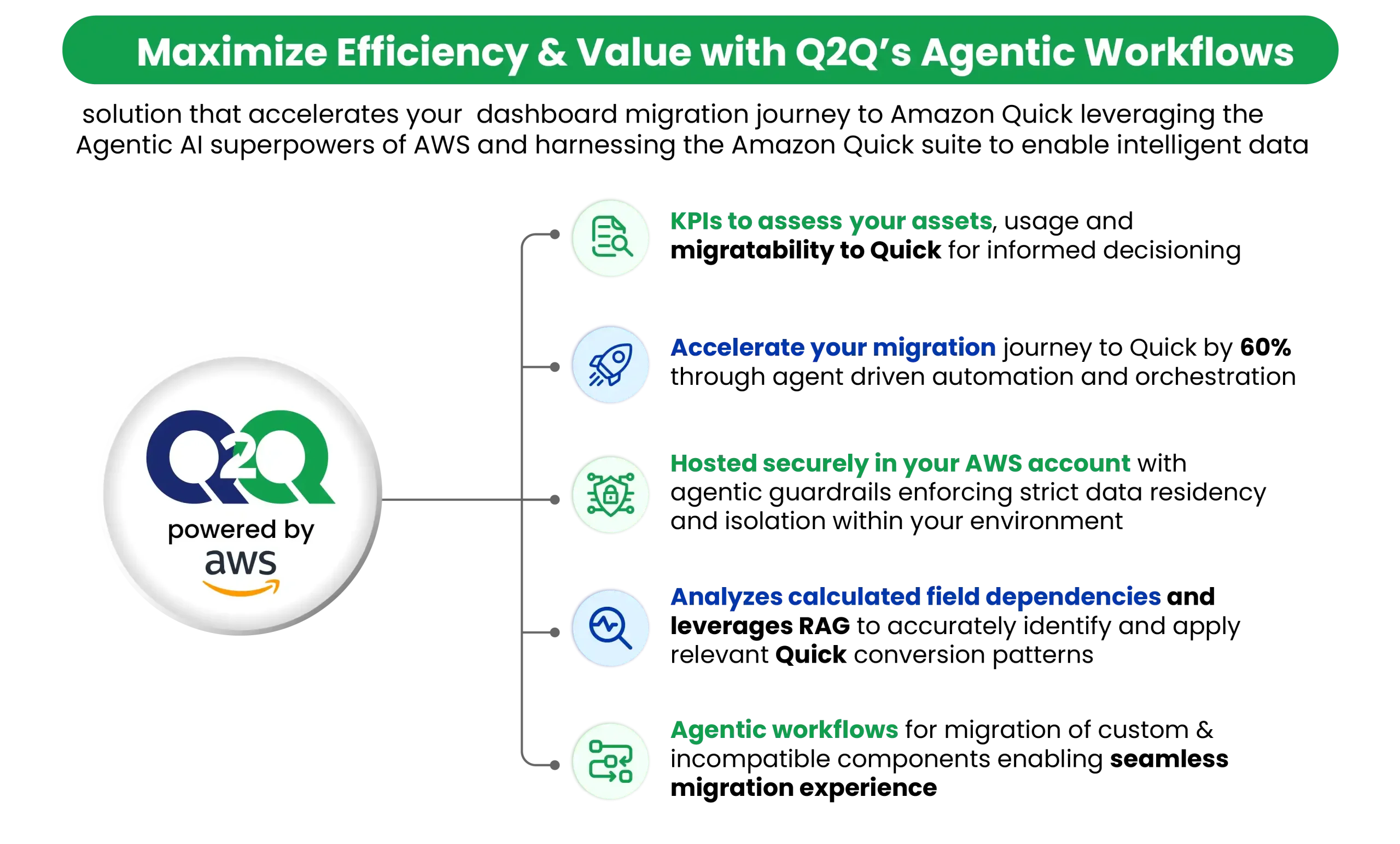
Overview of Quick to Quick (Q2Q) and its Features
The Target Destination – Why Amazon Quick?
Q2Q is the bridge between where your organization is today — anchored to legacy tooling — and what Amazon Quick makes possible.
- Beyond Dashboards: It connects Slack, Teams, Outlook, CRMs, and core databases into a unified experience, allowing users to automate workflows, build visualizations, and schedule deliverables natively.
- Tailored for Business Roles: Tailored capabilities are available out of the box for Sales, Finance, Marketing, Legal, Operations, and IT.
- Conversational Insights: It enables business users to query systems using natural language, receiving instant, context-aware narratives and reasoning systems instead of static visuals.
How Q2Q Delivers: Five Phases, One Continuous System
Unlike point solutions or manual migration factories, Q2Q operates as an integrated system. Each phase produces structured outputs that feed the next, preserving context and business meaning throughout the journey.
Phase 1: Intelligent Discovery and Assessment (Know What You Have)
Q2Q’s discovery agents automatically scan your entire legacy BI environment (Tableau, Power BI, Qlik, etc.). Within hours, they produce a comprehensive, classified asset inventory. Assets are automatically scored by usage frequency, business criticality, and migration complexity. This allows leadership to aggressively deprecate obsolete dashboards, instantly reducing the project’s migration scope.
Phase 2: Semantic Mapping & Lineage (Preserve What Matters)
One of the hardest parts of a migration is preserving business meaning. Semantic agents extract KPI definitions and calculation rules directly from legacy metadata and map them to a unified business glossary. Simultaneously, data lineage agents reconstruct source-to-dashboard data flows and transformation logic across ETL pipelines, creating a single, authoritative definition of every core business metric.
Phase 3: Migration Execution at Scale (Migrate Parallelly)
Once the logic is locked down, execution agents recreate the validated BI assets within the target cloud environment. These agents operate in parallel, translating SQL dialects (e.g., Oracle SQL → cloud-native SQL), reconstructing datasets, and generating visualization templates based on legacy design patterns autonomously.
Phase 4: Automated Validation & Testing (Validate with Confidence)
Q2Q automates the heavily manual QA cycle by cross-reconciling data between source and target systems, checking KPI consistency, and running visual parity checks. If discrepancies are flagged, the system generates explainability reports rather than raw error logs, allowing business users to evaluate exceptions quickly rather than hunting through individual data cells.
The Practical Impact
QA cycle times are slashed by 60% to 70%, accelerating formal business sign-off.
Phase 5: Continuous Post-Migration Optimization (Optimize Continuously)
Unlike traditional projects that end at cutover, optimization agents run continuously post-migration. They monitor real-time query performance, detect underutilized dashboards, surface cloud cost-reduction opportunities, and recommend semantic model updates as your enterprise scales.
The Business Value: Comparing the Horizons of Return
Q2Q generates value across three horizons, each relevant to a different stakeholder audience.
Immediate: Migration Economics
The direct cost savings from an accelerated, automated migration are substantial. Fewer consultant months. Lower infrastructure overlap costs from running parallel environments. Faster realization of cloud BI efficiencies. For a large enterprise migrating thousands of assets, Q2Q typically delivers a two to four times improvement in migration economics versus a traditional approach.
Near-Term: Analyst Productivity and Data Trust
Once the migration is complete and Amazon Quick is live, the productivity dividend begins. Business users who previously submitted data requests get answers directly. Analysts who spent 60 percent of their time on report maintenance redirect that capacity toward analysis and strategy. And because Q2Q’s semantic mapping phase established a single source of truth for every metric, the chronic problem of conflicting numbers is resolved at the foundation.
Strategic: Enterprise Intelligence at Scale
The longest-horizon return — and the most significant — is the extension of intelligence beyond the BI function. Amazon Quick serves every part of the organization: Sales teams building account plans, Finance teams answering ad-hoc questions without analyst involvement, Legal teams reviewing contracts at speed, Operations teams resolving incidents before they escalate. When intelligence is no longer gated by a request queue, the compounding effect on organizational velocity is difficult to overstate.
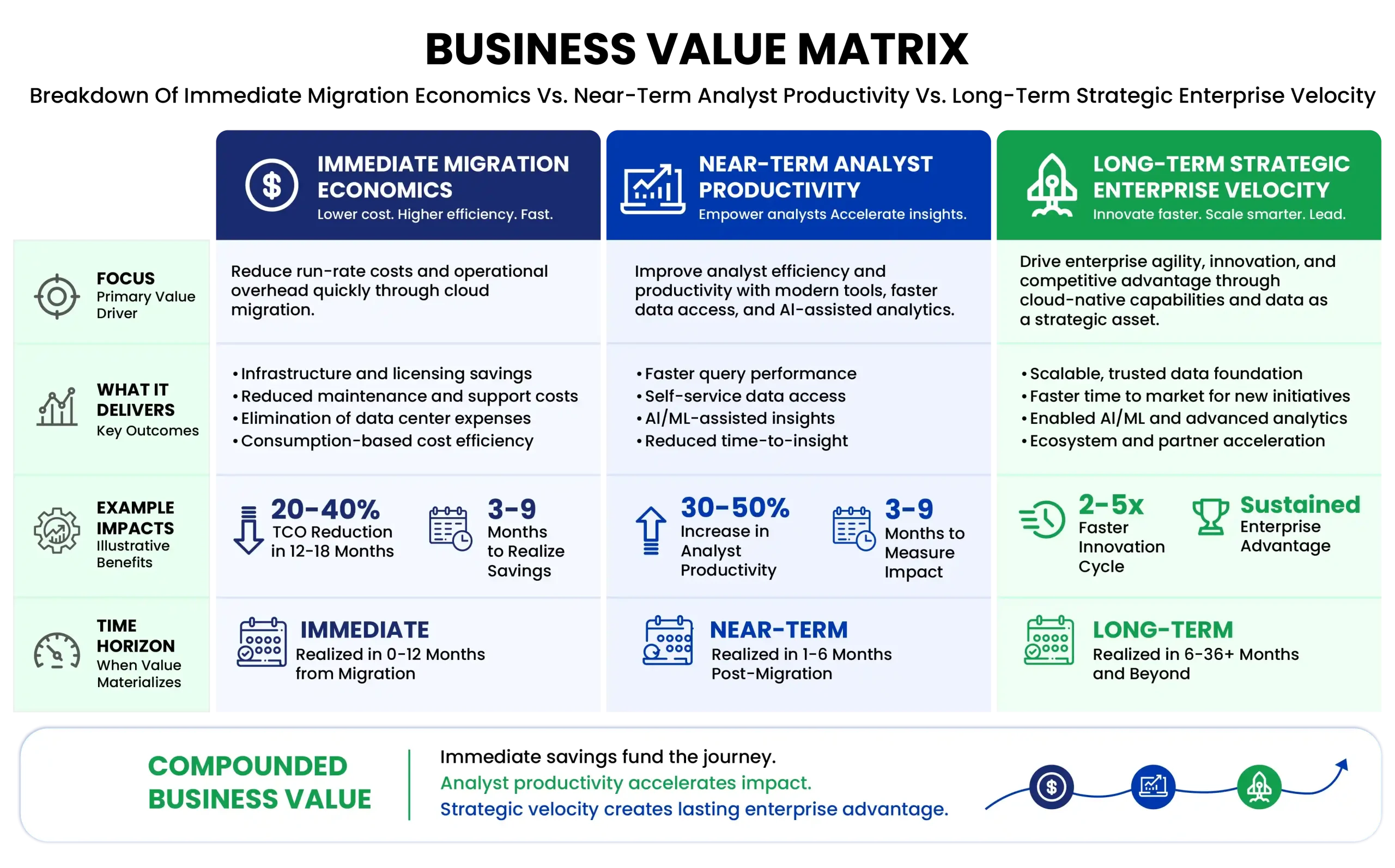
Comparing the Business Value Matrix between Immediate, Long Term and Strategic Perspectives
| Evaluation Metric | Legacy Approach | Q2Q on Amazon Quick |
| Time to Value | 6–9 months to cutover | 2–3 months to live, optimized platform |
| Asset Discovery | Manual audits over weeks | AI-powered scan completed in hours |
| Business Logic Retention | Dependent on institutional memory | Semantically mapped and validated by AI |
| Quality Assurance | Manual line-by-line validation | Automated, 60–70% faster sign-off |
| Post-Go-Live Trajectory | Platform degrades without investment | Continuously self-optimizing |
| Business Reach | BI team and power users only | Every function — Finance, Sales, Ops, Legal, IT |
| ROI Horizon | 12–18 months to break even | Accelerated, with measurable quick wins |
Value Realization by Business Function
Following a Q2Q-enabled migration, every core function across the enterprise realizes a major productivity dividend via Amazon Quick:
Finance and FP&A
Enjoys automated data reconciliation and plain-language answers to complex, ad-hoc questions like “Why did gross margin compress in Q3?” Month-end cycles that once heavily tied up analyst bandwidth become largely self-service.
Sales and Revenue Operations
Surfaces pipeline risks prior to forecast calls and retrieves account context in seconds. Sales reps spend more time acting on live insights and less time waiting in a BI ticket queue.
Marketing
Brings campaign performance, audience segmentation, and content analytics together without tool-switching. It automatically drafts performance narratives and flags underperforming segments within a single workspace.
Operations and IT
Operational anomalies are instantly flagged alongside AI-generated root cause analysis. IT infrastructure engineering teams are redirected from handling reactive dashboard support to driving high-value cloud optimizations.
Real World Scenario – What it Looks like in Practice
Consider a global manufacturing enterprise operating across 18 countries, with a BI estate of approximately 9,000 Tableau dashboards spread across Finance, Supply Chain, Commercial, and Operations. Leadership has committed to a cloud analytics platform but the migration program has been running for 11 months with less than 20 percent of assets migrated.
| Without Q2Q | With Q2Q |
| 11 months in, 20% migrated | Full 9,000-asset inventory completed in 96 hours |
| 47 conflicting definitions of “On-Time Delivery” | Single authoritative KPI glossary covering 63 core metrics |
| No documentation for core supply chain KPIs | Business logic extracted and preserved without legacy documentation |
| Business users are still running parallel legacy reports | Migration completed across all regions in under 14 weeks |
| Cloud platform underutilized; ROI case weakening | Supply chain and Finance teams self-serving on Amazon Quick |
| Migration team at risk of attrition | Legacy environment decommissioned; cloud ROI case restored |
The outcome was not simply a faster migration. It was a restored business case, a decommissioned legacy environment, and an analytics capability that serves the entire enterprise — not just the BI team.
Strategic Guardrails for Enterprise Leadership
While Q2Q’s agentic framework removes the vast majority of technical friction, senior leadership must actively manage a few critical areas to maximize success:
-
Executive sponsorship of the KPI governance process
Q2Q’s semantic mapping phase surfaces metric conflicts that require business owners — not technologists — to arbitrate. This is a moment of organizational clarity that delivers long-term value, but it requires time and authority.
-
A change management investment proportional to the transformation
Amazon Quick changes how people work. The organizations that realize the highest returns invest in enablement, communication, and adoption support alongside the technical migration.
-
Realistic sequencing for data platform dependencies
Q2Q migrates the analytics layer. If the underlying data is fragmented across legacy on-premise warehouses, a parallel data modernization workstream will be required. These can run concurrently, but both require resourcing.
-
Human oversight for regulated business logic
In financial services, healthcare, and other regulated industries, certain KPI definitions and calculation methodologies require formal human sign-off before go-live. Q2Q surfaces these checkpoints explicitly — they are not automated away.
The Quantiphi Advantage: This is where Quantiphi acts as a strategic partner, ensuring these guardrails are successfully navigated right from the start. To establish a baseline of certainty, we first deploy Q2Q’s Assessment module to comprehensively scan your existing Tableau (or legacy) inventory, evaluating migration complexity and projecting costs across the entire repository. Based on these intelligent insights, we work with your leadership to strategically identify the high-value dashboards targeted for the engagement, ensuring a mutual agreement on the finalized scope before execution begins. Once the scope is locked, our data strategists step in to facilitate KPI arbitration, pair the technical rollout with tailored change management, align parallel data modernization streams, and ensure mandatory compliance checkpoints are seamlessly integrated. This end-to-end partnership empowers your business to maintain absolute control over strategic logic while fully capitalizing on the speed of agentic AI.
Conclusion: The Decision in front of You
BI migration has traditionally been a slow, manual, and high-risk endeavor. Agentic AI fundamentally changes this paradigm by introducing autonomy, intelligence, and continuous learning into the migration lifecycle. By leveraging specialized AI agents for discovery, semantic mapping, execution, and validation, enterprises can transform BI migration into a scalable, accurate, and strategic initiative.
The question is not whether to modernize — that decision has already been made. The question is how quickly and how confidently it can be done. Quantiphi’s Q2Q, built on Amazon Quick, offers a fundamentally different answer to that question. Not a larger team working the same process, but a smarter process that compresses timelines, protects business logic, and delivers a platform that grows in value after go-live rather than requiring its next overhaul. The organizations that move decisively will compound the advantage. Those that continue with manual approaches will continue to compound the cost.
The Bottom Line
Q2Q is not a migration tool. It is the fastest path from a legacy reporting function to an enterprise intelligence capability that works for every team in your organization.