Self-Learning Agentic AI: A Framework for Transforming Telecom Service

Quantiphi’s AI-First Digital Engineering approach transforms multi-agent systems from static deployments to evolving, AI agent ecosystems that deliver compounding value.
Key Takeaways:
- Self-Learning Agentic AI moves beyond static deployment, utilizing structured feedback to constantly improve.
- It relies on a continuous loop of four pillars: Capture & Curate, Inferencing, Evaluation, and Repeat.
- Implementing this framework lowers operational costs, increases first-call resolution, and prevents the customer dissatisfaction associated with over-automation.
Why Do Telecom Businesses Need Self-Learning Agentic AI?
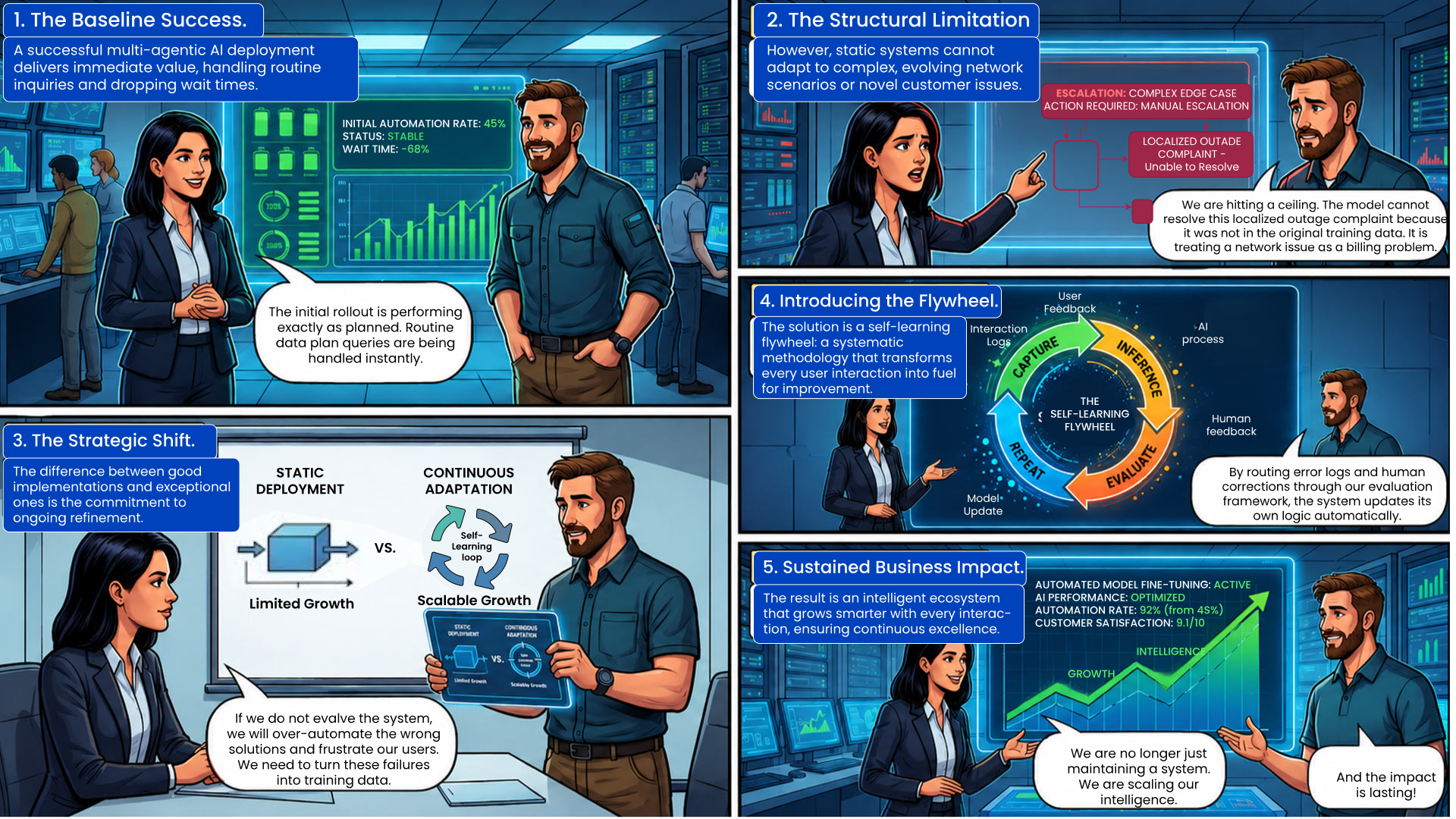
Getting your telecom AI customer service system live is a massive win. Wait times drop, and customers get instant answers. But what happens next? While Gartner predicts AI agents will resolve 80% of common customer service issues on their own by 2029 and IDC sees telecom executives pushing for massive AI adoption, the path forward requires caution. Forrester offers a crucial warning that automating complex or emotional inquiries can quickly damage customer satisfaction. This means the best AI implementations are never truly finished. They rely on structured AI customer service feedback loops to constantly refine their performance.
To achieve this, you need a self-learning flywheel. This framework moves beyond one-time training cycles to create a state of continuous enhancement, where agents grow smarter and more effective with each task they perform. Let us explore how this systematic approach turns every customer interaction into the exact fuel your AI needs to continuously improve.
The Four Pillars of Self-Learning Agentic Systems
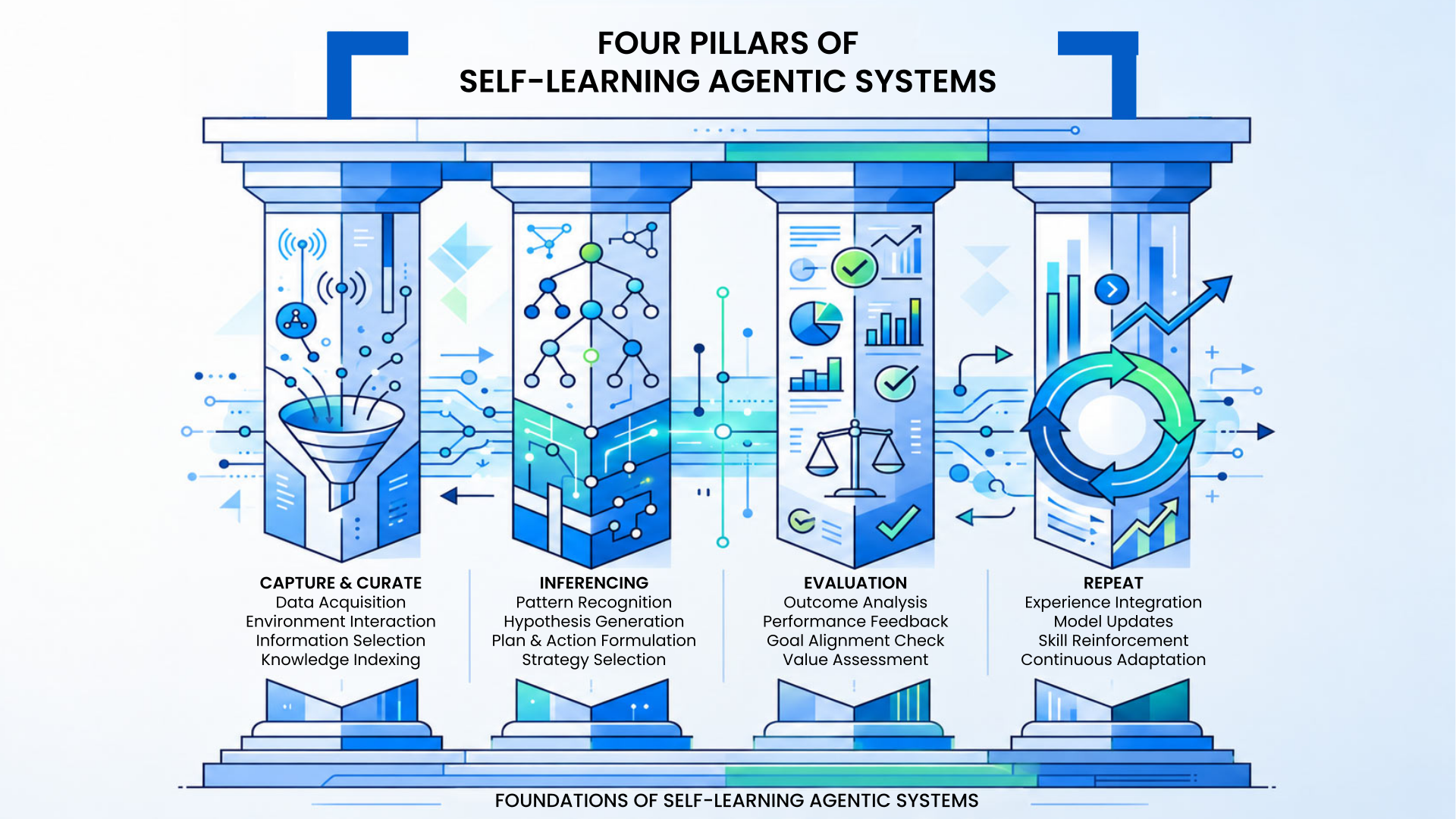
This framework is built on a virtuous cycle of four pillars: Capture & Curate, Inferencing, Evaluation, and Repeat. By implementing this operational discipline, we can transform static agents into dynamic systems that learn, adapt, and consistently deliver superior performance. Let’s explore each pillar using the practical example of a customer service agent for a telecommunications company.
Pillar 1 – Capture & Curate: Building Your Intelligence Foundation
A self-learning system is only as good as the data it learns from. The first pillar is about systematically harvesting learning signals from every touchpoint and transforming raw interaction logs from noise into a structured, actionable intelligence foundation.
What Gets Captured: For our telecom agent, every interaction is a potential learning opportunity.
- Approvals: A user asks, “How much data have I used this month?” The agent retrieves the correct amount, and the user ends the chat. This successful interaction is logged as an approval, reinforcing the agent’s current process.
- Edits: A user types, “My internet is buggy.” The agent asks for clarification. The user rephrased to, “My download speed is less than 10 Mbps.” The user’s rephrasing is captured as an edit, revealing a gap in the agent’s understanding of informal language.
- Errors: A user asks about a new “5G Ultra Capacity” plan, but the agent, trained on older data, has no information and responds with, “I can’t find that plan.” This is a documented failure.
- Behavioral Signals: A user trying to dispute a bill is routed through three different conversational turns without a clear answer and abandons the session. This high time-on-task followed by abandonment is a critical behavioral signal indicating a flawed workflow.
How It’s Processed:
- Automated Classification: An LLM-as-Judge automatically scores the agent’s responses for helpfulness and categorizes interactions (e.g., “billing inquiry,” “network issue”).
- Human-in-the-Loop Validation: High-stakes or ambiguous cases, like the abandoned billing dispute, are routed to a human expert for review. The expert can confirm if the agent’s workflow was confusing or incorrect.
- Centralized Storage: All this structured feedback including approvals, edits, classified errors are stored in a queryable format, creating a rich dataset for analysis and model improvement.
- Real-Time Dashboards: Establish granular performance visibility and proactive trend monitoring to ensure operational transparency.
The key insight: Raw interaction logs are noise; structured feedback is signal. Build pipelines that transform user interactions into actionable training datasets.
Pillar 2 – Inferencing: From Feedback to Intelligence
Curated feedback triggers targeted improvements. However, not all feedback requires the same intervention. The inferencing pillar is about routing insights to the right improvement mechanism, converting potential into tangible system upgrades. Captured data represents potential. Inferencing converts it into tangible system improvements through three primary mechanisms:
| Improvement Mechanism | Description & Use Case Example | Resource Intensity |
|---|---|---|
| Prompt Refinement | Based on the “buggy internet” example from the Capture phase, we see a pattern of users using informal terms for speed issues. We update the agent’s system prompt: “If a user mentions ‘buggy,’ ‘slow,’ or ‘laggy’ internet, interpret this as a query about their network speed and initiate a diagnostic test.” | Low-overhead fix for immediate impact. |
| Model Fine-Tuning | Systematic failures require deeper intervention. By collecting dozens of failed interactions (like missing the “5G Ultra Capacity” plan), we create a dataset to fine-tune the base language model, teaching it new terminology. | More resource-intensive, but creates lasting capability. |
| Knowledge & Workflow Adaptation | Human review revealed the abandoned billing dispute workflow was unnecessarily complex. The workflow is redesigned to provide a direct path. New human troubleshooting steps are also added to the agent’s knowledge base. | Medium overhead for high operational impact. |
The strategic choice is key: Minor edge cases may warrant prompt adjustments; systematic failures demand comprehensive fine-tuning. A robust decision framework is needed to route feedback to the appropriate improvement mechanism.
Pillar 3 – How to Evaluate AI Agents: Measuring What Matters
Improvement without measurement is guesswork. The evaluation pillar ensures that enhancements deliver genuine value. Effective evaluation requires examining two distinct layers: the semantic layer (what the agent produces) and the behavioral layer (how it arrives at decisions). A response might appear correct while hiding a flawed and costly reasoning process.
Semantic Layer Evaluation: This layer evaluates the truthfulness and quality of the agent’s final response.
- Factual Accuracy: For the telecom agent, did it quote the correct price for a data plan? This is measured against a ground truth database using metrics like precision and recall.
- Retrieval Quality: When asked for troubleshooting steps, did the agent retrieve the most relevant document from its knowledge base?
- Consistency Monitoring: Ensure logical coherence by leveraging LLM-as-a-Judge evaluations to systematically detect and resolve self-contradictions.
- Contextual Memory: Validate the retention of multi-turn conversational history through rigorous “Needle in a Haystack” diagnostic probing.
Behavioral Layer Evaluation: This layer evaluates the agent’s decision-making and execution quality.
- Tool Selection: Did the agent correctly choose the “run network diagnostic” tool instead of the “fetch billing data” tool?
- Parameter Handling: Rigorously validates the accuracy of input parsing through comprehensive schema compliance checks.
- Path Accuracy: Did the agent follow the correct sequence of steps for troubleshooting? For a network complaint, the correct path is: 1) check for local outages, 2) run a line test, 3) suggest a plan upgrade.
- Goal Achievement: Measures the convergence of similar queries using advanced any-order match analysis to ensure consistent outcomes.
Why Both Layers Matter: Uncovering Silent Failures
A customer complains about poor connectivity. The agent recommends upgrading to a premium fiber-optic plan. On the surface (semantically), this is a reasonable suggestion. However, an evaluation of the behavioral layer reveals the agent skipped a critical first step: checking for a local network outage. The real issue was a temporary tower outage affecting the customer’s entire neighborhood.
This is a silent failure. The agent’s output appeared plausible but was based on a flawed process that could lead to an unnecessary and expensive upgrade, eroding customer trust. Without evaluating both the semantic and behavioral layers, such errors remain invisible, degrading performance in ways that are difficult to detect.
Pillar 4 – Repeat: The Automation Imperative
Self-learning is not a one-time project; it’s an operational discipline. The final pillar automates the entire cycle, transforming manual improvement efforts into a continuous, scalable learning loop that requires minimal human intervention.
Building Sustainable Cycles:
- Automate the Routine: The capture of user feedback, classification of interactions, standard evaluations (e.g., checking for factual accuracy), and even some prompt adjustments are fully automated. This cycle runs weekly or even daily.
- Escalate the Exceptional: The system is designed to flag novel failure modes, significant performance regressions, or highly ambiguous feedback for human review. This ensures that human experts focus their judgment on the most complex and strategic issues.
- Iterate Continuously: A system that improves every week will consistently and dramatically outperform one that is overhauled quarterly. The automation imperative creates a compounding effect where intelligence accumulates rather than depreciates.
The paradox of this automation is that it demands sharper human judgment. By automating the routine, we free up experts to focus on the high-impact decisions that cannot be automated. This synergy is the hallmark of a mature self-learning system.
The Virtuous Cycle: The Intelligence Multiplication Engine
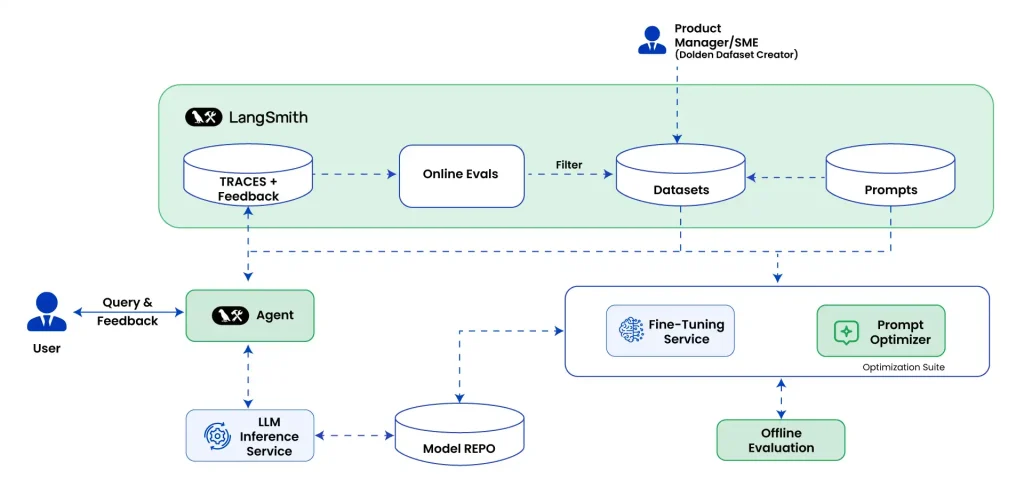
The synergy between these four pillars creates a powerful compounding effect, accelerating system maturity with every iteration. Captured learning signals provide the raw fuel for intelligent inferencing, which in turn generates systemic upgrades that must be rigorously validated through evaluation. This evaluation then surfaces refined data points for the next capture phase. By repeating this cycle automatically and systematically, we transform the learning process into an engine of continuous excellence. The cycle repeats: automatically, continuously, and systematically.
What Each Improvement Cycle Delivers:
- Higher task accuracy and completion rates that directly impact customer satisfaction and first-call resolution (FCR) AI metrics.
- Reduced customer friction and repetitive interactions that improve operational efficiency and reduce call volume.
- Faster generalization to novel use cases as your customer base evolves and service offerings expand.
- Proactive identification of emerging failure modes before they affect large customer segments or create service disruptions.
The Business Impact of Agentic AI in Telecom
The competitive advantage lies with systems that grow smarter with every user interaction, every correction, and every piece of feedback. Enterprises implementing the four pillars: Capture, Inference, Evaluate, and Repeat provide the framework to achieve transformational results that align with the industry trends identified by leading research firms:
- Higher Adoption Rates: Human-aligned outputs drive increased user acceptance and engagement.
- Lower Operational Costs: Automated learning loops reduce manual intervention by up to 60%.
- Compounding ROI: Each improvement cycle builds on the last-intelligence accumulates rather than depreciates.
- Stakeholder Confidence: Transparent evaluation metrics establish trust at every level.
- Adaptive Resilience: Systems evolve with changing needs without costly rebuilds.
Engineering AI-First Telecom Transformation at Scale with Quantiphi
Quantiphi combines deep technical expertise with an AI-first digital engineering approach to deploy self-learning agentic AI frameworks for telecom operators. We deliver transparent, trustworthy, and responsible solutions designed specifically for mission-critical operations. Our end-to-end implementation handles the entire lifecycle right from knowledge capture to continuous optimization; seamlessly integrating AI into your existing workflows. By partnering with Quantiphi, telecom operators accelerate time-to-value and minimize implementation risks, turning technical innovation into measurable business outcomes.
Wrapping Up!
The question isn’t whether your AI agents can handle today’s customer service challenges. The question is whether they can adapt to tomorrow’s opportunities and obstacles while avoiding the over-automation pitfalls that Forrester warns against. Self-Learning Agentic AI ensures your customer service capabilities grow stronger, smarter, and more valuable over time.
The time to build self-learning systems is now. Your customers, your team, and your competitive position depend on it. The future belongs to agentic systems that evolve. Are you ready to transform your telecom contact center and stay ahead of the curve? Connect with our AI expert team today for a quick consultation. We can help you navigate the adoption of Self-Learning Agentic AI to drive continuous excellence and unlock sustainable business growth.