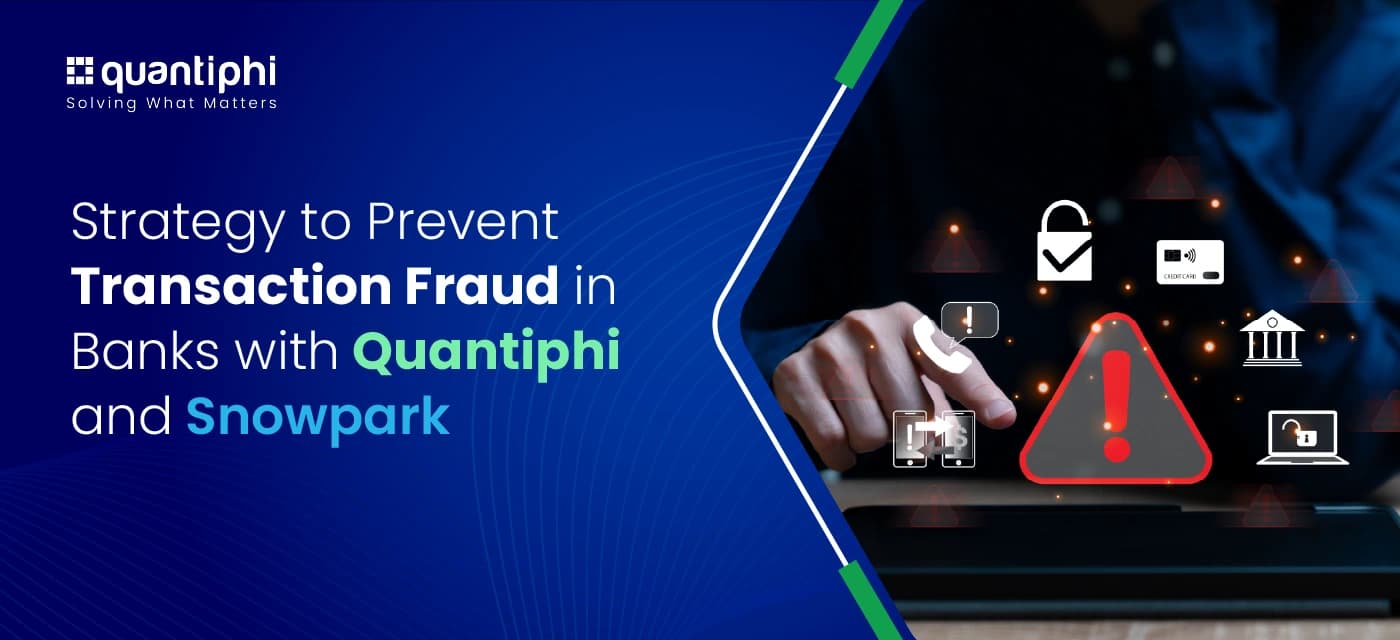
Strategy To Prevent Transaction Fraud in Banks With Quantiphi and Snowpark

In 300 BC, Hegestratos and Zenosthemis, two Greek maritime merchants, devised a scheme to enrich themselves by taking out a bottomry, an insurance scheme, on their ship and cargo. The agreement dictated that if they failed to repay the loan, the lender would take possession of the vessel and its cargo. Hegestratos and Zenosthemis attempted to wreck the ship and steal all the borrowed funds but were caught. Hegestratos died while trying to flee, and Zenosthemis was brought before the law in Athens’ courts.
The nature of financial fraud has changed over time and has gone beyond the Greek incident. With the development of technology, fraud has become increasingly sophisticated since the late 1980s, taking on more intricate forms, including the distribution of fake banknotes and credit card fraud.
Global cashless payment volumes are expected to triple by 2030. As digital banking grows, there are more transactions taking place through more channels that need to be tracked. Mobile fraud, identity theft, ATM fraud, and credit card fraud have dramatically increased during the last ten years.
How does it affect banks?
Banks face risks from frauds, including direct expenses, indirect costs, and lost consumer loyalty. Surveys show fraud warnings cause 67% of people to switch banks or credit unions, and 90% are concerned about digital banking and credit fraud.
For every $1 lost to fraud, businesses spend more than $4 dealing with the aftermath—recovery, resolution, and compliance.
A 2024 Nasdaq report revealed that payment fraud made up 79.6% of the $485.6 billion lost to financial scams in 2023.
What makes detection difficult?
Banks employ Suspicious Activity Reports (SARs) to detect fraud. Employees file SARs for suspicious activity, triggering investigation by the bank’s fraud department. If evidence confirms fraud, appropriate action follows. This process is meticulous and lengthy.
Transactional Fraud comes to a pause with Quantiphi’s ML model on Snowpark (Deck link for use case details)
Banks can combat rising fraud complexity with machine learning (ML), which analyzes large datasets to detect unusual transaction patterns in real time. ML can cut fraud detection time by up to 90% while improving accuracy. Transaction monitoring software, risk scoring, and enriched KYC data from open sources enable near real-time prevention. Using Snowpark, our team has built a model to detect and stop fraud across the transaction workflow.
- Client onboarding and risk scoring
Our scoring model gives a risk score to every event transaction. A historical scan is performed on new clients across millions of data points to add to their risk score. Machine learning algorithms and robust risk scoring are used to help catch fraudsters attempting to enter fake information. The risk score will help identify transactions with a high risk of fraud. Businesses can then take effective measures, depending on the risk group, to shorten queues and save the time of investigators. - Real-time monitoring
This model is harnessed to study the behavior of the users and detect variations or anomalies in transactions. It also helps in identifying sanctions, politically exposed accounts, and negative publicity by screening millions of clients across billions of data items. Real-time data processing capabilities are utilized to detect fraud in near real-time. Verification of applicants’ identities, maintaining verification records, and flagging in real-time when a person appears on any suspected criminal list. - Threat investigation
Real-time monitoring enables the detection of massive amounts of data with greater speed and accuracy. The transaction dataset is transferred to the Snowflake warehouse, a centralized, secure, and scalable platform used to store and manage vast amounts of transaction data, which is used to build large training datasets that can be utilized to train machine learning models for fraud detection. - Anomaly detection
Financial organizations must first grasp typical consumer behaviors to accurately detect fraud. This helps to create a buyer’s profile. Based on historical transaction data, the model is taught to detect trends and anomalies that point to fraudulent activity. It will then make use of this data to mark transactions as suspicious so they may be investigated further.
The objective is to increase the precision and effectiveness of fraud detection, which ultimately results in preventing monetary loss for both banks and customers. The self-learning ML model on Snowpark has been taught to spot well-known frauds and adjust to new, unknown fraud techniques too. - Dashboarding
- Streamlit UI is used to create a dashboard to visualize analytics and gain insights.
- The “Transactions with the Propensity to be Fraudulent” visual enables us to track the transactions with the propensity to be fraudulent and launch an investigation to prevent further financial loss.
- An interface is created to track the percentage of fraudulent transactions per month.
- Additionally, a distribution showing the “Top 10 Merchants by Number of Fraud Transactions” gives us insight into which merchants are most likely to enable fraudulent transactions.
Why Snowpark?
- Snowpark allows developers to code programmable Python notebooks directly in Snowflake, eliminating the need for data hair-pinning and preventing data duplication.
- Snowpark offers increased execution speed at lower costs, while also providing improved governance and compliance measures.
- By combining Snowpark’s AI/ML capabilities with business rules, organizations can achieve remarkable straight-through processing.
- Snowpark enables the processing of large volumes of structured and unstructured data using optimized computing capabilities.
The solution itself is implemented in Snowpark, and its execution and processing take place inside the Snowflake environment, which makes the whole process fully secure and robust as the data never leaves the Snowflake environment.
Transform banking with us
Our model will allow banks to prevent and block suspicious activity 24*7.
Having a strong fraud detection system will also allow consumers to continue their transactions unhindered. Quantiphi fraud detection model will help your bank increase the level of consumer trust. Simultaneously, it will be time efficient as banks won’t have to investigate false positives to detect fraud. Time spent on compliance and verification to look into false positives will be less. This will also prove to be cost-effective for both banks and consumers.