Types of AI Agents in Agentic AI Systems: Architectures and Behaviors

What Are AI Agents and Why Do They Matter in Agentic AI?
AI agents are autonomous software entities designed to perceive their environment, make decisions, and take actions to achieve specific objectives. These intelligent systems operate independently, processing inputs from their surroundings and executing tasks without constant human intervention. AI agents play a crucial role in decision-making and automation across industries, from simple rule-based systems to sophisticated learning algorithms. They interact with their environment through sensors (to perceive) and actuators (to act), creating a continuous feedback loop that enables adaptive behavior and intelligent responses to changing conditions.
Types of AI Agents: A Quick Overview of Agent Classifications
AI agents are classified based on their capability, behavior, and level of intelligence:
Simple Reflex Agents
React to current inputs using predefined rules
Model-Based Reflex Agents
Maintain internal state and use historical context
Goal-Based Agents
Work toward specific objectives through planning
Utility-Based Agents
Optimize outcomes using utility functions
Learning Agents
Improve performance through experience and feedback
Hybrid AI Agents
Combine multiple agent architectures
Multi-Agent Systems
Coordinate multiple agents working collaboratively
What Are Simple Reflex Agents?
Simple reflex agents operate on condition-action rules, responding directly to current perceptions without considering historical context or future consequences. These agents follow an “if-then” logic structure, making them fast and efficient but limited in handling complex scenarios. They lack memory and learning capabilities, making them suitable only for fully observable environments where the current state provides all necessary information.
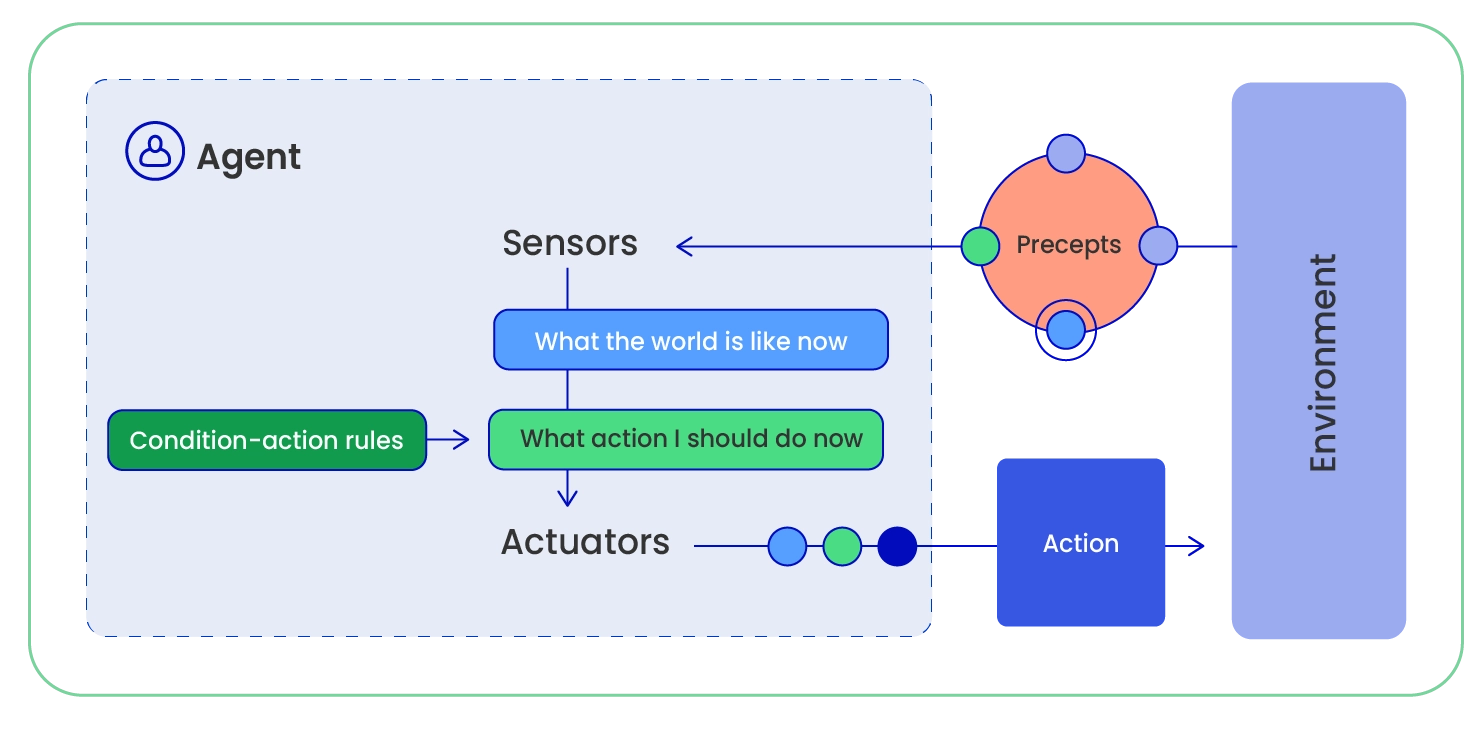
Example: A thermostat is a classic simple reflex agent. When temperature drops below a threshold, it turns on heating; when temperature exceeds the threshold, it turns off heating. The decision is purely based on current temperature reading without considering past patterns or future predictions.
What Are Model-Based Reflex Agents?
Model-based reflex agents enhance simple reflex agents by maintaining an internal state that tracks aspects of the environment not immediately visible. These agents use past data and an internal model of how the world works to make more informed decisions. This internal representation allows them to handle partially observable environments more effectively than simple reflex agents.
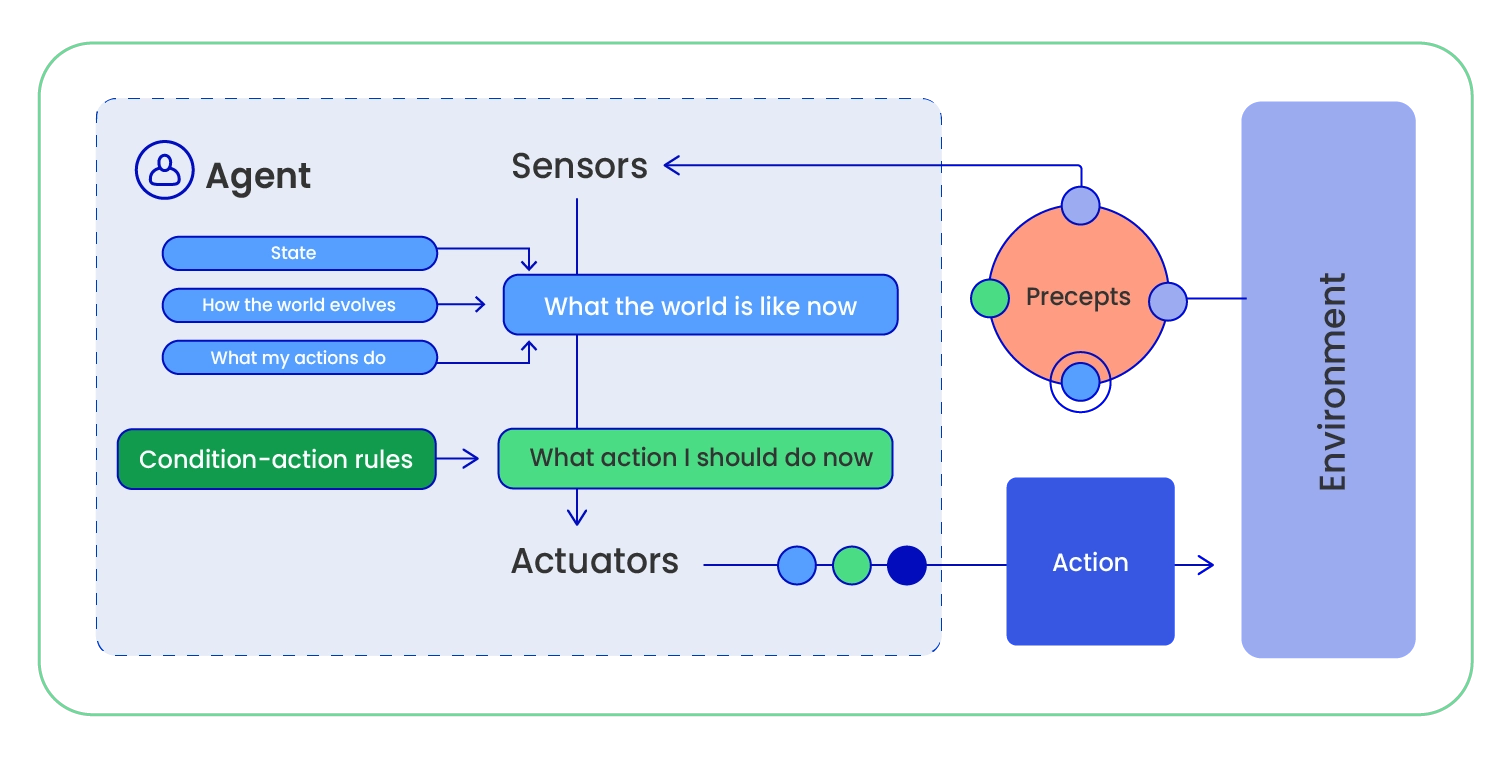
Example: A basic self-driving car system that tracks the position of other vehicles even when they’re temporarily out of sensor range. It maintains a model of the road environment, remembering where cars were last seen and predicting their likely positions, enabling safer navigation decisions.
What Are Goal-Based Agents?
Goal-based agents work toward defined objectives by evaluating multiple possible actions and selecting those that lead to goal achievement. Unlike reflex agents, they consider future consequences and can plan sequences of actions. These agents evaluate different scenarios and choose paths that maximize the likelihood of reaching their goals, making them suitable for complex problem-solving tasks.
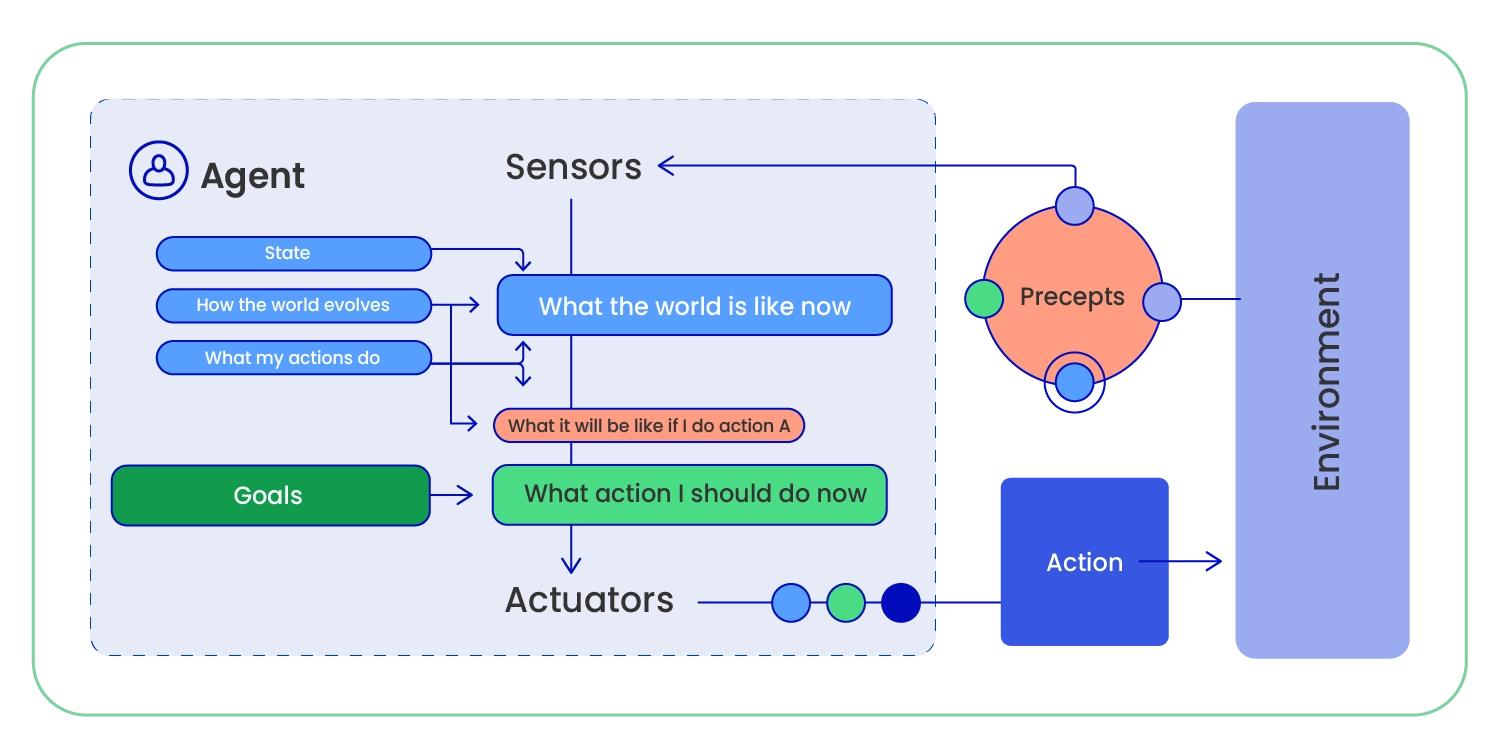
Example: Navigation systems like Google Maps function as goal-based agents. Given a destination (goal), they evaluate multiple routes, considering factors like distance, traffic, and road conditions, then select the optimal path to achieve the objective of reaching the destination efficiently.
What Are Utility-Based Agents?
Utility-based agents go beyond simple goal achievement by using utility functions to measure the desirability of different outcomes. They handle trade-offs and uncertainty by assigning numerical values to different states, choosing actions that maximize expected utility. This approach enables sophisticated decision-making when multiple goals conflict or when outcomes are probabilistic.
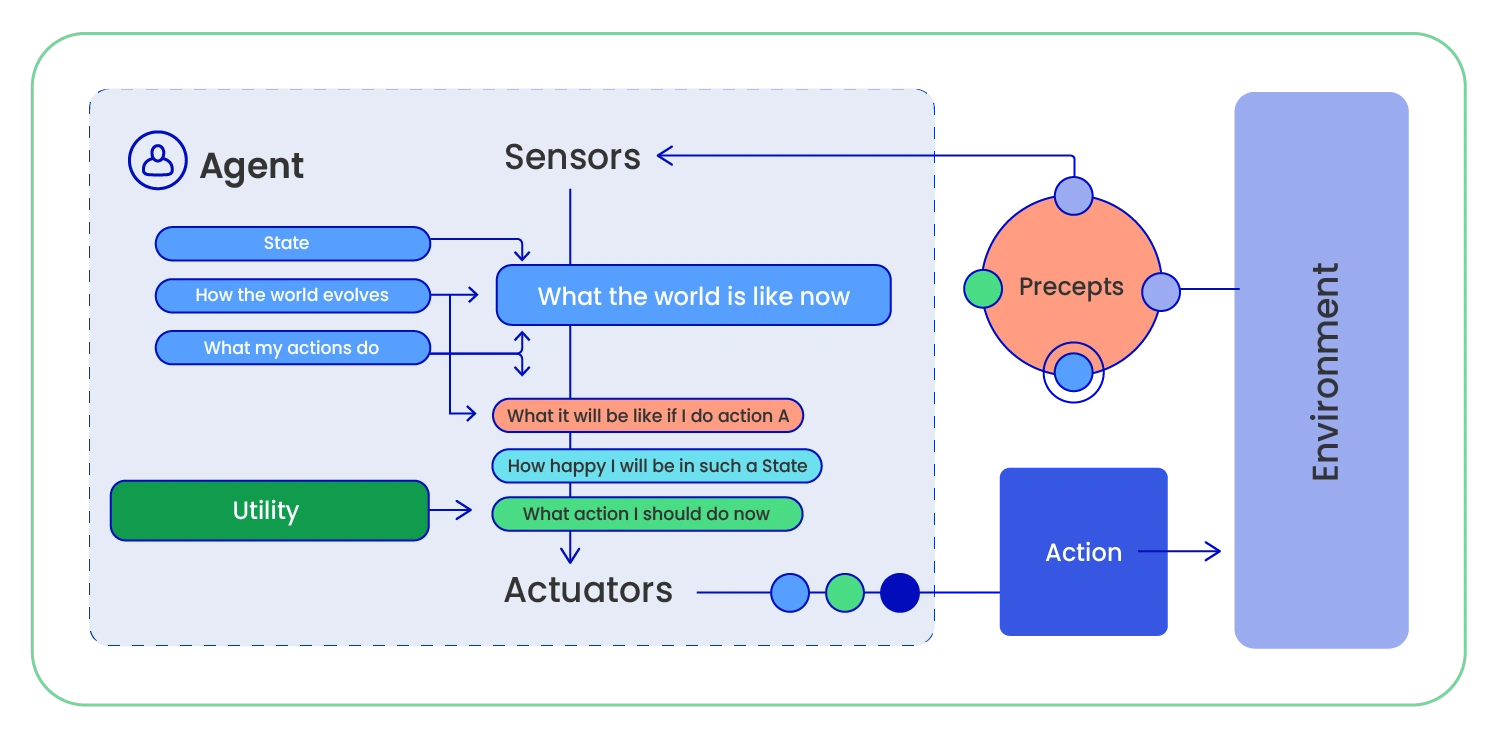
Example: Recommendation engines like Netflix or Amazon use utility-based agents. They evaluate multiple factors (user preferences, viewing history, ratings, trending content) and assign utility scores to different recommendations, selecting content that maximizes predicted user satisfaction while balancing exploration and exploitation.
What Are Learning Agents?
Learning agents possess the capability to improve their performance over time through experience and feedback. They consist of four key components: a learning element (improves performance), a performance element (selects actions), a critic (provides feedback), and a problem generator (suggests exploratory actions). These agents adapt to changing environments and continuously refine their decision-making strategies.
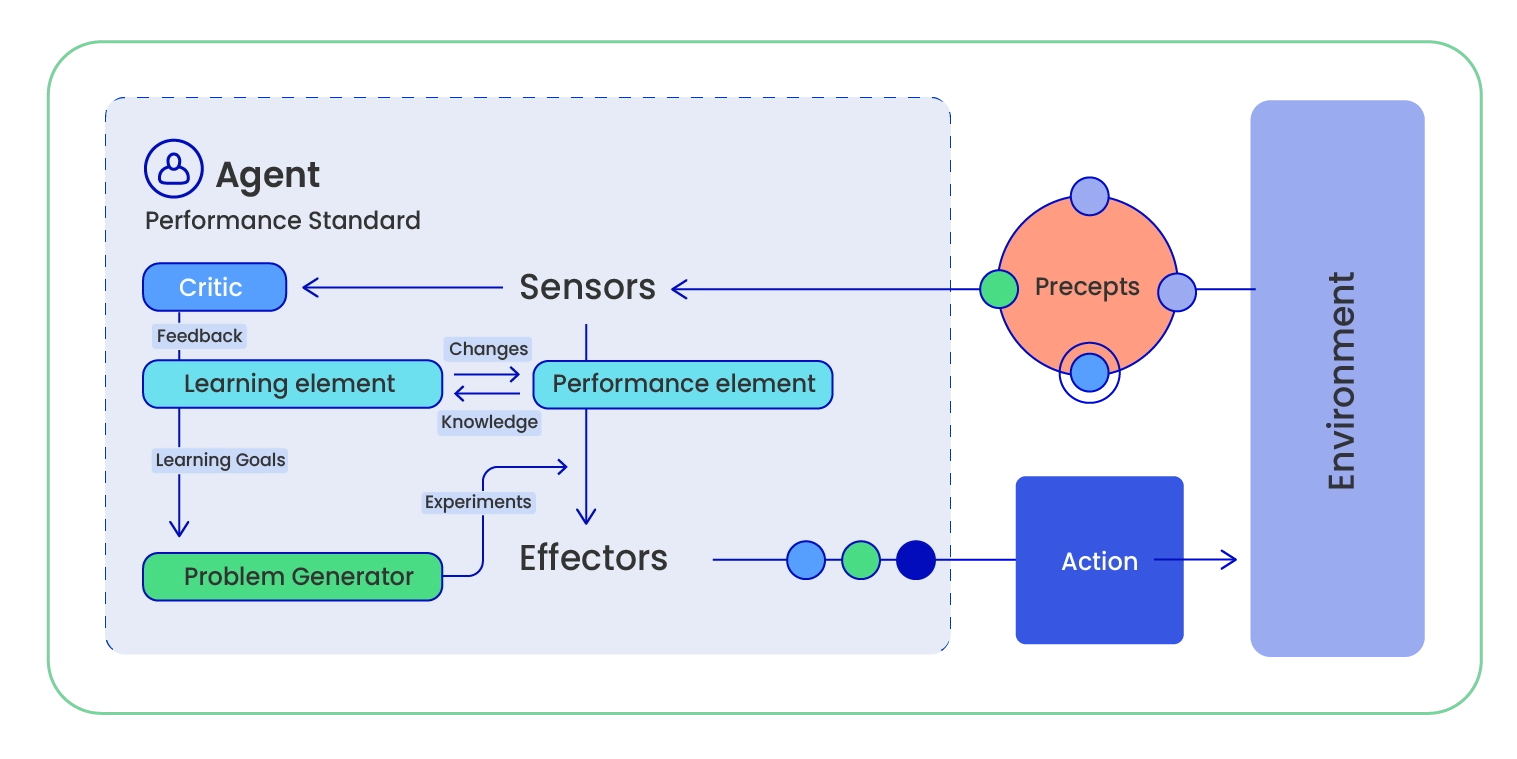
Example: AI copilots like GitHub Copilot or Microsoft Copilot are learning agents. They analyze user interactions, code patterns, and feedback to continuously improve code suggestions and assistance. Over time, they learn individual developer preferences and coding styles, becoming more personalized and effective.
What Are Hybrid AI Agents?
Hybrid AI agents combine multiple agent architectures to leverage the strengths of different approaches. By integrating reactive, deliberative, and learning capabilities, hybrid agents can handle complex real-world scenarios that require both quick reflexes and strategic planning. Modern AI systems, including large language models and agentic AI platforms, typically employ hybrid architectures.
Example: Advanced conversational AI systems combine goal-based planning (understanding user intent), utility-based decision-making (selecting best responses), and learning capabilities (improving from interactions). ChatGPT and similar LLMs represent hybrid agents that integrate multiple AI paradigms to deliver sophisticated, context-aware responses.
What Are Multi-Agent Systems?
Multi-agent systems consist of multiple autonomous agents working together, collaborating, or competing to achieve individual or collective goals. These systems enable distributed decision-making, parallel processing, and emergent behaviors that single agents cannot achieve. Agents communicate, coordinate, and sometimes negotiate to solve complex problems requiring diverse expertise or distributed resources.
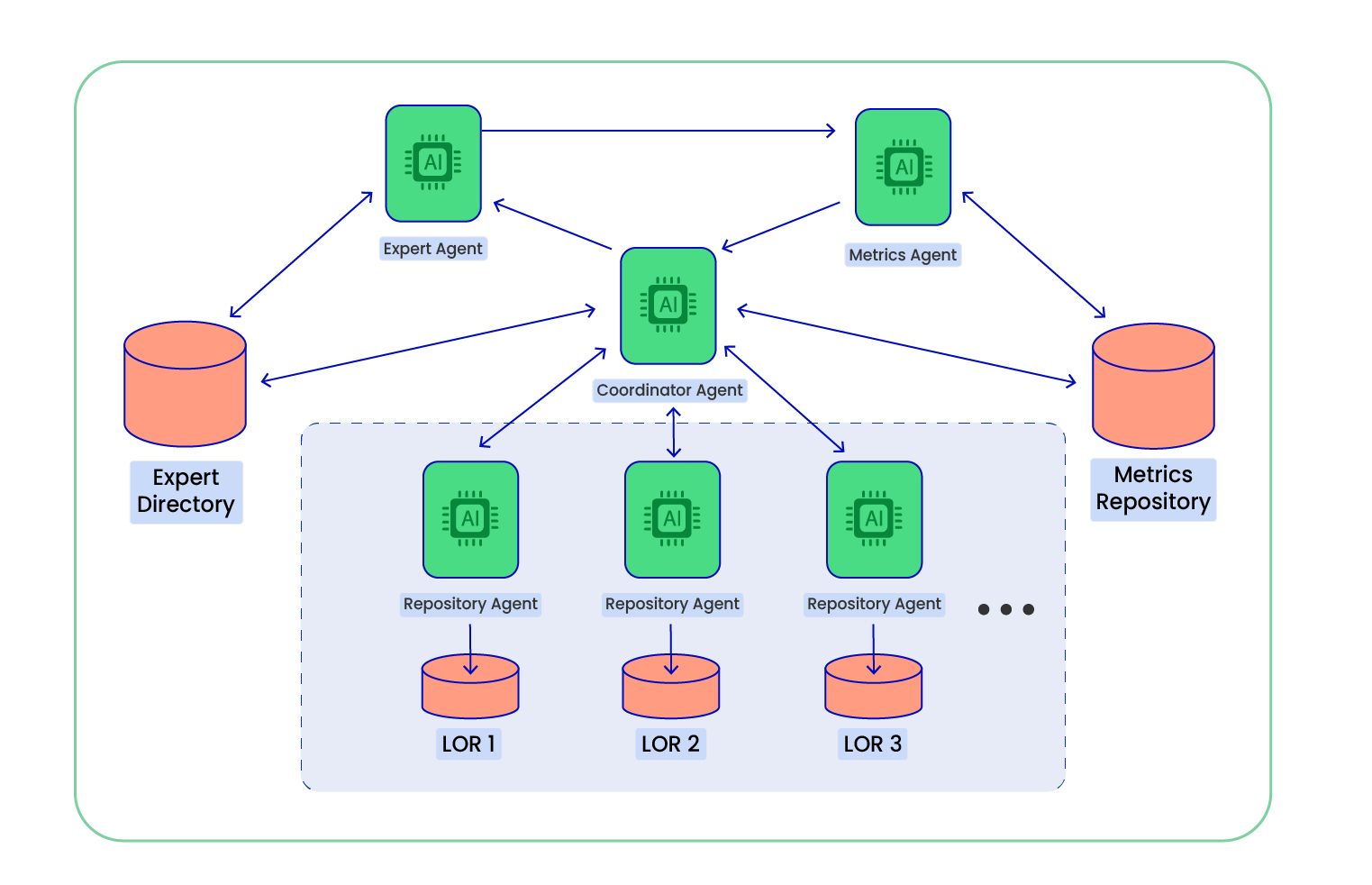
Example: Supply chain optimization systems deploy multiple agents representing different entities (suppliers, warehouses, transportation, retailers). Each agent optimizes its local objectives while coordinating with others to achieve global supply chain efficiency, handling dynamic changes like demand fluctuations or disruptions.
How AI Agents Are Classified
AI agents can be classified along multiple dimensions:
Based on Behavior:
Reactive Agents
Respond to immediate stimuli without internal deliberatio
Proactive Agents
Take initiative and plan actions to achieve goals
Social Agents
Interact and cooperate with other agents or humans
Based on Learning Capability:
Non-learning Agents
Fixed behavior based on predefined rules
Learning Agents
Adapt and improve through experience
Evolutionary Agents
Improve through genetic algorithms and population-based methods
Based on Environment Interaction:
Passive Agents
Observe without affecting the environment
Active Agents
Take actions that modify the environment
Autonomous Agents
Operate independently with minimal human intervention
Comparing AI Agent Types: Key Differences in Logic, Learning, and Capability
| Agent Type | Logic Basis | Memory | Learning | Environment Handling | Complexity | Use Case |
| Simple Reflex | Condition-action rules | None | No | Fully observable only | Low | Thermostats, basic sensors |
| Model-Based Reflex | Rules + internal model | Short-term state | No | Partially observable | Medium | Basic autonomous systems |
| Goal-Based | Goal achievement | Planning state | Limited | Dynamic environments | Medium-High | Navigation, robotics |
| Utility-Based | Utility maximization | State + preferences | Limited | Uncertain environments | High | Recommendation systems |
| Learning | Experience-driven | Long-term memory | Yes | Adaptive environments | Very High | AI assistants, copilots |
| Hybrid | Multiple paradigms | Multi-level | Yes | Complex real-world | Very High | LLMs, enterprise AI |
| Multi-Agent | Distributed coordination | Shared + local | Varies | Distributed systems | Very High | Supply chains, swarms |
AI Agent Types at a Glance: Quick Definitions and Examples
| Agent Type | Definition | Real-World Example |
| Simple Reflex | Reacts to current input using predefined rules | Smart home light switches responding to motion |
| Model-Based Reflex | Uses internal state and past data for decisions | Spam filters tracking email patterns |
| Goal-Based | Plans actions to achieve specific objectives | GPS navigation systems finding optimal routes |
| Utility-Based | Maximizes utility function for best outcomes | Stock trading algorithms optimizing portfolios |
| Learning | Improves performance through feedback and data | Virtual assistants learning user preferences |
| Hybrid | Combines multiple agent architectures | Autonomous vehicles using reactive + planning + learning |
| Multi-Agent | Multiple agents collaborating on tasks | Drone swarms coordinating for search and rescue |
Choosing the Right AI Agent: A Decision Framework for Enterprises
Selecting the right AI agent type depends on several factors:
For Static, Fully Observable Environments
- Use Simple Reflex Agents when rules are clear and environment is predictable
- Ideal for basic automation, sensors, and control systems
For Partially Observable Environments
- Use Model-Based Reflex Agents when you need to track hidden states
- Suitable for systems requiring context awareness
For Complex Problem-Solving
- Use Goal-Based Agents when planning and future consequences matter
- Best for navigation, scheduling, and strategic tasks
For Optimization Under Uncertainty
- Use Utility-Based Agents when trade-offs and preferences are involved
- Ideal for recommendation systems, resource allocation
For Adaptive, Evolving Scenarios
- Use Learning Agents when environment changes or personalization is needed
- Essential for AI assistants, predictive systems, personalization
For Enterprise-Scale Complexity
- Use Hybrid Agents for real-world applications requiring multiple capabilities
- Necessary for autonomous systems, conversational AI, enterprise workflows
For Distributed, Collaborative Tasks
- Use Multi-Agent Systems when problems require coordination across entities
- Critical for supply chains, smart grids, distributed optimization
Real-World Applications of AI Agents Across Industries
Chatbots → Simple Reflex Agents
- Basic FAQ bots responding to keyword triggers
- Customer service automation for routine queries
Fraud Detection → Model-Based Reflex Agents
- Banking systems tracking transaction patterns
- Security systems monitoring behavioral anomalies
Autonomous Vehicles → Goal-Based + Utility-Based Agents
- Self-driving cars planning routes while optimizing safety and efficiency
- Delivery robots navigating warehouses to fulfill orders
AI Copilots → Learning Agents
- GitHub Copilot improving code suggestions through developer feedback
- Microsoft 365 Copilot personalizing assistance based on work patterns
Enterprise Workflows → Hybrid Agents
- Intelligent document processing combining OCR, NLU, and learning
- Contact center AI integrating speech recognition, intent detection, and personalization
Smart Manufacturing → Multi-Agent Systems
- Factory floor optimization with coordinated robots and sensors
- Predictive maintenance systems collaborating across equipment
Healthcare Diagnostics → Utility-Based + Learning Agents
- AI-assisted radiology weighing multiple diagnostic possibilities
- Treatment recommendation systems optimizing patient outcomes
The Future of AI Agents: From Individual Systems to Agentic Ecosystems
The evolution of AI agents is accelerating toward more autonomous, collaborative, and intelligent systems:
Rise of Hybrid and Autonomous Agents
- Integration of multiple AI paradigms (symbolic + neural, reactive + deliberative)
- Self-improving agents that continuously optimize their architectures
- Agents capable of meta-learning and transfer learning across domains
Agentic AI Ecosystems
- Interconnected agent networks forming intelligent enterprise systems
- Agents specializing in specific tasks while collaborating seamlessly
- Platform-based approaches enabling rapid agent deployment and orchestration
Self-Improving and Adaptive Agents
- Agents that modify their own code and architecture
- Continuous learning from minimal human feedback
- Emergent capabilities through agent-to-agent learning
Responsible and Explainable Agents
- Transparent decision-making processes for regulatory compliance
- Built-in ethical guidelines and bias mitigation
- Human-in-the-loop systems for critical decisions
Edge and Distributed Intelligence
- Agents operating on edge devices with minimal latency
- Federated learning enabling privacy-preserving agent improvement
- Swarm intelligence for large-scale coordination
Building Enterprise-Grade Agentic AI Systems with Quantiphi
Quantiphi leverages deep expertise in AI and cloud technologies to design and deploy enterprise-grade AI agent solutions. Our approach combines proven frameworks with cutting-edge innovation:
Agent Design Frameworks
We architect AI agents using modular, scalable designs that integrate seamlessly with existing enterprise systems. Our methodology encompasses the full spectrum of agent types—from simple reflex systems for process automation to sophisticated hybrid agents powering conversational AI and intelligent document processing. Through our baioniq platform, we accelerate agent development by providing pre-built components, orchestration capabilities, and integration with foundation models.
Enterprise AI Deployment
Our deployment strategy ensures AI agents deliver measurable business value from day one. We focus on production-grade implementations that handle high-concurrency workloads, maintain low latency, and scale elastically. With partnerships with hyperscalers like Google Cloud, NVIDIA, AWS, and other leading AI platforms, we leverage best-in-class infrastructure while customizing solutions to each client’s unique requirements. Our track record includes deploying conversational AI agents that reduced response times by 60% and operational costs by 40%.
Scalable and Responsible AI Systems
Quantiphi builds AI agents with responsibility and governance at their core. We implement robust monitoring, explainability, and bias mitigation mechanisms to ensure agents operate ethically and transparently. Our solutions incorporate human-in-the-loop workflows for critical decisions, comprehensive audit trails for compliance, and continuous performance optimization. As AI agents become more autonomous, we ensure they remain aligned with business objectives and societal values, delivering innovation that organizations can trust.
Ready to transform your business with intelligent AI agents?
Quantiphi’s expertise in agentic AI systems can help you design, deploy, and scale solutions that drive measurable outcomes. From conversational AI to autonomous workflows, we build agents that work.