An AI agent is an artificial intelligence system that can understand inputs, reason through a task, use tools, and take actions to achieve a defined goal. Unlike basic automation or a chatbot, an AI agent can work across multiple steps, adapt to context, and operate with a degree of autonomy.
What Is an AI Agent?
An AI agent is an artificial intelligence system that can understand inputs, reason through information, make decisions, and take actions to achieve a specific goal. Unlike basic automation, which follows predefined rules, an AI agent can operate with a degree of autonomy, use available tools, and adapt its actions based on context, feedback, or changing conditions.
In simple terms, an AI agent does not just generate a response. It works toward an outcome.
AI agents are designed to perceive information from their environment, reason over that information, and act toward an objective. In enterprise settings, this can include answering customer queries, supporting employees, processing documents, analyzing data, coordinating tasks across business systems, or escalating cases that require human judgment.
For example, in an insurance workflow, an AI agent may read an incoming claims document, classify the request, extract relevant information, check for missing details, and route the case to the right team. In a banking workflow, an AI agent may help review lending documents, validate borrower information, and support faster decision-making.
What Does an AI Agent Do?
An AI agent helps complete tasks by understanding input, making context-aware decisions, and taking actions toward a defined goal.
At a basic level, an AI agent can answer questions or generate outputs. In more advanced enterprise settings, it can retrieve information, use business applications, trigger workflows, validate data, update systems, and escalate exceptions to human teams.
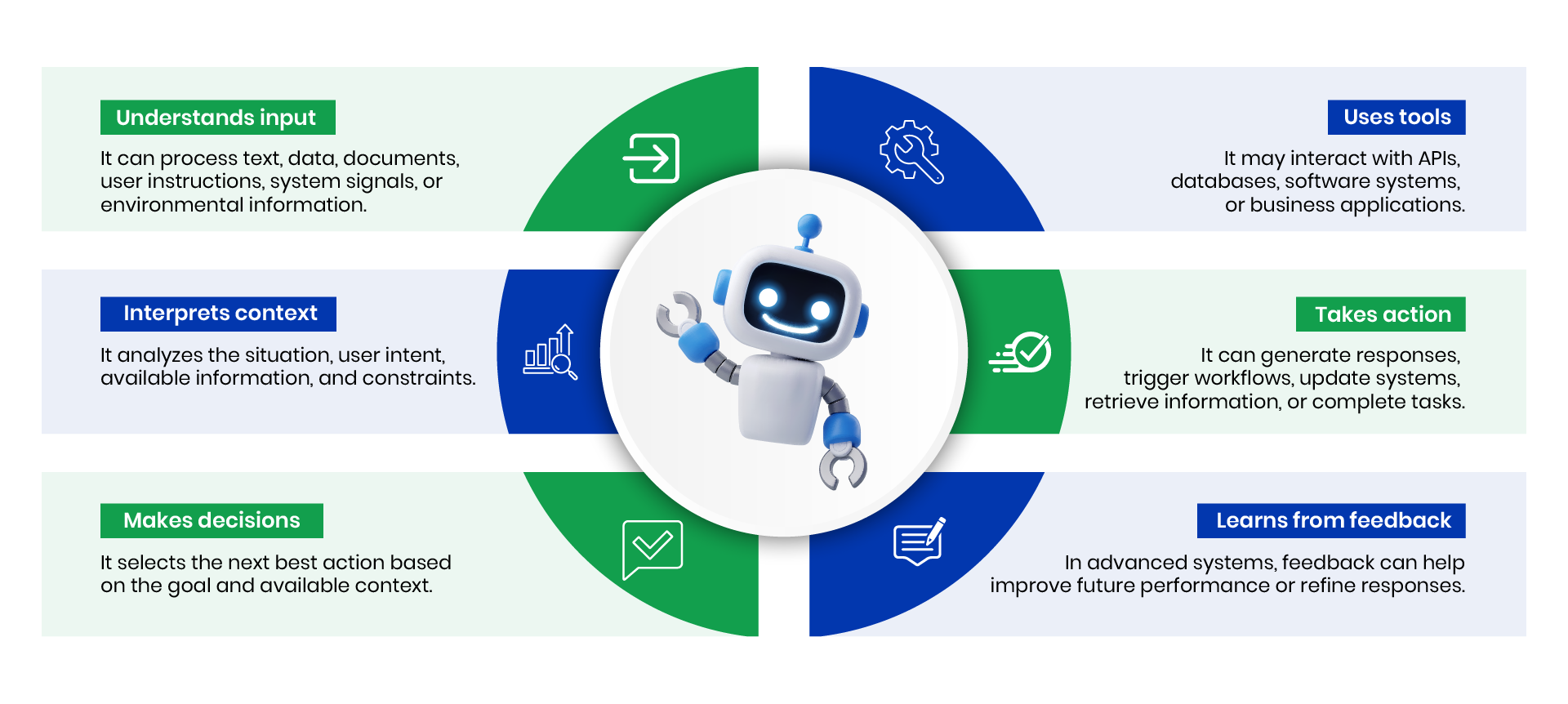
In simple terms, an AI agent does more than respond. It understands what needs to be done and works toward completing it.
How Does an AI Agent Work?
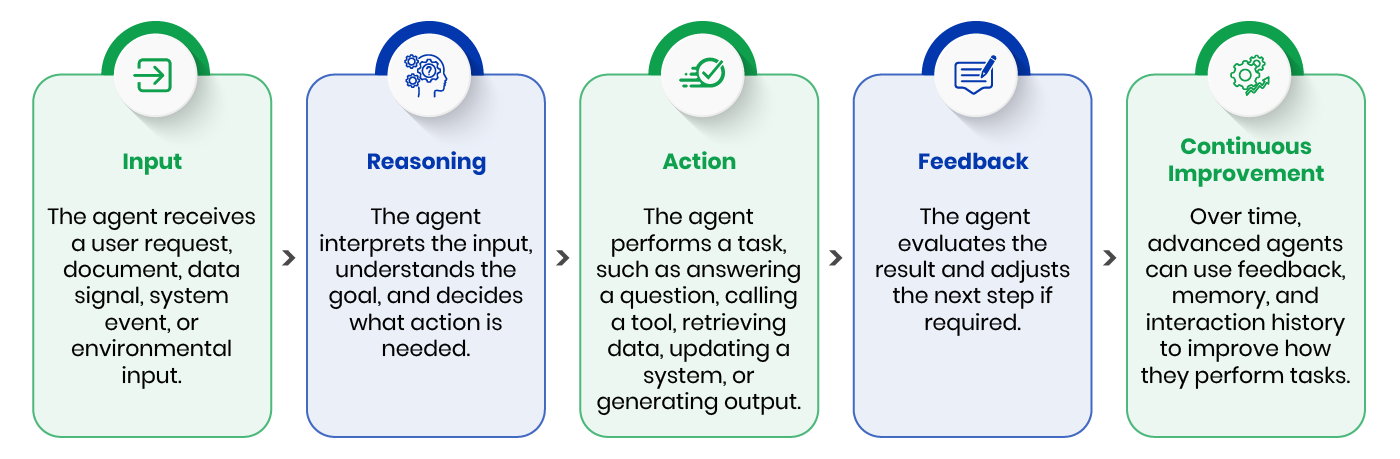
An AI agent works through a continuous loop of input, reasoning, action, and feedback. It receives information, evaluates what needs to be done, chooses an action, performs the task, and uses the results to guide the next step.
A simple AI agent workflow looks like this:
Anthropic describes agentic systems as progressing from augmented language models to workflows and more autonomous agents that can use tools, retrieval, and memory to complete tasks.
What Are the Key Characteristics of AI Agents?
AI agents are defined by their ability to act with autonomy, pursue goals, adapt to context, and make decisions that lead to action. These characteristics separate AI agents from traditional AI models, rule-based automation, and basic chatbots.
Key characteristics include:
-
Autonomy:
AI agents can perform tasks with limited human intervention once a goal, policy, or workflow is defined.
Example: A customer support agent can resolve a common service request by retrieving account information, checking policy rules, and sending a response without requiring an employee to guide every step. -
Goal-oriented behavior:
They are designed to complete a specific task or achieve a defined business or user outcome.
Example: A claims intake agent may work toward the goal of preparing a complete claim file by collecting documents, extracting key details, identifying missing information, and routing the case to the right team. -
Adaptability:
AI agents can adjust their actions based on new information, feedback, exceptions, or changing conditions.
Example: If a lending document agent finds that an uploaded income document is incomplete, it can request the missing document, flag the exception, or route the case for human review instead of continuing with an incomplete file. -
Decision-making capability:
They can evaluate context, compare available options, and choose the next best step.
Example: In a support workflow, an AI agent can decide whether to answer a query directly, retrieve more information from a knowledge base, escalate the issue, or create a service ticket. -
Perception:
AI agents can gather and interpret information from data sources, user inputs, documents, tools, or operating environments.
Example: A document processing agent can read an insurance submission, identify the document type, extract policy details, and understand whether required fields are missing. -
Action-taking ability:
They can move beyond analysis and trigger outputs, workflows, system updates, notifications, or escalations.
Example: After reviewing a customer request, an AI agent can update a CRM record, send a notification to the operations team, create a follow-up task, or route the request to a specialist. -
Tool orchestration:
Advanced AI agents can coordinate multiple tools, APIs, databases, and applications to complete a task across systems.
Example: An enterprise AI agent may retrieve customer data from a CRM, verify policy information from a core system, summarize the case using a language model, and update the workflow status in a ticketing platform.
What Are the Core Capabilities of AI Agents?
The core capabilities of AI agents include reasoning, planning, learning, tool usage, and memory. These capabilities help agents move from simple response generation to more outcome-driven task execution.
-
Reasoning and planning:
AI agents can break down a goal into smaller steps evaluate available options, and decide what action to take next.
-
Learning from interactions:
Some agents can improve through feedback, user interactions, performance data, or repeated exposure to similar tasks.
-
Tool usage:
AI agents can use external tools such as search systems, APIs, databases, enterprise applications, or workflow platforms, and analytics systems.
-
Memory:
Agents may use short-term or long-term memory to retain relevant context across steps, sessions, or user interactions.
-
Context understanding:
They can use available information to tailor decisions to the task, user, business rule, or operational environment.
-
Workflow execution:
Advanced agents can coordinate multiple steps across systems to complete larger tasks, such as document review, customer support resolution, claims routing, compliance checks, or software testing.
-
Evaluation and escalation:
Enterprise-grade agents should be able to evaluate confidence, identify exceptions, and escalate high-risk or low-confidence cases to human reviewers.
What Is the Difference Between AI Agents and Traditional AI?
Traditional AI usually analyzes data, makes predictions, classifies information, or generates outputs within a defined task. AI agents go a step further by deciding what action to take, using tools, and coordinating steps toward a goal.
In other words, traditional AI helps answer or predict. AI agents help act and complete.
| Parameter | Traditional AI | AI Agents |
|---|---|---|
| Behavior | Mostly static or rule-based | Dynamic and context-aware |
| Role | Performs a specific task | Works toward a defined goal |
| Action | Usually gives output or prediction | Can take action using tools or systems |
| Human involvement | Often requires step-by-step human input | Can operate with more autonomy |
| Adaptability | Limited to trained rules or models | Can adjust based on context and feedback |
| Workflow role | Supports isolated automation | Can coordinate multi-step workflows |
| Example | A model that classifies support tickets | An agent that classifies, routes, responds, and updates the ticketing system |
This distinction is especially important for enterprises. A traditional AI model may identify a high-risk insurance claim or classify a support ticket. An AI agent can take the next step by retrieving supporting information, applying business rules, updating a workflow, and routing the case to the right team.
What Are Examples of AI Agents?
Examples of AI agents include chatbots, virtual assistants, autonomous systems, AI copilots, and task-specific enterprise agents.
Common examples include:
-
Chatbots:
AI agents that answer user questions, resolve basic issues, or guide customers through support journeys.
-
Virtual assistants:
Agents that help schedule meetings, retrieve information, summarize content, or complete personal productivity tasks.
-
Autonomous systems:
AI systems that sense their environment and act toward a goal, such as robotics, autonomous navigation, or industrial automation.
-
AI copilots:
Assistive agents that help users write code, analyze data, create content, prepare documents, or complete business tasks.
-
Customer support agents:
Enterprise agents that can understand customer intent, retrieve policy or account information, recommend next steps, and escalate unresolved issues.
-
Software development agents:
Agents that can help generate code, debug issues, run tests, review pull requests, or support development workflows.
-
Document processing agents:
Agents that can read documents, classify file types, extract relevant fields, validate information, and route exceptions for review.
-
Insurance claims agents:
Agents that can intake claims documents, identify missing information, summarize claim details, and route cases to adjusters.
-
Banking and lending agents:
Agents that can support loan document review, borrower data validation, risk checks, and underwriting workflows.
-
Compliance agents:
Agents that can review policies, check transactions, flag anomalies, generate summaries, and support audit preparation.
What Are the Benefits of AI Agents?
Gartner predicts that by 2028, 60% of brands will use agentic AI to support streamlined one-to-one interactions. This points to a growing role for AI agents in customer experience, personalization, and service workflows.
AI agents help organizations improve efficiency, automate repetitive work, support better decisions, and scale operations across complex workflows.
Key benefits include:
-
Task automation:
AI agents can reduce manual effort by completing repetitive, rule-based, or coordination-heavy tasks. Instead of requiring employees to manually review inputs, search for information, update systems, or trigger the next step, agents can handle these activities within a defined workflow.
-
Improved efficiency:
AI agents can speed up workflows by reducing delays between steps, systems, and teams. Many business processes slow down because employees must move information manually from one application to another or wait for handoffs. AI agents can reduce these delays by keeping the workflow moving.
-
Better decision support:
AI agents can analyze context, retrieve relevant information, compare available options, and recommend next steps. This helps employees make faster and more informed decisions, especially in workflows where information is spread across documents, databases, emails, and enterprise systems.
-
Scalability:
AI agents can support large volumes of interactions, documents, requests, or tasks without proportional increases in human effort. This is useful for enterprises that need to manage seasonal spikes, high-volume customer interactions, or document-heavy operations.
-
Consistency:
AI agents can help standardize responses, decisions, reviews, and workflow execution across teams. When processes depend heavily on manual judgment, outcomes can vary by person, location, or team. Agents can apply defined rules, policies, and workflow steps more consistently.
-
Faster response times:
In customer-facing environments, AI agents can respond instantly, retrieve information quickly, and route complex issues faster. This can improve the customer experience by reducing wait times and making support more responsive.
-
Workflow continuity:
AI agents can connect tasks across systems, reducing handoffs, process fragmentation, and manual coordination. This is important because many enterprise workflows do not fail at one single task; they slow down because information has to move across multiple teams and platforms.
-
Improved employee productivity:
AI agents can support employees by handling repetitive steps, summarizing information, preparing drafts, and surfacing relevant insights. This allows employees to spend more time on judgment-heavy, strategic, or customer-facing work.
-
Stronger operational control:
When designed with governance, monitoring, and human oversight, AI agents can help enterprises automate workflows while maintaining control over risk-sensitive decisions. This is especially important in regulated industries where accuracy, accountability, auditability, and escalation paths matter.
What Are the Limitations of AI Agents?
AI agents have limitations related to data quality, reliability, cost, complexity, governance, and the need for human oversight.
Gartner expects more than 40% of agentic AI projects to be scrapped by the end of 2027 because of rising costs, unclear business value, and immature implementations. This makes it important for enterprises to start with well-defined use cases, measurable outcomes, governance controls, and realistic deployment plans.
While they can automate and coordinate complex tasks, they must be designed carefully before being deployed in production environments.
Common limitations include:
-
Dependence on data quality:
Poor, incomplete, outdated, or biased data can affect the quality of an agent’s decisions. Since AI agents rely on available information to reason, decide, and act, inaccurate data can lead to incorrect outputs or flawed workflow execution.
-
Reliability challenges:
AI agents may make incorrect decisions if goals, tools, prompts, workflows, or constraints are not well designed. Unlike simple automation, agents may take different paths to complete a task, which can make reliability harder to control.
-
Cost and complexity:
Building and maintaining production-grade AI agents can require strong architecture, system integration, testing, monitoring, governance, and ongoing optimization. The cost is not limited to the model itself; enterprises also need infrastructure, security controls, workflow design, evaluation frameworks, and support processes.
-
Need for oversight:
Human review is important for high-risk tasks, regulated industries, and decisions with business, legal, financial, or customer impact. AI agents should not always act independently, especially when the outcome affects eligibility, compliance, claims, lending, fraud review, or customer rights.
-
Tool-use risks:
If an agent has access to external systems, incorrect tool calls can create operational, financial, or compliance risks. An agent may retrieve the wrong data, update the wrong field, trigger an incorrect workflow, or send information to the wrong recipient if controls are weak.
-
Evaluation difficulty:
Measuring agent performance can be complex because agents may follow different paths to complete the same task. Evaluation must go beyond response accuracy and include task completion, reasoning quality, tool use, escalation accuracy, latency, cost, and business outcomes.
-
Security and access control:
Agents that connect with enterprise systems must be designed with appropriate permissions, audit trails, data protection, and access controls. Since agents may interact with sensitive documents, customer information, financial data, or internal systems, enterprises need clear boundaries around what the agent can access and what actions it can perform.
-
Accountability:
Organizations need clear ownership over what an agent can do, when it should escalate, and how decisions are reviewed. Without defined accountability, it becomes difficult to manage errors, explain decisions, assign responsibility, or improve agent behavior over time.
The goal should not be to make every AI agent fully autonomous. For many enterprise workflows, the better approach is controlled autonomy, where agents handle repeatable tasks while humans review exceptions, approvals, and high-risk decisions.
How Are AI Agents Different from Agentic AI?
AI agents are individual systems that can perceive, decide, and act toward a goal. Agentic AI is the broader approach of using one or more AI agents, tools, data sources, workflows, and governance controls to complete complex tasks with limited supervision.
In simple terms, an AI agent is a building block. Agentic AI is the operating model that connects multiple agents and systems to complete larger workflows.
For example, a single AI agent may summarize a document. An Agentic AI system may intake the document, classify it, extract key fields, validate information, flag exceptions, update a workflow, and route the case to the right team.
The difference becomes important in enterprise environments. Businesses rarely need isolated agents alone. They need agentic systems that can work across applications, follow business rules, maintain auditability, escalate exceptions, and support measurable outcomes.
AWS clearly distinguishes an AI agent as an individual goal-directed component, while an agentic system includes orchestration, tooling, identity, policies, and evaluation.
How Do AI Agents Fit into Agentic AI Systems?
AI agents fit into agentic AI systems as the functional units that perform specific tasks inside a larger workflow. Each agent may handle a role such as planning, retrieval, validation, analysis, execution, or escalation.
In a multi-agent system, different agents can work together to complete a larger business process:
- A planning agent may interpret the goal and decide the steps.
- A retrieval agent may gather information from documents, databases, or knowledge systems.
- A validation agent may check outputs against business rules.
- An execution agent may update systems or trigger workflows.
- A monitoring agent may track progress, confidence, and exceptions.
- A human reviewer may approve, reject, or correct outputs when needed.
This makes AI agents important building blocks for enterprise-scale automation. When connected with business systems, governance controls, and human oversight, they can support more reliable and scalable agentic AI workflows.
What Is the Future of AI Agents?
The future of AI agents will move toward more autonomous, context-aware, and collaborative systems.
Enterprise adoption of AI agents is already moving from experimentation to scale. McKinsey’s 2025 global AI survey found that 23% of organizations are scaling agentic AI systems in at least one business function, while another 39% are experimenting with AI agents. This signals that AI agents are becoming part of enterprise workflow redesign, not just isolated pilots.
Enterprises are expected to use AI agents not just for simple assistance, but for multi-step workflows across business functions.
Key future directions include:
-
More autonomous systems:
AI agents will handle more complex tasks with less step-by-step human direction.
-
Better reasoning capabilities:
Advances in model reasoning may help agents plan, evaluate options, and solve problems more effectively.
-
Multi-agent collaboration:
Multiple agents may work together across workflows, each handling a specific role.
-
Enterprise adoption:
Organizations will use agents across customer service, operations, finance, software development, compliance, and knowledge work.
-
Stronger evaluation and governance:
As agents take more actions, businesses will need stronger controls for accuracy, safety, compliance, and accountability.
-
Improved tool integration:
Agents will become more useful as they connect with enterprise systems, data platforms, and workflow tools.
-
Human-agent collaboration:
The future will not be about replacing humans from every workflow. It will be about designing systems where agents handle repetitive work, humans guide judgment-heavy decisions, and both work together with clear controls.
The shift will not only be about making agents more autonomous. It will also be about making them reliable, measurable, secure, and aligned with business outcomes.
How Does Quantiphi Build AI Agent Solutions?
Quantiphi builds AI agent solutions with a focus on enterprise readiness, responsible AI, scalability, governance, and business workflow integration. The goal is not just to create standalone agents, but to design AI systems that can operate reliably within real enterprise environments.
Quantiphi’s approach focuses on aligning AI agents with business goals, connecting them with enterprise data and applications, embedding governance controls, and enabling human oversight where required.
This includes:
-
Workflow-first design:
Identifying high-value workflows where AI agents can reduce manual effort, improve speed, support decisions, or remove process bottlenecks.
-
Enterprise data and system integration:
Connecting agents with the right data sources, APIs, applications, document repositories, knowledge systems, and workflow platforms.
-
Human-in-the-loop controls:
Designing review, approval, and escalation mechanisms for tasks that require judgment, compliance checks, or risk control.
-
Responsible AI and governance:
Embedding controls for accuracy, transparency, access, security, monitoring, and accountability.
-
Evaluation and performance monitoring:
Testing agents for reliability, task completion, tool usage, cost, latency, accuracy, and business impact.
-
Scalable deployment:
Designing AI agent systems that can move from proof of concept to production while supporting enterprise-grade security, maintainability, and operational control.
Quantiphi’s approach focuses on practical deployment: AI agents that support decision-making, automate workflows, improve operational efficiency, and scale responsibly across business functions.
For enterprises, the value of AI agents is not only in autonomy. It is in building reliable, governed, and measurable systems that can work within existing business processes.