An AI agent may work well in one department, yet the next team building a similar solution can find itself starting almost from scratch. A new integration must be developed, test cases written, permissions configured, and monitoring established. The organization has gained another agent, but not necessarily a more efficient way to build one.
That distinction is becoming consequential as deployment accelerates. McKinsey’s 2026 State of AI survey found that 54% of respondents from organizations with more than $1 billion in annual revenue reported scaling AI across the enterprise. The same survey found that about one in five respondents said their organization is limiting AI use because of operating costs.
For enterprise leaders, the question is shifting from how many agents can be built to whether the process of building, testing, and operating them can become repeatable and cost-efficient with each deployment.
The Hidden Cost of Building Agents One at a Time
The problem with bespoke agent development is that costs do not end when an agent goes live. Every custom integration, testing procedure, and operational control becomes another component the enterprise must maintain.
Consider five agents connected to the same enterprise application. If each has been developed independently, a single API change could require five separate modifications, five rounds of regression testing, and five opportunities for something to break. Multiply this across dozens of agents, applications, and model updates, and maintenance can quickly consume resources that could otherwise support new development.
These costs are also easy to underestimate because they are spread across different teams and projects. Each deployment may appear economical in isolation, while the enterprise repeatedly pays for similar engineering work. The challenge, therefore, is not simply to reduce the cost of individual agents, but to eliminate the unnecessary duplication built into how they are developed and operated.
From Individual Projects to Repeatable Production
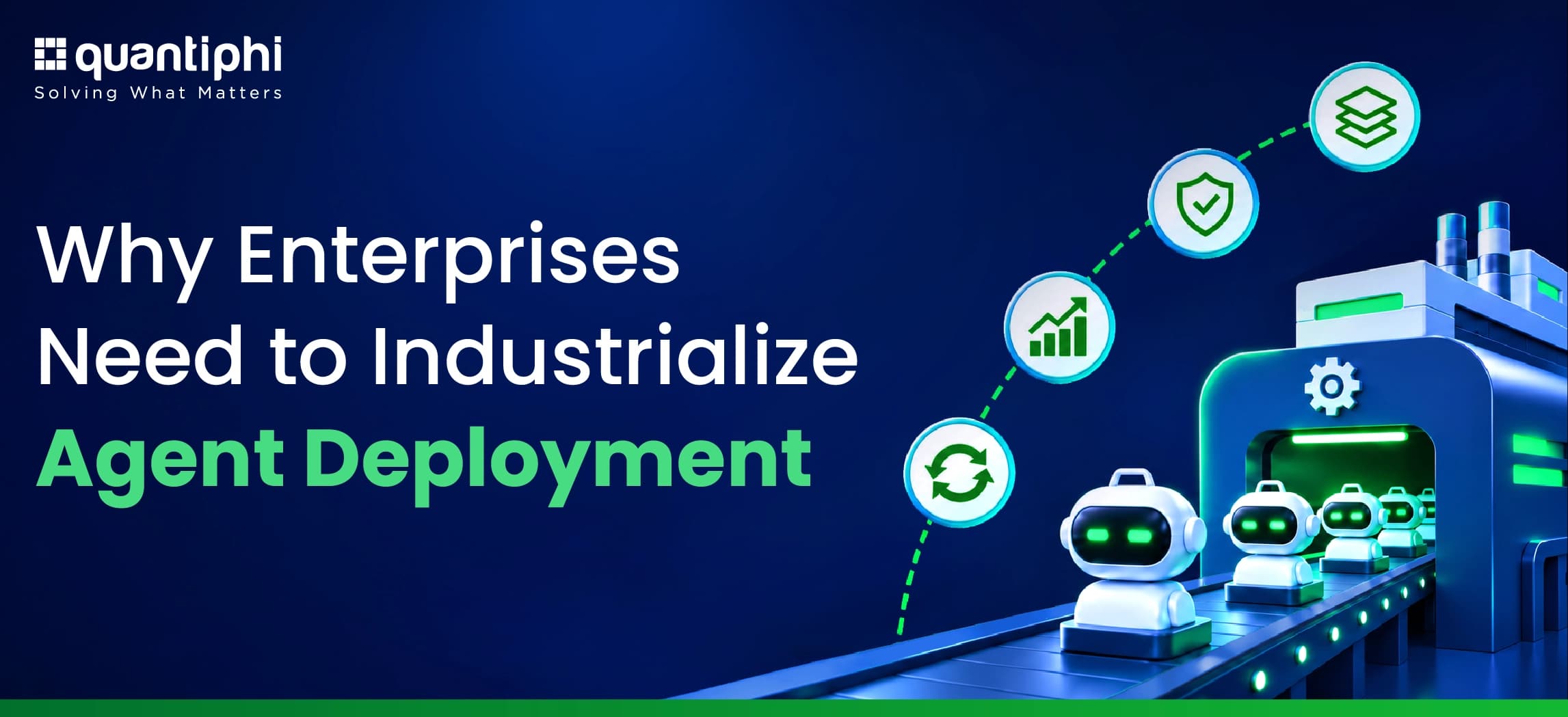
Addressing this challenge means establishing a repeatable process for developing, evaluating, releasing, and improving agents, rather than treating each implementation as a self-contained project. The objective is not to remove engineering judgment but to reserve that judgment for the problems that genuinely require it.
Several capabilities can be standardized across an enterprise portfolio:
- Development patterns: Reusable components for connecting to approved systems, managing tool access, handling common errors, and coordinating agent actions.
- Evaluation methods: Shared test frameworks, representative failure scenarios, regression checks, and documented criteria for approving changes.
- Deployment controls: Consistent release processes, permissions, logging, monitoring, and mechanisms for escalation or rollback.
- Continuous improvement: Versioned components and documented lessons from production incidents that can inform subsequent releases and new agents.
For enterprises managing multiple agents, the practical implication is to make these activities part of a common delivery process. A shared evaluation framework, for example, can provide consistent testing methods while allowing each agent to be assessed against its specific business requirements. Similarly, standardized monitoring and incident-response procedures can reduce the effort required to diagnose problems across independently deployed systems.
Standardize the Process, Not the Intelligence
Industrialization should not mean that every agent is built to the same specification. The opportunity is to standardize how decisions around agent design and deployment are made. Teams can use a common method to classify risk, establish test coverage, set permissions, and determine when a human must intervene, while tailoring the actual controls to each workflow.
Similarly, agents may share approved integration components or evaluation infrastructure without sharing the same business rules, instructions, or decision boundaries. Reuse should reduce unnecessary engineering work, not dilute the expertise required for a particular task.
This distinction also encourages better technology choices. Some tasks may be handled more reliably through conventional software or deterministic automation. A mature production process should make it easier to decide when an autonomous agent is warranted, rather than making agent deployment the default answer to every problem.
The Real Measure of Agentic AI Maturity
The number of agents an enterprise has deployed says little about the maturity of its AI operations. A more revealing measure is whether each successive deployment benefits from the engineering, testing, and operational capabilities established by those before it.
Enterprises should evaluate their progress across four dimensions:
- Marginal delivery effort: Track the engineering hours and time required to move comparable agents into production. How much work is genuinely new, and how much is being repeated from previous implementations?
- Effective reuse: Measure how frequently teams use existing integrations, evaluation frameworks, guardrails, and deployment pipelines without substantial rework. Reuse should translate into reduced development effort, not simply a growing library of components.
- Production reliability: Monitor evaluation pass rates, deployment failures, incidents, and recovery times. Faster delivery is meaningful only if reliability is maintained or improved.
- Operational economics: Assess the cost per successfully completed task, accounting for inference, orchestration, monitoring, and exception handling. The objective is to understand whether agents can operate economically as usage expands.
These measures should be compared across deployments of similar complexity and risk. The stronger indicator of maturity is whether the enterprise can expand its agent portfolio without a proportional increase in duplicated engineering effort, operational overhead, and maintenance burden.
Building an Enterprise Capability That Can Keep Improving
Repeatable production requires more than a collection of templates. Shared components need owners, maintenance budgets, and processes for updating them as technologies and requirements change. Teams also need ways to contribute improvements back to common tools rather than solving the same problems in isolation.
This changes how enterprises approach scale. The aim becomes more than simply launching agents faster; it becomes establishing an engineering and operating capability that can support a growing portfolio without allowing duplicated effort, inconsistent controls, and maintenance burdens to grow at the same pace.
How Quantiphi Helps
At Quantiphi, we help enterprises move beyond fragmented AI investments and build lasting AI capability across the organization with our core promise: Own Your Enterprise Intelligence. Compound Your Edge.
Our approach brings together secure and portable AI foundations, enterprise context and data, lean AI assembly line engineering, human-centered design, and measurable value realization so organizations can retain greater control over their data, context, IP, and unit economics while continuing to evolve with evolving AI technologies.
Learn more about Quantiphi’s approach here: https://quantiphi.com/own-your-enterprise-intelligence/