Assessing Neurovirulence Risks Using Human-Relevant NAMs
Executive Summary
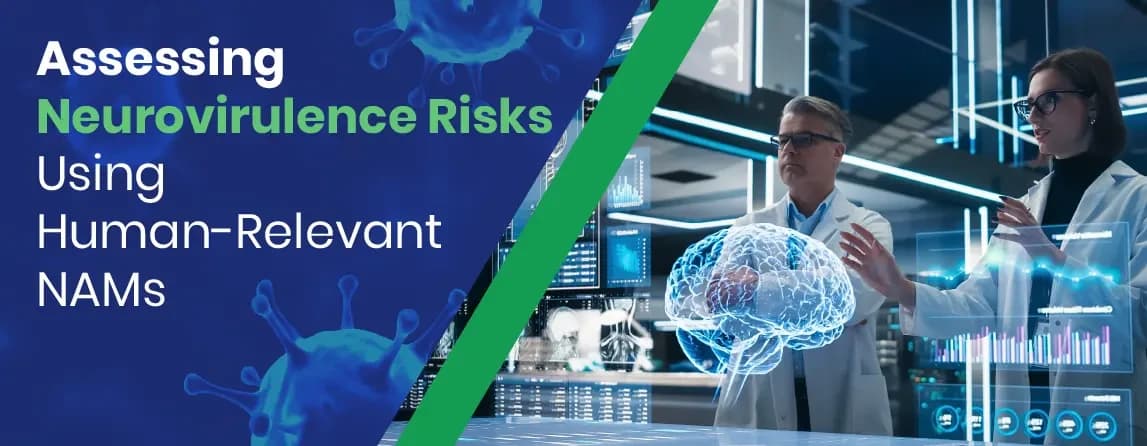
A leading Indian biologics company focused on vaccine innovation sought to assess human neurovirulence risks without relying on animal-based Monkey Neurovirulence Tests (MNVT). Leveraging Quantiphi’s DART platform—integrating human-relevant Microphysiological Systems and AI/ML-driven modeling—the company successfully developed a non-animal New Approach Methodology (NAM) that delivered accurate, scalable, and regulatory-aligned neurovirulence safety insights. The approach not only reduced time and costs but also enabled confirmatory results directly translatable to human nervous system biology.
About the Client
The client is a pioneering biologics company dedicated to the discovery and development of novel vaccines against infectious diseases.
- Industry: Life Sciences (Small molecule drug discovery)
- Size: ~500 employees
- Country: India
Problem Statement
The client, a leading biologics company engaged in the discovery and development of vaccines against infectious diseases, faced growing regulatory and scientific expectations to enhance vaccine safety assessment. Traditional Monkey Neurovirulence Testing (MNVT) methods were time-consuming, costly, and lacked human biological relevance. To overcome these limitations, the company sought an innovative, human-relevant, and regulatory-aligned solution to assess vaccine neurovirulence with precision—eliminating the need for animal testing while ensuring data credibility and mechanistic rigor.
Challenges
- MNVT is a time-consuming and costly testing method.
- Tests must be outsourced, reducing internal control over data integrity.
- Animal studies have limited translatability to human neurobiology.
- MNVT-passed vaccines have been linked to GBS-related fatalities.
- Growing regulatory pressure to adopt non-animal, scientifically validated NAMs.
The Solution
DART introduced a non-animal, AI-driven testing strategy that combined human microphysiological models with advanced machine learning analytics to assess vaccine neurovirulence with high precision and human relevance. Powered by its NeurASSURE module, the platform provided clinically translatable safety data within a peer-reviewed NAM framework, meeting regulatory expectations while significantly reducing time and cost.
Key capabilities included:
- Human-relevant modeling: Simulated human nervous system responses for accurate neurotoxicity prediction.
- AI/ML analytics: Automated interpretation of phenotypic responses for rapid, reproducible insights.
- Regulatory-ready validation: Delivered scientifically robust, ethical, and scalable data.
- Seamless integration: Compact, bench-deployable system easily adopted within existing R&D workflows.
- Sustainable testing: Enabled periodic, in-house monitoring of vaccine quality attributes.
By merging human biology, automation, and AI, DART empowered the client to replace animal-based testing with a modern, scalable, and human-relevant neurovirulence assessment framework.
Customer’s Testimonial
“We are satisfied with the insights provided regarding the risks of human cardiotoxicity. With the data now available, we are prepared to select the IND for further investment in our lead program.”
Clinical Development Scientist
Impacts
- Neurovirulence risk reports ready for regulatory submission.
- 100% relevance to human nervous system modeling.
- Confirmatory insights supporting both test and reference vaccines.
- Applicable for preclinical studies and routine stock testing.
- Established a sustainable, scalable neurovirulence assessment framework.
Technologies Used

DART (Digital Animal Replacement Technology)
NeurASSURE module

Human Microphysiological Systems

AI/ML-based neurotoxicity modeling
Deep learning analytics for mechanistic validation
Results
- Generated human-relevant neurovirulence reports with 100% species relevance.
- Provided insights into Dengue vaccine neurovirulence risks, improving formulation strategies.
- Enabled confident lead vaccine candidate selection through predictive modeling.
- Successfully transferred bioassay SOPs into customer workflows for scalable in-house adoption.