Solving Enterprise AI Agent Performance and Accuracy Challenges With Data Flywheels
Executive Summary
Quantiphi partnered with a leading telecommunications provider to transform their enterprise operations. By implementing an advanced, enterprise-grade AI software stack and establishing a comprehensive “data flywheel” system, we enabled the client to achieve operational efficiency, cost savings, and customer experience improvements across their organization.
About the Client
- Industry: Telecommunications
- Country: North America
The Challenge
The telecommunications industry operates in a state of constant flux, with network conditions, customer issues, and service offerings changing daily. Our client faced several critical challenges:
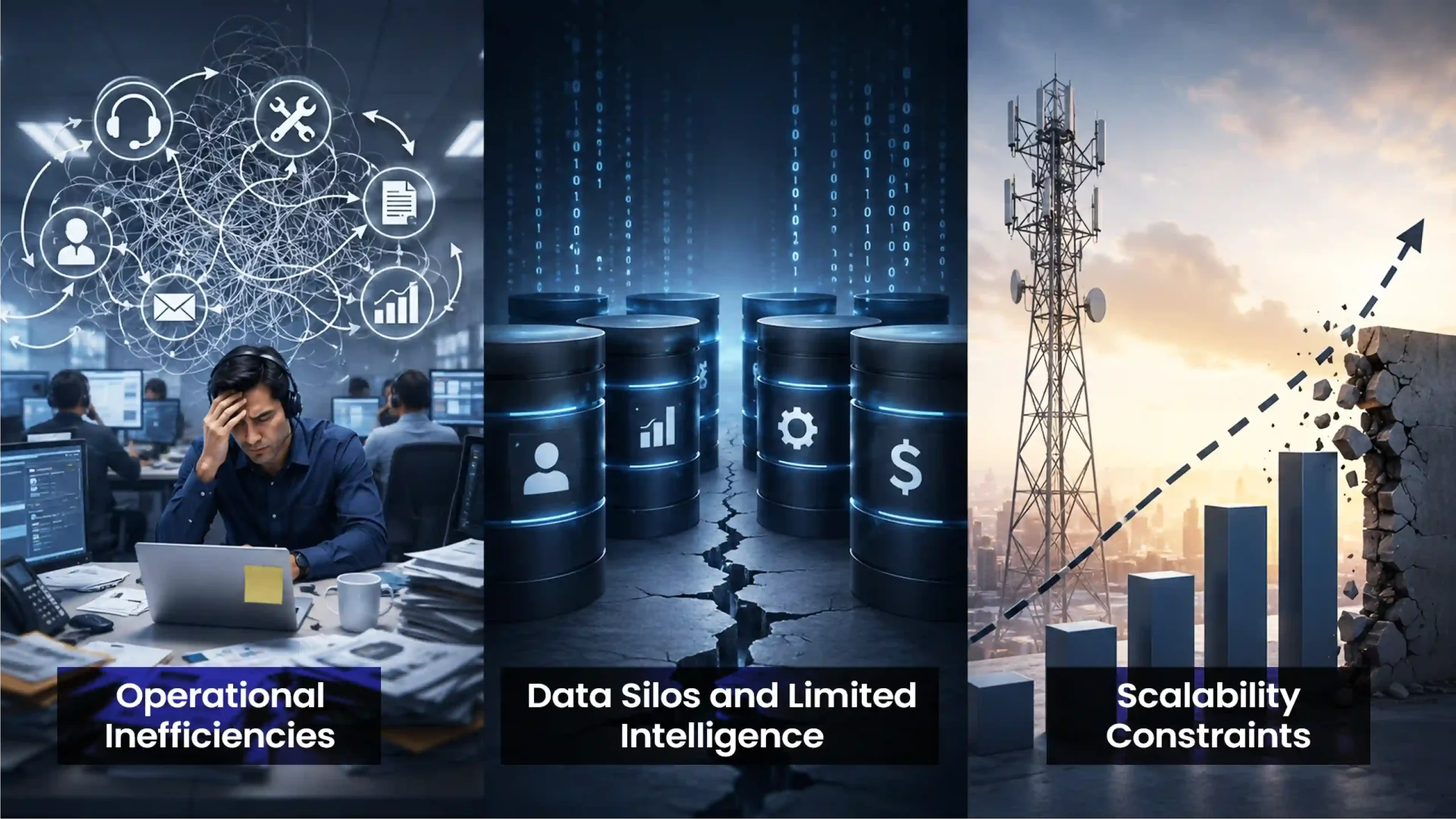
Operational Inefficiencies
- Manual processes across customer service, field operations, and network management
- Inconsistent response times and service quality across different touchpoints
- High operational costs due to resource-intensive manual interventions
Data Silos and Limited Intelligence
- Fragmented data across multiple systems and departments
- Inability to leverage historical knowledge for real-time decision making
- Limited automation capabilities for routine operational tasks
Scalability Constraints
- Difficulty scaling operations to meet growing customer demands
- Challenges in maintaining consistent service quality during peak periods
The Solution

Quantiphi designed and implemented a comprehensive AI-powered enterprise platform leveraging an advanced AI software stack:
Core Technology Components:
- NVIDIA NeMo Microservices: For model customization, evaluation, and guardrails.
- Scalable Inference Architecture: For scalable model deployment.
- Optimized Inference Frameworks: For accelerated inference performance.
- Production-Grade Serving: For robust, enterprise-wide model serving.
Key Solution Features
-
Enterprise AI Platform
A centralized AI model deployment platform that streamlines inference operations and maximizes efficiency across enterprise use cases:- Scalable LLM Deployment: Orchestrates large language model workloads on cloud-native Kubernetes infrastructure using industry-leading inference servers.
- Multi-Format Model Optimization: Supports conversion and execution across multiple model formats for maximum compatibility and performance.
- Advanced Inference Acceleration: Integrates cutting-edge techniques for throughput optimization and faster response generation.
- Standardized Monitoring & Governance: Provides unified performance monitoring and reusable deployment templates across business units.
- High-Throughput Scale: Seamlessly handled millions of daily inference requests at enterprise scale.
- Diverse Model Portfolio: Supported a vast ecosystem of unique models simultaneously served across diverse AI use cases.
- Accelerated Response Times: Achieved an order-of-magnitude latency reduction for document embedding and querying.
-
Downstream Applications
Implemented fine-tuned LLMs to drive cost reduction through optimized open-source models across key business functions:- Real-time call summarization and classification.
- Customer churn prediction and prevention.
- Automated quality assurance and compliance monitoring.
- Technical troubleshooting assistance.
- Real-time access to documentation and procedures.
- Predictive maintenance recommendations.
- Automated incident resolution workflows.
-
Data Flywheel Implementation
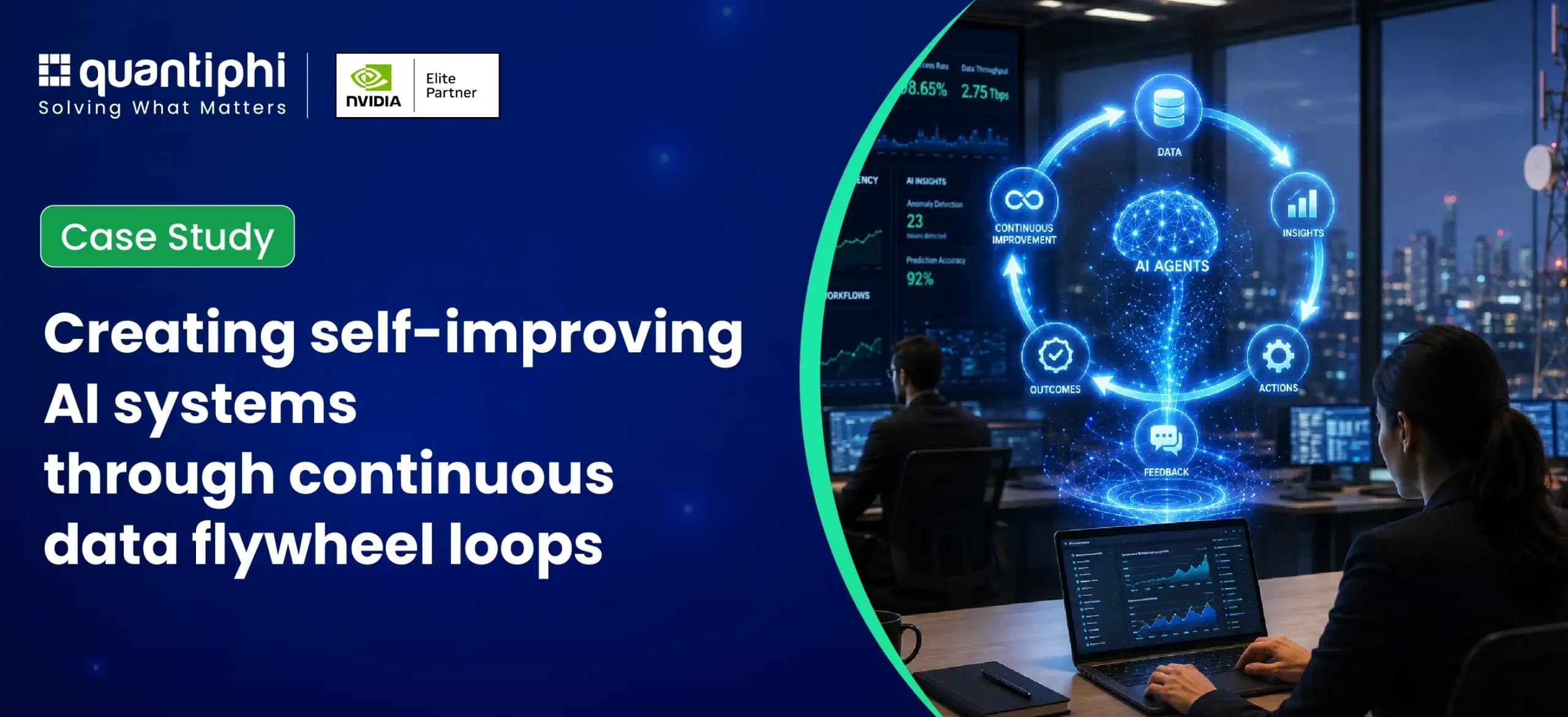
Established a continuous improvement system featuring:- Data Quality Tools: For data quality refinement and filtering.
- Model Customization: For model fine-tuning and optimization.
- Evaluation Frameworks: For performance benchmarking and validation.
- Security Guardrails: For safety and compliance enforcement.
Key Outcomes and Business Impact
The strategic collaboration with Quantiphi accelerated the client’s AI transformation, setting a new enterprise benchmark for scalable, feedback-driven AI solutions. Key outcomes include:
- Enhanced AI Accuracy: The customized AI agents demonstrated significant improvement in response accuracy post-training.
- Decreased Operational Costs: The optimized multi-agent architecture and improved data pipelines resulted in decrease in call center analytics costs.
- Reduced Latency: By utilizing fine-tuned, lightweight models deployed on NVIDIA NIM, the client significantly lowered computational overhead while seamlessly handling immense customer demand with minimal latency.
- Sustained AI Improvement: The successful implementation of the data flywheel approach created a centralized feedback loop, continuously refining AI agent quality and ensuring long-term adaptability to evolving business needs.