The Future of Insurance: How Generative AI is Shaping the Industry
Generative AI, a cutting-edge subset of artificial intelligence, is transforming the insurance industry by automating processes, improving accuracy, and enhancing customer experiences. This comprehensive guide explores the journey of generative AI in insurance, from its origins and the reasons for its adoption to its current applications and future potential. By understanding the impact of generative AI, insurers can harness its power to stay competitive and meet evolving customer needs.

Strategic Benefits of Generative AI in Insurance
The insurance industry thrives on accurate and efficient data processing. Traditional workflows, however, are burdened with inefficiencies,
high costs, and errors. Generative AI is transforming this landscape by delivering tangible business value across the board.
Generative AI analyzes granular customer data to provide hyper-personalized policy recommendations and proactive service, fostering trust and ensuring long-term loyalty.
By automating claims workflows—document extraction, validation, and settlement—Generative AI slashes processing times while improving accuracy, directly enhancing customer satisfaction scores (CSAT).
With predictive risk modeling powered by diverse datasets, Generative AI equips underwriters to deliver competitive pricing and improve portfolio quality, boosting market share.
Real-time anomaly detection powered by Generative AI identifies fraud patterns earlier, reducing financial losses and safeguarding brand reputation.
Generative AI automates labor-intensive tasks like policy endorsements, renewals, and reviews, ensuring higher compliance and reduced operational costs.
From policy documents to customer correspondence, Generative AI produces high-quality, compliant outputs at scale, accelerating time to market for new products.
Generative AI synthesizes data into actionable insights, enabling insurers to improve strategic planning, portfolio diversification, and cross-selling opportunities.
Generative AI’s Role Across the Insurance Value Chain
Generative AI is reshaping every aspect of the insurance value chain, delivering unprecedented efficiency, accuracy, and scalability. Its transformative capabilities span across life, health, property, casualty insurance and reinsurance - making it indispensable in modern insurance operations.
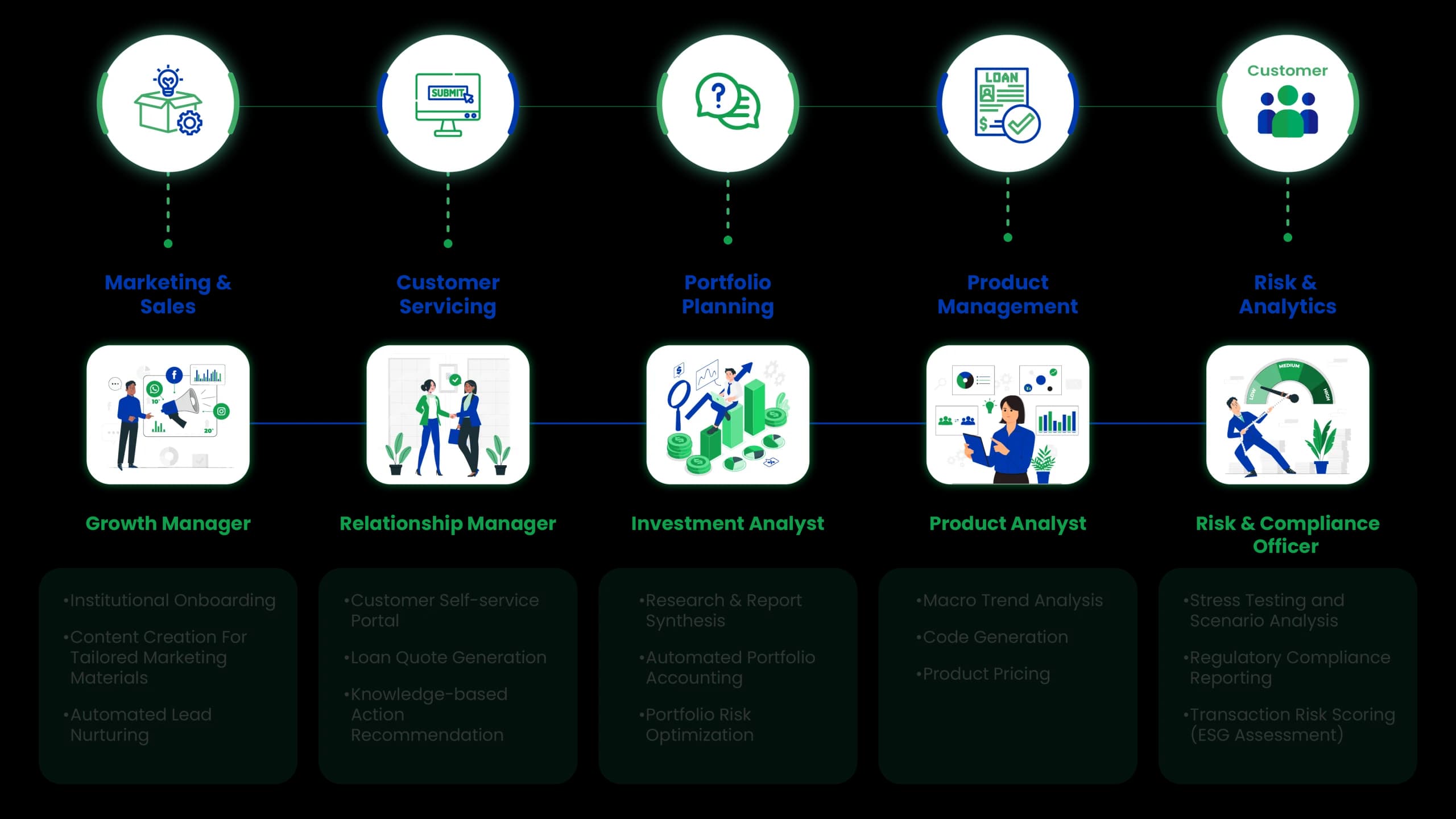
Below are key use cases that illustrate how generative AI in insurance is driving innovation, enhancing efficiency, and improving customer experiences in the industry.
Generative AI analyzes customer behavior, preferences, and historical data to craft tailored policy options. This drives product adoption and shortens the sales cycle, ensuring customers receive offerings aligned with their unique needs.
By analyzing claims and transactional data, Generative AI identifies fraud patterns in real-time. This accelerates legitimate claims processing, ensuring trust and operational efficiency.
Generative AI automates data extraction from documents like repair invoices or medical reports and validates claims in real-time. This reduces settlement times, minimizes manual intervention, and enhances customer satisfaction.
Generative AI automates the creation of policy documents by generating tailored content based on customer profiles, coverage preferences, and regulatory requirements. It ensures each document is accurate, compliant, and aligned with individual customer needs, significantly reducing manual effort and expediting onboarding and renewal cycles.
Generative AI consolidates data from actuarial models, IoT sensors, and historical loss data to deliver granular risk assessments. This enables underwriters to make data-driven pricing decisions, improving underwriting precision.
Generative AI simulates disaster scenarios to assess climate-related risks. This helps insurers design risk-adjusted policies and strengthen preparedness for extreme weather events.
Virtual assistants powered by Generative AI provide real-time, personalized communication, resolving queries efficiently. This ensures seamless 24/7 support for policyholders, improving their overall experience.
Generative AI creates synthetic datasets that mimic real-world scenarios for training machine learning models. This reduces dependence on sensitive data, ensuring compliance with data privacy regulations without compromising innovation.
Generative AI automates the preparation of ESG and regulatory reports, helping insurers meet sustainability goals and adapt to evolving compliance standards with minimal effort.
Generative AI analyzes market trends, customer data, and external factors to deliver insights that enhance portfolio performance. This ensures insurers make informed investment decisions aligned with stakeholder expectations.

How Quantiphi is Driving Transformation with Generative AI
Quantiphi is at the forefront of the generative AI revolution, offering innovative solutions tailored to the insurance industry.
Codeaira is Quantiphi’s generative AI-powered assistant designed to boost developer productivity. It accelerates project delivery across all stages of the SDLC, improving efficiency while ensuring security and privacy.

Dociphi, Quantiphi's Generative AI-powered document processing platform, automates data extraction, analysis, and generation to streamline workflows in insurance, mortgage, and banking. It accelerates processing, improves accuracy, and reduces costs, driving better CSAT scores, customer retention, and product adoption. Its scalable architecture expands the Total Addressable Market and shortens sales cycles, transforming critical insurance processes. Here’s how Dociphi transforms key insurance processes:

The Future of Generative AI in Insurance
Generative AI is reshaping the insurance landscape by unlocking transformative potential in ways that traditional AI could not. Its unique ability to create, generate, and synthesize data is enabling hyper-personalization, where insurers can craft policy offerings tailored to individual customer needs with 90% faster turnaround times. In the future, Generative AI will redefine regulatory compliance, automating the adaptation to evolving legal frameworks while minimizing compliance costs by up to 25%. Risk modeling, powered by Generative AI, will move beyond static datasets to simulate highly accurate, dynamic scenarios, reducing underwriting errors by 40% and enabling proactive risk mitigation strategies. Future integration with blockchain technology will amplify Generative AI's capabilities, creating secure, transparent systems for data sharing and fraud prevention. As insurers leverage Generative AI to automate policy creation, claims adjudication, and customer engagement, the industry will become more agile, scalable, and customer-centric.