Agentic AI: The Complete Enterprise Guide (2026)

Artificial Intelligence is entering a new era — one where systems don’t just respond to commands but think, plan, and act independently. This evolution is called Agentic AI, representing a fundamental shift from traditional automation to truly autonomous, intelligent systems that drive measurable business outcomes.
What is Agentic AI?
Agentic AI refers to autonomous AI systems that can reason, plan, make decisions, and execute tasks with minimal human intervention.
Unlike conventional AI that operates within rigid, predefined rules, Agentic AI introduces genuine “agency”—the capability to make decisions, take initiative, and continuously improve without constant human oversight.
These systems can:
- Understand context and navigate complex environments
- Make real-time, goal-driven decisions
- Learn from every interaction and improve outcomes
- Execute multi-step workflows autonomously
This shift makes Agentic AI a game-changer for enterprises, enabling them to move from automation to intelligent, self-optimizing systems that drive measurable business outcomes.
Why Agentic AI Matters
The rise of Agentic AI is not a future-state prediction; it’s happening now. Per a survey by PwC, 79% of organizations are already adopting AI agents in some form. This momentum is driven by a convergence of technological breakthroughs: the reasoning power of Large Language Models (LLMs), the growing need for intelligent orchestration to manage business complexity, and the availability of advanced compute infrastructure.
The business case is compelling. Deloitte predicts that 25% of enterprises using GenAI are expected to deploy AI agents in 2025, growing to 50% by 2027. More importantly, McKinsey estimates that Agentic AI could be responsible for over 60% of the total business value generated by AI in functions like sales and marketing, signaling a massive opportunity for competitive advantage.
Agentic AI Evolution
The evolution of Agentic AI reflects the broader shift in artificial intelligence from rule-based automation to autonomous, adaptive systems.
Early AI Systems (1950s–1990s)
Early AI relied on predefined rules and symbolic logic to automate simple tasks, but these systems lacked learning and adaptability.
Intelligent AI Emerges (1990s–2010)
AI systems became more capable of understanding environments, making decisions, and working toward specific goals.
Rise of Machine Learning (2010–2020)
Advancements in machine learning and NLP enabled AI to learn from data, powering applications like chatbots, recommendation engines, and predictive analytics.
The Era of Agentic AI (2020–Present)
With the rise of large language models (LLMs), retrieval-augmented systems, and orchestration frameworks, AI systems can now reason, plan, and execute tasks autonomously. Modern agentic systems are no longer reactive — they are proactive, adaptive, and capable of managing complex workflows across enterprises.
Why is Agentic AI Emerging Now?
Agentic AI wasn’t a sudden breakthrough; it was the result of multiple advancements converging at the same time. What was once limited to static models and rule-based automation is now evolving into systems capable of goal-driven, autonomous behavior. Let’s look at some of the key drivers:
- Large Language Models (LLMs):
The rapid evolution of Natural Language Processing (NLP) and LLMs significantly improved how machines understand context, generate responses, and handle complex inputs. More importantly, they enabled structured reasoning and multi-step execution, which are foundational to agentic systems. - Enterprise AI Adoption:
Enterprises are moving beyond simple automation toward end-to-end workflow transformation. Traditional tools struggle with dynamic, unstructured tasks, creating demand for systems that can adapt, decide, and act across processes. - Advanced Compute Infrastructure:
The availability of hyperscalable cloud platforms, GPUs, and distributed computing has made it possible to train, deploy, and run complex AI systems at scale. This infrastructure supports real-time inference, orchestration, and continuous learning required for agentic architectures. - Evolution of Tool Use and Integration:
AI can now interact with APIs, databases, and enterprise systems seamlessly. This allows agents to move from insight generation to real-world execution, making them operationally valuable.
Together, these advancements have made agentic AI both technically viable and enterprise-ready, marking a clear shift from reactive AI to autonomous, adaptive intelligence systems.
How Does Agentic AI Work?
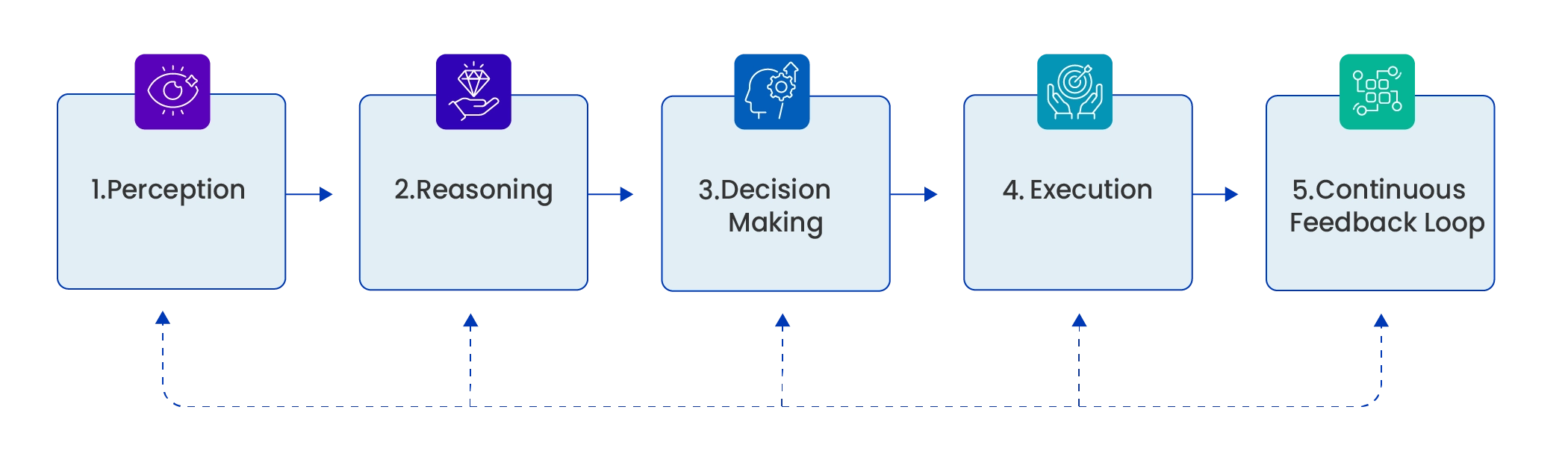
Agentic AI works through a continuous loop of perception, reasoning, decision-making, execution, and feedback. AI agents operate independently or collaboratively to optimize decision-making and task execution. Below is a breakdown of a typical agentic workflow:
-
Perception
Perception is how agentic AI gathers and understands information from its environment. It can collect data from user prompts, APIs, databases, documents, or enterprise applications to understand the current situation.
For example, a customer support agent may read a support ticket and pull customer history before responding.
-
Reasoning
Once the information is collected, the agent analyzes the context and plans the next steps. Instead of following fixed rules, it evaluates different possibilities and decides the best approach. For instance, if an order is delayed, the AI may first check shipment status, then review refund options before responding.
-
Decision-Making
In this stage, the agent chooses the most suitable action based on goals, business rules, and available data. It may decide to automate the task or involve a human if needed. For example, a finance agent might automatically approve low-risk transactions while escalating high-risk ones for review.
-
Execution
Execution is where the agent takes action. This could include sending emails, updating systems, querying databases, or triggering workflows. For example, an HR onboarding agent can automatically create accounts, schedule meetings, and send welcome emails.
-
Continuous Feedback Loop
After execution, the agent evaluates the outcome and adjusts if needed. If the result is incomplete or inaccurate, it can refine its approach and try again. For example, if a database query returns missing data, the agent may recheck another source or modify the query automatically.
Types of AI Agents
Agentic AI systems are built using different types of AI agents, each designed to handle tasks in a specific way. The difference between these agents mainly comes down to how they understand information, make decisions, and interact with their environment. As systems become more advanced, these agents can also work together to power complex enterprise workflows and autonomous operations.
-
Simple Reflex Agents
Simple reflex agents work using predefined rules. They respond directly to a specific input without considering past interactions or context. These agents are best suited for straightforward and repetitive tasks where decisions are simple and predictable.
Example: A customer support bot that automatically replies with password reset instructions when a user types “forgot password.”
-
Model-Based Reflex Agents
Model-based reflex agents maintain an internal understanding of their environment. Instead of reacting only to the current input, they consider changes, context, and partial information before making decisions.
Example: A warehouse monitoring system that tracks inventory levels and adjusts recommendations based on real-time stock availability.
-
Goal-Based Agents
Goal-based agents make decisions based on achieving a specific objective. They evaluate multiple possible actions and choose the one most likely to help them reach the desired outcome.
Example:A travel booking assistant that compares flight routes, hotel options, and pricing to help users complete a trip booking efficiently.
-
Utility-Based Agents
Utility-based agents focus not only on achieving goals but also on optimizing the outcome. They evaluate different options and choose the one that delivers the highest overall value or efficiency.
Example: A logistics AI that selects the fastest and most cost-effective delivery route based on traffic, fuel costs, and delivery deadlines.
-
Learning Agents
Learning agents continuously improve through experience, feedback, and historical data. Over time, they adapt their behavior, making them highly effective in dynamic and changing environments.
Example: Recommendation engines on streaming platforms that improve suggestions based on user viewing behavior and preferences.
Key Components of Agentic AI Systems
Agentic AI Architecture
Architecture is the foundation of an agentic AI system. It defines how different components such as AI models, data sources, tools, memory systems, and workflows connect and interact with each other. A well-designed architecture ensures the system can scale, handle complex tasks, and coordinate multiple agents effectively.
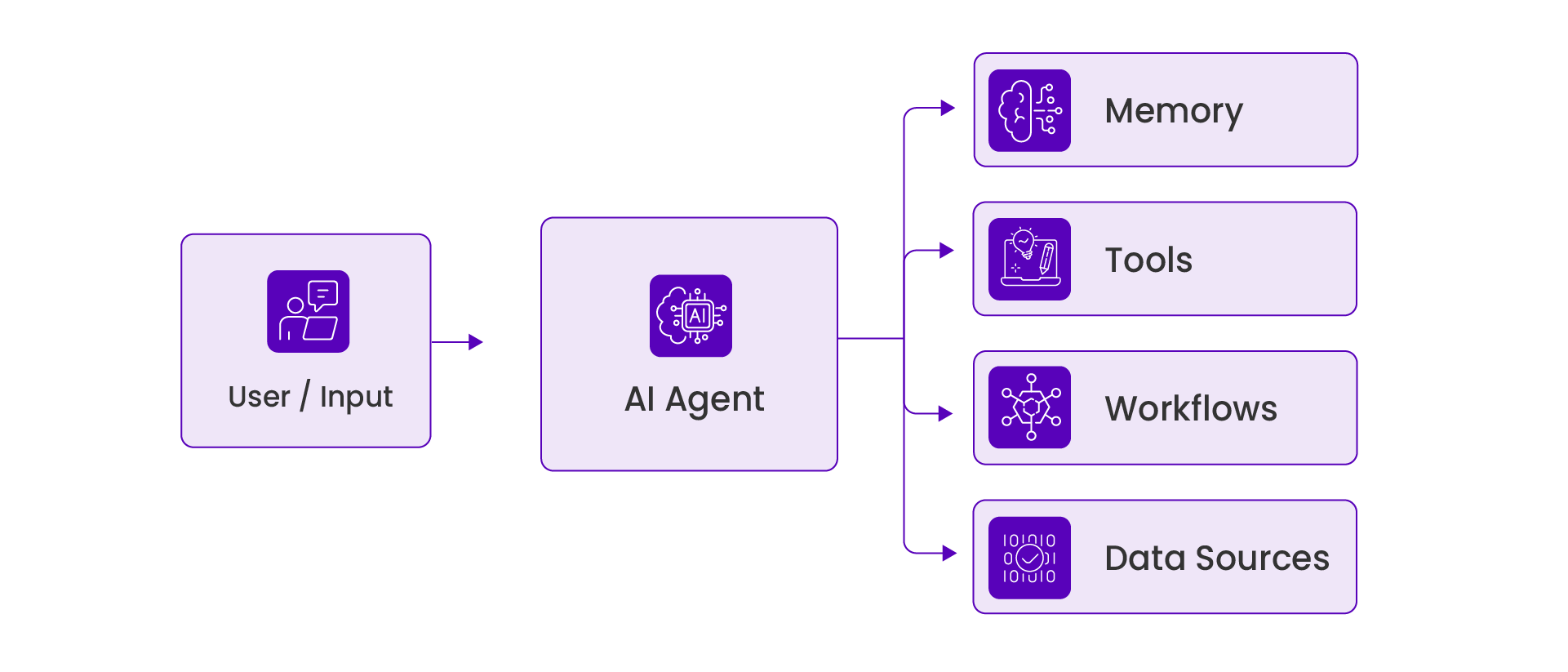
For example, some businesses may use a single-agent architecture for simple automation tasks, while larger enterprise systems may use multi-agent architectures where different agents handle planning, research, execution, and validation separately.
Agentic AI Workflows
Workflows determine how the agent moves from one task to another to achieve a goal. Unlike traditional automation, agentic workflows can adapt dynamically based on the situation, results, or changing inputs.
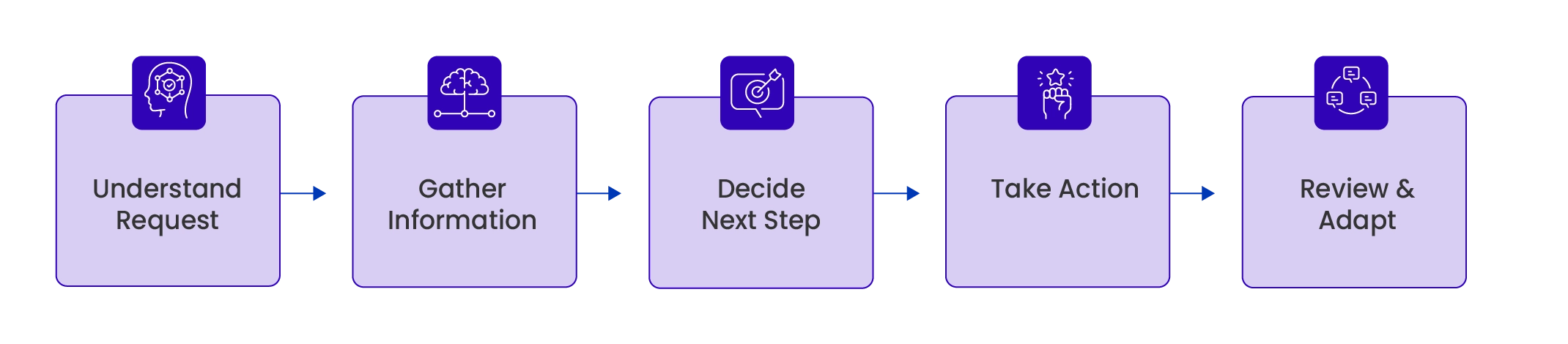
For instance, in a customer service workflow, the agent may first analyze the query, then retrieve customer data, decide whether escalation is needed, and finally generate a response. If new information appears during the process, the workflow can adjust automatically instead of following a rigid sequence.
Agentic AI Memory
Memory helps the agent retain context, past interactions, and important information over time. This allows the system to provide more accurate, personalized, and context-aware responses instead of treating every interaction as completely new.
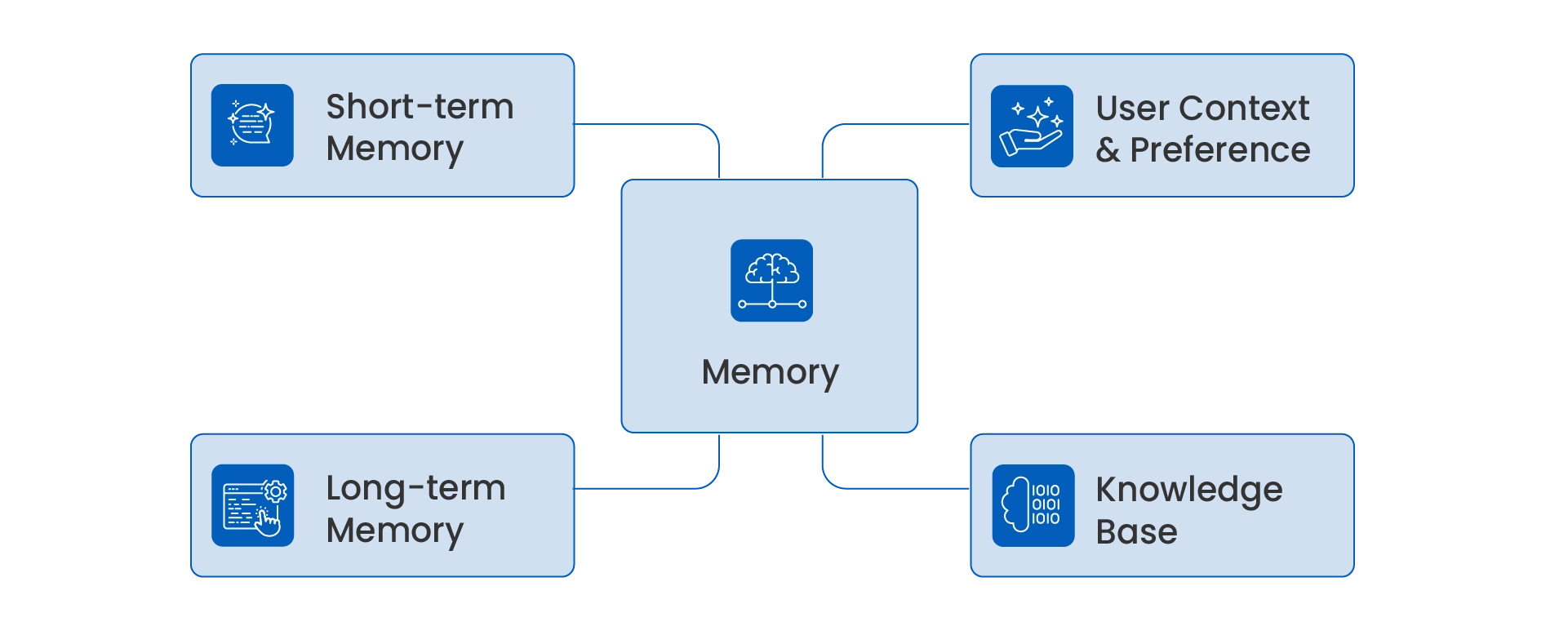
For example, a healthcare assistant AI could remember previous patient interactions, treatment history, or preferences to provide more relevant recommendations in future conversations. Memory also helps agents maintain continuity across long and complex workflows.
Agentic AI Tools
Tools are the external systems and resources the agent uses to perform actions in the real world. These may include APIs, databases, search engines, enterprise applications, or automation platforms. Without tools, an AI agent can generate responses but cannot actively complete tasks.
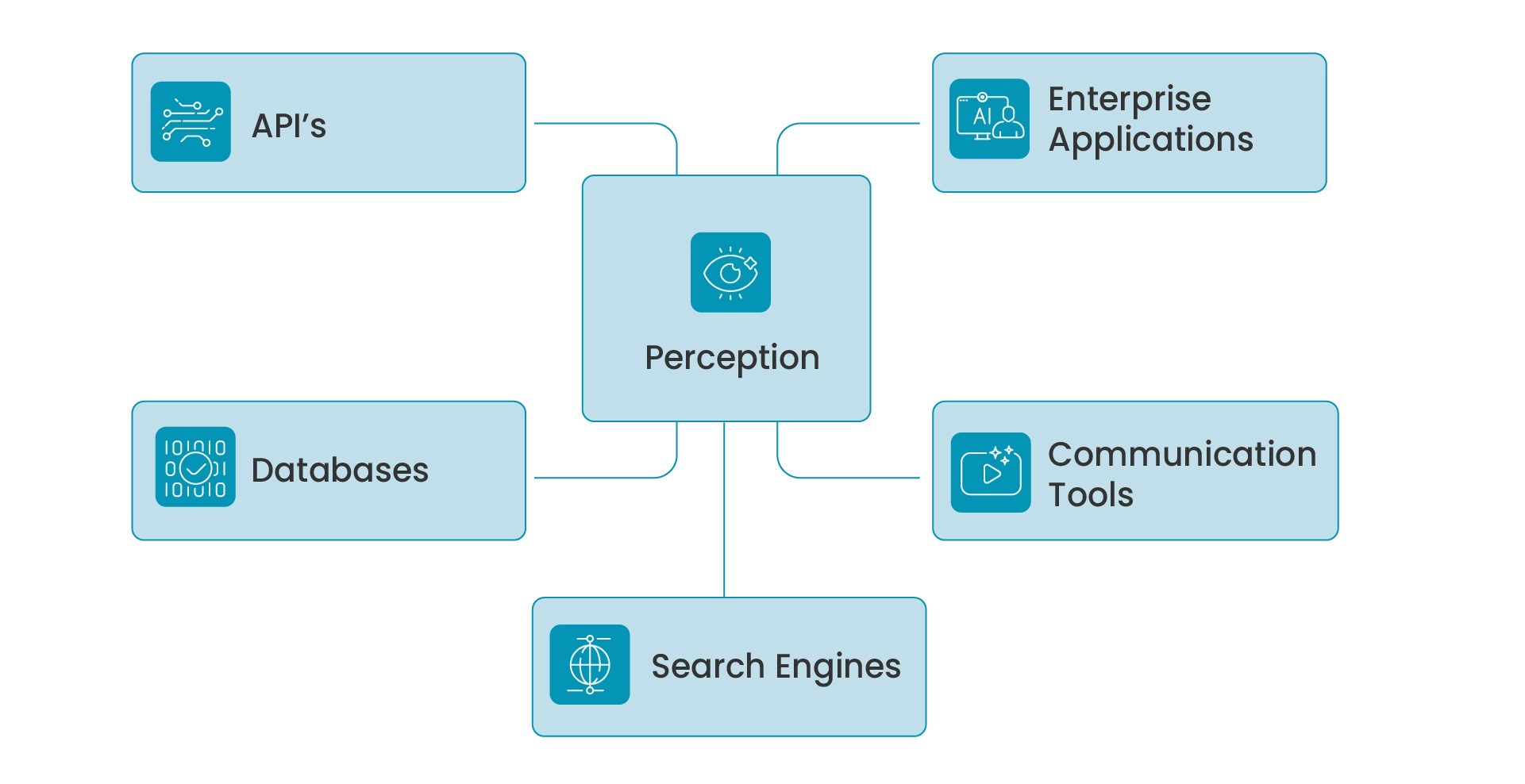
For example, an agent connected to a CRM system can retrieve customer records, while integration with email platforms allows it to send notifications automatically. The more effectively an agent can use tools, the more capable and autonomous it becomes.
Agentic AI Technology: Core Technologies Behind Autonomous Agents
Agentic AI operates through a combination of advanced technologies that enable it to understand, learn, and make decisions autonomously. These core components work together to create intelligent, adaptable systems.
-
Machine Learning (ML)
Enables AI to learn from data, identify patterns, and improve over time. Techniques like supervised, unsupervised, and reinforcement learning help AI refine decision-making, automate tasks, and adapt to dynamic environments.
-
Natural Language Processing (NLP)
Allows AI to understand and generate human language, enabling seamless interactions through text analysis, speech recognition, and intelligent conversation generation.
-
Large Language Models (LLMs)
Power AI’s ability to comprehend and create human-like text, making it highly effective in tasks like virtual assistance, content creation, and customer support.
-
Contextual Understanding
Helps AI interpret information based on user history, emotional cues, and real-time context, improving response accuracy and personalization.
-
Decision-Making Frameworks
Combines rule-based systems and probabilistic models to enable AI to make smart, data-driven choices even in complex and uncertain scenarios.
Modern Agentic AI systems rely on a growing ecosystem of orchestration frameworks, memory systems, and tool integration platforms. Technologies such as LangChain, LangGraph, AutoGen, Semantic Kernel, CrewAI, and Vertex AI Agent Builder help enterprises build multi-agent workflows, integrate enterprise systems, and manage autonomous AI execution at scale.
As enterprise adoption grows, the focus is shifting from standalone AI models to scalable orchestration, governance, and system-level AI architectures capable of supporting complex enterprise workflows.
Comparison: Agentic AI vs. Traditional AI vs. Generative AI
To understand the significance of Agentic AI, it’s important to distinguish it from Generative AI. Generative AI powers tools like chatbots, copilots, and content generation systems by creating outputs based on learned patterns. However, it is largely reactive, responding to prompts without independently deciding the next action.
Agentic AI builds on these capabilities by adding autonomy, reasoning, and action, enabling systems to make decisions and execute tasks with minimal human intervention.
Instead of just generating responses, Agentic AI systems:
- Interpret high-level goals (e.g., “optimize customer onboarding”)
- Break them into multi-step workflows
- Decide which tools or systems to use
- Execute tasks across systems
- Continuously adapt based on results
| Aspect | Agentic AI | Generative AI | Traditional AI |
|---|---|---|---|
| Purpose | Autonomous decision-making & execution | Content generation | Task automation |
| Behavior | Proactive, goal-driven | Reactive, prompt-driven | Rule-based |
| Capability | Multi-step workflows, planning, execution | Text, image, code creation | Predefined tasks |
| Learning | Continuous, feedback-driven | Model-based (pre-trained) | Limited, requires retraining |
Generative AI creates. Traditional AI automates. Agentic AI decides, acts, and optimizes. This makes Agentic AI the next evolution of enterprise intelligence, enabling organizations to move beyond experimentation and unlock real, scalable business impact.
Agentic AI Use Cases
Agentic AI is helping businesses move beyond basic automation by enabling systems to make decisions, execute tasks, and adapt in real time. From operations to customer engagement, autonomous agents are improving efficiency, reducing manual effort, and accelerating decision-making across industries.
Insurance: Claims Automation
AI agents can assess claims, validate information, and communicate with customers automatically, helping insurers reduce processing time and operational costs.
Supply Chain & Logistics: Real-Time Optimization
Agentic AI helps predict disruptions, optimize delivery routes, and manage inventory dynamically to improve efficiency and resilience.
Financial Services: Fraud Detection & Risk Management
Financial institutions use AI agents to monitor transactions, detect fraud patterns, automate underwriting, and support faster decision-making.
Healthcare: Patient Care & Drug Discovery
AI agents support diagnostics, personalize treatment plans, streamline workflows, and accelerate drug discovery through faster data analysis.
Customer Service: Personalized Support
AI-powered agents provide 24/7 support, handle multi-step interactions, and deliver more personalized customer experiences.
IT Operations & Cybersecurity: Threat Detection
AI agents continuously monitor systems, detect anomalies, and automate incident response to strengthen cybersecurity and reduce response times.
What are the benefits of Agentic AI?
The primary benefits of Agentic AI include improved productivity, autonomous decision-making, workflow automation, scalability, and enhanced customer experiences. Studies suggest productivity gains of up to 60% in AI-assisted workflows, along with substantial cost reductions.
-
Boosts Productivity
By handling time-consuming, repetitive tasks, Agentic AI liberates human talent for creative problem-solving and strategic innovation. A study by MIT researchers found that AI agents can boost team productivity by 60% per employee.
-
Improves Decision-Making
Agentic AI processes vast amounts of data rapidly, identifying trends and insights that would take humans significantly longer to discover. McKinsey research suggests a potential for 30% to 50% in cost savings from its deployment, while a PwC survey projects an average ROI of 171% from companies using it.
-
Enhances Customer Experience
AI agents personalize interactions, predict customer needs, and provide instant support, making interactions feel seamless and human-like through answering questions, troubleshooting problems, and offering tailored recommendations.
-
Scales Effortlessly
Unlike rigid automation, Agentic AI learns and adjusts in real-time, scaling operations based on demand, adapting to new data, and optimizing processes without constant human input. A First Page Sage report highlights an average time savings of 66.8% across tasks.
-
Automates Complex Workflows
From supply chain management to financial transactions, Agentic AI handles complicated tasks with precision, keeping systems optimized, reducing errors, and ensuring smooth operations. This trend highlights a rapidly growing market, with Grand View Research projecting the global AI market to reach $50.31 billion by 2030.
-
Human-AI Collaboration
Rather than replacing jobs, Agentic AI enhances them, acting as a reliable assistant that helps teams work more efficiently, stay organized, and focus on high-value work.
What Are the Challenges and Risks of Agentic AI?
The biggest challenges of Agentic AI include governance, transparency, security, bias, and maintaining human oversight over autonomous systems. As these systems become more autonomous, organizations must ensure they remain secure, transparent, and aligned with business objectives. In fact, Gartner predicts that more than 40% of agentic AI projects could fail by the end of 2027 due to poor data quality, weak governance, and unclear value delivery.
Autonomy vs. Human Oversight
Agentic systems can make independent decisions, but too much autonomy without proper oversight can create risks. Businesses need clear guardrails and human-in-the-loop mechanisms for critical actions.
Transparency and Explainability
Many AI systems operate like “black boxes,” making it difficult to understand how decisions are made. This can impact trust, compliance, and accountability, especially in regulated industries.
Security and Data Privacy
Since agentic AI often interacts with sensitive enterprise data and connected systems, strong security controls and access management are essential to prevent misuse or breaches.
Bias and Ethical Concerns
AI agents can inherit biases from training data or workflows, potentially leading to unfair or inaccurate outcomes. Responsible AI practices are critical to ensure fairness and reliability.
Infrastructure and Compute Costs
Running autonomous AI systems at scale requires significant computing power, memory, and real-time processing capabilities, which can increase operational costs.
To successfully scale Agentic AI, organizations need strong governance frameworks, responsible AI practices, and continuous monitoring to balance innovation with control
Governance and Responsible AI for Agentic Systems
Responsible Agentic AI depends on strong governance, human oversight, explainability, security controls, and continuous monitoring. To deploy these systems safely and effectively, organizations should adopt the following governance practices:
- Human-in-the-loop systems for critical decisions
- Explainability and transparency tools
- Continuous monitoring and evaluation
- Ethical AI frameworks
- Strong data security protocols
Responsible AI practices are not just about risk mitigation; they are essential for building trust and enabling long-term scalability. By embedding governance into the design and deployment of Agentic AI systems, organizations can unlock their full potential while maintaining control and accountability.
Cost and ROI of Agentic AI
The cost of implementing Agentic AI varies based on infrastructure, data readiness, integrations, and workflow complexity. While enterprise deployments may require significant upfront investment, the long-term business impact can be substantial.
Organizations adopting AI-driven systems are already seeing measurable benefits such as:
- Reduced operational costs
- Faster and more accurate decision-making
- Higher employee productivity
- Improved customer experience and service quality
According to research from Deloitte Insights, organizations are seeing strong returns from AI implementations across customer service, IT operations, and business planning. More recent findings from Deloitte Global also highlight that leading enterprises are achieving significant long-term value through Generative and Agentic AI initiatives, particularly when paired with strong governance and workflow redesign.
As Agentic AI continues to mature, businesses are increasingly viewing it not just as a technology upgrade, but as a strategic investment that can drive operational efficiency, scalability, and competitive advantage.
Agentic AI Adoption: How Enterprises Can Get Started
Implementing agentic AI systems requires a shift from model-centric thinking to system-level design, where agents, tools, data, and governance work together as a cohesive stack. Enterprises can follow these practical guidelines for a solid foundation:

Step 1: Define a High-Impact Use Case
Start with a focused business problem where Agentic AI can deliver measurable value, such as customer support automation, IT operations, or workflow orchestration.
Step 2: Build the Right Infrastructure
Set up scalable cloud infrastructure, secure data pipelines, and access to enterprise knowledge systems to support real-time reasoning and execution.
Step 3: Choose an Agent Framework
Select frameworks and orchestration platforms that support multi-agent coordination, memory, workflows, and tool integration.
Step 4: Integrate Enterprise Systems and Tools
Connect AI agents with CRMs, ERPs, APIs, databases, and workflow systems so they can move from insight to execution.
Step 5: Implement Governance and Human Oversight
Establish guardrails, monitoring, access controls, and human-in-the-loop workflows to ensure secure and responsible AI operations.
Step 6: Monitor, Optimize, and Scale
Track performance, evaluate outputs, refine workflows, and gradually expand into more complex enterprise use cases.
How Quantiphi can help you transform with Agentic AI
Adopting Agentic AI requires more than just technology. It requires a strategic partner who can help bridge the gap between experimentation and enterprise-scale transformation.
At Quantiphi, we help organizations move from AI experimentation to enterprise-scale impact through our AI-first digital engineering approach. We design and deploy production-grade Agentic AI systems that integrate seamlessly with existing enterprise platforms while ensuring scalability, governance, security, and measurable business outcomes.
Why Organizations Choose Quantiphi for Agentic AI
- Up to 55% reduction in operational costs
- Up to 70% more time available for high-value tasks
- 24/7 operational capability without increasing headcount
- Up to 3.5x faster information retrieval and decision-making
Future of Agentic AI: Emerging Trends and Evolution
Agentic AI is rapidly evolving from task-based automation into intelligent, self-optimizing systems that can operate across entire enterprises. Organizations are moving toward multi-agent ecosystems where AI agents collaborate across workflows, applications, and teams to solve complex problems in real time. At the same time, businesses are prioritizing human oversight, governance, and responsible AI practices to ensure transparency, security, and accountability as autonomy increases. Advancements in orchestration, infrastructure, and standardized agent frameworks are also making it easier to build scalable, context-aware systems that continuously learn and adapt. As the technology matures, Agentic AI is expected to become a foundational enterprise capability, driving automation, decision-making, and operational efficiency at scale.
Agentic AI FAQs
-
Goal-oriented execution:
Understands high-level goals and its role.
-
Multistep problem-solving:
Plans and strategizes to achieve goals.
-
Self-directed execution:
Works autonomously across tools and workflows.
-
Adaptability:
Adjusts dynamically to changes and trial-and-error scenarios.
-
Boosts productivity:
Employees shift from task execution to AI supervision.
-
Expands roles:
AI democratizes skills, enabling broader job functions.
-
Speeds up decision-making:
AI accelerates workflows and enhances autonomy.
-
Enhances collaboration:
AI aids work, but human coordination remains key.
-
Increases risk management needs:
Requires new oversight to prevent unintended consequences.
-
Focus on ROI:
Implement AI where it drives the most value.
-
Test and iterate quickly:
AI adoption moves fast—adapt even faster.
-
Optimize data and tools:
Ensure AI has the right inputs to perform effectively.
-
Avoid isolated solutions:
Ensure AI integrates well with existing systems.
-
Embrace continuous learning:
Foster a culture of AI experimentation.
-
Establish guardrails for legal, compliance, security, and privacy risks.
-
Define AI constraints to ensure alignment with business goals.
-
Build AI with transparency, fairness, and accountability in mind.
-
Monitor AI decisions and keep humans in the loop for critical choices.
-
Healthcare:
AI-assisted diagnostics and treatment planning.
-
Smart Assistants:
AI-powered personal bots.
-
Customer Service:
AI-driven chatbots and virtual agents.
-
Content Creation:
AI-generated content personalization.
-
Education:
Adaptive learning platforms.