Mortgage loan origination and servicing present significant operational challenges for financial institutions. Complex documentation requirements, lengthy approval processes, and extensive compliance obligations create bottlenecks that impact both operational efficiency and customer satisfaction. The mortgage industry fundamentally operates across two main operational domains: loan origination (evaluating, approving, and funding loans) and loan servicing (ongoing loan lifecycle management). These distinct operational areas both offer substantial opportunities for AI-driven optimization and automation.
For lending institutions, understanding how AI can enhance both phases is crucial for maintaining competitive advantage, reducing operational costs, and improving customer experience while ensuring regulatory compliance.
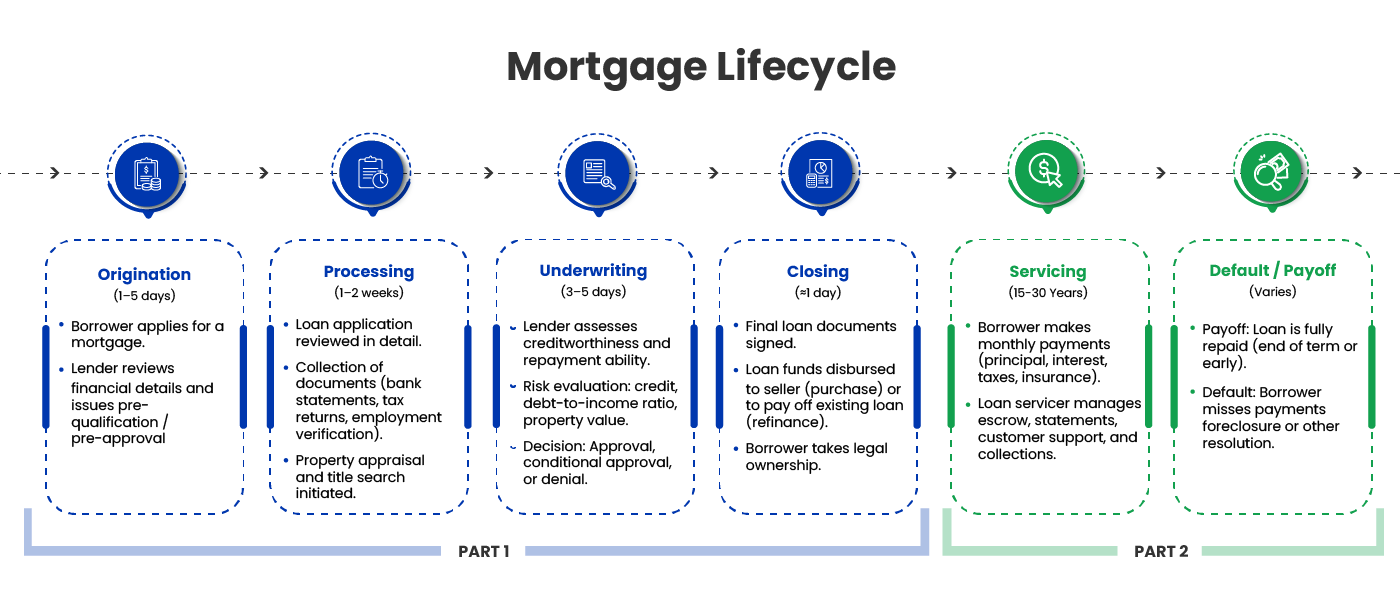
Part 1: The Loan Origination Process
Loan origination is the meticulous, multi-step process of approving a new mortgage.This is where it all starts—from the moment you fill out that first application to the day you get the keys to your new home.This phase is heavily focused on data gathering, verification, and risk assessment.
Step 1: Application and Submission
This is the initial stage where the borrower provides their financial and personal information. They submit the loan application along with a suite of essential documents like tax returns, W-2s, and bank statements.
Step 2: Loan Processing and Underwriting
Once submitted, the lender’s team begins processing the application. The most critical stage here is underwriting, where professionals carefully review the entire package to evaluate risk. This involves checking credit reports, employment history, and cross-referencing dozens of documents.
This is where the first major bottleneck occurs. The sheer volume and variety of documents: some digital, some scanned, others with handwritten notes, make manual data verification incredibly time-consuming and prone to error. An underwriter can spend hours sifting through files just to verify a few key data points, contributing to an average closing time of 35 to 40 days.
Step 3: Closing and Funding
Once the underwriter gives a final stamp of approval, the loan moves to its final stage. The borrower receives a final closing disclosure outlining all terms, fees, and costs. After all final documents are signed, the funds are disbursed, officially making the borrower a homeowner.
Part 2: The Loan Servicing Process
Loan servicing begins immediately after the loan is closed. This phase is focused on the ongoing management and administration of the mortgage throughout its entire lifespan.
Step 1: Account Setup and Payment Processing
As soon as the loan is closed, the servicer sets up the borrower’s account. Their main responsibility is to collect and process monthly payments, making sure funds are correctly applied to the principal, interest, and any escrow accounts (like taxes or insurance).
Step 2: Customer Service and Communications
For the entire life of the loan, the servicer is the borrower’s primary point of contact. Whether it’s answering questions about payments, balances, or escrow adjustments, the servicer ensures borrowers always have support. Modern servicing also focuses on digital convenience — giving borrowers easy access to their account details online or via mobile apps.
Step 3: Default and Loss Mitigation
In cases where a borrower is unable to make payments, the servicer handles the default management process. They work with borrowers to find solutions like loan modifications or forbearance to avoid foreclosure.
The Role of Intelligent Automation
For decades, both origination and servicing have been slowed down by a reliance on manual document handling. These processes are not only inefficient but also introduce a high risk of errors and create a fragmented customer experience. A recent J.D. Power study found a 131-point satisfaction gap between origination and servicing.
To solve this, many financial institutions are now adopting Intelligent Document Processing (IDP) platforms. These solutions use AI and machine learning to understand and process financial documents in the same way a human would, but with greater speed and accuracy. Here’s how:
- Automation of Repetitive Tasks: IDP and RPA eliminate manual data entry and document validation, speeding up processes and reducing human error.
- Enhanced Underwriting and Risk Assessment: AI-powered underwriting quickly analyzes borrower profiles, while fraud detection models flag suspicious activity early on.
- Customer Experience: AI-driven chatbots and personalized customer journeys ensure borrowers get quick answers, tailored recommendations, and a smoother overall experience.
- Operational Efficiency: Predictive analytics help lenders forecast loan demand, staffing requirements, and market trends, while RPA streamlines back-office workflows.
A specialized platform like Dociphi provides a solution that bridges the gap between these two phases. It can automate the initial document intake and data extraction during origination, ensuring clean, validated data is passed downstream. That same data can then be seamlessly used in the servicing phase to power systems for payment processing, compliance, and customer communications.
By leveraging intelligent automation, the entire mortgage lifecycle is transformed. From a streamlined digital application and automated underwriting to rapid payment processing and a seamless, digital borrower experience, technology is proving to be the critical enabler for efficiency, accuracy, and customer satisfaction in today’s mortgage industry.