RBI’s New Data Governance Guidance: Why Financial Institutions Must Look Beyond Compliance

For years, financial institutions have invested in collecting more data, storing it across expanding technology estates and using it to support everything from customer onboarding to regulatory reporting. Yet a deceptively simple question often remains difficult to answer:
Can the institution consistently prove where its data came from, who owns it, how it changed and whether it can be trusted?
The Reserve Bank of India’s Draft Guidance on Regulatory Expectations for Data Governance, released in July 2026, brings that question into sharp regulatory focus.
The draft signals a fundamental shift in how RBI expects regulated entities in India to manage data. Data can no longer be treated merely as an operational output owned by technology teams. It must be governed as an enterprise asset, with clear ownership, measurable quality, end-to-end traceability and accountability extending all the way to the Board.
The guidance is currently open for stakeholder comments until 17 August 2026. However, its direction is already clear: data governance is becoming central to financial resilience, regulatory confidence and responsible digital growth. (The Economic Times)
Why Has Data Governance Become a Regulatory Priority?
The modern financial institution operates through an interconnected web of core systems, digital channels, cloud platforms, analytics environments, external data providers and third-party technology partners.
A single customer or transaction data element may be captured in one system, transformed in another, enriched using an external source and finally used across credit decisions, risk calculations, customer communications and regulatory reports.
This complexity creates several persistent challenges:
- Multiple versions of the same data across departments
- Unclear ownership when quality issues arise
- Limited visibility into data transformations
- Manual reconciliation across reports and systems
- Inconsistent definitions of critical business terms
- Uncontrolled duplication or reuse by third parties
- Fragmented privacy, retention and disposal controls
These are not unique to India. A March 2026 Bank for International Settlements report found that, among 31 assessed global systemically important banks, only two were fully compliant with all BCBS ( Basel Committee on Banking Supervision) 239 principles for effective risk data aggregation and reporting. The report identified fragmented IT landscapes, legacy systems, manual processes, incomplete lineage and inconsistent taxonomies as continuing barriers. (Bank for International Settlements)
The RBI’s draft guidance brings these long-standing data challenges into one enterprise-wide governance framework for India’s regulated financial sector.
Who Falls Within the Scope of the Guidance?
The proposed guidance covers a broad spectrum of RBI-regulated institutions, including:
- Commercial banks
- Small finance banks
- Payments banks
- Local area banks
- Regional rural banks
- Urban and rural cooperative banks
- Non-banking financial companies
- All India Financial Institutions
- Asset reconstruction companies
- Credit information companies
Its reach is significant. Whether an institution is a large commercial bank or a smaller financial entity, the underlying expectation remains consistent: data must be reliable, secure, traceable and governed in proportion to the institution’s size, complexity and risk profile.
What Does the RBI’s Guidance Propose?
The RBI’s Draft Guidance on Regulatory Expectations for Data Governance outlines an enterprise-wide model covering governance, ownership, data architecture, quality, lifecycle management and third-party accountability.
-
Board-level governance
Regulated entities must establish a Data Governance Framework aligned with enterprise risk management. The Board, supported by Board-level and executive committees, would oversee its implementation, metrics, breaches and material risks.
-
Clearly defined ownership
A dedicated Data Function must coordinate governance across the enterprise. Data Owners would be accountable for individual domains, Data Stewards for day-to-day implementation and Data Custodians for technical controls, access, storage, backup and disposal.
-
A Single Source of Truth
Each data element must have one designated authoritative source. Downstream systems, models, reports and business processes should derive from this source, with reconciliation controls to resolve inconsistencies.
-
Lifecycle-wide traceability
Data must be governed from origination and processing through sharing, retention, archival and disposal. Metadata and lineage should show where data originated, how it was transformed and where it is used.
-
Measurable data quality
Regulated entities must track dimensions such as accuracy, completeness, consistency, timeliness, relevance, validity and reliability. Persistent issues would require documented remediation, escalation and governance reporting.
-
Accountability for third-party data
Responsibility remains with the regulated entity even when data is shared with vendors or group entities. Access must be purpose-bound, need-based, secure, contractually governed and subject to ongoing monitoring and periodic audits.
-
Alignment with data protection requirements
The Data Governance Framework must comply with the DPDP Act, applicable rules and other relevant laws. Classification, consent, access, retention, lineage and secure disposal must therefore operate as connected controls across the data lifecycle.
From Regulatory Readiness to Strategic Advantage
Responding to the guidance through policies, committees and standalone technology tools may address the visible requirements, but data governance requires a broader operating-model change. Accountability, architecture, processes and controls must work together to avoid disconnected catalogues, overlapping controls, manual reconciliation and recurring audit observations.
Approached strategically, regulatory readiness can also help institutions solve structural data challenges and create value across the enterprise.
-
Faster and more reliable regulatory reporting
Standard definitions, authoritative sources and lineage-enabled pipelines can reduce manual reconciliation while making reported data easier to validate, trace and explain.
-
Greater operational resilience
Visibility into where critical data resides, how it moves and which systems depend on it can strengthen responses to outages, breaches, migrations and business continuity events.
-
Stronger third-party risk management
Clear classification, approved-purpose controls and traceable data sharing can reduce exposure across expanding vendor, cloud and partner ecosystems.
-
Better decision-making
Analytics and intelligent systems are only as reliable as the data beneath them. High-quality, well-documented data enables faster decisions with greater confidence, consistency and explainability.
-
A more scalable transformation foundation
A common governance framework allows new products, platforms and use cases to reuse trusted data, definitions and controls instead of rebuilding them for every initiative.
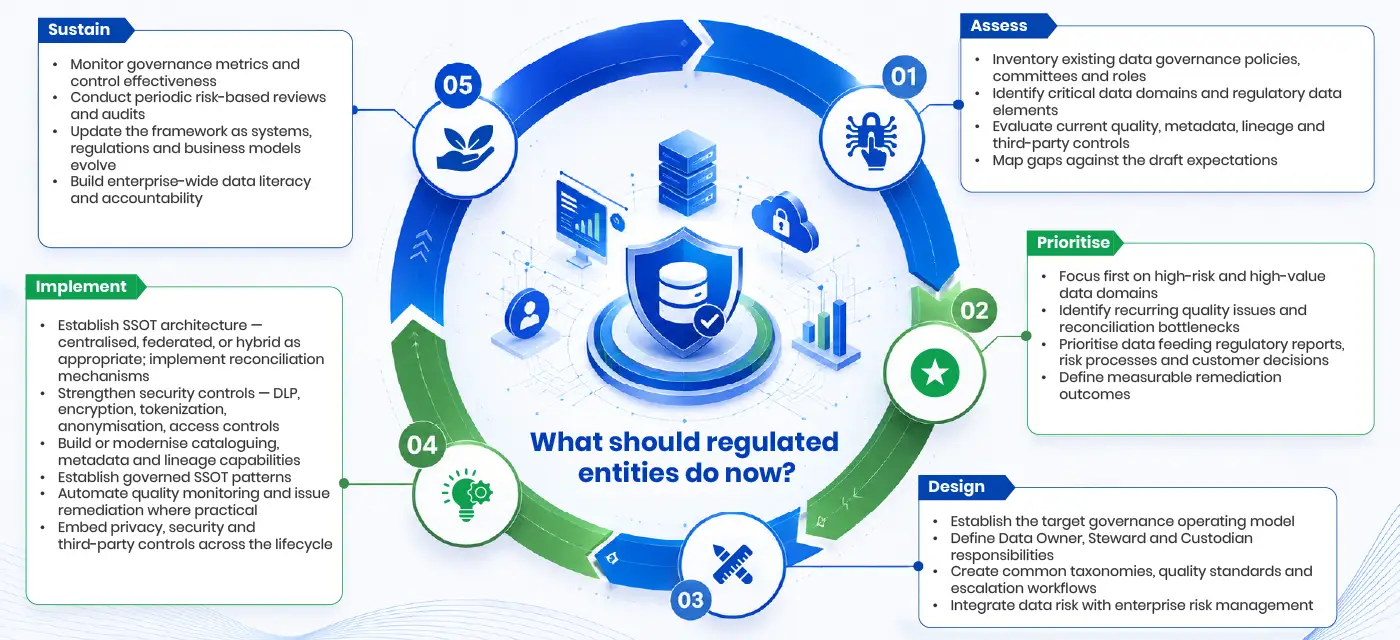
What Should Regulated Entities Do Now?
Because the guidance is still in draft form, institutions have an opportunity to prepare thoughtfully rather than react after finalisation.
How Quantiphi Can Support the Data Governance Journey
Building enterprise-grade data governance requires more than isolated policy, risk or technology interventions. It requires these capabilities to work as one coordinated system.
Quantiphi can support regulated entities across the compliance and transformation journey through:
- Data governance maturity assessments to evaluate current capabilities and identify priority gaps
- Framework and operating-model design covering governance structures, ownership, stewardship, policies and controls
- Data architecture implementation spanning SSOT, metadata, lineage, quality, classification and lifecycle management
- Managed data governance services for continuous monitoring, remediation, reporting and control enhancement
The objective is not simply to help institutions demonstrate compliance. It is to help them build a trusted data foundation that makes regulatory reporting faster, risk management stronger and enterprise decisions more reliable.
From Governance Principles to Measurable Outcomes
The capabilities outlined in the RBI’s draft guidance are not new territory for Quantiphi. Across banking and insurance, Quantiphi has helped institutions improve data quality, establish traceability, strengthen governance and protect sensitive information.
- Modernizing data quality and governance for a global insurer: Quantiphi modernized a decentralized financial data environment where fragmented processes and inconsistent governance affected reporting accuracy and regulatory compliance. The solution strengthened data quality, stewardship and financial data operations. Read the case study
- Building a Single Source of Truth for an Indian insurer: Quantiphi unified disparate data streams within a governed data platform, embedding data-quality standards into ingestion pipelines and creating a more reliable foundation for reporting and decision-making. Read the case study
- Establishing a data governance framework for financial services: Quantiphi helped establish a metadata management framework, define data-quality metrics and rules, clarify stewardship responsibilities and create a structured execution plan for improving data quality. Read the case study
- Enabling data lineage and cataloguing for an insurer: For a large insurance company operating with data in multiple formats, Quantiphi built a cloud-native data lake with a structured data dictionary and lineage-tracking capabilities, improving data discoverability, traceability and enterprise consumption. Read the case study
- Strengthening Data Loss Prevention for a financial services company: Quantiphi implemented a secure cloud environment incorporating Cloud Data Loss Prevention and identity and access management controls, helping protect sensitive financial and customer information. Read the case study
The Opportunity Is Larger
The Reserve Bank of India’s newly released Draft Guidance on Data Governance marks a pivotal moment for every financial institution in India — and the time to act is now. As your trusted AI and data partner, Quantiphi is here to help you move beyond mere compliance and transform this regulatory imperative into a genuine strategic advantage. At Quantiphi, we bring proven experience across banking and insurance to help you assess your current maturity, design the right governance framework, implement a trusted Single Source of Truth, and sustain it through managed services — so your regulatory reporting becomes faster, your risk management stronger, and your business decisions more confident. Let’s build your trusted data foundation together — reach out to us today.