Agentic AI adoption is rapidly transforming how enterprises automate workflows, improve decision-making, and scale intelligent operations. This guide explores the complete adoption journey, including enterprise readiness, implementation strategies, governance, challenges, ROI, and future trends shaping autonomous AI systems.
Introduction: Agentic AI Adoption
Agentic AI adoption refers to the enterprise-wide implementation of autonomous AI systems that can reason, plan, make decisions, and execute tasks with minimal human intervention. Unlike traditional AI automation, which typically follows predefined rules or isolated workflows, Agentic AI systems can dynamically adapt, interact with enterprise tools, and optimize outcomes in real time.
Enterprises are rapidly moving from AI experimentation toward scalable AI-driven operations, with autonomous agents emerging as a key focus area for workflow automation, operational efficiency, and intelligent decision-making.
At its core, Agentic AI adoption is not just about deploying AI models. It represents a broader shift toward AI-driven enterprise execution, where intelligent agents become embedded across business workflows, applications, and decision-making systems.
Modern Agentic AI systems can:
- Understand context across enterprise environments
- Reason through complex, multi-step workflows
- Interact with APIs, databases, and enterprise applications
- Execute actions autonomously
- Continuously learn and optimize outcomes through feedback loops
This shift is enabling organizations to move beyond task-based automation toward intelligent, adaptive systems that improve productivity, reduce operational friction, and accelerate business outcomes at scale.
Why Are Businesses Accelerating Agentic AI Adoption?
Businesses are accelerating Agentic AI adoption to automate complex workflows, improve operational efficiency, reduce costs, and enable faster decision-making at scale. Unlike traditional automation, Agentic AI systems can reason, adapt, and execute multi-step tasks autonomously across enterprise environments.
According to McKinsey & Company, AI technologies could unlock trillions of dollars in annual business value across enterprise functions. At the same time, PwC reports that organizations are increasingly investing in AI-driven transformation to improve productivity, agility, and customer experience.
-
Automation of Complex Workflows
Organizations are moving beyond basic task automation toward autonomous systems capable of managing multi-step workflows across departments, applications, and enterprise systems.
-
Faster and Smarter Decision-Making
Agentic AI systems can analyze data, reason through scenarios, and execute actions in real time, helping enterprises improve responsiveness and operational speed.
-
Cost Optimization and Productivity Gains
By reducing repetitive manual work and streamlining operations, businesses can improve efficiency, optimize resources, and lower operational overhead.
-
Enterprise Scalability and Competitive Advantage
Agentic AI enables organizations to scale operations more efficiently while gaining a competitive edge through faster innovation, intelligent automation, and adaptive decision-making.
How Are Companies Adopting Agentic AI Today?
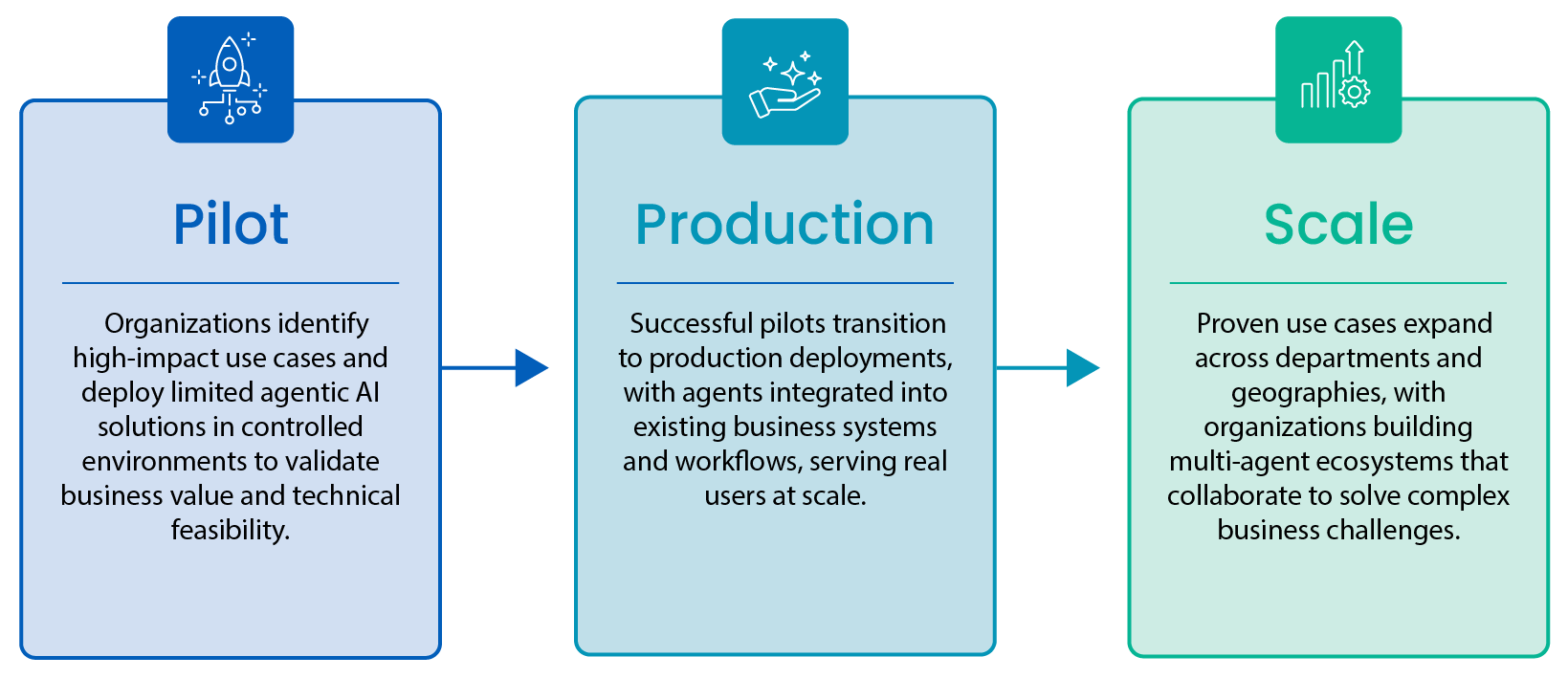
Most enterprises follow a progressive adoption journey, moving from experimentation to enterprise-wide deployment:
-
Pilot
Organizations identify high-impact use cases and deploy limited agentic AI solutions in controlled environments to validate business value and technical feasibility.
-
Production
Successful pilots transition to production deployments, with agents integrated into existing business systems and workflows, serving real users at scale.
-
Scale
Proven use cases expand across departments and geographies, with organizations building multi-agent ecosystems that collaborate to solve complex business challenges.
This use case-led approach ensures that each deployment delivers measurable ROI before expanding investment, while integration into existing systems maintains business continuity.
Key Steps for Successful Agentic AI Adoption
A structured approach is critical for successful adoption:

-
Identify Use Cases
Analyze business processes to find repetitive, decision-heavy tasks where agentic AI can deliver maximum impact. Focus on areas with clear success metrics.
-
Define Business Goals
Establish specific, measurable objectives for each use case, including productivity targets, cost reduction goals, and quality improvements.
-
Select Tools and Models
Choose foundation models and platforms that align with your technical requirements, security standards, and integration needs.
-
Build and Test Agents
Develop AI agents with appropriate guardrails, test extensively in controlled environments, and refine based on performance data.
-
Deploy and Monitor
Roll out agents to production with robust monitoring systems, human oversight mechanisms, and continuous optimization processes.
This step-by-step approach ensures scalable and sustainable adoption.
Different Stages of Agentic AI Adoption
Step 1: Exploration Stage in Agentic AI Adoption
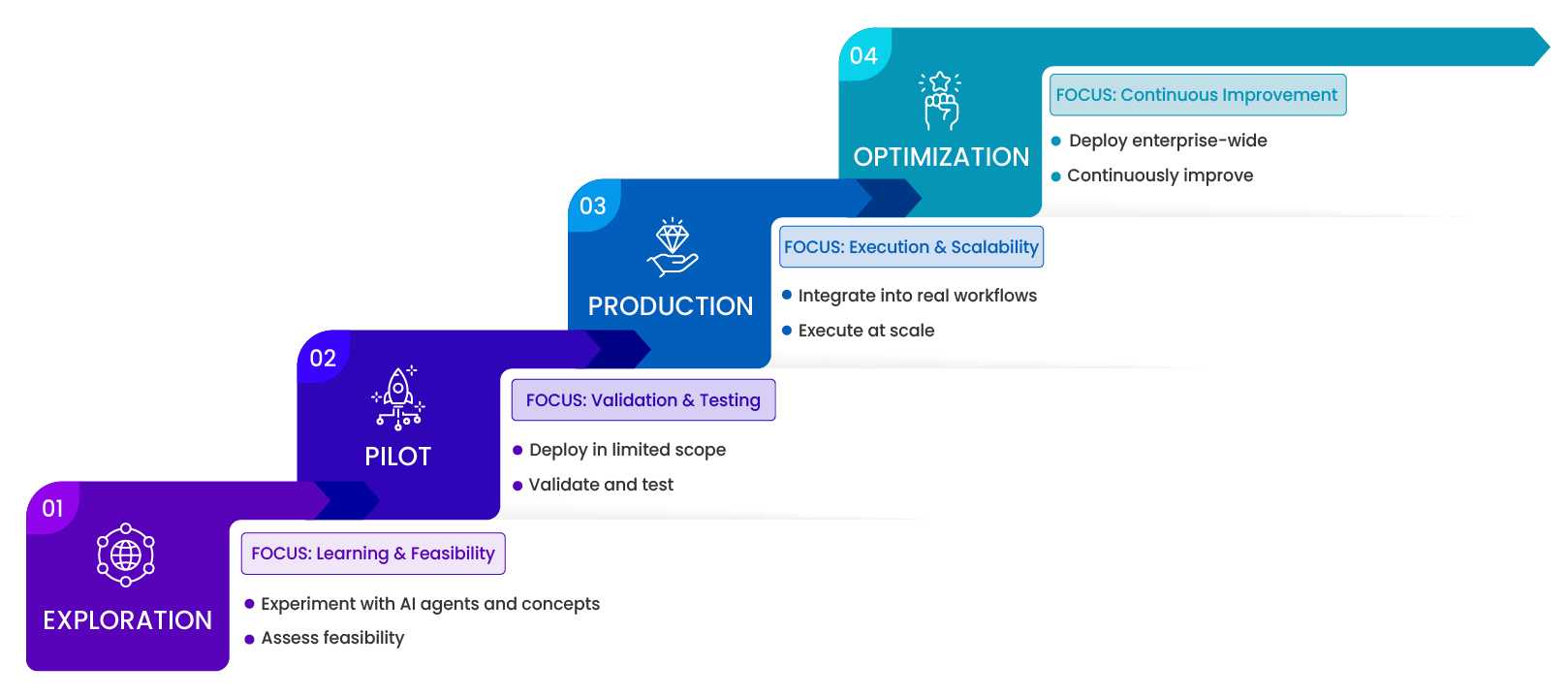
The exploration stage is the first step in Agentic AI adoption, where organizations evaluate how autonomous AI systems can support business operations and workflow automation. Companies experiment with AI agents, orchestration frameworks, and enterprise AI technologies to identify high-impact use cases and assess technical feasibility. At this stage, businesses focus on understanding infrastructure readiness, data availability, integration requirements, governance needs, and potential ROI before moving toward implementation.
Step 2: Pilot Stage for Agentic AI Implementation
During the pilot stage, organizations deploy limited Agentic AI solutions in controlled environments to validate business value and system performance. AI agents are tested for reasoning accuracy, workflow execution, scalability, and integration with enterprise systems such as CRMs, APIs, databases, and automation platforms. The primary goal of this stage is validation and testing, helping businesses measure efficiency improvements, operational impact, and deployment readiness before scaling further.
Step 3: Production Deployment of Agentic AI Systems
In the production stage, Agentic AI systems are integrated into real business workflows and enterprise operations. AI agents begin executing tasks autonomously, interacting with enterprise applications, users, and connected systems at scale. Organizations focus on operational reliability, workflow orchestration, governance, security, and performance monitoring to ensure scalable and secure deployment. This stage marks the transition from experimentation to production-grade autonomous AI execution.
Step 4: Optimization and Scaling of Agentic AI
The optimization stage focuses on scaling Agentic AI adoption across departments, business functions, and enterprise environments. Organizations continuously refine AI agent performance, improve workflow orchestration, strengthen governance frameworks, and optimize decision-making accuracy using real-world feedback and monitoring data. Many enterprises also expand into multi-agent ecosystems where autonomous AI agents collaborate to solve complex operational challenges. The long-term focus is continuous improvement, enterprise scalability, and maximizing business impact through intelligent automation.
Mature organizations move quickly from pilots to production-scale deployments.
Challenges in Agentic AI Adoption
While Agentic AI offers significant opportunities for automation, efficiency, and intelligent decision-making, enterprises often face several challenges when adopting these systems at scale.
-
Integration Complexity
One of the biggest challenges in Agentic AI adoption is integrating AI agents with existing enterprise systems, APIs, databases, and legacy infrastructure. Many organizations operate across fragmented technology environments, making orchestration and seamless workflow execution more difficult.
-
Data Quality and Availability
Agentic AI systems rely heavily on accurate, real-time, and context-rich data to make decisions effectively. Poor data quality, inconsistent formats, missing information, or siloed enterprise data can reduce agent performance and impact decision accuracy.
-
Cost and ROI Uncertainty
Implementing production-grade Agentic AI systems often requires investment in infrastructure, orchestration platforms, integrations, and governance frameworks. Many organizations initially struggle to quantify long-term ROI, operational impact, and business value before large-scale deployment.
-
Governance, Security, and Compliance
As AI agents become more autonomous, enterprises must address governance, explainability, data privacy, and regulatory compliance challenges. Organizations need strong guardrails, human oversight, and responsible AI practices to ensure secure and ethical AI operations.
-
Talent and Skill Gaps
Successful Agentic AI adoption requires expertise in AI engineering, orchestration frameworks, cloud infrastructure, data systems, and workflow automation. However, many enterprises face a shortage of professionals with the technical and strategic skills needed to build and manage autonomous AI systems.
-
Organizational Change Management
Adopting Agentic AI also requires operational and cultural transformation. Employees and teams may resist new AI-driven workflows due to concerns around job changes, process disruption, or lack of understanding. Effective change management and stakeholder alignment are essential for long-term adoption success.
Best Practices for Agentic AI Adoption
Successful Agentic AI adoption requires a strategic balance between technology, governance, scalability, and business outcomes. Organizations should focus on building secure, measurable, and adaptable AI systems that can scale effectively across enterprise workflows.
-
Start with High-Impact Use Cases
Begin with focused use cases where Agentic AI can deliver measurable business value, such as workflow automation, customer support, or operational optimization.
-
Build Scalable AI Architectures
Use modular and scalable architectures that support orchestration, tool integration, memory systems, and enterprise workflows.
-
Maintain Human Oversight
Implement human-in-the-loop governance for critical decisions to improve accountability, reliability, and responsible AI deployment.
-
Prioritize Business Outcomes and ROI
Define clear KPIs around productivity, efficiency, cost reduction, and customer experience to measure the impact of Agentic AI initiatives.
-
Strengthen Data Readiness and Governance
Ensure access to high-quality, secure, and well-governed enterprise data to improve AI performance and decision-making accuracy.
-
Enable Cross-Functional Collaboration
Successful adoption requires alignment between business, IT, data, security, and leadership teams to ensure scalable implementation.
-
Continuously Monitor and Optimize
Monitor AI agent performance, workflow accuracy, and operational outcomes continuously to refine systems and improve long-term scalability.
How Do You Choose the Right Use Cases for Agentic AI?
Choosing the right use cases is one of the most important steps in successful Agentic AI adoption. Organizations should focus on areas where autonomous AI systems can deliver measurable business value while remaining technically feasible to implement and scale.
Focus on Repetitive and Decision-Heavy Workflows
Agentic AI performs best in processes that involve repetitive tasks, structured decision-making, and multi-step workflows. Common examples include customer support, document processing, compliance checks, and IT operations.
Prioritize High-Impact Business Outcomes
The best Agentic AI use cases are those with strong ROI potential, such as reducing operational costs, improving productivity, accelerating response times, or enhancing customer experiences.
Evaluate Data Readiness
Successful AI agents rely on accurate, high-quality, and accessible enterprise data. Organizations should ensure the necessary data is available to support reliable reasoning, automation, and decision-making.
Assess Integration Complexity
Enterprises should evaluate how easily AI agents can integrate with existing systems, APIs, databases, and enterprise applications. Lower integration complexity often leads to faster deployment and scalability.
The most effective Agentic AI use cases combine strong business impact with technical feasibility, allowing organizations to scale adoption more efficiently and deliver measurable outcomes faster.
How Does Governance Impact Agentic AI Adoption?
Governance plays a critical role in successful Agentic AI adoption by ensuring autonomous AI systems operate securely, ethically, and within defined business boundaries. As AI agents become more capable of making decisions and executing tasks independently, organizations need clear governance frameworks to manage risk, maintain accountability, and support responsible AI deployment.
Risk Management and Decision Boundaries
Enterprises should define clear guardrails for acceptable AI agent behavior, decision-making authority, and escalation protocols. This helps prevent unintended actions and ensures critical decisions remain aligned with business policies.
Compliance and Regulatory Readiness
Agentic AI systems often operate across industries with strict regulatory requirements. Organizations must build systems with auditability, transparency, data privacy controls, and compliance monitoring to meet legal and industry standards.
Ethical and Responsible AI Practices
As AI agents influence customer experiences, employee workflows, and business operations, ethical AI becomes increasingly important. Organizations should implement bias detection, explainability mechanisms, and transparent decision-making processes to ensure fairness and accountability.
Strong governance frameworks not only reduce operational and compliance risks but also help organizations build trust, improve scalability, and accelerate long-term Agentic AI adoption.
How Does Cost Impact Agentic AI Adoption?
Cost plays a major role in Agentic AI adoption, especially as organizations evaluate infrastructure, integration, and operational investments against expected business outcomes. Enterprises must balance implementation costs with long-term ROI to ensure scalable and sustainable adoption.
Infrastructure and Deployment Costs
Building Agentic AI systems often requires investment in cloud infrastructure, compute resources, orchestration platforms, integrations, and data pipelines. More advanced autonomous systems may also require higher processing power and real-time execution capabilities.
ROI and Business Value Evaluation
Organizations need to assess whether Agentic AI can deliver measurable improvements in productivity, operational efficiency, customer experience, or cost reduction. Clear ROI metrics help justify investment and support long-term scaling decisions.
Start Small and Scale Strategically
Many enterprises reduce adoption risk by starting with focused pilot projects that target high-impact use cases. Once value is demonstrated, organizations can scale deployments gradually and reinvest operational gains into broader Agentic AI initiatives.
A well-defined adoption strategy helps businesses align Agentic AI costs with measurable business value, making long-term enterprise deployment more effective and sustainable.
ROI of Agentic AI Adoption
Agentic AI adoption can deliver measurable business value by improving operational efficiency, accelerating decision-making, and reducing manual effort across enterprise workflows. As organizations scale autonomous AI systems, the impact is often seen across productivity, cost optimization, and customer experience.
Productivity and Efficiency Gains
By automating repetitive and multi-step workflows, Agentic AI helps teams focus on higher-value strategic work while improving overall operational efficiency.
Cost Reduction and Operational Savings
AI-driven automation reduces manual effort, streamlines processes, and lowers operational overhead, helping organizations optimize resource utilization at scale.
Faster Decision-Making
Agentic AI systems can process data, analyze context, and execute actions in real time, significantly reducing delays in business operations and customer workflows.
Improved Accuracy and Business Outcomes
Autonomous AI agents help reduce human errors, improve consistency, and deliver more reliable outcomes across tasks such as compliance checks, customer support, and operational management.
For example, organizations using Agentic AI for insurance claims processing can reduce processing time by 50–70%, lower operational costs by up to 30%, and improve customer satisfaction through faster and more accurate resolutions.
Future of Agentic AI Adoption
The future of agentic AI adoption is defined by:
-
Enterprise-wide adoption
Agentic AI will evolve from departmental tools to enterprise-wide platforms, with agents embedded across all business functions
-
Multi-agent ecosystems
Organizations will deploy specialized agents that collaborate, negotiate, and coordinate to solve complex cross-functional challenges
-
Autonomous business processes
End-to-end workflows will operate with minimal human intervention, from supply chain optimization to customer lifecycle management
-
AI-driven organizations
The most advanced enterprises will restructure around AI capabilities, with humans focusing on strategy, creativity, and oversight while agents handle execution
Agentic AI will become the foundation of next-generation digital enterprises.
How Does Quantiphi Support Agentic AI Adoption?
Quantiphi brings deep expertise in enterprise AI transformation, helping organizations navigate the complete journey from strategy to scaled deployment. With end-to-end implementation capabilities spanning use case identification, platform selection, agent development, and production deployment, Quantiphi accelerates time-to-value while reducing risk.
The company’s industry expertise across healthcare, financial services, retail, and manufacturing ensures agents are designed with domain-specific knowledge and compliance requirements built in.
Quantiphi’s baioniq platform provides the infrastructure for scalable AI solutions, bridging foundation models with enterprise needs through retrieval optimization, fine-tuning, and governance controls. Throughout every engagement, responsible AI practices guide development, ensuring transparency, fairness, and accountability in autonomous systems.
Final Thought
Agentic AI adoption is not just a technology shift; it’s a strategic transformation. Organizations that successfully build the right roadmap, align stakeholders, and invest in scalable systems will unlock the full potential of autonomous AI, driving efficiency, innovation, and long-term competitive advantage.
Ready to move from AI experimentation to enterprise-scale impact? Connect with Quantiphi to build and scale agentic AI systems that drive real-world outcomes.