Agentic AI in Banking : The Next Frontier for Smart Banking

Leverage intelligent AI agents that reason, adapt, and operate autonomously to elevate your banking operations and deliver exceptional consumer experience
In an era where financial institutions are racing to redefine customer experience, the financial services landscape is undergoing a seismic shift. With Gartner predicting that Agentic AI will autonomously resolve 80% of common customer service issues by 2029, financial institutions are at the cusp of a revolutionary transformation.
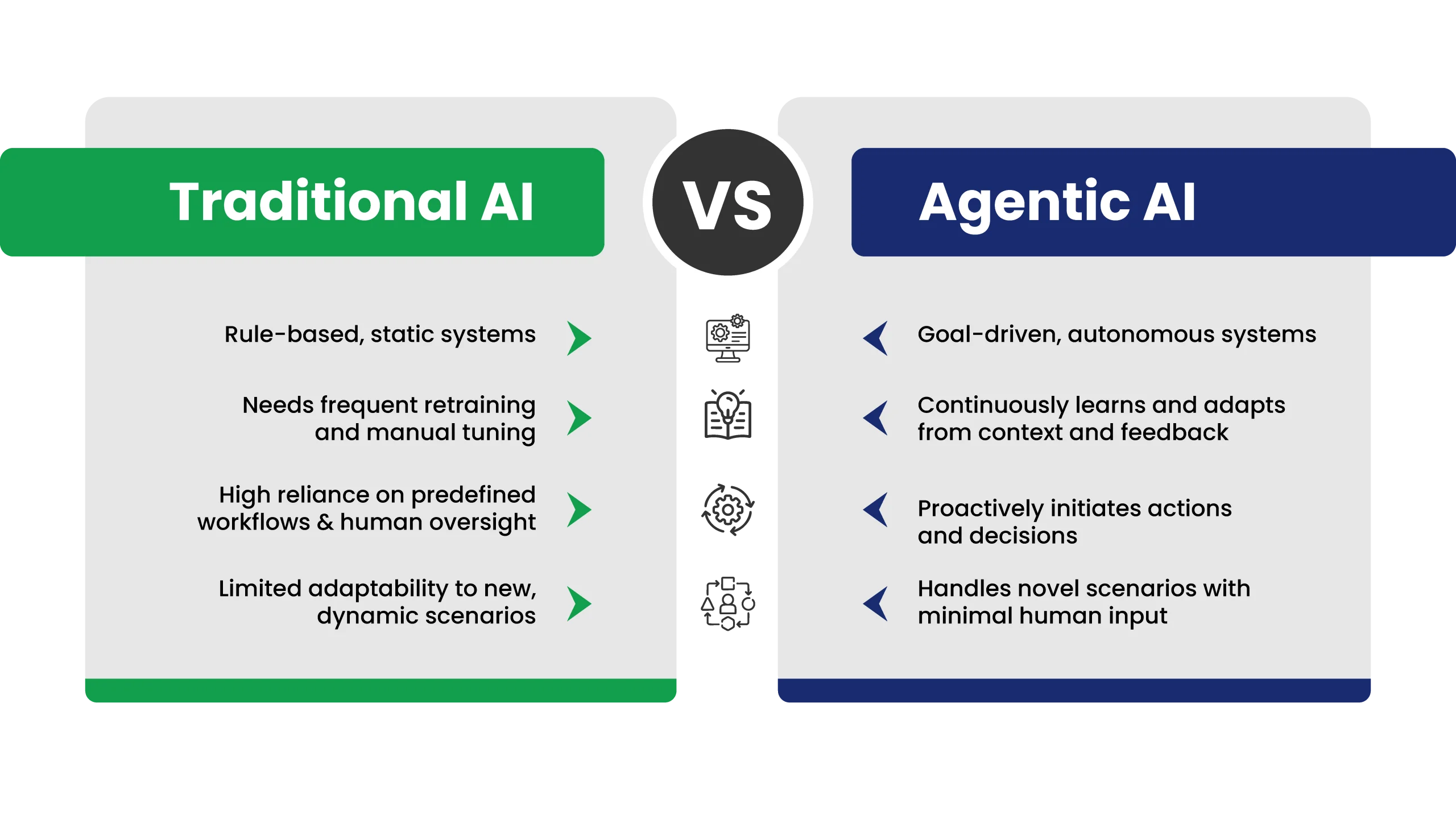
Traditional AI vs. Agentic AI: The Shift Toward Agentic AI in Banking
Agentic AI in banking represents a revolutionary advancement from traditional AI systems to autonomous, intelligent agents capable of independent decision-making and adaptive learning. Unlike conventional automation that follows predetermined rules, these AI agents possess true agency—the ability to reason, adapt, and make complex decisions across banking operations.
Benefits of Agentic AI in Banking
Some of the major benefits delivered by agentic AI to banking institutions are:
- Operational Efficiency:Agents can handle tasks across departments—24/7—with greater speed and fewer errors, dramatically reducing costs and turnaround time.
- Improved Decision-Making: Through continuous learning and contextual reasoning, Agentic AI enables data-driven decisions in real-time, often uncovering insights human analysts might overlook.
- Increased Resilience: Agentic systems can anticipate potential breakdowns—technical or financial—and proactively reconfigure operations to maintain business continuity.
- Personalized Experiences at Scale: Each customer’s banking experience can be hyper-personalized, with agents acting as digital financial concierges, learning and adapting to individual behavior patterns.
Agentic AI in Banking: Real-World Use Cases Shaping the Future
As global financial institutions modernize for a digital-first world, agentic AI is already reshaping operations in measurable ways. Here are the key use cases:
Customer Service Assistants That Think Ahead
In modern banking, responsiveness is table stakes. Agentic AI is upping the game by powering assistants that understand customer context, retrieve relevant data in real time, and draft responses proactively—elevating customer service into intelligent orchestration.Bank of America’s AI agent Erica, actively oversees customer accounts, provides spending notifications, assists with scheduling bill payments, and implements fraud prevention measures without human intervention.
Similarly, the AI agents at JPMorgan Chase handle everyday customer queries, manage account-related tasks automatically & even pre-approve certain loan applications by accessing multiple internal systems.
Source: TheFinancialBrand
Fraud Response That’s Faster Than the Fraud
Agentic AI is enabling a paradigm shift in fraud detection: from passive monitoring to autonomous intervention. These systems identify threats, take action, and escalate in real time—before damage is done.Wells Fargo deploys AI agents that actively analyze transaction behaviors, automatically suspending potentially compromised cards, delivering instant notifications to customers, and streamlining the dispute resolution procedures.
Source: TheFinancialBrand
Intelligent Risk & Compliance Management
Agentic AI is redefining the way banks manage regulatory complexity—moving from static rule-based systems to agents that adapt in real time, autonomously adjusting to evolving compliance demands and capital requirements.HSBC is leveraging agentic AI to modernize credit risk management, enabling automated regulatory adaptation and real-time capital allocation. These agentic systems help banks to continuously align with global compliance standards while optimizing resource deployment—without requiring manual recalibration.
Source: Economic Times
-
Back-Office Agents That Run the Ops
Not all transformations are customer-facing. Behind the scenes, banks are deploying agentic AI to manage repetitive and complex operational flows—freeing up human bandwidth while improving accuracy and speed.HSBC is working to explore agents that can autonomously manage middle and back-office operations, including trade reconciliation and compliance checks—transforming months of processing into minutes.
-
Autonomous Cybersecurity in Action
With growing digital threat vectors, banks are using agentic AI to secure their environments—autonomously detecting, triaging, and mitigating risks in real time.HDFC Bank is integrating agentic AI into its SOC (Security Operations Center), where autonomous bots monitor for anomalies, classify risk levels, and initiate responses—operating as intelligent cybersecurity agents.
-
Proactive Financial Insights for Customers
Banks are increasingly using agentic systems to predict customer needs, send real-time nudges, and offer tailored financial recommendations without needing user input.HDFC Bank, along with other early movers, is deploying agentic platforms that analyze behavior and autonomously deliver insights on savings, spending, or investment opportunities—turning mobile banking into an intelligent experience.
Tackling BFS Challenges with Agentic AI
Implementing Agentic AI brings tremendous potential but also unique hurdles that banking leaders must navigate carefully to ensure success. Key challenges include:
- Compliance with Strict Regulatory Standards: Banking regulations demand transparency in AI decision-making. Agentic AI models must explain their reasoning and avoid bias in areas like credit scoring, fraud detection, and loan approvals.
- Data Security and Privacy Concerns: Banks handle sensitive customer data, making data security paramount. Agentic AI systems must adhere to strict privacy regulations like GDPR and CCPA, ensuring data protection and responsible use.
- Ethical Considerations & Bias in AI Decisions: If AI models are trained on biased historical data, they may discriminate against certain demographics. Agentic AI must be regularly audited to ensure fairness and transparency.
- Integration with Legacy Banking Systems: Many banks still operate on outdated IT infrastructures. Seamless integration of Agentic AI with legacy CRM, payment gateways, and risk management platforms remains a challenge.
Technology Behind Agentic AI
The foundation of Agentic AI in banking rests on these critical technologies:
- Machine Learning & Deep Learning: Allows AI to learn from past transactions, market trends, and customer behavior patterns.
- Natural Language Processing (NLP) & Chatbots: Powers autonomous customer support and personalized financial advice.
- Edge AI & Cloud Computing: Ensures real-time AI decision-making across distributed banking systems.
- Multi-Agent AI Systems: Enables multiple AI agents to collaborate for complex workflows like portfolio management and risk analysis.
How Can We Help
- Compliance-Focused AI: Build explainable AI models that meet regulatory requirements, minimize bias, and ensure fairness.
- Robust Data Security: Implement industry-leading security measures to protect sensitive data within organizational boundaries, ensuring complete data sovereignty and compliance with privacy regulations.
- Seamless Integration: Integrate AI solutions with existing banking systems, minimizing disruption and ensuring smooth transition.
- Ethical AI Development: Employ rigorous testing and validation processes to identify and mitigate bias in AI models.
- Tailored Solutions: Offer customized AI solutions tailored to specific banking challenges, such as fraud detection, risk assessment, and personalized financial advice.
Human-AI Partnership: Co-Workers, Not Replacements
One of the most exciting aspects of Agentic AI is its complementarity with human roles. These systems aren’t here to replace bankers, advisors, or compliance officers. Instead, they take over repetitive, data-heavy, and real-time reactive tasks, freeing up knowledge workers’ bandwidth to focus on strategic, creative, and relational work.
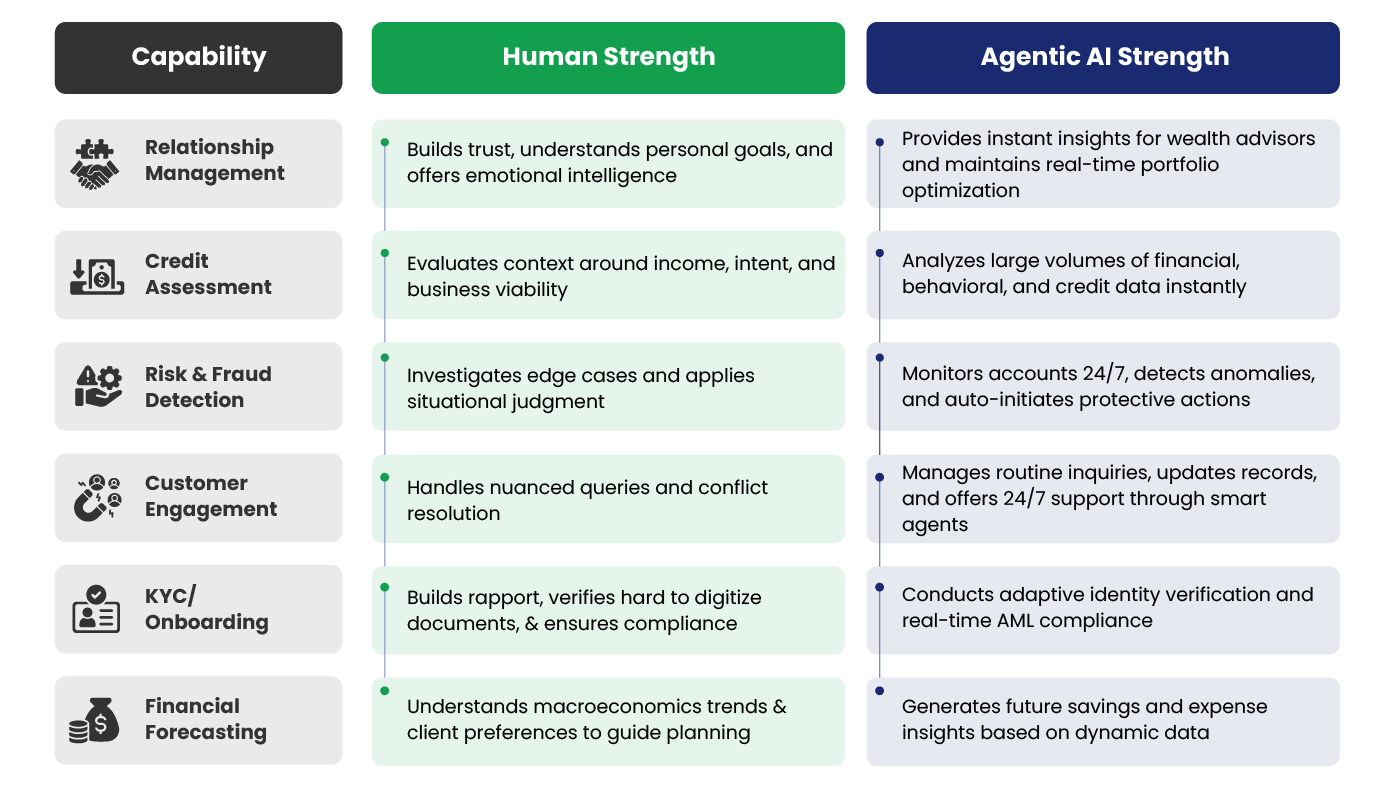
Human x AI: Why This Balance Matters
In finance, trust is currency. Agentic AI brings automation, scale, and intelligence & humans ground decision-making in ethics, empathy, and strategic foresight. Together, they enable:
- AI-automated services reducing costs and reaching more customers
- Smarter compliance that’s both scalable and nuanced
- Faster customer service that doesn’t lose the personal feel
- Resilient systems that react to crises without panic, but with precision
Real-World Use Case: Agentic Workflows with baioniq
baioniq, Quantiphi’s enterprises search and generative AI agent, is built to operationalize agentic intelligence at scale—empowering financial institutions to unlock unprecedented efficiency, accuracy, and agility. With its autonomous agents and no-code workflows, Baioniq enables banks, wealth managers, and financial service providers to automate high-value processes across departments.
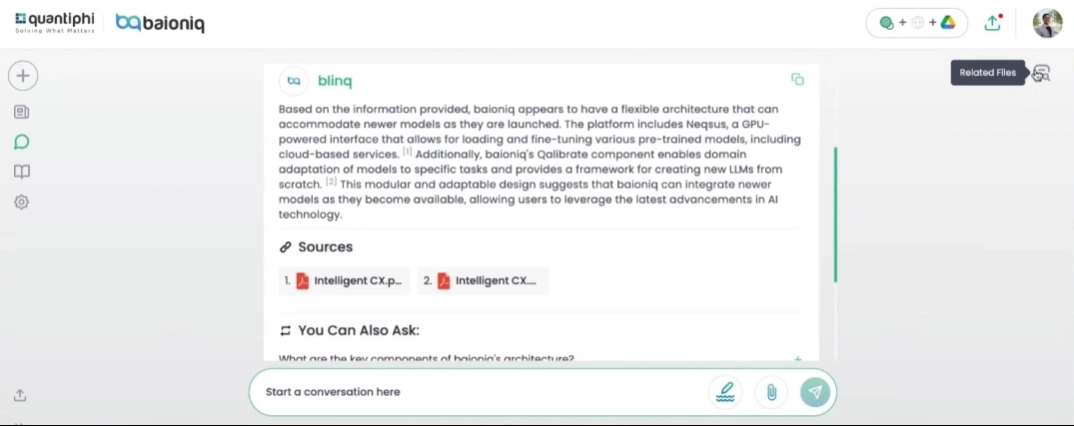
Key Features:
- Custom Skills: Build workflows specific to banking needs like KYC validation or compliance checks.
- Intelligent Agents: Coordinate multi-step processes with autonomy and context-awareness.
Partner with Quantiphi
With 12+ years of AI-first digital engineering expertise, Quantiphi is ideally positioned to help financial institutions navigate their journey toward agentic AI adoption. Our deep understanding of banking operations, combined with our proven track record in artificial intelligence and machine learning, makes us the right partner to help banks explore and implement autonomous intelligent solutions. Partner with Quantiphi to explore how agentic AI can enhance your banking operations while maintaining the security, compliance, and reliability standards that your stakeholders expect.
Quantiphi can help you deploy AI Agents faster through reusable pipelines and pre-built agents that cut development cycles by half and we can help you standardize agent development lifecycle with common tooling, templates, and risk controls. We can also help you establish Risk & Governance Gates for consistent pre-launch RAI and post-launch monitoring.
Final Thoughts
As banks grapple with economic uncertainty, digital disruption, and rising customer expectations, agentic AI offers a strategic edge. It doesn’t just “assist”—it acts. It learns, adapts, and makes decisions within defined ethical and operational boundaries.
The institutions that lean into this shift early—investing in trustworthy, explainable, and secure agentic systems—will be the ones defining the future of finance.