What is AI Agent Memory? Data, Context, and Memory in Agentic AI Systems

What Is Agentic Memory in AI Agents?
Agentic memory in AI agents is what transforms intelligent systems from reactive to truly adaptive. AI agents with memory can store, recall, and build on information over time, enabling true context-aware intelligence rather than one-off responses. It forms the backbone of autonomous behavior, helping agents understand what has already happened, what matters, and what to do next across multi-step tasks.
For example, consider a customer support AI agent handling a complex query over multiple interactions. A stateless system would treat each message independently, forcing users to repeat context. In contrast, an agent with memory can track prior conversations, recall preferences, and adapt its responses based on what has already been resolved, delivering a seamless and intelligent experience.
This distinction highlights why memory is essential for agentic AI. Unlike stateless AI systems that reset with every interaction, agentic systems use memory to create continuity, adapt dynamically, and operate with greater coherence, making them far more effective in real-world, goal-driven environments. Let’s take a closer look.
Why Do AI Agents Need Memory?
Memory is a foundational capability that enables agents to operate beyond single-step interactions. It helps AI agents:
Maintain context across interactions
Memory allows AI agents to retain information from previous steps or conversations, ensuring continuity. This is critical in multi-turn interactions where understanding past inputs directly impacts current responses.
Enable personalization
By remembering user preferences, behaviors, and prior interactions, agents can tailor responses and actions, creating more relevant and user-specific experiences over time.
Improve decision-making
By remembering user preferences, behaviors, and prior interactions, agents can tailor responses and actions, creating more relevant and user-specific experiences over time.
Support long-running workflows
Many real-world tasks span multiple steps and timeframes. Memory enables agents to track progress, manage dependencies, and execute complex workflows without losing state.
What Are the Types of Agentic Memory?
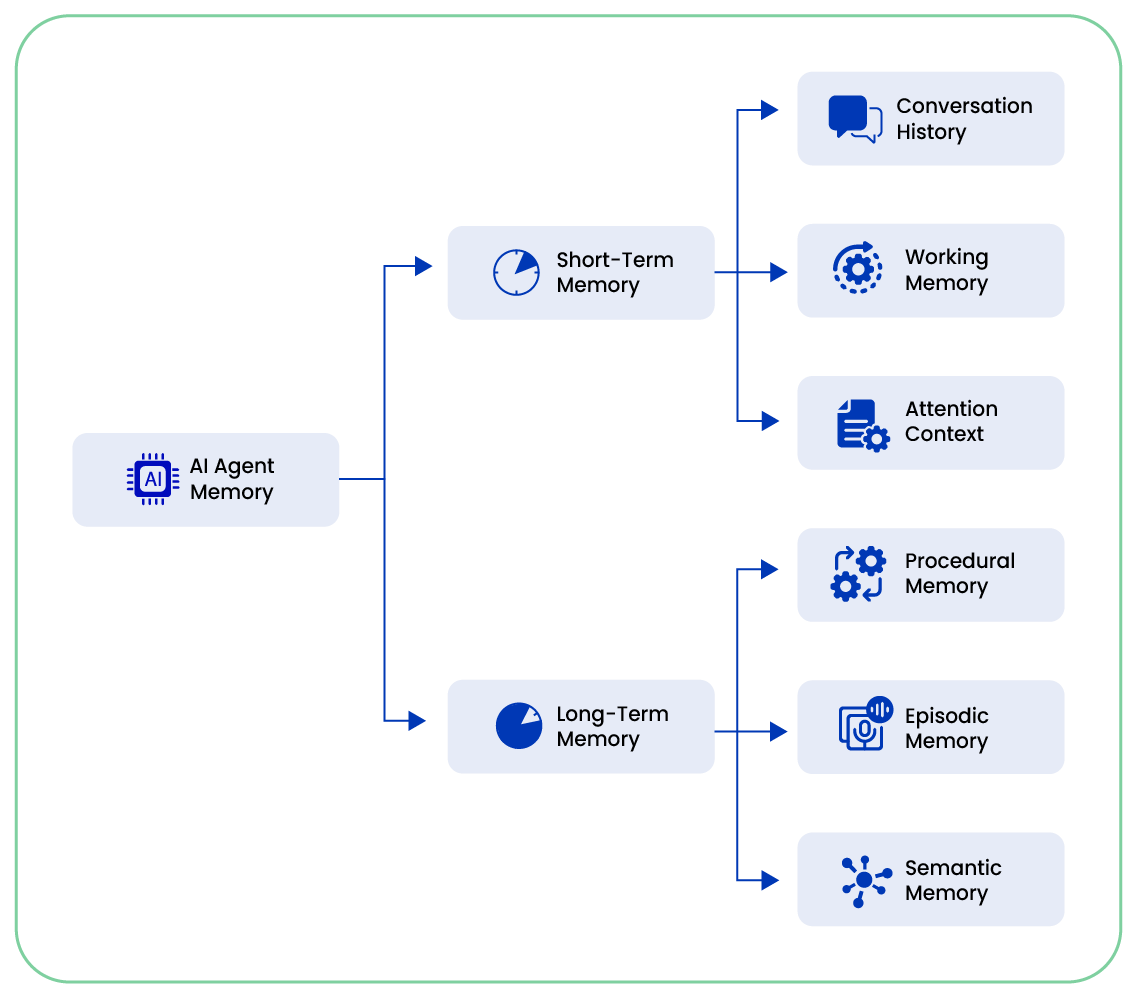
Agentic memory can consist of a combination of mechanisms that allow an AI agent to retain context, access knowledge, and execute tasks over time. At a high level, memory in AI agents can be divided into two layers: short-term memory, which handles immediate context, and long-term memory, which enables persistence across interactions. Within long-term memory, more specialized forms, like episodic, semantic, and procedural memory, determine how information is organized and used.
Short-Term Memory
Short-term memory is the information an agent actively works with during a task or interaction. It exists within the model’s execution loop and is tightly tied to the context passed into each step.
In practice, this includes:
- Recent user inputs and system responses
- Intermediate reasoning steps
- Current goals or instructions
This layer enables the agent to stay coherent within a conversation or workflow. However, it is bounded and temporary; once the interaction ends or exceeds capacity, the information is no longer available. This makes short-term memory ideal for real-time reasoning, but insufficient for continuity across sessions.
Long-Term Memory
Long-term memory allows an agent to retain and reuse information beyond a single interaction. It is typically implemented outside the model using vector databases, document stores, or structured knowledge layers. This layer is responsible for:
- Storing historical interactions
- Retaining user preferences or state
- Providing domain knowledge when needed
Rather than being passed directly into every step, long-term memory is usually accessed through retrieval mechanisms, where only relevant information is brought into the agent’s working context.
Episodic Memory
Episodic memory captures what the agent has experienced over time: specific interactions, actions taken, and their outcomes. These are structured records that can be queried when needed. It allows the agent to:
- Revisit past conversations or workflows
- Identify patterns in prior interactions
- Adjust behavior based on what has previously worked
For example, an agent assisting with onboarding tasks may recall earlier steps completed by a user and continue from the correct stage without restarting the process.
Semantic Memory
Semantic memory refers to the knowledge an agent can draw upon that is not tied to a specific interaction. This includes:
- Domain-specific information
- Definitions, rules, and relationships
- Structured or unstructured knowledge sources
In modern systems, this is often implemented using embedding-based retrieval or indexed knowledge stores, allowing the agent to fetch relevant information dynamically. Semantic memory is what enables the agent to reason, explain, and operate with domain awareness.
Procedural Memory
Procedural memory defines how an agent performs tasks, rather than what it knows or remembers. It includes:
- Task flows and execution sequences
- Tool usage patterns
- Predefined or learned strategies for completing actions
Instead of recomputing every step, the agent can follow established patterns, improving both speed and consistency. In many systems, this is encoded through orchestration logic, prompt templates, or learned policies.
Together, they enable AI agents to function as stateful systems that can maintain context, retrieve relevant information, and execute complex workflows without starting from scratch each time.
Short-Term vs. Long-Term Memory in AI Agents
Short-term and long-term memory serve distinct but complementary roles in agentic AI systems. While short-term memory focuses on immediate context and active interactions, long-term memory enables persistence and learning across sessions and workflows. Together, they allow AI agents to operate both in the moment and over time.
| Aspect | Short-Term Memory | Long-Term Memory |
| Scope | Limited to recent interactions and current context | Broad, spanning historical data, knowledge, and past interactions |
| Persistence | Temporary (cleared after session or context window limit) | Persistent (stored across sessions and time) |
| Usage | Maintains conversational flow and immediate task context | Enables recall of past events, preferences, and learned knowledge |
| Speed | Fast access, used in real-time reasoning | Slightly slower retrieval, often requires search or indexing |
| Data Type | Recent messages, active variables, current goals | User history, structured knowledge, past outcomes |
Episodic vs. Semantic Memory in Agentic AI
Episodic and semantic memory represent two distinct ways AI agents store and use information. While episodic memory captures specific experiences and interactions, semantic memory focuses on structured knowledge and facts. Together, they enable agents to both remember what happened and understand what it means, supporting more effective reasoning and learning.
| Aspect | Episodic Memory | Semantic Memory |
| Definition | Memory of specific events or interactions | Memory of general knowledge, facts, and concepts |
| Nature | Experience-based and contextual | Knowledge-based and abstract |
| Content | Conversations, actions taken, outcomes | Rules, definitions, structured data |
| Time Sensitivity | Tied to when events occurred | Time-independent |
| Role | Helps agents recall past experiences | Helps agents understand and reason using knowledge |
Example:
In a customer support AI agent, episodic memory stores a user’s previous issue, the steps taken to resolve it, and the outcome. Semantic memory, on the other hand, contains knowledge about product features, troubleshooting steps, and policies. When a similar issue arises, the agent can combine both, resulting in faster and more accurate responses.
How Does Memory Work in Agentic Systems?
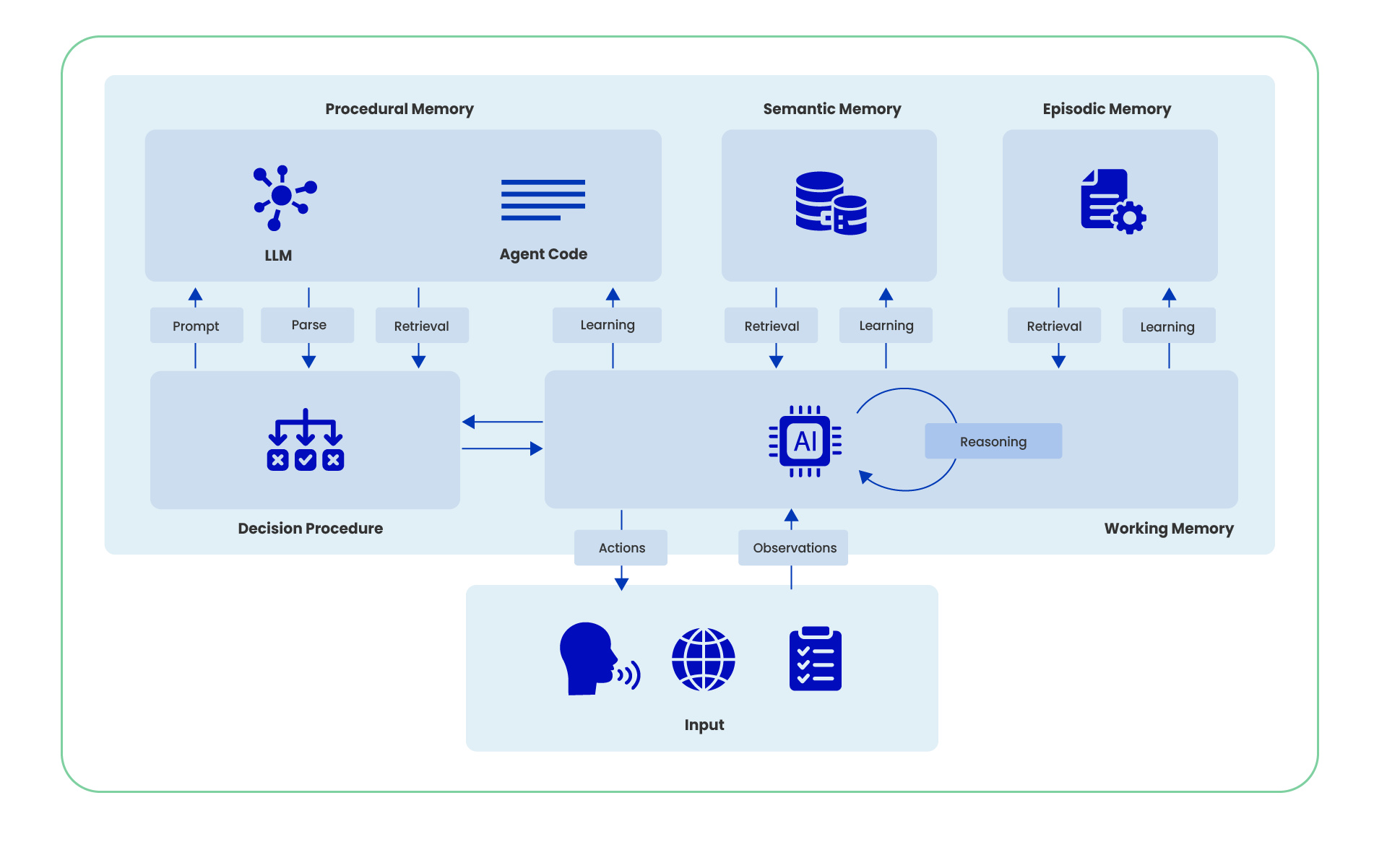
Input → Short-Term Memory:
The incoming input is first processed within short-term (working) memory, where it is combined with the current objective, task state, and recent interactions to establish immediate context.
Triggering Retrieval from Long-Term Memory:
Using this context, the agent determines what additional information is needed and queries long-term memory accordingly.
Accessing Episodic Memory:
The agent pulls in relevant past experiences, like previous interactions, sequences, and outcomes, to inform how similar situations were approached earlier.
Accessing Memory Retrieval:
It retrieves factual knowledge, user-specific details, and domain understanding to ensure responses are accurate and contextually grounded.
Accessing Procedural Memory:
The agent references established workflows or action patterns, helping it choose efficient and proven ways to carry out the task.
Context Fusion in Short-Term Memory:
The retrieved insights are merged back into short-term memory, enriching the agent’s current understanding before decision-making.
Decision-Making and Action:
With this enhanced context, the agent plans next steps, interacts with tools if needed, and generates outputs, while continuously updating its working memory.
Reflection and Evaluation:
Once actions are completed, the agent reviews the results to identify what was effective, what needs adjustment, and what is worth retaining.
Memory Update (Write-back to Long-Term Memory):
Valuable learnings are stored appropriately, e.g.: experiences into episodic memory, knowledge into semantic memory, and refined methods into procedural memory, enabling better future performance.
How Does Memory Improve Agentic AI Performance?
Agentic memory significantly enhances the effectiveness of AI systems by enabling them to retain context, learn from past interactions, and make more informed decisions over time. Instead of reacting to each input independently, memory allows agents to operate with continuity and purpose.
Better Context Retention
Memory enables agents to carry forward relevant information across interactions, ensuring continuity in conversations and workflows. This is especially critical in multi-step tasks, where understanding previous inputs directly impacts the quality of current responses.
Reduced Hallucinations
By grounding outputs in stored context, historical interactions, or validated knowledge, memory reduces the likelihood of generating incorrect or fabricated responses. It helps anchor the agent’s reasoning in known data rather than purely probabilistic outputs.
Improved Personalization
Agents can adapt their responses based on user preferences, past behavior, and interaction history. Over time, this leads to more relevant, tailored experiences that feel consistent and aligned with user expectations.
More Accurate Decision-Making
Access to prior outcomes, actions taken, and contextual signals allows agents to make better decisions in complex workflows. This is particularly valuable in scenarios where decisions depend on accumulated knowledge rather than a single input.
Example:
In a customer support workflow, an agent with memory can recall previous issues, solutions provided, and user preferences. This allows it to avoid redundant questions, suggest more relevant solutions, and resolve issues faster.
How is Agentic Memory Used in Real-World Use Cases?
Agentic memory plays a critical role in enabling AI systems to function effectively in real-world environments, where tasks are rarely isolated and often require continuity, context, and adaptation over time.
Customer Experience
Memory enables agents to carry forward relevant information across interactions, ensuring continuity in conversations and workflows. This is especially critical in multi-step tasks, where understanding previous inputs directly impacts the quality of current responses.
Reduced Hallucinations
By grounding outputs in stored context, historical interactions, or validated knowledge, memory reduces the likelihood of generating incorrect or fabricated responses. It helps anchor the agent’s reasoning in known data rather than purely probabilistic outputs.
Improved Personalization
Agents can adapt their responses based on user preferences, past behavior, and interaction history. Over time, this leads to more relevant, tailored experiences that feel consistent and aligned with user expectations.
More Accurate Decision-Making
Access to prior outcomes, actions taken, and contextual signals allows agents to make better decisions in complex workflows. This is particularly valuable in scenarios where decisions depend on accumulated knowledge rather than a single input.
How to Architect Agentic Memory Systems?
Designing memory for AI agents is about deciding what information should be retained, how it should be retrieved, and when it should influence the agent’s behavior. A well-architected memory system balances relevance, latency, and accuracy, ensuring that the agent has access to the right context without being overwhelmed by unnecessary information.
Define the Right Memory Layers for the Use Case
The starting point is identifying the memory types the agent actually needs. Not every system requires all forms of memory.
For instance, a conversational agent may rely heavily on short-term context and episodic interaction history, while a domain-specific assistant may depend more on semantic knowledge. The goal is to design a memory architecture that is aligned with the task: capturing what is necessary, without adding complexity that does not improve performance.
Optimize Retrieval Mechanisms
Memory is only useful if it can be retrieved efficiently. In most agentic systems, long-term memory is stored externally and accessed dynamically.
This makes retrieval design critical. Systems must be able to surface the most relevant information quickly, often using similarity-based search and ranking techniques. The challenge is precision: retrieving the right context without introducing noise that can affect the agent’s output.
Manage Context Injection Efficiently
Once memory is retrieved, it must be carefully integrated into the agent’s working context. AI models operate within limited context windows, and excessive or redundant information can reduce both performance and accuracy.
Effective systems prioritize high-signal information and often compress or summarize retrieved memory before injecting it into the reasoning process. This ensures that the agent remains focused while still benefiting from past context.
Implement Retention and Update Policies
Memory systems must evolve over time. Without clear retention strategies, stored information can quickly become outdated or irrelevant. Designing mechanisms to update memory based on new inputs, remove stale data, and maintain accuracy is essential. This is especially important in dynamic environments, where decisions depend on current and reliable context.
Balance Persistence with Privacy and Control
Because memory often includes user or operational data, it must be handled with care. Systems need clear rules around what is stored, how long it is retained, and how it can be accessed or modified. Balancing persistence with control ensures that memory improves the agent’s capabilities without introducing risks related to data privacy, compliance, or misuse.
Best Practices for AI Agent Memory Design
Designing memory is only part of the challenge; ensuring it performs reliably in real-world systems requires a set of practical guardrails. The following best practices help maintain accuracy, efficiency, and long-term effectiveness in agentic memory systems.
Use hybrid memory models
Combine short-term and long-term memory to balance immediate context with persistent knowledge. This allows agents to reason effectively in the moment while still leveraging historical data when needed.
Limit unnecessary context
Avoid storing or retrieving excessive information that does not directly contribute to the task. Keeping memory focused and relevant improves response quality and reduces latency.
Regularly update memory
Ensure that stored information remains accurate by refreshing or replacing outdated data. This prevents memory drift and reduces the risk of decisions being based on stale context.
Combine memory with evaluation mechanisms
Continuously assess how memory is influencing outputs. Monitoring performance and validating results helps ensure that memory is improving outcomes rather than introducing errors or bias.
The Challenges and Risks of Agentic Memory
While agentic memory enables more intelligent and context-aware systems, it also introduces a set of challenges that can impact reliability, performance, and trust if not properly managed. Let’s take a look:
Memory drift and outdated data
Over time, stored information can become inaccurate or irrelevant as conditions change. If not updated regularly, agents may rely on stale context, leading to poor decisions or inconsistent outputs.
Context overload
As memory grows, retrieving too much information can overwhelm the system. Excessive context not only increases latency but can also confuse the model, reducing the quality and focus of its responses.
Retrieval inaccuracies
Memory systems depend heavily on retrieving the right information at the right time. If irrelevant or partially related data is surfaced, it can distort reasoning and lead to incorrect or suboptimal outcomes.
Data privacy concerns
Storing user interactions, preferences, or operational data raises important questions around security and compliance. Without proper controls, memory systems can expose sensitive information or violate data protection requirements.
Memory poisoning risks
If incorrect or malicious inputs are stored, they can influence future behavior. Over time, this can degrade system performance or introduce vulnerabilities, especially in systems that rely heavily on learned or accumulated memory.
The Future of Agentic Memory: A New Paradigm for Intelligent Systems
We have reached a pivotal moment where autonomous agents are developing sophisticated memory systems that fundamentally transform their capabilities. Studies have shown that AI agents can develop internal representations of their environments without explicit programming, creating emergent mapping capabilities solely through experience
This phenomenon suggests that future agentic memory systems will possess increasingly sophisticated spatial and temporal understanding, enabling navigation and decision-making in complex, dynamic environments.
As autonomous agents become integral to business operations, their memory systems will need to balance performance with governance. Future architectures must incorporate explainability and accountability mechanisms, ensuring that decision-making processes remain transparent and auditable. This requirement becomes particularly critical as agents handle sensitive data and make consequential decisions affecting human stakeholders.
Looking ahead, agentic memory will likely evolve toward distributed, collaborative frameworks where multiple agents share and synthesize experiences. This collective intelligence approach could dramatically enhance problem-solving capabilities while maintaining individual agent specialization.
Furthermore, advances in neuromorphic computing and quantum technologies may enable memory systems that mirror biological neural networks, offering unprecedented efficiency and adaptability. All in all, the future of agentic memory lies in creating novel architectures that leverage computational advantages while maintaining ethical boundaries and operational transparency.
Building Agentic Memory Systems: The Quantiphi Way
At Quantiphi, we approach agentic memory as a core part of how intelligent systems are designed to operate at scale. We focus on building memory architectures that can handle dynamic context, persist relevant information, and integrate seamlessly with modern AI frameworks.
This includes designing efficient retrieval mechanisms, ensuring secure and compliant data handling, and enabling memory to evolve with the system over time. At the same time, we apply responsible AI practices to ensure that memory is used thoughtfully, maintaining accuracy, minimizing risk, and supporting reliable, real-world decision-making.
Explore Quantiphi’s Agentic AI solutions.