AI in Banking: The Complete Guide to Artificial Intelligence Transforming Financial Services

This blog will cover the shift from AI experimentation to enterprise-scale execution. We examine why AI is an imperative for the banking industry and how it operates across high-impact use cases, adoption benefits, challenges, and risk mitigation strategies alongside the operating models and technologies required for successful AI implementation.
1. What is Artificial Intelligence (AI) in Banking?
Artificial Intelligence (AI) in banking refers to the use of data-driven algorithms and systems to analyze information, automate processes, and support decision-making across financial services. Unlike traditional rule-based systems, AI can learn from data, identify patterns, and adapt over time, enabling banks to handle complex, high-volume tasks with greater accuracy and speed.
In practice, AI is used across areas such as customer interactions, fraud detection, credit decisioning, and operational automation, helping banks improve efficiency, manage risk more effectively, and deliver more responsive customer experiences.
2. Why is AI Important in Banking Today?
The urgency for AI adoption is driven by a convergence of technological maturity and intensifying market pressures.
-
Digital transformation:
Banks are shifting from digitizing processes to embedding data-driven decision-making and automation directly into workflows, making operations more adaptive and efficient.
-
Customer expectations:
Customers expect fast responses, seamless digital experiences, and interactions tailored to their needs—something that requires AI to deliver consistently at scale.
-
Operational efficiency:
AI helps reduce manual effort, streamline processes, and improve productivity across both front-office and back-office functions in increasingly complex banking environments.
-
Competition:
Fintechs and digital-native institutions are leveraging AI to deliver faster, more intuitive services, pushing banks to modernize their capabilities to remain competitive.
-
Rise of real-time decisioning:
With the rise of instant payments and digital channels, banks need to detect fraud, assess risk, and make decisions instantly—capabilities that rely heavily on AI.
-
Risk and compliance demands:
AI enables better monitoring, anomaly detection, and risk assessment, helping banks maintain control while operating at higher speed and scale.
3. How Does AI Work in Banking?
Moving from experimental pilots to production-grade systems requires a robust AI banking pipeline.
-
Data Ingestion & Unification:
Centralizing fragmented data from across the enterprise is the first step. For AI to reason over a complete customer view, banks must unify data that typically sits across more than five disparate systems. Leaders usually require 12–18 months for this foundation.
-
Model Training & Validation:
Algorithms are trained on high-quality datasets to recognize financial patterns. Currently, only about 35% of surveyed institutions have fully validated their AI models for production, signaling a significant readiness gap.
-
Feature Engineering:
This involves extracting specific variables—such as transaction velocity, behavioral biometrics, or geographical consistency—that allow models to make precise decisions in real-time.
-
Decision Engines & Hybrid Models:
AI-rule engine hybrids combine machine learning insights with institutional guardrails. These systems move from simple “if-then” logic to reasoning about intent to automate high-stakes decisions like loan approvals.
-
Integration with Core Systems:
Modern API connectors bridge legacy core banking platforms with AI agents. By utilizing protocols like Model Context Protocol (MCP), agents can securely connect data across disparate systems, ensuring context travels with the customer from mobile to call centers.
Step-by-Step Process:

4. What are the Key Use Cases of AI in Banking?
AI is transforming every aspect of banking operations. Here are the most impactful use cases:
-
Customer Service & Engagement
-
AI-Powered Chatbots:
Enable 24/7 customer support by handling routine queries, reducing wait times, and improving service availability while freeing up human agents for more complex issues.
-
Virtual Assistants:
Go beyond basic support to provide personalized financial guidance, account insights, and proactive alerts based on customer behavior and preferences.
-
Intelligent Contact Centers:
Use AI for smart call routing, sentiment analysis, and real-time agent assistance, helping improve resolution rates and overall customer satisfaction.
-
-
Fraud Detection & Prevention
-
Real-Time Transaction Monitoring:
Continuously analyzes transactions to detect suspicious patterns instantly, helping prevent fraud before it impacts customers or the bank.
-
Behavioral Analytics:
Builds a baseline of normal user behavior and flags deviations, enabling detection of account takeovers or unusual activity that rule-based systems may miss.
-
Network Analysis:
Uses graph-based techniques to uncover connections between entities, helping identify coordinated fraud schemes and hidden relationships across accounts.
-
-
Credit Scoring & Underwriting
-
Alternative Data Analysis:
Incorporates non-traditional data sources (such as transaction behavior or digital activity) to improve credit assessments, especially for underserved or thin-file customers.
-
Automated Underwriting:
Streamlines the evaluation process by automating data collection, validation, and decisioning, significantly reducing turnaround time.
-
Risk-Based Pricing:
Enables dynamic pricing of loans and financial products based on individual risk profiles, improving both competitiveness and risk management.
-
-
Risk Management
-
Predictive Risk Modeling:
Uses historical and real-time data to forecast potential defaults, market risks, and liquidity issues, enabling more informed decision-making.
-
Stress Testing:
Simulates different economic scenarios to assess how portfolios may perform under adverse conditions, supporting regulatory and internal risk assessments.
-
Early Warning Systems:
Identifies signals of deteriorating credit quality or portfolio risk early, allowing banks to take proactive measures before issues escalate.
-
-
Marketing Personalization
-
Customer DNA Analysis:
Combines behavioral, transactional, and demographic data to create a more complete understanding of customer needs and preferences.
-
Next Best Action:
Recommends the most relevant product, service, or interaction based on real-time insights, improving engagement and conversion rates.
-
Hyper-Personalization:
Delivers highly targeted offers and communication tailored to individual customers, moving beyond segment-based marketing to one-to-one engagement.
-
-
Operations Automation
-
Document Processing:
Uses AI to extract, classify, and validate information from documents such as invoices, contracts, and forms, reducing manual effort and errors.
-
Regulatory Reporting:
Automates the preparation and validation of compliance reports, improving accuracy and reducing the burden of regulatory requirements.
-
Back-Office Automation:
Streamlines routine administrative tasks such as reconciliation, data entry, and workflow management, improving efficiency across operations.
-
5. What are the Benefits of AI in Banking?
The financial impact of AI adoption in banking is no longer theoretical—it is measurable, scalable, and increasingly central to how institutions compete and grow. From cost efficiency to revenue expansion, AI is reshaping core banking economics.
-
Revenue Generation:
AI is emerging as a powerful revenue driver, enabling smarter pricing, targeted product recommendations, and entirely new business models. AI technologies could generate up to $1 trillion in additional annual value for the global banking industry driven by improvements across sales, risk, and operations.
-
Improved Efficiency:
By automating repetitive, rules-based processes and augmenting human workflows, AI reduces manual intervention while improving accuracy and speed. Banks adopting AI at scale are seeing 20–30% productivity improvements, particularly across operations-heavy functions. This efficiency extends across the value chain—from document-heavy workflows like onboarding and lending, to compliance monitoring and reporting—where AI can significantly reduce turnaround times and operational bottlenecks.
-
Better Decision-Making:
Unlike traditional analytics, AI systems can process vast volumes of structured and unstructured data to uncover patterns that would otherwise remain hidden. This capability is particularly critical in areas such as credit underwriting, fraud detection, and portfolio management, where even marginal improvements in decision accuracy can translate into substantial financial impact.
-
Enhanced Customer Experience:
As customer expectations evolve, banks are increasingly leveraging AI to move from standardized service models to individualized experiences. AI-driven personalization allows institutions to tailor recommendations, communication, and services based on customer behavior and preferences.
-
Scalability:
AI allows banks to efficiently scale operations using cloud architecture and intelligent automation. This lets institutions manage higher transaction and customer interaction volumes without a proportional cost increase, which is vital for high-growth, demanding areas like digital banking and global operations.
Above all, the real advantage of AI in banking lies not in isolated use cases, but in its ability to act as a foundational layer—connecting data, decisions, and workflows to drive consistent, measurable outcomes across the enterprise.
6. What are the Challenges of AI in Banking?
Financial institutions must navigate a complex landscape of data, regulation, technology, and trust to successfully operationalize AI at scale.
-
Data Quality Issues
AI’s effectiveness in banking relies prominently on the data it uses, and data quality is a major barrier. Many large banks use old, fragmented infrastructure, resulting in customer, transaction, and risk data being spread across siloed legacy systems. Inconsistent data formats and standards, along with missing or incomplete records, complicate integration and lead to inaccurate AI outputs. Without data governance and modernization, AI initiatives are built on unreliable foundations, limiting their success.
-
Regulatory Compliance
AI adoption in the heavily regulated banking industry adds significant compliance complexity. Banks must navigate continuously evolving regulations concerning data privacy, algorithmic accountability, and responsible AI. Cross-border operations further complicate compliance with varying jurisdictional requirements. Additionally, banks must keep detailed records of AI-driven decisions to ensure fairness, avoid bias, and meet consumer protection regulations.
-
Model Explainability
In banking, where decisions around lending, fraud, and risk have significant financial and social implications, explainability is not just a technical concern but a business and regulatory necessity. From a customer perspective, the ability to clearly explain why a loan was approved or declined is critical to maintaining trust. Internally, lack of explainability can also slow adoption, as employees may be reluctant to rely on systems they do not fully understand. Building interpretable models—or complementing complex models with explainability frameworks—is therefore essential for scaling AI responsibly in banking.
-
Legacy System Integration
Legacy infrastructure, a persistent challenge in banking, hinders AI adoption. Many institutions rely on outdated core systems unsuited for modern AI workloads, creating significant technical debt and complicating the deployment of advanced analytics. Integrating AI requires complex, resource-intensive connection of disparate platforms and data modernization, risking data loss or inconsistency during migration. This reliance on legacy systems slows digital transformation, forcing banks into complex hybrid environments that increase operational complexity and maintenance overhead.
-
Trust and Adoption Barriers
Beyond technology and regulation, AI adoption in banking is also shaped by human factors—particularly trust. Customers often remain cautious about AI-driven financial decisions, especially when it comes to sensitive areas like lending or fraud detection. Concerns around fairness, bias, and lack of transparency can impact adoption and satisfaction. At the leadership level, securing sustained investment in AI requires clear demonstration of ROI and alignment with long-term strategic goals.
7. What are the Risks of AI in Banking?
Banks must carefully manage several risks associated with AI adoption:
-
Bias in Models
One of the most critical risks in AI adoption is the potential for bias—particularly in areas like credit scoring, underwriting, and fraud detection, where decisions directly impact customers. AI models are trained on historical data, which may already contain embedded biases. Regulators are increasingly scrutinizing and emphasizing that ensuring fairness and avoiding discrimination in AI-driven decisions is a key supervisory priority for financial institutions. Mitigating this risk requires a combination of diverse and representative training data, regular bias audits, and explainability frameworks that allow institutions to detect and correct unintended outcomes early.
-
Data Privacy Concerns
Banks operate on highly sensitive personal and financial data, making privacy a central concern in AI adoption. AI systems often require large volumes of data to function effectively, increasing the complexity of data governance, consent management, and secure data usage. This becomes even more challenging in environments where data is shared across multiple systems, teams, or third-party vendors. Ensuring compliance with global privacy frameworks, maintaining clear audit trails, and implementing robust access controls are essential to managing this risk effectively.
-
Cybersecurity Risks
The integration of AI into banking systems expands the attack surface for cyber threats, introducing new and more sophisticated vulnerabilities. AI systems can be targeted through adversarial attacks, where malicious actors manipulate inputs to deceive models, or through data poisoning, where training datasets are intentionally corrupted to influence outcomes. There is also growing concern around model theft, where proprietary AI systems are reverse-engineered or extracted. As AI becomes more deeply embedded in critical banking operations, securing both the data and the models themselves becomes a strategic priority.
8. How Do Banks Ensure Responsible AI Adoption?
As AI adoption accelerates across banking, ensuring its responsible use has become a critical priority. However, this is still an evolving journey—not a completed transformation. Most institutions are actively working to balance innovation with governance, while adapting to changing regulatory expectations and operational realities.
Rather than relying on isolated controls, banks are increasingly building structured approaches around a few key pillars to guide responsible AI adoption:
-
Establishing Governance & Accountability
A foundational step for banks is defining how AI systems are governed across their lifecycle. This includes setting up clear ownership, approval processes, and monitoring mechanisms to ensure accountability. Many institutions are in the process of formalizing model risk management frameworks, audit trails, and validation protocols. With 88% of organizations already using AI in at least one function, the focus is shifting toward ensuring that governance keeps pace with growing adoption.
-
Strengthening Data Governance & Quality
Efforts are underway to improve data standardization, lineage tracking, and access controls, particularly as institutions move toward more unified data environments across the industry. At the same time, challenges such as fragmented data systems and inconsistent formats continue to impact AI outcomes. Data-related issues remain a key barrier, with data quality and availability cited as major challenges in AI adoption. As a result, many banks are prioritizing data governance as a parallel transformation alongside AI adoption.
-
Improving Transparency & Explainability
Banks are exploring ways to make AI models more interpretable—through explainability tools, simplified models, or additional validation layers. This is particularly important in areas such as lending and fraud detection, where decisions must be justified to both regulators and customers. However, balancing model complexity with explainability remains an ongoing challenge, especially as more advanced AI techniques are introduced.
-
Addressing Bias & Ensuring Fairness
Managing bias in AI models is another area where banks are actively evolving their approach. Institutions are beginning to incorporate fairness checks, bias testing, and monitoring mechanisms into their AI workflows. These efforts aim to identify and reduce unintended disparities in outcomes across different customer segments. At the same time, ensuring fairness is not a one-time activity—it requires continuous monitoring, especially as models learn and adapt over time.
-
Enhancing Security & Resilience
Banks are working to strengthen protections against risks such as data breaches, adversarial attacks, and model manipulation, while also building resilience into AI-driven processes. This includes developing fallback mechanisms and ensuring that critical systems can continue operating even if AI components fail or behave unexpectedly—an area that is gaining importance as real-time decisioning becomes more common.
-
Balancing Automation with Human Oversight
While AI enables significant automation, banks are increasingly recognizing the importance of maintaining human oversight—especially in high-impact decisions.
Many institutions are adopting human-in-the-loop approaches, where AI supports decision-making but does not fully replace human judgment. This is particularly relevant in areas involving risk, compliance, and customer outcomes.
At the same time, with up to 30–40% of banking tasks expected to be automated or augmented by AI, banks are also focusing on upskilling employees to work effectively alongside AI systems.
9. What Technologies Power AI in Banking?
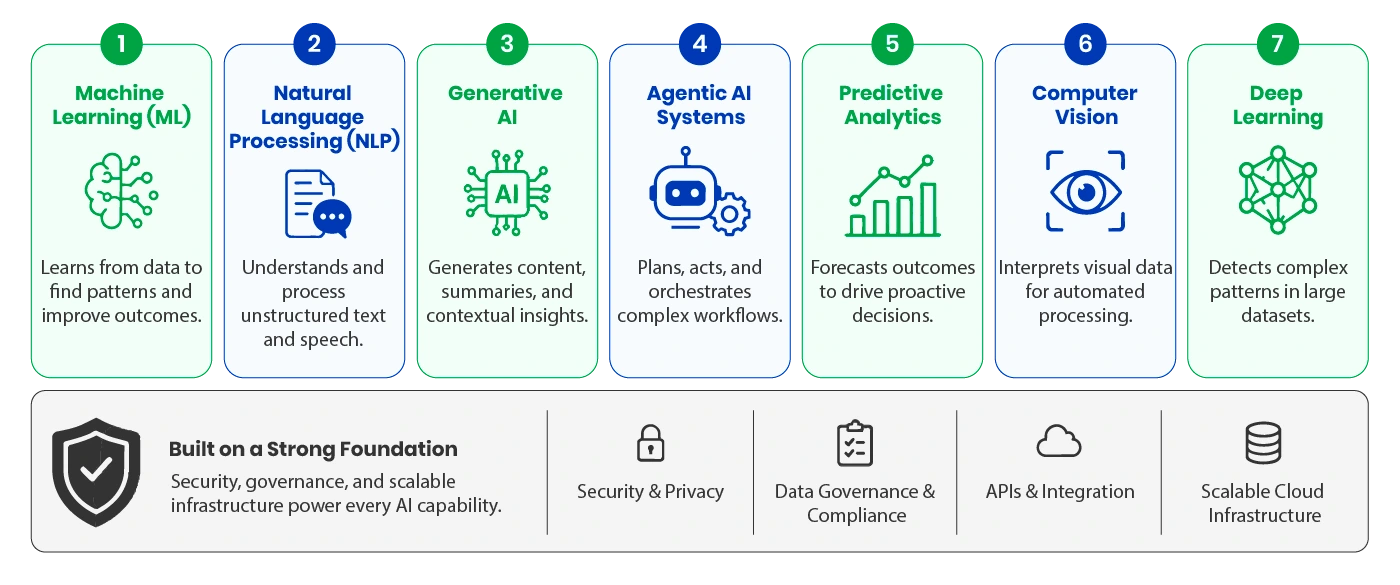
A robust technology stack enables AI capabilities in banking:
-
Machine Learning (ML):
It enables systems to learn from historical data, identify patterns, and continuously improve outcomes over time. Banks rely on ML for credit risk assessment, fraud detection, transaction monitoring, and portfolio optimization, where speed and accuracy are critical. Increasingly, these models are being embedded directly into operational workflows rather than functioning as standalone analytical tools.
-
Natural Language Processing (NLP):
It allows banks to unlock value from unstructured data such as documents, emails, contracts, and customer conversations. It powers chatbots, virtual assistants, and intelligent document processing, while also supporting use cases like regulatory compliance review and internal knowledge extraction. With growing digital interactions, NLP is key for both customer engagement and operational efficiency.
-
Generative AI:
Generative AI is expanding the scope of AI in banking from prediction to content generation, summarization, and contextual decision support. Large Language models are being used across customer service, compliance documentation, knowledge management, and internal operations. At the same time, there is a growing shift toward domain-specific models, which offer greater control, lower costs, and improved data privacy.
-
Agentic AI Systems:
Agentic AI is bringing goal-driven systems that can plan, act, and orchestrate multi-step workflows. In banking, this enables more complex use cases such as end-to-end onboarding, credit decisioning, and operations automation, where multiple systems and decisions must be coordinated. These systems operate within defined guardrails and typically incorporate human oversight for high-impact decisions.
-
Predictive Analytics:
Predictive analytics builds on machine learning and statistical modeling to forecast future outcomes based on historical trends. It enables banks to anticipate customer behavior, credit risk, and operational events, supporting use cases such as churn prediction, early risk detection, and next-best-action recommendations. This capability is driving a shift toward more proactive and insight-led banking models.
-
Computer Vision:
It enables AI systems to interpret and process visual data, making it essential for automating document-heavy workflows. Banks use it for identity verification, KYC, document validation, and check processing, improving both speed and accuracy. It also supports biometric authentication, enhancing security while reducing friction in customer onboarding.
-
Deep Learning:
Deep learning extends machine learning by enabling more advanced pattern recognition in large and complex datasets. It is widely used in fraud detection, behavioral biometrics, anomaly detection, and high-frequency transaction analysis, where subtle patterns need to be identified in real time. It is also increasingly relevant in detecting emerging threats.
10. What is the AI Operating Model in Banking?
Successful AI adoption requires a fundamental shift in organizational structure.
-
Centralized AI Teams (CoE):
Many banks are using a Center of Excellence to drive standards and scale talent enterprise-wide, achieving consistency across banking verticals.
-
Federated & Hybrid Models:
Some banks are moving toward a hybrid ownership model where centralized units supervise standards while business lines hold accountability for “data as a product”.
-
Integration into Business Workflows:
A key shift in AI operating models is the move from standalone solutions to AI embedded within core processes. This integration ensures that AI delivers measurable impact, rather than remaining limited to pilot or experimental use cases.
11. How to Implement AI in Banking? (Step-by-Step Guide)
A structured approach ensures successful AI implementation:
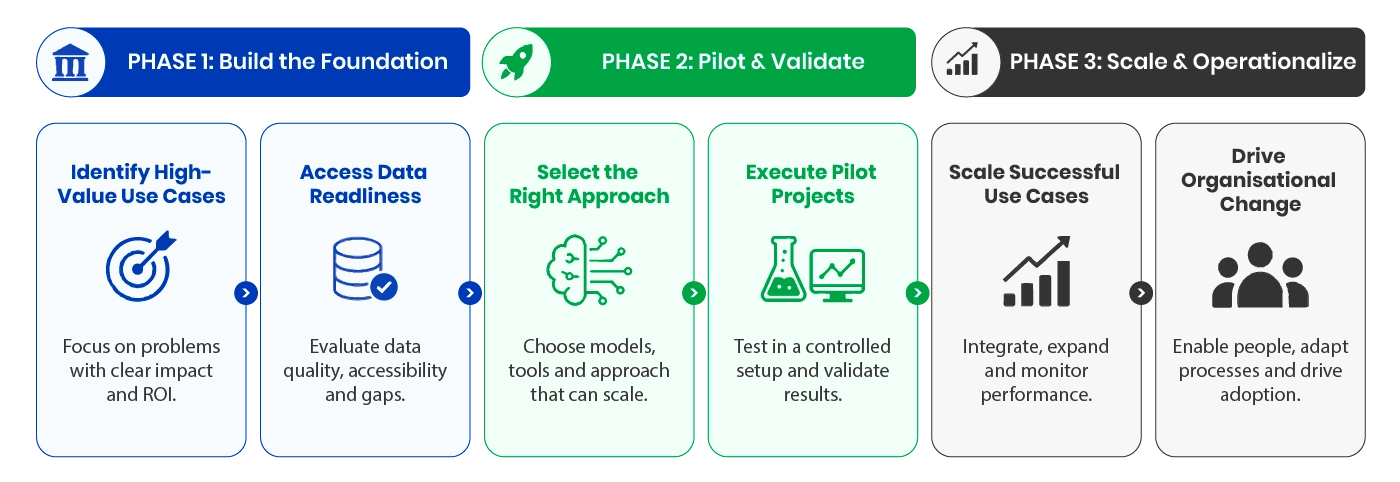
Phase 1: Build the Foundation
Step 1: Identify High-Value Use Cases
The first step is to focus on problems where AI can deliver clear, measurable impact.
This involves:
- Evaluating business value vs. implementation feasibility
- Prioritizing use cases with strong ROI potential
- Starting with well-defined problems (e.g., fraud detection, document processing)
- Considering regulatory and compliance implications early
A focused approach helps avoid scattered efforts and builds early momentum.
Step 2: Assess Data Readiness
AI success depends heavily on data quality and availability.
Banks need to:
- Inventory existing data sources
- Evaluate quality, completeness, and accessibility
- Identify gaps and remediation requirements
- Establish governance frameworks for data usage
This step often determines how quickly AI initiatives can move forward.
Phase 2: Pilot & Validate
Step 3: Select the Right Approach
Choosing the right models and tools is critical for early success.
Key considerations include:
- Matching algorithms to the use case
- Balancing performance with explainability
- Evaluating build vs. buy vs. partner approaches
- Planning for validation, testing, and compliance
The goal is not perfection—but selecting an approach that can scale if successful.
Step 4: Execute Pilot Projects
Pilots allow banks to test AI in a controlled environment before scaling.
Best practices include:
- Starting with a limited scope
- Defining clear success metrics upfront
- Collecting feedback from users and stakeholders
- Documenting learnings for future rollouts
Well-executed pilots create a strong foundation for broader adoption.
Phase 3: Scale & Operationalize
Step 5: Scale Successful Use Cases
Once pilots demonstrate value, the focus shifts to scaling.
This involves:
- Expanding to larger user groups or geographies
- Integrating AI into production systems
- Establishing monitoring, alerting, and performance tracking
- Building operational support and governance mechanisms
Scaling is often where many AI initiatives struggle—making this phase critical.
Step 6: Drive Organizational Change
AI adoption is as much about people as it is about technology.
Banks must:
- Train employees to work with AI systems
- Address resistance and build trust
- Communicate outcomes and business impact
- Redesign processes to fully leverage AI insights
Without strong change management, even successful models may fail to deliver impact.
12. What are Real-World Examples of AI in Banking?
Global financial giants are proving that AI can deliver firm-level value at scale.
- AI-powered customer service: Bank of America’s virtual assistant, Erica, was used by 20.6 million clients nearly 700 million times in 2025, taking total interactions since launch to more than 3.2 billion.
- Real-time fraud prevention: CommBank’s AI systems monitor over 80 million signals daily, while an agentic AI system helps identify emerging threats and propose new fraud-detection rules. The bank says its fraud technology contributed to a more than 20% reduction in fraud losses during the first half of FY2026.
- Employee and developer productivity: JPMorganChase has more than 500 AI use cases in production and has provided its internal LLM Suite to 200,000 employees. Its generative AI coding tools have delivered up to 20% efficiency gains across the software-development lifecycle.
- Personalisation and measurable business value: DBS deployed more than 2,000 AI models across 430 use cases in 2025, generating approximately SGD 1 billion in economic value. Its generative AI corporate-banking assistant, DBS Joy, was used by over 20,000 customers.
13. What are the Latest AI Trends in Banking (2026)?
Banks are now scaling, integrating, and achieving real business impact with AI, while embedding it deeply into operations, customer experiences, and decision-making.
-
AI Embedded Across Banking Workflows
AI is increasingly becoming invisible but pervasive—embedded directly into products, processes, and customer journeys rather than existing as standalone tools.
From onboarding and lending to fraud detection and customer servicing, AI is being integrated into core workflows to enable continuous, real-time decision-making. This shift reflects a broader move toward “AI-first” processes where intelligence is built into every interaction.
-
From Pilots to Enterprise-Scale AI
One of the most defining trends is the shift from experimentation to enterprise-wide scaling. While AI adoption is widespread, many banks are still working to move beyond isolated pilots and deliver consistent value across the organization. The focus is now on integrating AI into core systems, standardizing deployment and governance, measuring tangible business outcomes.
This transition—from pilot to production—is becoming a key differentiator between leaders and laggards in banking.
-
Rise of Generative AI in Core Banking Functions
Generative AI is rapidly expanding beyond chatbots into more critical banking functions. It is being applied to customer support and advisor, regulatory and compliance documentation, internal knowledge management, software development and operations. Its ability to work with unstructured data and generate contextual outputs is making it a powerful tool for both front-office and back-office transformation.
-
Agentic AI and Workflow Automation
A major emerging trend is the shift toward agentic AI systems—AI that can plan, execute, and coordinate multi-step workflows.
These systems go beyond task automation to enable end-to-end process orchestration, cross-system decision-making, autonomous handling of complex workflows. Banks are beginning to explore these capabilities in areas such as onboarding, fraud resolution, and operations, marking a transition toward more autonomous, workflow-driven AI systems.
-
Real-Time Intelligence & Decisioning
Banking is becoming increasingly real-time, driven by instant payments, digital channels, and rising customer expectations. AI is enabling real-time fraud detection, instant credit decisioning, continuous risk monitoring This shift is critical as financial services move toward always-on, event-driven architectures, where decisions must be made in milliseconds rather than hours or days.
-
Hyper-Personalization at Scale
AI is enabling banks to move from segment-based targeting to individual-level personalization. By analyzing behavioral, transactional, and contextual data, banks can deliver tailored product recommendations, personalized financial insights, and context-aware customer interactions. This is transforming banking from a transactional service into a more advisory and relationship-driven experience, with customers increasingly expecting proactive financial guidance.
-
Convergence of AI, Data, and Risk Governance
As AI systems become more embedded in critical workflows, governance is becoming a central focus.
There is a growing emphasis on model transparency and explainability, risk management and monitoring, data governance and security. This reflects a broader shift toward responsible and controlled AI scaling, where trust becomes a key enabler of adoption.
14. What is the Future of AI in Banking?
-
AI as a Core Operating Layer
AI is evolving from isolated use cases to becoming embedded across core systems and workflows.It will continuously influence decisions in real time, enabling adaptive, intelligence-driven operations.
-
Increasing Role of Autonomous & Agentic Systems
Agentic systems will orchestrate multi-step workflows and support decisions across banking functions. However, banks will maintain human-over-the-loop oversight, with AI augmenting—not replacing—decision-making.
-
Shift Toward Proactive & Predictive Banking
Banks will move from reactive servicing to anticipating customer needs and risks in advance. AI will enable continuous, context-aware engagement and more dynamic, personalized offerings.
-
Real-Time, Always-On Decisioning
Banking operations will shift toward instant, event-driven decision-making across all channels. AI will power real-time risk monitoring, transaction decisions, and always-on customer engagement.
-
Stronger Focus on Trust, Governance, and Control
As AI scales, trust will become a key differentiator driven by transparency and explainability. Robust governance, data privacy, and responsible AI will be central to sustainable adoption.
-
Evolution of Workforce & Roles
AI will augment roles by handling repetitive tasks while humans focus on strategy and oversight. Future teams will require strong AI and data literacy, working alongside intelligent systems.
15. How to Measure ROI of AI in Banking?
Measuring the ROI of AI in banking is not always straightforward. Unlike traditional technology investments, AI delivers value across multiple dimensions—cost savings, revenue growth, risk reduction, and customer experience—often at the same time.
As a result, banks are moving beyond simple financial metrics to adopt a more holistic, outcome-driven approach to measuring AI performance.
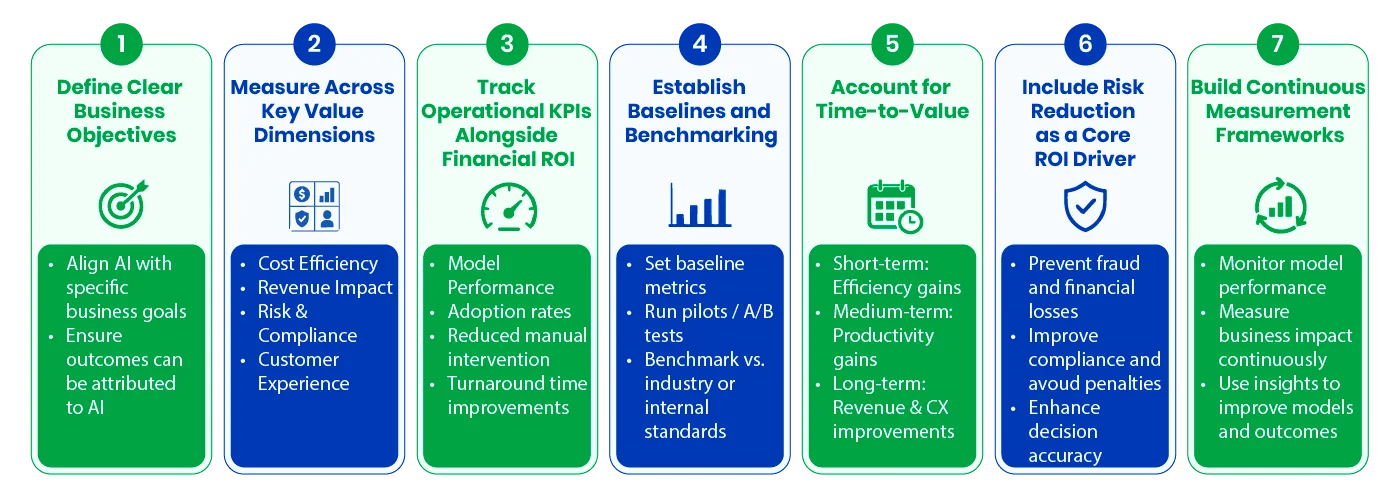
Define Clear Business Objectives
ROI measurement starts with clarity on why AI is being implemented.
Banks typically align AI initiatives to specific business goals such as:
- Reducing operational costs
- Improving risk and fraud detection
- Increasing revenue through cross-sell or personalization
- Enhancing customer experience
Without clearly defined objectives, it becomes difficult to attribute outcomes directly to AI initiatives.
Measure Across Key Value Dimensions
AI impact in banking is usually measured across four primary dimensions:
-
Cost Efficiency:
AI reduces manual effort and streamlines operations, enabling faster processing across workflows like onboarding and loan approvals. This is measured through reductions in processing time, lower operational costs, and decreased error and rework rates.
-
Revenue Impact:
AI enhances targeting, pricing, and product recommendations, helping improve conversion rates and drive cross-sell and up-sell opportunities. Key metrics include growth in conversion rates, increased revenue per customer, and improved customer lifetime value.
-
Risk & Compliance:
AI strengthens fraud detection and risk monitoring by improving model accuracy and reducing false positives. Impact is measured through reduced fraud losses, higher accuracy of risk models, and fewer false positives in monitoring systems.
-
Customer Experience:
AI enables faster, more personalized interactions, improving responsiveness across channels. This is reflected in higher customer satisfaction scores (CSAT, NPS), faster response and resolution times, and increased digital engagement.
Track Operational KPIs Alongside Financial ROI
Not all AI benefits are immediately visible in financial terms. Many are reflected first in operational improvements.
Banks therefore track:
- Model accuracy and performance
- Adoption rates among employees or customers
- Reduction in manual intervention
- Turnaround time improvements
These indicators act as early signals of long-term ROI.
Establish Baselines and Benchmarking
To measure impact effectively, banks compare performance before and after AI implementation.
This involves:
- Establishing baseline metrics for existing processes
- Running controlled pilots or A/B tests
- Benchmarking against industry or internal standards
Without a baseline, it is difficult to isolate the contribution of AI from other factors.
Account for Time-to-Value
AI investments often require time before delivering full returns.
Banks typically see:
- Short-term gains in efficiency (automation, cost reduction)
- Medium-term gains in productivity and decision-making
- Long-term gains in revenue growth and customer experience
Understanding this timeline helps set realistic expectations and avoid premature evaluation of ROI.
Include Risk Reduction as a Core ROI Driver
In banking, not all value is about revenue or cost—risk avoidance is equally critical.
AI contributes to:
- Preventing fraud and financial losses
- Improving compliance and reducing regulatory penalties
- Enhancing decision accuracy
While these benefits may not always appear directly in revenue figures, they have a significant impact on overall financial performance.
Build Continuous Measurement Frameworks
AI systems evolve over time, and so should their ROI measurement.
Banks are increasingly adopting continuous monitoring frameworks that:
- Track model performance in real time
- Measure business impact on an ongoing basis
- Feed insights back into model improvement
This ensures that AI continues to deliver value beyond initial deployment.
Frequently Asked Questions About AI in Banking
- Customer service: Chatbots and virtual assistants
- Fraud detection: Real-time transaction monitoring
- Credit decisions: Automated underwriting and scoring
- Risk management: Predictive risk modeling
- Operations: Document processing and automation
- Marketing: Personalized recommendations and offers
- Real-time fraud detection and prevention
- Continuous monitoring for anomalies
- Consistent application of security policies
- Advanced threat detection capabilities
- Cost reduction: Up to 25% reduction in operational costs
- Efficiency: 70% automation of manual tasks
- Speed: Real-time decisions vs. days/weeks
- Accuracy: Reduced errors and improved consistency
- Customer experience: 24/7 personalized service
- Risk management: Proactive threat detection
- Bias: Potential for discriminatory outcomes
- Privacy: Concerns about data handling
- Security: New attack vectors for cybercriminals
- Dependency: Over-reliance on automated systems
- Explainability: Difficulty explaining AI decisions
- Identify high-value use cases aligned with business goals
- Assess data readiness and infrastructure
- Start with pilot projects to prove value
- Build governance and ethical frameworks
- Scale successful pilots across the organization
- Invest in talent and change management
Partner with Quantiphi for Your AI Banking Transformation
Quantiphi, an award-winning AI-first digital engineering company, brings over a decade of AI expertise to help banks navigate their transformation journey. With strategic partnerships with Google Cloud, AWS, NVIDIA, and Snowflake, and recognition in the BFSI industry, Quantiphi has worked with multiple Fortune 500 institutions across the world and helped them in their transformation journey.
Ready to transform your banking operations with AI? Connect with our experts to explore how AI can drive measurable outcomes for your organization.