From KYC friction to merchant verification bottlenecks—AI is transforming how banks and financial institutions onboard customers, partners, and vendors with speed, accuracy, and compliance.
A century ago, a bank’s identity verification meant a handshake, a ledger entry, and trust built over years. Mid-20th century brought paper-heavy forms, typewriters clacking in back offices, and clerks shuffling manila folders between departments. By the late 1990s, computers sped up data entry — but onboarding still meant weeks of back-and-forth and mountains of paperwork.
Over time, the pace of life quickened, technology leapt forward, and customers grew accustomed to services that were instant, digital, and always available. This shift in expectation is transforming onboarding from a slow, manual process into an experience that must be fast, secure, and intuitive with the help of Artificial Intelligence. From Intelligent Document Processing that eliminates manual bottlenecks to Digital Humans that guide applicants through each step — AI is reshaping onboarding into a smarter and faster experience. Moreover, banks that implement AI and automation in onboarding can reduce customer acquisition costs by up to 30% while improving customer satisfaction scores (source).
Inside the Onboarding Process
Traditional onboarding in financial services follows a complex 8-step process that spans from initial application to final activation. This can feel like navigating a long path with multiple checkpoints, where each stage demands its own validations and approvals before they can finally move forward.
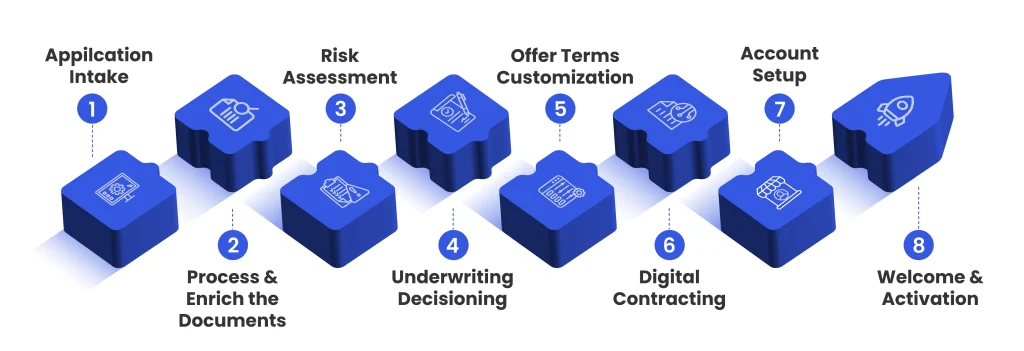
Though comprehensive, this multi-step journey often becomes a lengthy process that can take weeks or even months to complete.
The Challenge with Manual Onboarding
Manual onboarding continues to be a bottleneck for growth. For banks and financial institutions, it’s more than an operational headache—it’s a business risk. Whether it’s retail customers applying for loans, mortgages, or insurance, or merchants and SMBs being onboarded by acquirers and payment processors, the time taken to complete onboarding is often plagued by manual investigations, verifications, and document reviews.
Common Pain Points in Onboarding Today
A typical onboarding journey—whether for a retail customer or a merchant—spans several stages. Each comes with its own set of challenges that slow down growth and frustrate applicants.
- Manual and Resource-Intensive Processes
Traditional onboarding workflows rely heavily on manual document collection, verification, and data entry. This slows down account openings for retail customers and prolongs business validation for merchants, resulting in lost opportunities and poor customer experiences. - Fragmented Systems and Lack of Integration
Onboarding journeys often require multiple systems to communicate. In retail banking, this leads to data silos across KYC, credit checks, and compliance tools. For merchants, integrating external data sources like tax IDs, financial records, and industry risk reports adds further complexity and inefficiency. - Risk Assessment Delays and Inefficiencies
Both retail and merchant onboarding involve evaluating financial and behavioral risk. Collecting, verifying, and analyzing data is time-consuming, with significant back-and-forth between stakeholders. This creates bottlenecks, increases operational costs, and can lead to customer frustration or business loss. - Compliance and Fraud Management
Financial institutions face increasing challenges in detecting fraudulent documents, ensuring regulatory compliance, and meeting global KYC/AML standards. For retail customers, this means intrusive and repetitive checks; for merchants, cross-border complexities and evolving regulations amplify the burden. Moreover, onboarding merchants in different countries involves navigating diverse regulatory landscapes, language barriers, and cultural differences. - Limited Personalization and Customer Engagement
Onboarding experiences are often generic and transactional. Retail customers expect seamless, digital-first interactions, while merchants look for tailored terms, pricing, and support. The absence of personalization leads to reduced trust, higher dropout rates, and missed revenue opportunities.
How AI De-Fragments Your Complex Operations
AI is transforming onboarding journeys for both customers and merchants—replacing fragmented, manual workflows with intelligent, seamless experiences..
1. Intelligent Document Processing (IDP): Turning Paperwork into Action
IDP automates the extraction, classification, and validation of data from a wide range of onboarding documents—such as identity proofs, financial statements, licenses, and contracts. By combining Optical Character Recognition (OCR) with Natural Language Processing (NLP), IDP systems can read both structured and unstructured data, flag anomalies, and route clean information directly into onboarding systems.
2. Digital Humans and Conversational AI: Making Onboarding Interactive
AI-powered digital agents are redefining customer interactions. These assistants can guide users through complex onboarding forms, answer context-specific queries, and even detect hesitation or confusion—offering real-time nudges or escalating to a human where needed. Digital humans create an intuitive, empathetic experience, helping institutions drastically lower drop-off rates while maintaining a human touch—especially important in high-friction onboarding journeys.
3. Advanced AI Capabilities: Enabling Faster, Safer Decisioning
AI tools extend far beyond automation—they enable smarter, faster decisions:
- Facial recognition and liveness detection confirm identities securely and remotely.
- AI-based document fraud detection flags tampered or synthetic documents in seconds.
- Reduce manual review time and improve approval rates by leveraging behavioral patterns and comprehensive data analysis.
- Automated AML and sanctions screening compares onboarding data against real-time global watchlists.
- Ensure regulatory compliance automatically & stay protected from sanctions violations and AML risks with real-time screening.
Benefits: AI Onboarding in Action
Adopting AI-driven onboarding solutions delivers measurable impact across key business metrics:
- Faster onboarding: Reduce processing times from days or weeks to a few minutes
- Lower cost-to-serve: Cut labor costs by automating up to 80% of onboarding workflows
- Higher conversion: Digital assistants and better UX significantly reduce drop-offs
- Improved compliance: Real-time fraud detection, AML screening, and audit trails ensure adherence to evolving regulations
- Scalability: Onboard 10 or 10,000 clients or merchants without linear growth in headcount
- Better customer experience: Reduce friction, personalize engagement, and make onboarding a competitive advantage
How Quantiphi Can Help
At Quantiphi, we specialize in building tailored AI solutions that modernize and simplify onboarding journeys for both retail and commercial financial institutions.
AIOS: AIOS is Quantiphi’s flagship solution for transforming onboarding journeys through automation, intelligence, and seamless integration. Whether you’re onboarding a customer or a merchant, AIOS simplifies the experience with no-code workflows, secure IDP modules, real-time compliance checks, and conversational guidance—built to scale with your institution’s needs.
Dociphi: An end-to-end AI-powered document management platform with GenAI features that automates complex business processes. Pretrained on major document types in financial services, it accelerates verification, classification, and compliance in onboarding journeys.
Baioniq: AI productivity agent that works across structured and unstructured data with a customizable interface. It provides role-based access, ready-to-plug connectors, and context-aware querying, enabling employees to quickly surface onboarding-relevant insights.
Digital Human: LLM-powered digital avatars that act as multilingual, interactive onboarding guides. With sentiment analysis, active learning, and multi-hop Q&A capabilities, they deliver personalized, conversational experiences to improve customer engagement and reduce drop-offs.
Conclusion
Manual onboarding is no longer viable in today’s experience-driven, digital-first financial ecosystem. It’s expensive, inefficient, and frustrating for both customers and partners. AI is enabling banks and financial institutions to replace clunky legacy processes with seamless, intelligent, and compliant onboarding journeys.
As expectations for speed, personalization, and trust continue to rise, intelligent onboarding powered by AI isn’t just a nice-to-have—it’s business critical.