Beyond the Hype: How AI and the TSaaS Model are Rewriting the Rules of Engineering

Engineering leaders everywhere are wrestling with a critical question: how is AI actually changing the developer experience and boosting productivity? To get past the buzzwords and theory, Mohak Moondra (Global Practice Leader – Data & Cloud at Quantiphi) and Nitin Mathur (AVP of Data Platform and Engineering at Definity) recently sat down on the Phi Moments podcast to share what is genuinely working on the ground.
Their conversation revealed a fundamental transformation in how tech is built, managed, and delivered, moving from a world of brute-force staffing to an era of intelligent, software-driven outcomes.
Watch or Listen on Your Favorite Platform:


The Rise of Technology Services-as-a-Software (TSaaS)
Historically, IT services were simply a numbers game. It was a headcount-based model where taking on a larger scope of work inherently meant putting more people in seats.
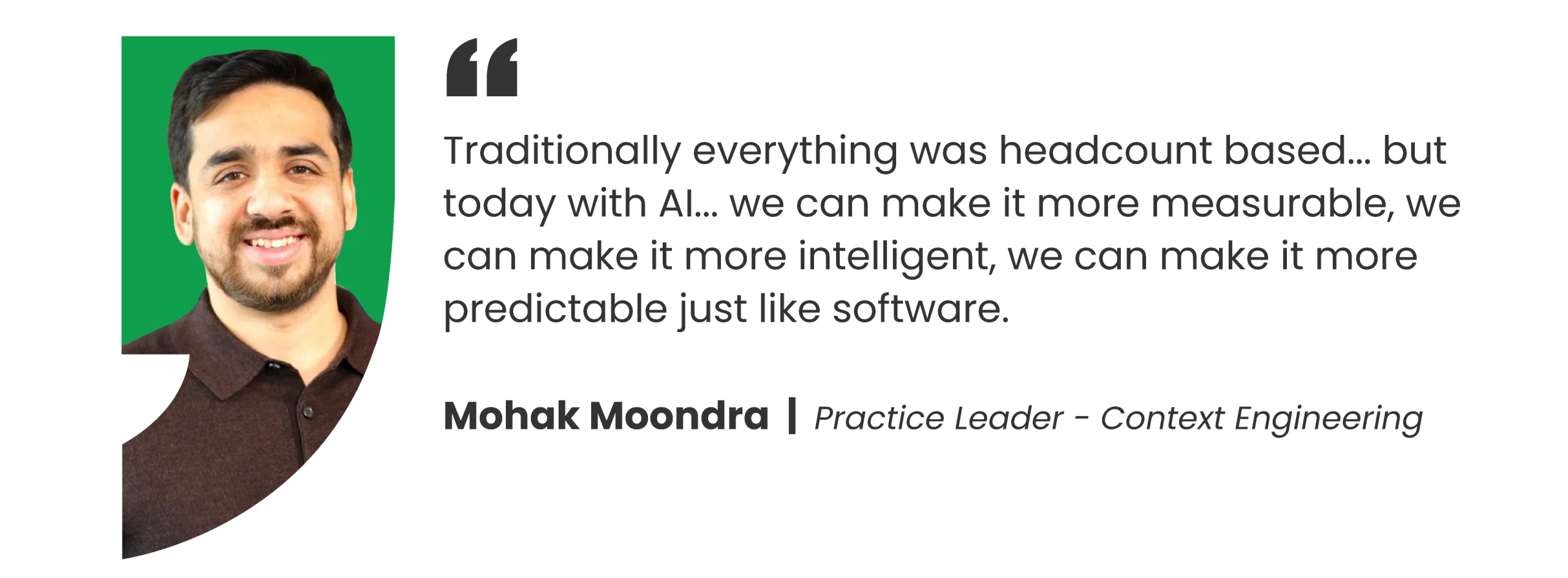
However, the industry is experiencing a massive shift. We are entering the era of Technology Services-as-a-Software (TSaaS). With AI integration, work is transitioning to be heavily “outcome and output-based.” As Mohak points out, this technology allows service delivery to become “more measurable… more intelligent… [and] more predictable, just like software.”
The Co-Pilot Reality
A common pitfall for leaders is expecting artificial intelligence to magically run the show. Both Mohak and Nitin stress that AI is an assistive technology, perfectly encapsulated by the idea of a “co-pilot, not a pilot.” Human expertise is still absolutely required to guide the process, understand the context, and ultimately write the code.
A Framework for Real Impact
To move from theory to tangible impact, Quantiphi and Definity partnered to utilize an engineering productivity platform called Codeaira. To ensure this tool actually moved the needle, they relied on a practical four-step adoption framework:
- Hack it: Start small by experimenting with ideas to see if they genuinely help developers move faster.
- Prove it: Establish real baselines and metrics. For example, comparing manual work to AI-assisted work revealed that a task which normally took 25 hours was slashed to under 5 hours.
- Nail it: Turn the most effective tools into reliable products to guarantee predictable outcomes for clients.
- Scale it: Roll the solution out widely. Today, around 3,000 engineers at Quantiphi use this platform to amplify their output.
Measuring What Actually Matters
The old project management yardsticks of being “in scope,” “within the timelines,” and “within the budget” are no longer enough. Because AI fundamentally changes how work is done, new metrics are essential. By tracking these new metrics, they’re already seeing a massive 20% to 30% productivity jump in development and testing at Definity, as per Nitin.
Leaders should now be looking at:
- Cycle Time: Tracking the true speed of a task from start to finish.
- Quality and Adoption: Ensuring tools are actively used across all projects and that they visibly reduce error rates by generating better code.
- Legacy Transformation: Using AI to reverse-engineer and document decades-old legacy systems where the original developers have long since retired.
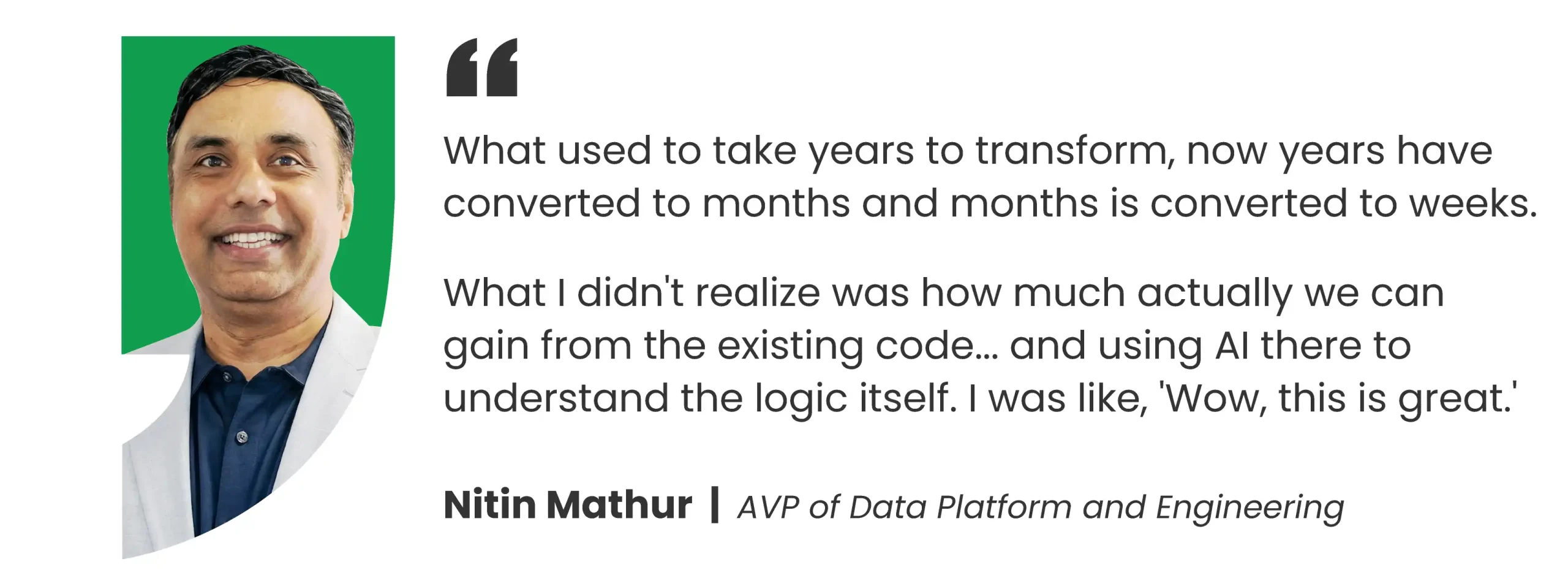
In fact, watching AI tackle 35 years of undocumented COBOL code and flawlessly translate it to SQL—without any available subject matter experts—was a massive technological “aha moment” for Nitin. It proved that technology can do things which were unimaginable in the past.
Leading Through the AI Transition
Nitin offers clear advice for leaders navigating this space: keep your tools native to avoid clutter, and manage expectations so your organization doesn’t expect instant, 100% perfection.
Most importantly, as the speed of technology changes, metrics must focus on outcomes rather than individuals. Prioritizing the team’s well-being over micromanagement is key to successful change management. As Mohak notes, true developer satisfaction doesn’t come from tracking their every move, but from “removing friction from their entire workflow.”
Why Quantiphi?
Pioneering the TSaaS model requires more than just access to large language models; it requires a partner who understands the DNA of engineering workflows. As a Diamond Tier Google Cloud Partner, Quantiphi isn’t just theorizing about AI-driven productivity, they are living it. By building and scaling platforms like Codera powered by advanced generative AI models across thousands of their own engineers, Quantiphi has moved past the “trial phase” of enterprise AI.
They understand that true digital transformation is not a point-problem fix, but a holistic workflow overhaul. By shifting the focus from traditional headcount to predictable, software-like outcomes, Quantiphi empowers organizations to accelerate modernization, eliminate developer burnout, and turn legacy debt into future-ready assets.
Learn how Quantiphi and Google Cloud help enterprises engineer AI-native transformation at scale.
The Bottom Line
The era of adding more bodies to solve complex engineering problems is ending. The future belongs to organizations that embrace AI as a collaborative partner and shift toward an outcome-driven TSaaS model. It is no longer just about writing code faster; it is about building smarter, frictionless environments where engineers can do their best work.
🚀 Want to see TSaaS in action? Contact Quantiphi today to learn how our AI-driven engineering platforms can transform your delivery timelines and boost developer productivity.