Closing the Loop: How BFSI Moves from Insights to Real Execution with Agentic AI

Over the last decade, banks and insurers have invested heavily in building data and analytics capabilities. Today, most large institutions operate mature data platforms, deploy multiple machine learning models, and are actively experimenting with generative AI.
Yet across core functions-claims, underwriting, fraud, and collections-a consistent gap remains: insights exist, but outcomes still depend on slow, fragmented execution.
This is the industry’s “last mile” problem-and it’s where a disproportionate amount of value is lost. What’s changing now is not just better models, but the emergence of systems that can translate decisions into action, instantly and at scale. Often referred to as agentic AI, this shift is redefining how BFSI organizations operate.
The Core Problem: Intelligence Without Execution
Most BFSI organizations today are not short of intelligence-they are short of coordination. Over time, institutions have layered multiple systems to solve specific problems, such as:
- Predictive models for fraud, risk, and customer propensity
- Rule engines governing approvals and workflows
- Dashboards and alerts highlighting what needs attention
- GenAI copilots assisting with summaries and queries
Each of these works well in isolation. But in reality, they don’t operate as a unified system.
A fraud alert still sits in a queue. A claim still waits for manual review. An underwriting decision still depends on how quickly someone can stitch together information from multiple systems.
The result? A system that is insight-rich, but execution-poor-where value is identified, but not fully realized.
This Gap Is a Business Problem-Not Just an Operational One
What appears as operational delay often translates directly into financial and customer impact. The breakdown typically shows up in the following ways:
- Slower claims settlement drives higher costs and customer dissatisfaction
- High false positives in fraud consume time and reduce investigation efficiency
- Underwriting delays impact conversion rates and revenue realization
- Delayed retention actions reduce the effectiveness of engagement strategies
Over time, these inefficiencies compound into larger business challenges-ranging from claims leakage claims leakage that erodes margins, higher expense ratios due to manual effort, inconsistent decision quality across teams, lower NPS and retention, and declining customer experience.
Most organizations try to solve this by improving models or adding more rules. But the real issue isn’t prediction quality-it’s the lack of a system that can take ownership of decisions end-to-end.
What Changes with an Agentic Approach?
This is where agentic AI introduces a fundamental shift-from assisting decisions to executing them. In traditional AI-driven systems, the role of intelligence typically stops at generating scores or risk signals, producing recommendations or supporting human decision-making. An agentic approach extends this further by enabling systems to:
- Understand context dynamically across data sources
- Determine the next best action based on real-time signals
- Execute that action within clearly defined guardrails
This transforms AI from a support layer into an active execution layer within business workflows.
For example, in a claims scenario, automation traditionally stops at extracting data or assigning a risk score. With an agentic approach, the system continues-evaluating coverage, analyzing historical patterns, assessing fraud signals, deciding the next step, and triggering that action with a complete audit trail.
This shift-from suggesting to doing-is where real transformation happens.
Where This Delivers Immediate Business Value
The impact of agentic execution is most visible in high-friction processes where delays and handoffs are common.
- Claims Processing:
Claims operations are often slowed down by multiple handoffs-across document review, validation, and fraud checks. By moving from assisted workflows to coordinated agentic execution, insurers can:- Reduce turnaround times from days to hours
- Lower claims leakage
- Improve fraud detection precision
- Underwriting:
Underwriting processes frequently depend on manually stitching together data from multiple sources, leading to delays and inconsistencies. By eliminating manual information stitching, organizations can pre-structure cases with relevant risk insights, proactively flag missing or inconsistent data. As a result, organisations can:- Drive faster, more consistent decisions
- Improved risk selection and loss ratios
- Fraud Investigation:
Traditional fraud systems generate alerts, but much of the investigation still remains manual and time-intensive. With an agentic approach, organisations can move one step beyond and automate initial investigation steps, connect patterns across entities and transactions, and escalate only high-confidence cases. Resulting in:- Reduction in false positives
- Significant productivity gains
- Collections & Retention
Customer engagement strategies in collections and retention are often static, limiting their effectiveness in dynamic scenarios. By enabling real-time, adaptive strategies, organizations can personalize engagement based on customer behavior and as a result:- Improve recovery rates
- Reduce customer churn
Across these use cases, the common thread is clear: fewer handoffs, faster decisions, and more consistent execution.
Connecting Intelligence to Action: Agentic Framework
The shift to agentic AI does not require rebuilding existing systems. Most BFSI organizations already have strong data and intelligence layers in place. What’s missing is an execution layer-a connective layer that ensures insights don’t stop at analysis but continue through to action. At its core, this layer sits above existing systems and answers one key question:
“Given everything we know, what should happen next-and who or what should execute it?”
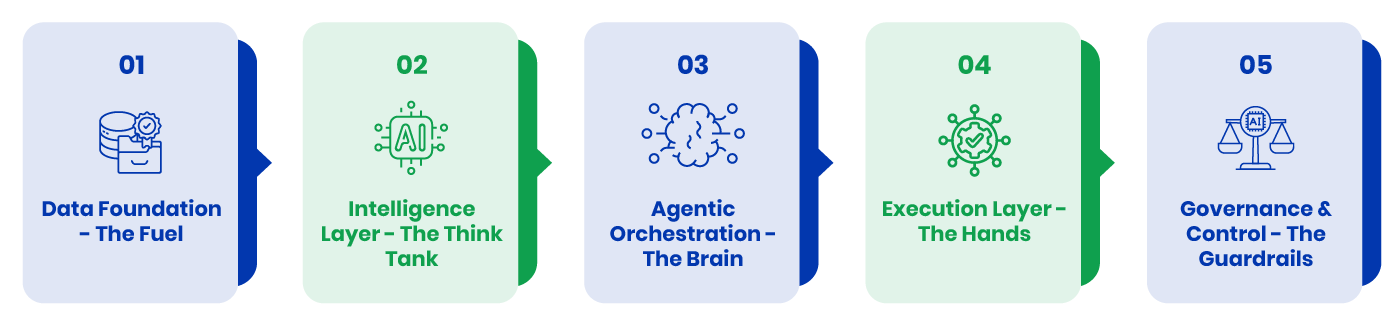
A practical implementation typically brings together the following layers:
- Data Foundation – The Fuel:
Every decision starts with data. The data foundation acts as the fuel that powers the entire system, bringing together inputs from customer channels, core banking/insurance systems, documents, external data sources, and real-time events. But the goal is not just to store data-it is to make it usable in context. When data is unified and accessible, it becomes the foundation for faster, more accurate, and more relevant decision-making across BFSI operations. - Intelligence Layer – The Think Tank:
If data is the fuel, the intelligence layer is the think tank that processes it. This is where different forms of intelligence come together-predictive models to assess risk and detect patterns, generative AI to interpret unstructured data, and decision intelligence to apply business rules and logic. Instead of operating in silos, these capabilities work together to create a holistic understanding of each situation, enabling more informed and context-aware decisions. - Agentic Orchestration – The Brain:
At the core of the architecture sits the brain-the agentic orchestration layer. This is where things fundamentally change. Instead of following predefined workflows, AI agents dynamically break down tasks, decide the next best step, and coordinate actions across systems and functions. Whether it’s underwriting, fraud investigation, claims processing, or customer service, these agents operate with a clear goal in mind. Supported by a reasoning engine, the brain enables the system to plan, decide, adapt, and improve continuously, making execution far more flexible than traditional automation. - Execution Layer – The Hands:
Once decisions are made, the hands bring them to life. The execution layer translates decisions into action-triggering workflows, updating systems, integrating with APIs, sending communications, and routing tasks. It ensures that insights don’t remain theoretical but are actually implemented across the business. Importantly, this layer also includes human involvement where needed, ensuring that critical decisions are reviewed and handled with the right level of oversight. - Governance & Control – The Guardrails:
Surrounding all these layers are the guardrails that ensure everything operates safely and responsibly. Governance in BFSI is non-negotiable. From policy enforcement and human-in-the-loop oversight to explainability, audit trails, and regulatory compliance, this layer ensures that every decision is transparent, traceable, and aligned with business and regulatory standards.
The Result: When the fuel, think tank, brain, and hands work together under strong guardrails, the results are tangible-faster turnaround times, reduced operational costs, improved fraud detection, and better customer experiences.
The value doesn’t come from any one component-but from how they interact and collaborate to enable continuous, end-to-end execution.
An End-to-End Example: Reimagining the Claims Journey
To make this more tangible, consider how a claims journey evolves in an agentic model:
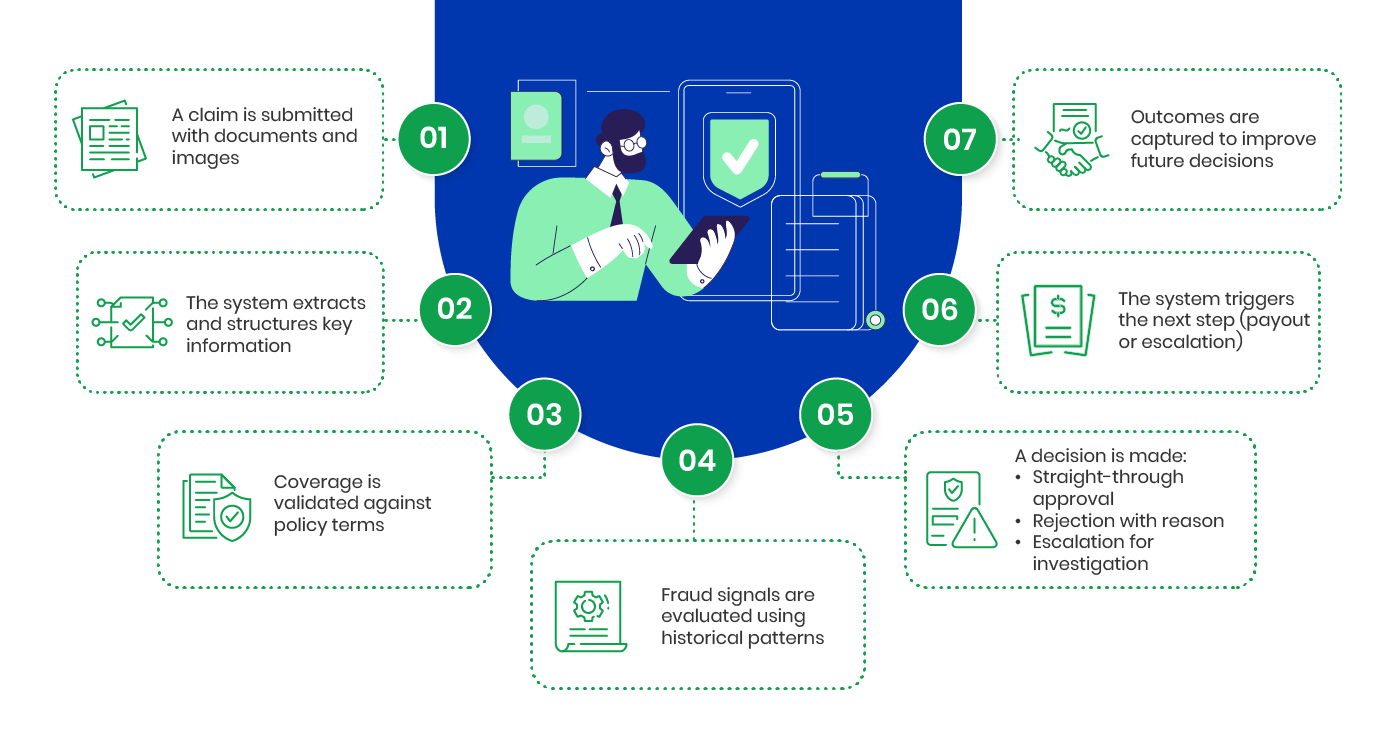
The difference is not in any single step-it’s in the seamless continuity across all steps, ensuring that insights consistently translate into outcomes.
The Journey to Agentic AI: How BFSI Organizations Typically Evolve
The journey toward agentic execution is gradual, with most organizations moving through distinct stages of maturity:

- Level 1: Rule-based automation: At this stage, workflows are largely static and predefined. Decisions are driven by fixed rules, and manual intervention remains high-especially when exceptions occur or data is incomplete. While this improves baseline efficiency, it lacks flexibility and scalability.
- Level 2: Predictive intelligence: Organizations begin to introduce machine learning models to generate signals such as risk scores, fraud alerts, or customer propensity. While decision quality improves, these insights are still loosely connected to execution, often requiring manual interpretation and follow-through.
- Level 3: AI assistants: The focus shifts to productivity, with GenAI-powered assistants helping users in tasks such as summarization, analysis, and decision support. While this reduces effort and speeds up workflows, humans still remain central to driving decisions and triggering actions.
- Level 4: Coordinated execution: This is where a meaningful shift occurs. Systems begin to connect insights directly to actions, managing end-to-end workflows with minimal intervention. Decisions are not just recommended-they are executed within defined guardrails, with human teams focusing primarily on exceptions and oversight.
- Level 5: Adaptive operations: At the most advanced stage, systems continuously learn from outcomes and feedback loops. Decisioning becomes more dynamic, processes evolve in real time, and operations are optimized continuously based on changing data, behaviors, and business conditions.
The transition from Level 3 to Level 4 is where the significant business value unlocks for financial organizations.
Common Pitfalls to Avoid
While the opportunity is significant, many initiatives fall short due to avoidable missteps. The most common challenges include:
- Treating agentic AI as a GenAI experiment rather than an operating model shift
This often limits impact to isolated use cases, without rethinking how decisions and workflows are executed end-to-end. - Running pilots that never integrate with core systems
Many initiatives show promise in controlled environments but fail to deliver value when disconnected from real production workflows. - Over-relying on LLMs without orchestration
While LLMs are powerful for interpretation and reasoning, without coordination across systems and actions, they cannot drive meaningful execution. - Delaying governance and control mechanisms
Postponing oversight, auditability, and policy enforcement can create compliance risks and slow down adoption later in the process.
Avoiding these pitfalls is often more critical than the technology choices themselves, as execution success depends as much on operating model design as it does on technical capability.
What Business Leaders Can Expect
When implemented effectively, agentic execution delivers measurable, compounding impact across the organization. Typical outcomes include:
- Improved decision consistency
- Reduced operational inefficiencies
- Faster turnaround times across customer journeys
- More accurate fraud detection with fewer false positives
- Higher customer retention driven by timely engagement
Individually, these improvements are meaningful. Together, they create a sustainable competitive advantage.
How to Get Started with Agentic Execution?
The most effective approach is to start small and scale with confidence. Rather than attempting an ambitious, resource-intensive, and often disruptive enterprise-wide transformation from the outset, organizations should adopt a phased strategy focused on manageable, high-impact areas. Organizations should:
- Identify a high-friction journey (e.g., underwriting)
- Pinpoint where decision delays occur
- Introduce an execution layer for that specific flow
- Measure impact across time, cost, and decision quality
Once the value is proven, scaling across adjacent processes becomes significantly easier and more predictable.
How Can Quantiphi Help?
Quantiphi, an award-winning digital engineering and AI-led transformation company with over 13+ years of experience, and strategic partnerships with leading hyperscalers like GCP, AWS, NVIDIA and Snowflake, making us uniquely positioned to guide organizations in adopting agentic execution. We help BFSI organizations operationalize agentic AI by connecting intelligence to action across core workflows. Our focus is on enabling scalable, governed execution. We help turn fragmented processes into coordinated, outcome-driven operations for organizations.
Final Thought
For years, BFSI organizations have focused on improving how they generate insights.
The next phase is about something more fundamental-building systems that can take responsibility for outcomes.
Because ultimately, a competitive edge won’t be achieved through superior knowledge, but through the capacity to act with greater speed, consistency, and scalability.