Disjointed Data, Disconnected Decisions in Retail — Here’s How to Fix It

Legacy systems were built for stability, not agility — and that’s the problem.
Historically, businesses relied on siloed transactional systems: ERPs for finance, standalone CRMs, disjointed inventory platforms, and isolated property or tenant management tools. These systems served their purpose for basic reporting and operational support, but the rules of engagement have changed.
But the business environment has evolved, and disconnected systems can’t keep up.
Customers now expect seamless, personalized experiences across every touchpoint. Buyers and tenants want instant access to relevant information. Decision-makers need real-time visibility to respond faster and plan smarter. And innovation, once a differentiator, is now a baseline requirement for any industry, including retail and real estate.
Yet, many enterprises find themselves hamstrung by legacy systems and fragmented data landscapes. When organizations rely on isolated transactional databases for analytics and reporting, they inevitably face challenges like:
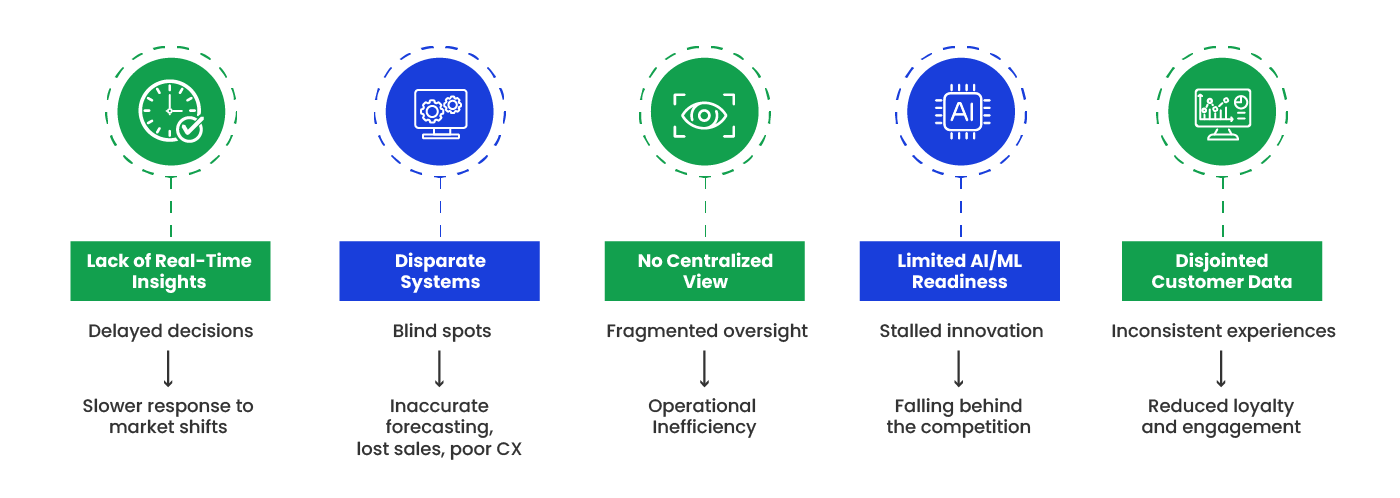
So, what should a company do when faced with such challenges?
The answer lies in rethinking the foundation: moving towards a unified, cloud-native data platform that consolidates disparate sources, enables real-time insights, and creates a scalable engine for advanced analytics and machine learning.
The organizations that succeed in this new era will be those that view data not as a byproduct of operations, but as a strategic asset, central to every decision and interaction.
The Blueprint for Transformation: Building a Unified Data Platform
Organizations looking to thrive must embrace a holistic modernization strategy anchored around these key principles:
1. Integrate Disparate Data Sources
Successful transformation begins by connecting the dots. Integrating systems like ERP, CRM, e-commerce, loyalty platforms, vendor portals, and POS into a centralized ecosystem ensures no critical information remains siloed.
Utilize automated connectors and ETL frameworks to support both real-time and batch ingestion, ensuring data flows seamlessly across all business units.
Advantage: Create a holistic view across departments — boosting collaboration, forecasting, and CX.
2. Design a Robust Data Lake Architecture
Following a Medallion Architecture approach provides structure and scalability:
- Raw data ingestion without transformation to preserve data fidelity.
- Data standardization and curation, enabling business-friendly analytics.
- Purpose-built datasets optimized for reporting, AI/ML models, and advanced use cases.
This layered architecture ensures a balance between data flexibility, quality, and performance.
Advantage: Faster analytics, cleaner data, and readiness for AI — all without compromising flexibility.
3. Leverage Advanced Data Management Features
Modern platforms like Snowflake offer powerful capabilities such as metadata management, time travel, data masking, and cross-region replication. These features are essential for enterprises looking to strengthen data governance, ensure compliance, and build resilience into their data operations. By automating performance, securing sensitive information, and providing complete visibility into data changes, Snowflake enables organizations to operate with greater confidence and control.
Advantage: Built-in security, scalability, and automation reduce risk and cost — while unlocking advanced use cases like cross-region reporting and AI-powered analytics.
4. Automate and Orchestrate Workflows
Data workflows must be reliable, auditable, and scalable. Tools like Apache Airflow can orchestrate complex ETL pipelines, enforce data quality, manage lineage tracking, and streamline master data management.
Advantage: More reliable pipelines, better data quality, and lower manual effort — improving team productivity.
5. Enable Self-Service Analytics and Reporting
Empowering business users is essential. Integration with powerful BI tools like PowerBI — coupled with ad-hoc querying capabilities — ensures that actionable insights are available at the fingertips of decision-makers across the organization.
Advantage: Empower decision-makers across business units with real-time dashboards and actionable insights.
The Tangible Benefits of a Modern Data Platform
Organizations that successfully modernize their data architecture can expect to realize significant advantages:
- Data Consistency and Reliability: A single source of truth improves trust in reporting and analytics.
- Real-Time Decision-Making: Instantaneous data capture fuels more agile operations.
- Streamlined Innovation: Readiness for AI, machine learning, and advanced analytics accelerates business transformation.
- Enhanced Customer Experiences: Unified customer profiles power more personalized engagement across channels.
- Faster Time to Insights: Modern BI capabilities shorten the gap between data generation and value realization.
Why Execution Excellence Matters
Modernizing the data foundation is not just about choosing the right technology stack — it’s about execution. Success hinges on:
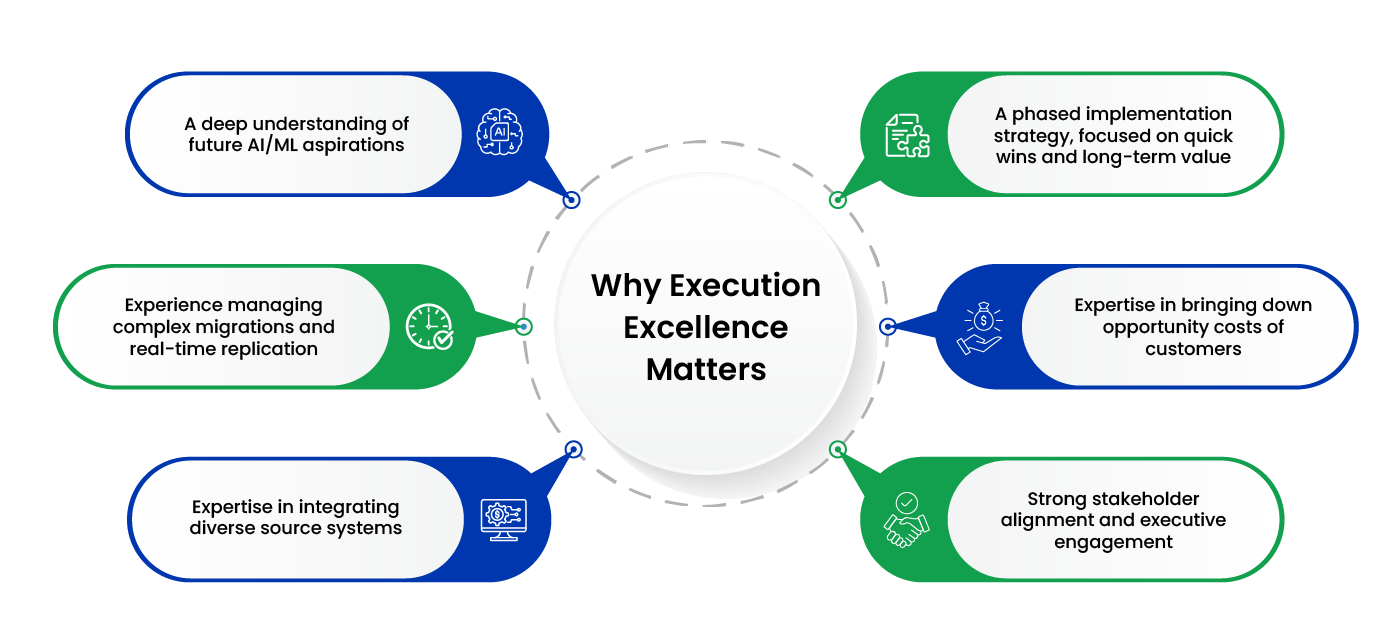
Partnerships with platform providers like Snowflake — and working with experts who bring both technical know-how and strategic vision — are critical for ensuring transformation initiatives achieve their full potential. Snowflake plays a critical role by offering a single, cloud-native platform that unifies all your data — structured or not — with near-infinite scalability and advanced governance. It’s not just a warehouse — it’s the engine for productizing AI and building intelligent, future-ready businesses
Working with established Snowflake partners who can bring in the technical know-how, implementation experience, and strategic vision is critical for ensuring transformation initiatives achieve their full potential
At Quantiphi, we have been helping organizations reimagine what’s possible with data for the past 12 years. With deep expertise across cloud platforms, data engineering, and AI/ML, we’ve successfully guided enterprises through complex transformation journeys — from integration and orchestration to insight and innovation.
Final Thoughts
Enterprises that proactively modernize their data landscapes today are positioning themselves to lead tomorrow. By centralizing data, building the foundation for advanced analytics they can turn data into their most powerful competitive advantage.
The future belongs to those who not only collect data but connect it across channels, curate it for quality and context, and capitalize on it to drive smarter decisions, better customer experiences, and continuous innovation.
Whether you’re aiming to streamline reporting, centralize data across business units, or future-proof operations, the first step is building the right foundation.
If you’re ready to transform fragmented data into a strategic advantage, we’re ready to help you get there.
Let’s build what’s next, together.