The Boardroom Moment Nobody Talks About
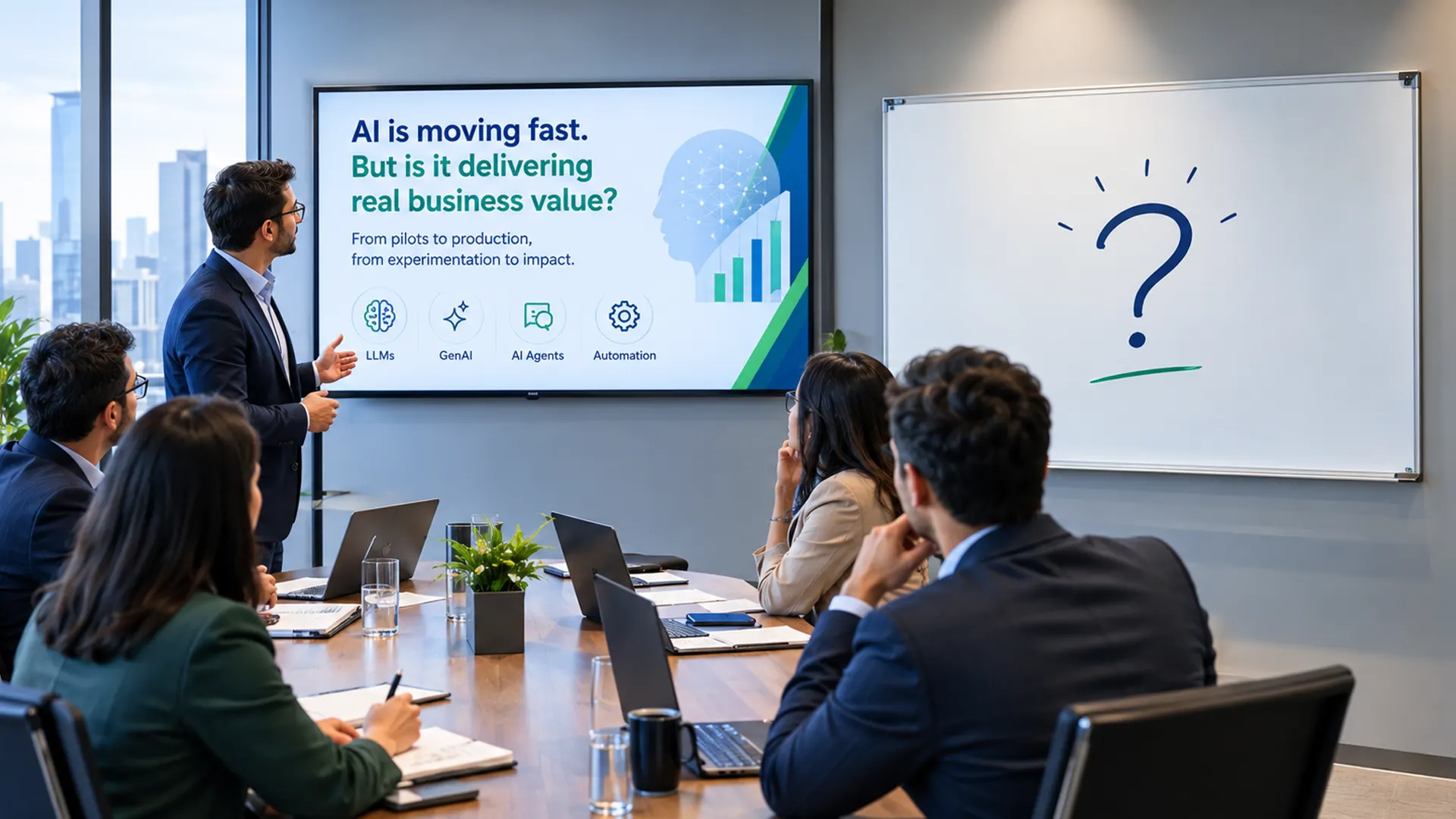
Walk into any enterprise boardroom and you will hear a familiar story. Budgets for AI are up. Pilots are running across functions. At least one generative AI initiative is on the agenda, usually more. And yet, when someone asks the simple question, “What measurable business outcome has it actually delivered?”
The room goes quiet.
That silence is not a technology problem. It is a strategy and structure problem. It is also far more common than most leadership teams care to admit.
The companies pulling ahead are not the ones with the largest GPU clusters or the most ambitious AI vision decks. What separates them from the ones stuck in pilot purgatory is something far more practical: a clear, honest, structured understanding of where they actually stand today.
This blog is the first in a three-part series. Across these pieces, we will examine how to evaluate your AI readiness, score your maturity across core dimensions, and build a roadmap that translates AI investment into measurable business returns.
To solve this, we must first understand the root of the problem.
The Numbers Behind the Silence
This is not merely anecdotal. Data from multiple independent research bodies points to the same structural gap:
- MIT Sloan reports that most enterprises still sit in the lowest tiers of AI maturity, with only a small minority operating AI as a true enterprise capability.
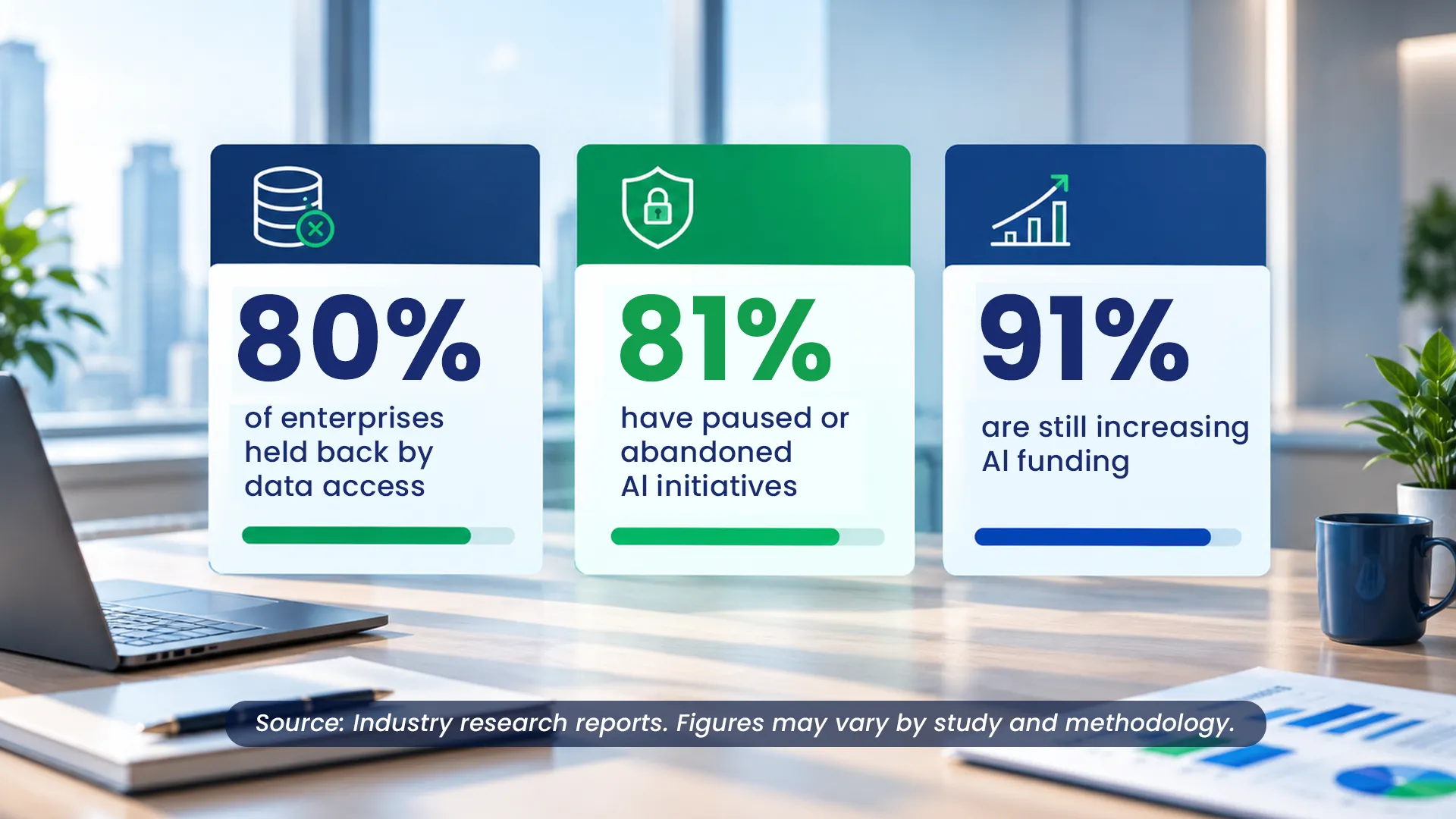
- Cloudera’s 2026 research found that nearly 80% of enterprises say AI is being held back by data access challenges.
- Transcend’s research shows that 81% of enterprises have delayed, scaled back, or abandoned an AI initiative because of data, permission, or governance gaps.
Meanwhile, 91% of industry leaders are still increasing AI funding. The bottleneck has shifted. The question is no longer “Can we build it?” It is “Can we run it, govern it, and make money from it?”
Most enterprises are spending more and scaling less. That is the reality the numbers describe.
What an AI Assessment Actually Is
Before we talk about why AI initiatives fail, it helps to be clear about what an AI assessment is, because the term gets used loosely.
An AI assessment is a structured, evidence-based evaluation of an organization’s ability to design, deploy, govern, and scale artificial intelligence to deliver measurable business outcomes. It examines strategy, data, technology, governance, talent, and operations against a defined maturity model and produces a prioritized roadmap.
It is not a vendor checklist. It is not a survey you fill out in fifteen minutes. It is a diagnostic exercise that combines executive interviews, document reviews, technical inspections, and cross-functional workshops to build an honest picture of where the organization actually stands.
The purpose is to replace opinion with evidence. Leadership teams frequently disagree about how AI-ready the business is. Engineering may believe the data infrastructure is solid. Data science may say it is unusable. The CFO may not be sure either side is telling the full story. An assessment resolves that disagreement with facts, not assumptions.
The output is concrete: a maturity score, a gap analysis against industry benchmarks, a prioritized use case portfolio, a target architecture, a governance blueprint, a talent plan, and a sequenced roadmap (for example, spanning 12 to 24 months, depending on the organization’s unique needs and timeframe).

AI Assessment vs. AI Readiness vs. AI Maturity: Knowing the Difference
These three terms are often used interchangeably in vendor marketing. They are not the same thing, and commissioning the wrong one means getting the wrong answer.
- AI Readiness Assessment: Asks, “Are we prepared to start?” It is a pre-flight check that examines whether the foundational conditions (data, infrastructure, skills, governance basics) exist before a major AI program is launched.
- AI Maturity Assessment: Asks, “How far have we come?” It measures progress against a defined model and benchmarks the organization against peers. Typically run after AI initiatives are already in motion.
- AI Assessment: Is the umbrella discipline. It incorporates both lenses, adds a forward roadmap, and produces the prioritization and business case needed to act. It can be run at any inflection point, before, during, or after a major AI scale-up.
Think of it this way. Readiness is the foundation check. Maturity is the in-flight altimeter. An AI assessment is the full mission planning exercise. Mature programs run all three on a defined cadence.
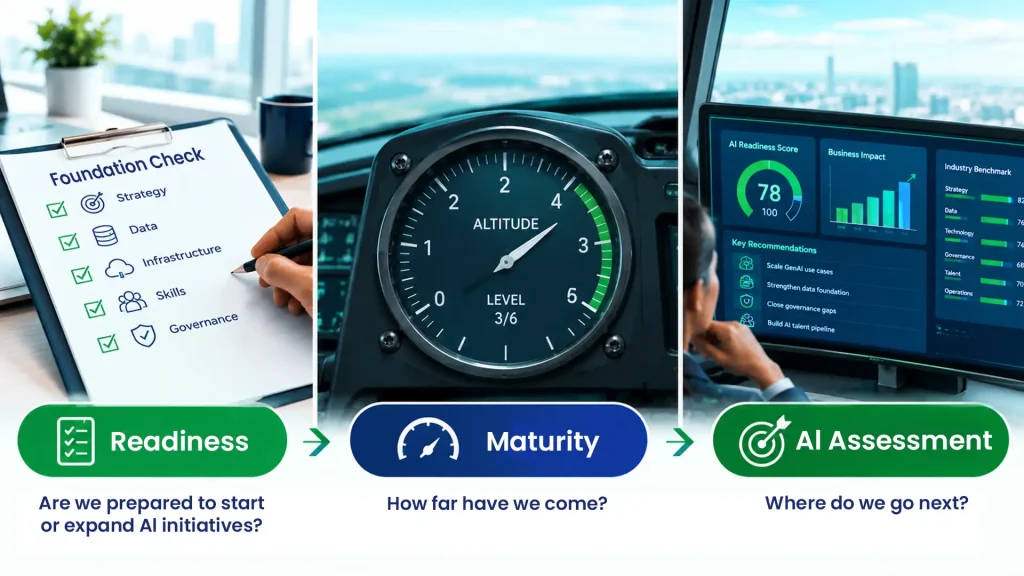
Deciphering the Difference
| Dimension | AI Assessment | AI Readiness Assessment | AI Maturity Assessment |
|---|---|---|---|
| Primary Question | Where are we today, and what is the prioritized path to scale AI for business value? | Are we prepared to start (or significantly expand) AI initiatives? | How far along the AI journey are we compared to peers and to a target state? |
| Focus | End-to-end: strategy, use cases, data, technology, governance, talent, operations, agentic readiness. | Foundational preparedness such as strategy clarity, data fitness, infrastructure, skills, governance baseline. | Capability depth like how repeatable, integrated, governed, and value-generating AI is across the enterprise. |
| Timing | At any inflection point, including before, during, and after AI scale-up. | Typically before launching a major AI program or moving from pilots to production. | After AI initiatives are running, to measure progress and benchmark against industry. |
| Deliverables | Scorecard, gap analysis, prioritized roadmap, target architecture, governance blueprint, business cases. | Readiness scorecard, foundational gap list, “minimum viable” remediation plan. | Maturity level (e.g., Level 3 of 6), capability heatmap, benchmark report, evolution roadmap. |
| Stakeholders | C-suite, business and technical leaders, risk and compliance, external partner. | CIO, CDO, CTO, head of AI, head of data engineering. | CEO, board, business leaders, head of AI/transformation. |
| Mindset | Diagnostic + prescriptive. | Pre-flight check. | Progress check. |
Five Reasons AI Initiatives Fail Without One
Across enterprise AI programs, the same failure patterns appear with striking regularity. Each one is preventable with a proper assessment. Each one is nearly guaranteed without one.

-
Strategic Misalignment:
AI initiatives get launched in pockets: one in IT, one in a data science team, one in an innovation lab, one in a business unit, all without a shared definition of what success looks like for the enterprise as a whole. The result is competing roadmaps, duplicate tooling, and models that nobody owns in production.
CIO research identifies this as the single most common reason enterprise AI programs fail. A proper assessment forces an explicit conversation about business outcomes first, then maps AI initiatives to them. The result is a unified portfolio and clear accountability at the executive level.
One example from the original assessment framework: a global insurer ran five overlapping document-intelligence pilots across claims, underwriting, compliance, and finance. An assessment consolidated them into a single platform with shared models, cutting projected spend by 40% and accelerating production deployment by six months.
-
Data Readiness Challenges:
AI models are only as good as the data they consume, and most enterprise data is fragmented, inconsistent, and locked behind organizational and technical silos. Cloudera’s 2026 research found that nearly 80% of enterprises say AI is being held back by data access challenges. Projects stall, and the ROI evaporates before a model reaches production.
A data readiness review profiles quality, lineage, governance, and accessibility for the specific use cases on the roadmap, producing a focused modernization plan tied to AI outcomes rather than a generic “fix all the data” program that never finishes.
-
Governance Gaps:
AI introduces a category of risk that traditional IT governance was not designed to handle: probabilistic outputs, opaque reasoning, evolving regulations, and the potential for a single model to affect millions of decisions. Without a structured assessment, governance is an afterthought, and afterthoughts become audit findings.
Transcend’s research shows that 81% of enterprises have delayed, scaled back, or abandoned an AI initiative because of data permission and governance gaps. Governance is one of the eight pillars of a proper enterprise AI assessment. The output is not a policy document. It is an operational framework with model inventory, risk classification, approval workflows, and clear accountability across legal, risk, compliance, and the business.
-
Talent and Skills Gaps:
Enterprises need a blend of AI engineers, data scientists, MLOps specialists, AI product managers, governance professionals, and business translators. The labor market does not have enough of any of them. The World Economic Forum describes this as AI’s dual workforce challenge: overcapacity in routine roles and chronic shortages in advanced AI skills.
A talent and operating model review identifies current capability, maps skill gaps against the roadmap, and recommends a practical mix of hiring, upskilling, partnering, and outsourcing.
-
Lack of an ROI Measurement Framework:
Most enterprises cannot answer the question: “What did our last significant AI investment actually deliver?” Without a measurement framework, AI looks expensive and uncertain. Vague claims of productivity improvement do not survive CFO scrutiny. Forrester argues that the real AI ROI problem is not technology. It is the measurement.
A proper assessment defines baseline metrics for each use case, the value tree that connects model performance to business outcomes, and the reporting cadence that turns AI from a cost center into a defensible portfolio.
Where Does Your Enterprise Stand?
Your organization is probably further along than you think in some areas and further behind than you realize in others.
Quantiphi’s AI Maturity Assessment gives you an evidence-based view across eight dimensions of enterprise AI readiness, benchmarked against your industry peers, in under five minutes.
Seven questions. An instant maturity report. A prioritized starting point for your next 90 days.
When to Commission an AI Assessment
The honest answer is: more often than most organizations do. AI moves quickly, and a roadmap built 18 months ago is almost certainly out of date. But there are specific trigger points where an assessment is not optional.
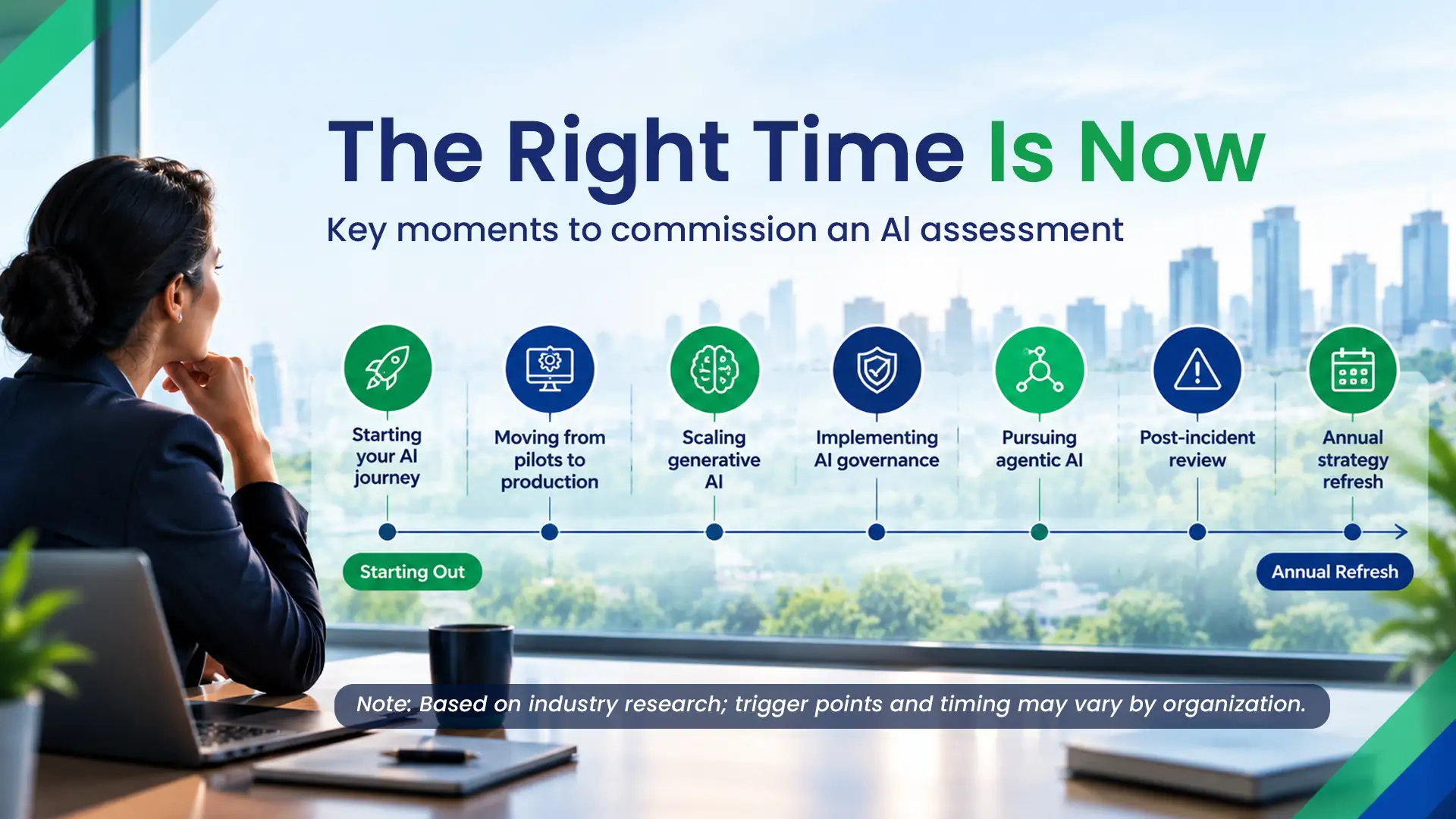
| Trigger | Why an Assessment Is Needed |
|---|---|
| Starting your AI journey | Establishes a credible baseline across strategy, data, technology, and talent before any spend is committed |
| Moving from pilots to production | Identifies the operational, governance, and platform gaps that quietly kill scale-up efforts |
| Scaling generative AI | Evaluates whether your data architecture, security model, and human review processes can handle GenAI’s specific risks |
| Implementing AI governance | Surfaces policy gaps, ownership ambiguity, and compliance exposure before regulators or auditors do |
| Pursuing agentic AI | Tests whether you have the orchestration, observability, and human-in-the-loop controls required for autonomous workflows |
| Post-incident review | After a model failure, bias incident, or regulatory query, an assessment establishes what went wrong and what must change |
| Annual strategy refresh | Keeps the AI roadmap connected to evolving business strategy and the rapidly changing AI landscape |
From Capability Talk to Outcome Proof
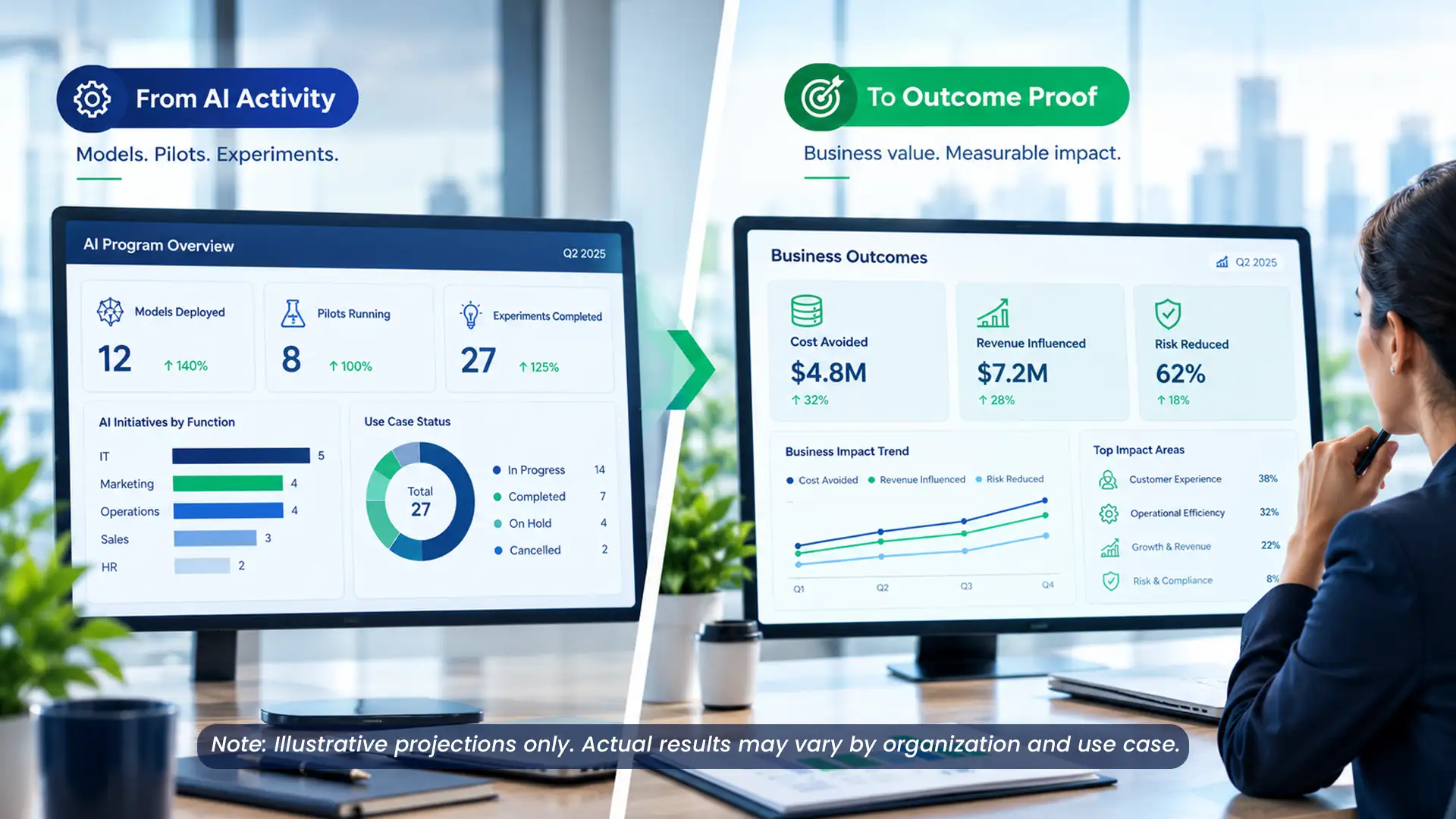
The shift most enterprises need to make is not a technology upgrade. It is a mindset upgrade.
For years, the measure of an AI program was what it could do: the number of models deployed, the breadth of use cases explored, the sophistication of the technology in play. That measure served its purpose when AI was new and the goal was building organizational familiarity.
Today, that measure is no longer good enough. Boards are asking about P&L impact. CFOs want to see a value tree that connects model performance to business outcomes. Business unit leaders want to know which AI capability moved their operating metrics last quarter.
The organizations that are winning are the ones that have made that shift, from reporting on capabilities to proving outcomes. An AI assessment is the instrument that makes that shift possible. It tells you, with evidence rather than optimism, what is actually working, what is not, and what to do about it first.
Owning that picture is the starting point for everything that follows. In Part 2 of this series, we will show you exactly what to measure: the eight-pillar framework that gives enterprises a complete, structured view of their AI maturity, along with the scoring model that benchmarks you against your industry peers. Own your enterprise intelligence. Compound your edge.
The Path Forward
If any of the five failure patterns in this blog felt familiar, that recognition is the most useful starting point you have right now.
Quantiphi’s AI Maturity Assessment takes less than five minutes, covers the full breadth of enterprise AI readiness, and delivers an instant, industry-benchmarked maturity report you can share with your leadership team today.
Seven questions. Five minutes. An instant maturity report. Try now!
Frequently Asked Questions
An AI assessment is a structured, evidence-based evaluation of your organization’s ability to design, deploy, govern, and scale AI to deliver measurable business outcomes. It covers strategy, use cases, data, technology, governance, talent, deployment, and agentic readiness, and produces a maturity scorecard and a prioritized roadmap.
An AI readiness assessment asks whether you are prepared to start or expand AI. An AI maturity assessment measures how far you have already come. An AI assessment is the umbrella exercise that combines both lenses and adds the prioritization, business case, and roadmap needed to act. Mature programs use all three on a defined cadence.
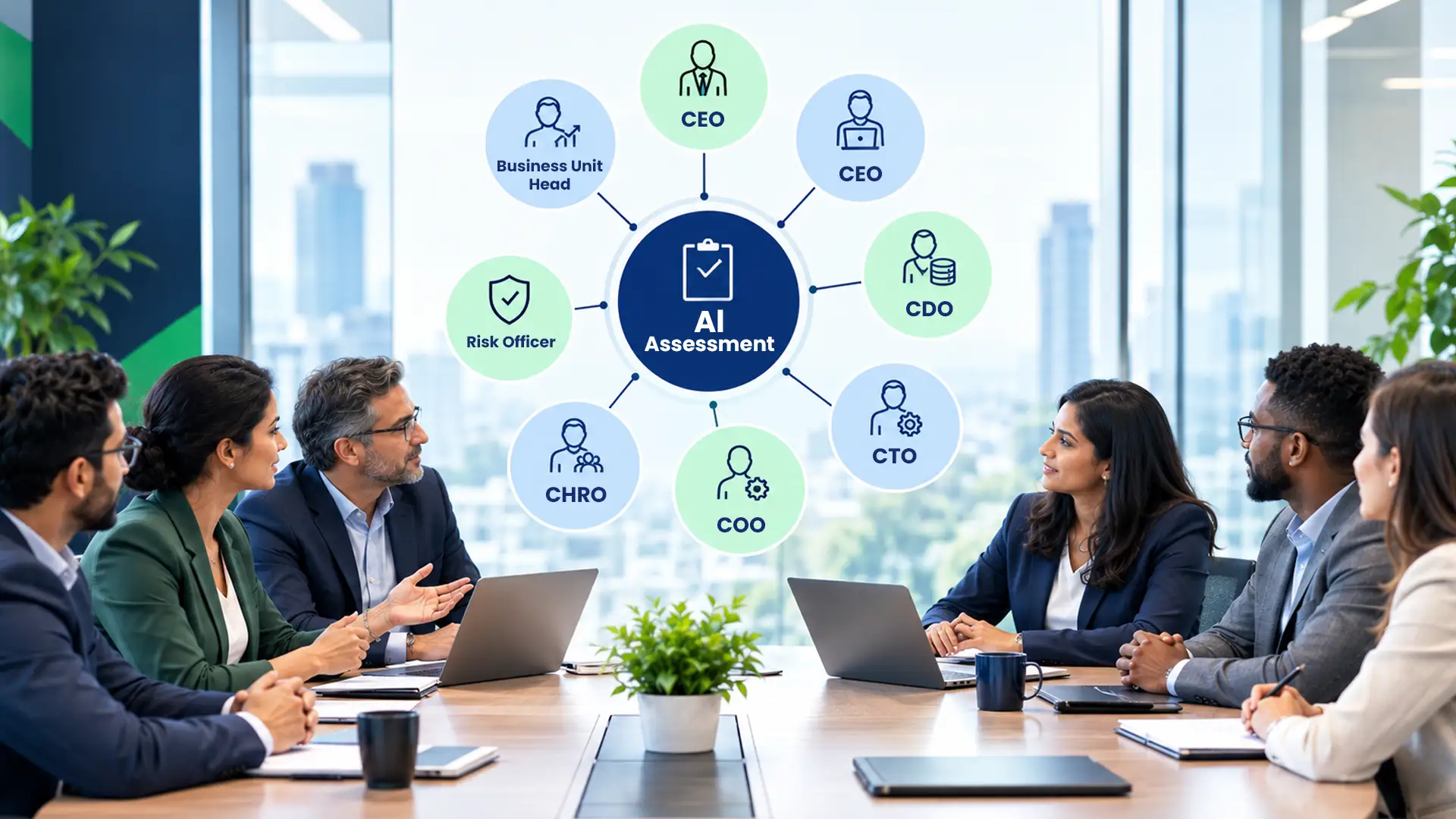
At minimum, the CEO sponsor, CIO, CDO, CTO, COO, Chief Risk or Compliance Officer, HR leadership, and the heads of the business units most affected. AI, data engineering, and security teams round out the working group, often alongside an external assessment partner to ensure the findings are grounded in evidence rather than internal politics.