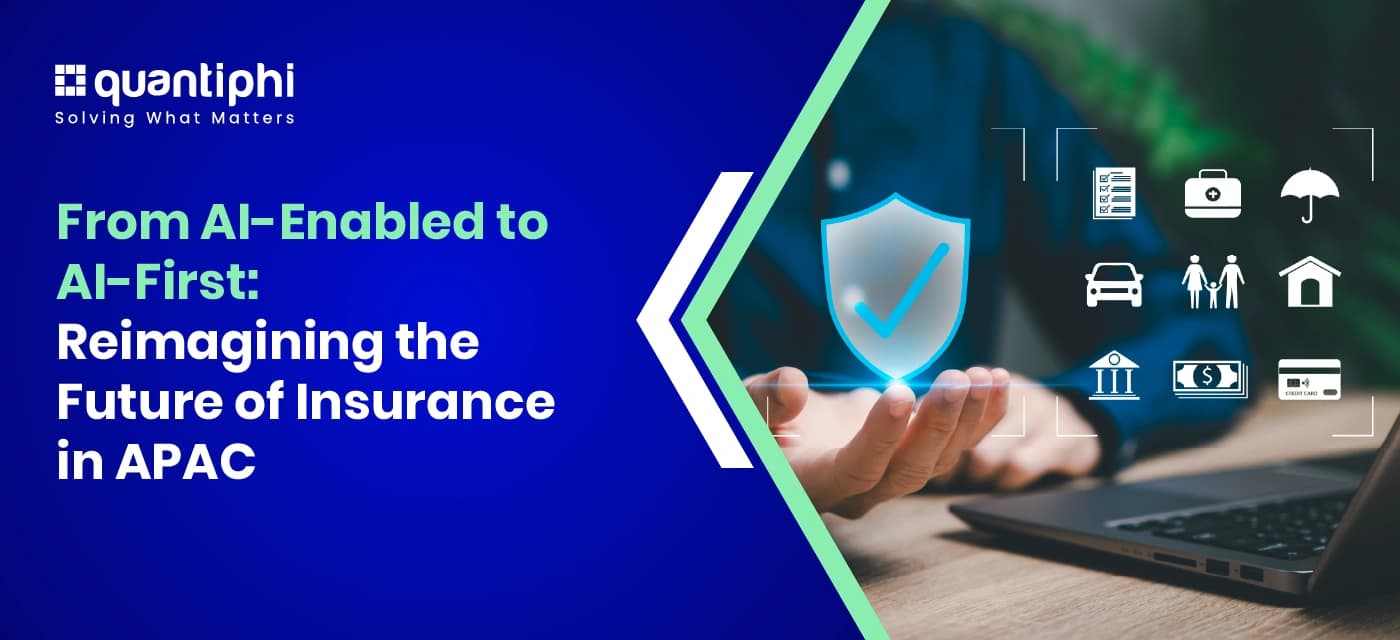
From AI-Enabled to AI-First: Reimagining the Future of Insurance in APAC

The insurance industry in APAC is undergoing one of the most significant transformations in its history. Rapid economic growth, rising middle-class populations, and increasing digital adoption are expanding the opportunity landscape for insurers. At the same time, customer expectations are evolving toward real-time, personalized, and seamless experiences.
According to Gartner, this transformation is being driven by a fundamental shift toward AI-first business models, where artificial intelligence is no longer an enabler but the core driver of business strategy. Yet, while momentum is strong, maturity is uneven.
Nearly 66% of insurers have already adopted AI in some form, and another 32% plan to do so within the next three years. However, only about 13% have truly transitioned to an AI-first operating model. This gap between adoption and impact defines the current state of the industry. Insurers are investing in AI, but most are not yet realizing its full potential.
Why AI Adoption Is No Longer Optional ?
The urgency for AI adoption is not just about innovation, it is about survival in an increasingly complex and competitive environment.
Risk landscapes are expanding rapidly. Insurance fraud alone costs the industry approximately $308 billion annually, while climate-related losses exceeded $140 billion in 2024. These pressures demand faster, more accurate, and data-driven decision-making capabilities that traditional systems cannot deliver.
At the same time, customer behavior is shifting. Younger consumers are twice as likely to prefer embedded and digital-first insurance experiences. They expect hyper-personalized offerings, instant servicing, and seamless integration into their everyday digital ecosystems.
Operationally, insurers are also facing a workforce transformation. An estimated 400,000 employees are expected to retire by 2026, while 67% of younger professionals perceive insurance as an unattractive career path. This creates a dual challenge of talent shortage and the need for new skill sets centered around AI and data.
In this context, AI is emerging as the only scalable lever that can simultaneously address efficiency, growth, and customer experience. It enables insurers to automate decisions, augment human expertise, and unlock new business models.
The Reality Check: What’s Slowing Down Transformation ?
Despite clear intent, the journey toward AI-first insurance is far from straightforward. Several structural challenges continue to slow down progress.
One of the most significant barriers is the persistence of legacy core systems. More than 75% of core insurance platforms in APAC remain on-premises and heavily customized. These systems are not designed for real-time processing or seamless AI integration, making it difficult to scale beyond isolated use cases.
Data readiness is another critical bottleneck. While 56% of insurers are actively exploring new data sources and 42% are prioritizing AI strategies, only about 7% have achieved high levels of AI data readiness. This disconnect creates a situation where organizations aspire to leverage AI but lack the foundational data infrastructure required to support it.
Organizational challenges further complicate the landscape. AI transformation requires a shift from IT-led initiatives to business-led ownership, which many insurers are still navigating. Additionally, the emergence of human-AI hybrid operating models demands new ways of working, new governance structures, and new talent strategies.
Finally, regulatory and ethical considerations are becoming increasingly prominent. As insurers deploy AI at scale, they must also address concerns around bias, explainability, and compliance, all while managing increasing regulatory scrutiny.
The Path Forward: Building an AI-First Insurance Enterprise
To move from experimentation to impact, insurers must rethink their approach to transformation.
The first step is to move beyond isolated AI pilots and embed AI into core business processes such as underwriting, claims, and servicing. This requires reengineering workflows rather than simply automating existing ones.
Second, core systems must evolve toward modular, cloud-enabled architectures that can support real-time data flows and integration with AI models. Without this foundation, scaling AI will remain a challenge.
Third, insurers must invest in building robust data ecosystems. Data needs to move from being a byproduct of operations to a strategic asset that drives decision-making. This includes integrating internal and external data sources, enabling real-time analytics, and ensuring strong governance.
Equally important is the transformation of the workforce. The future of insurance lies in human-AI collaboration, where AI augments human capabilities rather than replacing them. Organizations that successfully adopt this model are already seeing productivity gains of up to 34%, compared to 14% in traditional environments.
Finally, insurers must adopt a mindset of continuous innovation. AI-first is not a one-time transformation, it is an ongoing journey that requires agility, experimentation, and alignment between business and technology.
Enabling the Transformation: The Role of Quantiphi
Bridging the gap between AI ambition and execution requires the right combination of technology, expertise, and accelerators.
At Quantiphi, the focus is on enabling insurers to scale AI from pilots to enterprise-wide adoption. Platforms like Baioniq help rapidly deploy and operationalize AI use cases across underwriting, claims, and customer engagement, reducing time-to-value and driving measurable business outcomes.
For document-intensive processes, Dociphi enables intelligent automation of workflows such as claims processing, policy servicing, and KYC. This can reduce manual effort by 60–80% while improving turnaround times and accuracy.
In addition, modernizing legacy systems and accelerating engineering productivity is critical to sustaining transformation. Codeaira supports this by enabling faster code transformation, modernization, and development through AI-assisted engineering. This helps insurers accelerate core modernization initiatives and build scalable, future-ready architectures.
Together, these capabilities enable insurers to build a strong foundation for AI-first operations while delivering tangible business impact.
The Shift That Will Define the Next Decade
The APAC insurance industry stands at a pivotal moment. AI adoption is widespread, but true transformation is still in its early stages. The gap between experimentation and enterprise-scale impact remains significant.
The organizations that will lead the future are not those that simply invest in AI, but those that fundamentally redesign their business models around it. Moving to an AI-first operating model requires rethinking systems, data, processes, and people in a holistic manner.
This is not just a technology shift, it is a strategic reinvention of how insurance works. And for insurers in APAC, the time to make that shift is now.