Loss Run Automation: Transforming Insurance Underwriting with Agentic AI

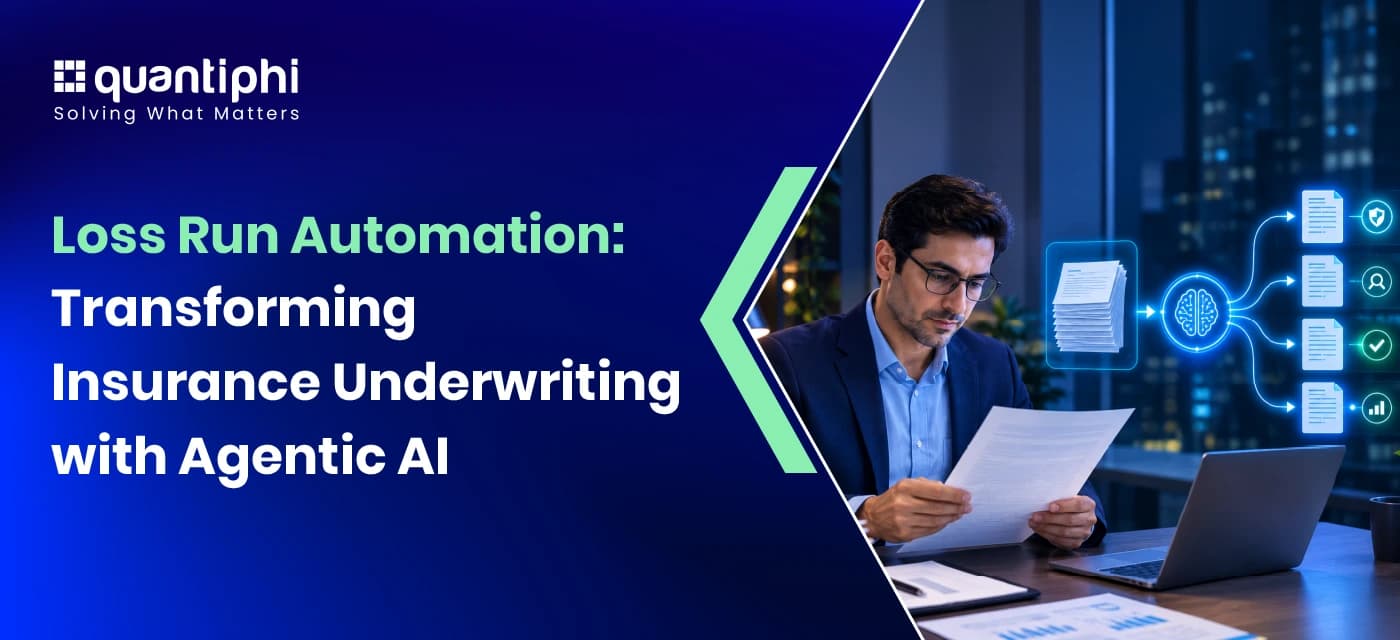
An underwriter receives a submission containing six loss runs from four different carriers. In an industry where speed is a competitive edge, over 80% of all insurance data still sits locked inside unstructured formats like PDFs, spreadsheets, and handwritten notes. Before pricing can even begin, they spend nearly 30% of their time locating claim numbers, reserves, incurred losses and duplicate claims across hundreds of pages. None of this work evaluates risk- it simply prepares data for analysis. This is precisely the problem Loss run Automation solves. The sheer variety of carrier-specific loss run templates leads to delayed quote turnaround times, high operational costs, and an increased risk of human error. As submission volumes rise and the industry faces an ongoing talent shortage, the pressure for faster quote-to-bind cycles is pushing insurers to look beyond legacy tools like traditional OCR.
Enter Agentic AI and Intelligent Document Processing (IDP). Modern loss run automation doesn’t just read text; it applies contextual intelligence to understand, validate, and standardize data across thousands of varying formats. By deploying autonomous AI agents that can cross-reference data, flag anomalies, and learn continuously, insurers are transforming chaotic paperwork into structured underwriting intelligence that accelerates decision-making and improves operational efficiency.
Organizations like Quantiphi are pioneering this shift. Through AI-first transformation strategies and platforms like Dociphi, insurers are achieving up to 99% extraction accuracy on complex loss runs seamlessly handling colossal files exceeding 7,000 pages. Furthermore, Quantiphi’s recently patented AI workflow automation specifically designed for loss run processing reduces processing and training time by up to 40%. By embracing these Agentic AI solutions, carriers can price risk more accurately, eliminate
What is a Loss Run Report?
Definition of a Loss Run
A loss run is a historical record of insurance claims associated with a policyholder over a specific period. Often considered the insurance equivalent of a credit report, it provides insurers with a detailed view of past claims activity and serves as a critical input for underwriting risk assessment.
Underwriters use loss runs to evaluate the frequency, severity, and nature of previous claims before pricing policies, determining coverage terms, or assessing overall risk exposure.
A typical loss run document may include:
- Policy information
- Claim numbers
- Dates of loss
- Claim reserves
- Incurred losses
- Claim descriptions
- Claim status (open, closed, pending, etc.)
Types of Insurance Lines Using Loss Runs
Loss runs are widely used across multiple insurance lines to help underwriters assess historical claims performance, evaluate risk exposure, and make informed underwriting decisions. While the structure and level of detail may vary by policy type, loss runs remain a foundational component of commercial insurance underwriting.
Common insurance lines that rely heavily on loss runs include:
-
Workers’ Compensation:
Used to evaluate workplace injury history, claim frequency, medical costs, and employee safety risks
-
Commercial Auto:
Helps assess accident history, vehicle-related claims, driver risk patterns, and liability exposure
-
General Liability:
Provides visibility into third-party injury claims, property damage incidents, and litigation-related losses
-
Property Insurance:
Tracks historical property damage claims caused by fire, weather events, theft, equipment failure, or natural disasters
-
Professional Liability:
Helps insurers evaluate errors, omissions, negligence claims, and industry-specific liability risks
-
Cyber Insurance:
Used to analyze historical cybersecurity incidents, data breaches, ransomware events, and digital risk exposure
The Traditional Loss Run Processing Workflow
How Manual Loss Run Processing Works
Traditional loss run processing is largely manual and involves multiple time-consuming steps across underwriting and operations teams. Because loss run documents often arrive in inconsistent formats and layouts, underwriters must manually review, extract, and standardize information before risk evaluation can begin.
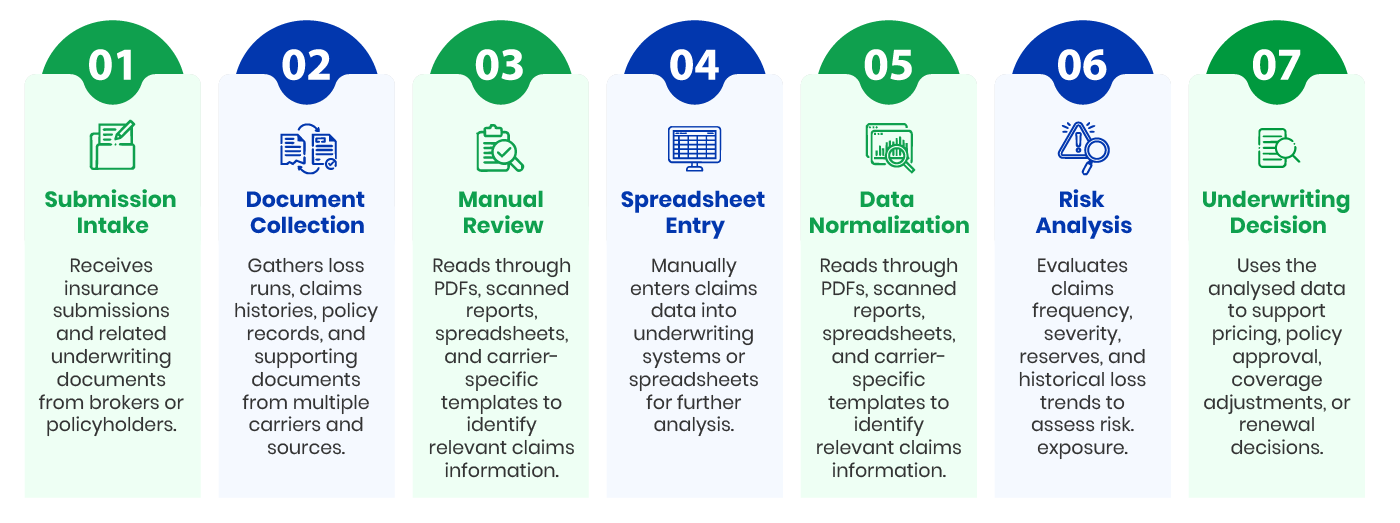
- Submission intake: Receiving insurance submissions and related underwriting documents from brokers or policyholders
- Document collection: Gathering loss runs, claims histories, policy records, and supporting documents from multiple carriers and sources
- Manual review: Reading through PDFs, scanned reports, spreadsheets, and carrier-specific templates to identify relevant claims information
- Spreadsheet entry: Manually entering claims data into underwriting systems or spreadsheets for further analysis
- Data normalization: Standardizing inconsistent formats, terminology, and claim structures across multiple carriers
- Risk analysis: Evaluating claims frequency, severity, reserves, and historical loss trends to assess risk exposure
- Underwriting decision: Using the analyzed data to support pricing, policy approval, coverage adjustments, or renewal decisions
Notice the problem? Steps 3, 4, and 5 force highly skilled underwriters to act as data entry clerks. By the time they reach Step 6 (Risk Analysis), hours or even days have been wasted, delaying the final quote.
Why Manual Loss Run Processing Creates Bottlenecks
Manual loss run processing creates significant operational bottlenecks because underwriting teams must handle large volumes of unstructured and inconsistent documents across multiple carriers and policy types. These inefficiencies slow down underwriting workflows, increase processing costs, and impact decision-making accuracy.
Some of the most common challenges include:
- Carrier format variability: Every carrier uses different templates, layouts, and claim structures, making standardization difficult
- Poor scan quality: Low-resolution scans, handwritten notes, and unclear PDFs reduce extraction accuracy and require manual intervention
- Missing fields: Incomplete claim information often forces underwriters to perform additional follow-ups and validations
- Inconsistent terminology: Different carriers use varying claim descriptions, abbreviations, and naming conventions
- Duplicate claims: Repeated or overlapping claim entries can create confusion and affect risk assessment accuracy
- Large document volumes: High submission volumes make manual review time-consuming and difficult to scale
- Fragmented workflows: Data is often spread across emails, PDFs, spreadsheets, and underwriting systems, creating disconnected processes and operational delays
Manual Loss Run Operational Impact on Insurance Teams
Manual loss run processing affects multiple stakeholders across the insurance value chain, creating operational inefficiencies, slower decision-making, and increased processing costs. As document volumes grow, these bottlenecks directly impact underwriting speed, customer experience, and overall business scalability.
- Underwriter: Manual “stare-and-compare” reviews of lengthy loss runs consume valuable underwriting time, increase fatigue, and raise the risk of missed claims, delayed quotes, and underwriting leakage.
- VP of Underwriting Operations: Manual loss run processing creates operational bottlenecks, slows quote turnaround, strains team capacity during peak seasons, and drives up costs through additional staffing needs.
- Broker: Slow, manual processing delays quote delivery, weakens client experience, and increases the likelihood of losing business to carriers with faster, AI-enabled underwriting.
- Chief Underwriting Officer (CUO): Critical claims data trapped in PDFs limits portfolio visibility, delaying insights into loss trends and making pricing and risk appetite decisions less timely and effective.
What is Loss Run Automation?
Definition of Loss Run Automation
Loss run automation refers to the use of AI-driven technologies to automatically extract, normalize, classify, and analyze data from loss run and claims history documents. Instead of relying on manual review and spreadsheet-based processing, automation platforms use artificial intelligence to transform unstructured insurance documents into structured underwriting intelligence.
Modern loss run automation solutions combine technologies such as Optical Character Recognition (OCR), Natural Language Processing (NLP), document intelligence, machine learning, and Generative AI to identify critical claims information across multiple carrier formats and document types.
These systems can automatically process and standardize data such as claim numbers, loss dates, reserves, incurred losses, claim descriptions, and claim status, enabling insurers to accelerate underwriting workflows, improve accuracy, reduce operational costs, and support faster risk assessment decisions.
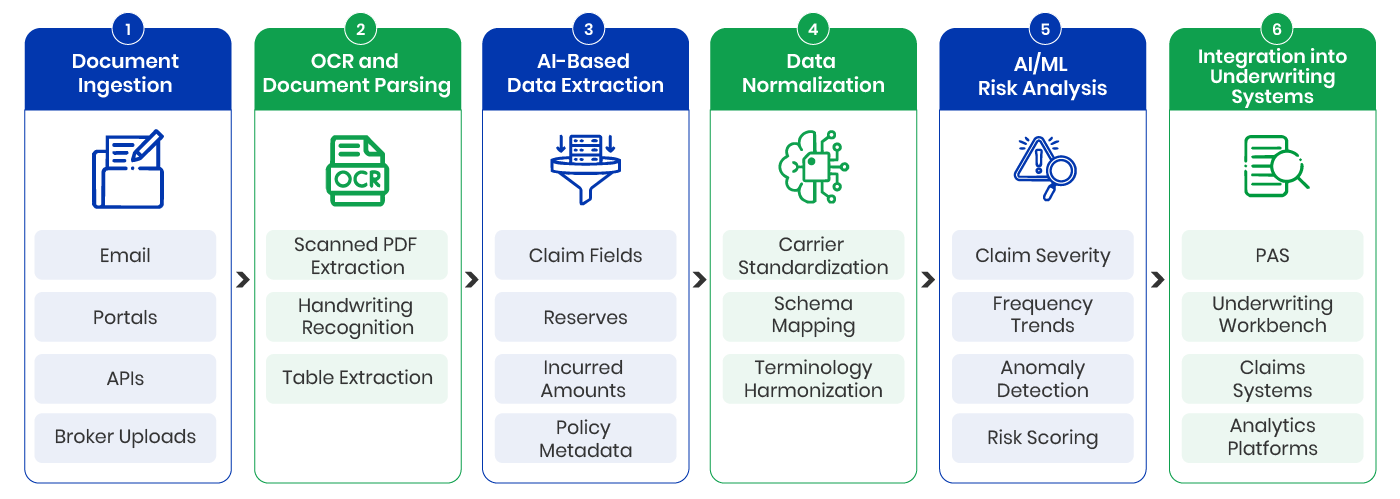
How Modern Loss Run Automation Works
-
The Assistive Approach: Human-in-the-Loop (HITL)
In a standard Intelligent Document Processing (IDP) workflow, AI acts as an ultra-fast assistant to the underwriter. The human remains a required checkpoint in the process.
- Step 1: Multi-Channel Ingestion: Loss runs arrive via email, broker portals, or APIs. The AI instantly ingests the unstructured PDFs, images, or spreadsheets.
- Step 2: Intelligent Extraction: Using Natural Language Processing (NLP) and contextual AI, the system identifies claim numbers, dates of loss, paid amounts, and open reserves—even if the carrier’s template has never been seen before.
- Step 3: The 3-Way Comparison Screen (The HITL Checkpoint): The extracted data is pushed into an intuitive UI (like Dociphi’s patented comparison screen). The underwriter views the original document alongside the AI-extracted data and the internal underwriting guidelines.
- Step 4: Human Validation: The AI highlights discrepancies or low-confidence data in red. The underwriter manually validates or corrects these specific fields before clicking “approve,” feeding the standardized data into the core system.
The Result: Extraction takes seconds instead of hours, but the underwriter still actively touches every file.
-
The Autonomous Approach: Agentic AI with Human-in-the-Loop (HITL)
This is where the paradigm shifts. Agentic AI doesn’t just extract data; it reasons, plans, and acts autonomously. With a Human-In-the-Loop (HITL) model, the AI handles the entire workflow end-to-end, and the human only intervenes when the AI asks for help.
- Step 1: Autonomous Triaging: The AI Agent receives the broker submission, instantly identifies the loss run documents, and categorizes them by complexity, risk appetite, and urgency.
- Step 2: Cross-Referencing & Enrichment: The Agent extracts the loss history and automatically cross-references it against third-party databases, historical policies, and internal business rules.
- Step 3: Reasoning & Decisioning: Instead of just outputting data, the Agent applies underwriting logic. For example, it might recognize: “This claim was closed yesterday for $0, so I will adjust the reserve total and recalculate the loss ratio.”
- Step 4: Exception Handling (The HITL Intervention): If the data is clean and meets all confidence thresholds, the Agent autonomously standardizes the data and routes it directly to the core system for pricing. The underwriter is only alerted if there is a severe anomaly, suspected fraud, or a complex edge case.
The Result: True scale. Underwriters are removed from the administrative assembly line entirely. They act as strategic supervisors, stepping in only to handle high-value exceptions, while the Agentic AI processes standard loss runs in the background at machine speed.
Core Technologies Behind Loss Run Automation
Modern loss run automation combines AI, document intelligence, and machine learning technologies to transform unstructured claims documents into structured underwriting insights.
- Intelligent Document Processing (IDP): IDP combines AI, OCR, NLP, and automation to process complex insurance documents across multiple carrier formats.
- Optical Character Recognition (OCR): OCR converts scanned PDFs, images, and handwritten documents into machine-readable text for digital processing.
- Natural Language Processing (NLP): NLP helps systems understand insurance terminology, claim descriptions, and contextual relationships within loss run documents.
- Large Language Models (LLMs): LLMs enable advanced document interpretation, claims summarization, contextual extraction, and underwriting insight generation.
- Machine Learning: Machine learning models analyze historical claims data to support fraud detection, risk scoring, anomaly detection, and severity prediction.
- Generative AI: Generative AI helps create automated summaries, underwriting recommendations, and natural language insights from claims data.
- Agentic AI: Agentic AI enables autonomous AI agents to manage workflows, perform multi-step analysis, trigger validations, and coordinate underwriting tasks.
- Human-in-the-Loop Validation: Human validation ensures AI outputs are reviewed for accuracy, compliance, and complex edge cases while continuously improving model performance.
Key Business Benefits of Loss Run Automation
- Accelerated Quote-to-Bind Cycles: Automate document intake and data extraction to reduce processing times from hours to minutes, enabling same-day quotes and higher win rates.
- Unlock Underwriting Capacity: Eliminate manual effort to process more submissions without increasing headcount, improving operational efficiency and reducing costs.
- Flawless Accuracy & Portfolio Protection: Extract and structure data accurately from any loss run format, minimizing manual errors and enabling more confident underwriting decisions.
- Deeper Risk Intelligence: Standardize claims data to unlock portfolio-wide visibility, identify loss trends, and support smarter pricing and risk strategies.
- Stronger Broker Relationships: Deliver faster quote turnaround and a seamless submission experience, helping carriers become preferred partners and drive higher retention.
- Built-in Compliance & Auditability: Replace manual processes with traceable, source-linked workflows that simplify governance, audits, and regulatory compliance.
Agentic AI in Loss Run Automation
From Document Processing to Autonomous Decision Support
Traditional loss run processing relies on OCR, Intelligent Document Processing (IDP), and rule-based automation to extract data from documents. While effective for repetitive tasks, these systems often require human intervention when handling complex formats, missing information, or exceptions.
Agentic AI takes automation a step further by introducing intelligent AI agents that can perceive, reason, and act autonomously. Instead of simply extracting data, AI agents can ingest loss runs, validate information, identify missing details, flag inconsistencies, and support underwriting decisions with minimal human involvement.
Unlike traditional automation, which follows predefined rules, autonomous workflows can adapt to varying document formats and dynamically respond to exceptions. This enables underwriting teams to move beyond document processing toward intelligent decision support.
As insurers seek faster quote-to-bind cycles, improved accuracy, and greater operational efficiency, Agentic AI is emerging as a key enabler of smarter, more scalable underwriting operations.
How Agentic AI Streamlines Loss Run Processing
Agentic AI enables insurers to automate and orchestrate the entire loss run processing workflow, from document intake to underwriting decision support. Instead of relying on disconnected tools and manual reviews, intelligent AI agents work together to analyze documents, validate information, and generate actionable insights.
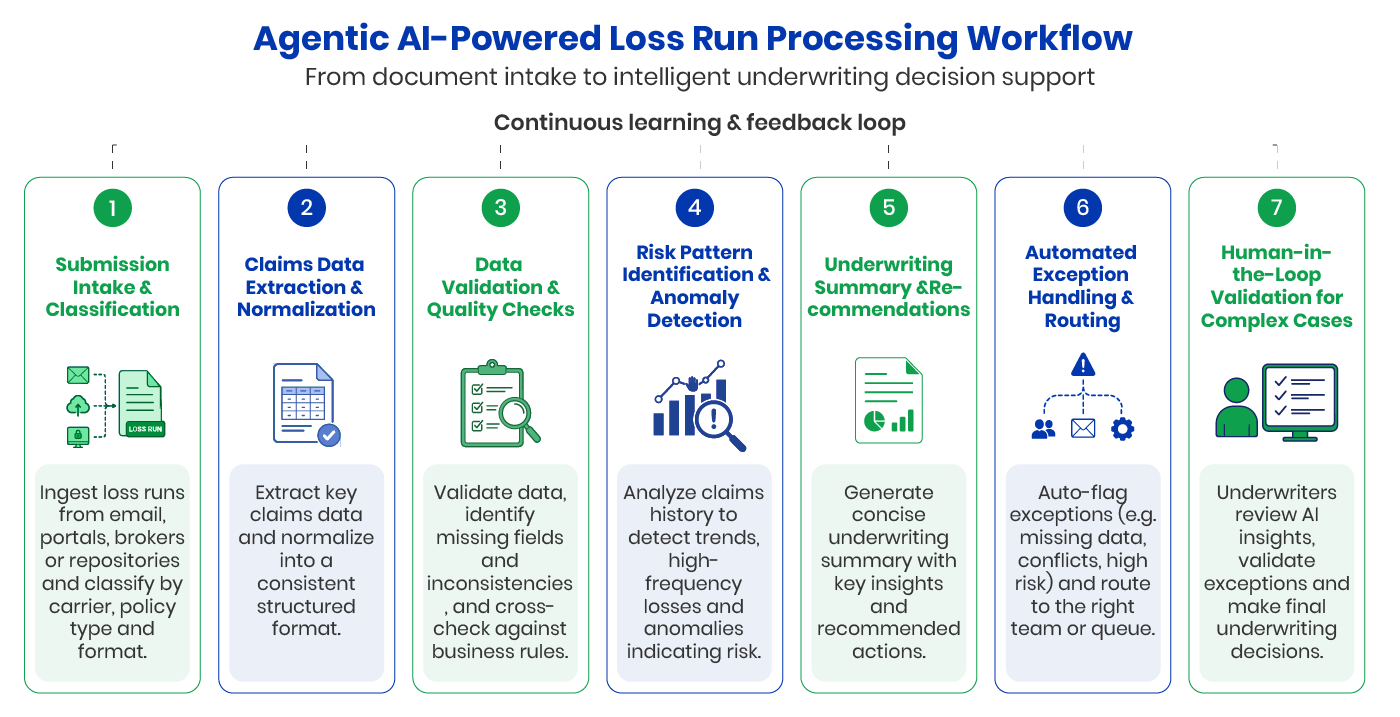
- Submission Intake and Document Classification
AI agents automatically ingest loss runs from emails, portals, broker submissions, or document repositories and classify them based on carrier, policy type, and document format. - Claims Data Extraction and Normalization
The agents extract key claims information such as claim numbers, loss dates, claim status, paid amounts, and reserves. Extracted data is then standardized into a consistent structure, regardless of how the source document is formatted. - Data Validation and Quality Checks
AI agents validate extracted information, identify missing fields, flag inconsistencies, and cross-reference data against business rules or internal systems to improve accuracy. - Risk Pattern Identification and Anomaly Detection
The system analyzes historical claims data to identify recurring loss patterns, high-frequency claims, severity trends, and unusual activities that may indicate elevated underwriting risk. - Underwriting Summary Generation and Recommendations
Based on the extracted and analyzed data, AI agents create concise underwriting summaries highlighting key risk indicators, claims trends, and recommended actions for underwriters. - Automated Exception Handling and Routing
If the system encounters incomplete documents, conflicting information, or high-risk scenarios, AI agents automatically route the submission to the appropriate underwriting, operations, or claims teams for review. - Human-in-the-Loop Validation for Complex Cases
For large, complex, or high-value submissions, underwriters review AI-generated insights, validate recommendations, and make final risk decisions, ensuring expert oversight where needed.
By combining autonomous AI agents with human expertise, insurers can accelerate quote-to-bind cycles, improve data accuracy, and enable faster, more informed underwriting decisions.
Enterprise Architecture for Loss Run Automation
Modern loss run automation requires a scalable, intelligent architecture that can process high volumes of carrier loss run documents, extract and normalize data accurately, and seamlessly integrate with underwriting workflows. A cloud-native, AI-driven architecture enables insurers, MGAs, brokers, and reinsurers to automate document-heavy processes while maintaining transparency, auditability, and regulatory compliance.
Enterprise Architecture for Loss Run Automation Architecture Overview
A typical enterprise loss run automation architecture consists of multiple interconnected layers that transform unstructured claims history documents into structured underwriting intelligence.
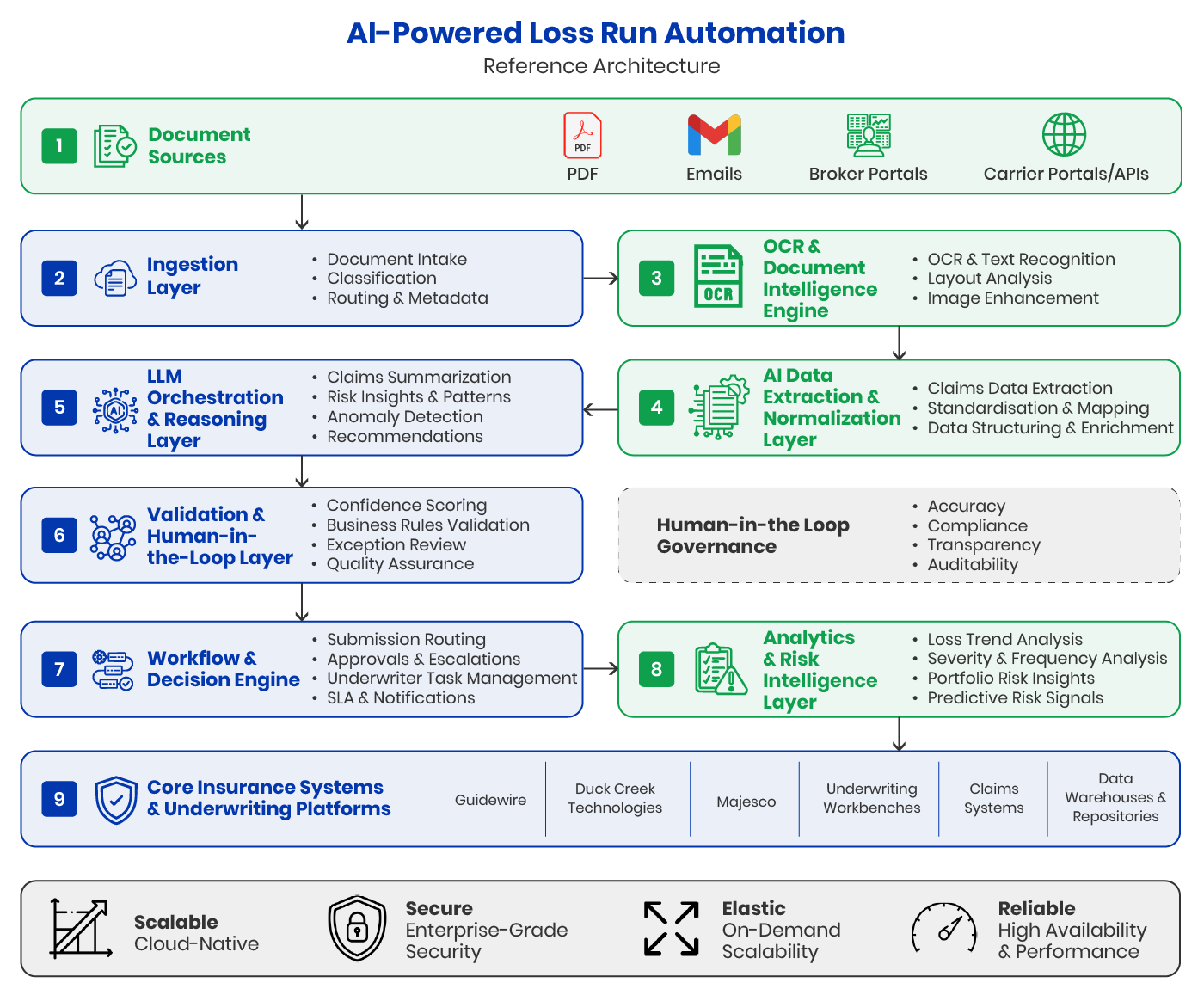
Ingestion Layer
Captures loss run documents from multiple sources, including email submissions, broker portals, carrier systems, document repositories, and APIs. The layer handles document routing, classification, and metadata tagging before processing begins.
OCR Engine
Converts scanned PDFs, images, and handwritten forms into machine-readable text. Advanced OCR capabilities help extract information from varying document layouts and low-quality scans.
AI Extraction Layer
Uses machine learning and document intelligence models to identify and extract critical claims information such as:
- Claim number
- Loss date
- Cause of loss
- Paid losses
- Reserved losses
- Total incurred values
- Policy details
- Coverage information
The extracted data is then standardized into a common underwriting-ready format.
LLM Orchestration Layer
Large Language Models coordinate complex reasoning tasks, including:
- Context-aware data interpretation
- Carrier-specific format understanding
- Missing field identification
- Claims summarization
- Risk pattern detection
- Underwriting recommendation generation
This layer enables more intelligent processing beyond traditional OCR and rule-based extraction.
Validation Layer
Ensures extracted data meets quality and compliance requirements through:
- Confidence scoring
- Business rule validation
- Data consistency checks
- Human-in-the-loop review workflows for exceptions and high-risk submissions
Workflow Engine
Automates operational processes such as:
- Submission routing
- Exception management
- Approval workflows
- Underwriter task assignment
- Escalation management
Analytics Layer
Transforms structured claims data into actionable insights through:
- Loss trend analysis
- Claims frequency and severity analysis
- Portfolio risk monitoring
- Predictive risk assessment
- Underwriting performance dashboards
Underwriting Integration Layer
Delivers validated insights directly into underwriting environments, enabling underwriters to review loss histories and risk assessments without manual data entry.
Loss run Automation platform Integration with Core Insurance Systems
Effective loss run automation should integrate seamlessly with an insurer’s existing technology ecosystem, ensuring insights flow directly into underwriting and claims workflows without creating additional operational complexity.
Policy Administration and Underwriting Platforms
Agentic AI solutions can integrate with leading insurance platforms such as:
- Guidewire
- Duck Creek Technologies
- Majesco
This enables extracted claims data, risk indicators, underwriting summaries, and recommendations to be automatically synchronized with policy and underwriting systems.
Underwriting Workbenches
Integration with underwriting workbenches allows underwriters to:
- Access AI-generated loss run summaries
- Review risk patterns and claims trends
- Receive automated recommendations and alerts
- Make faster, more informed underwriting decisions
All insights are delivered within existing workflows, minimizing the need to switch between multiple applications.
Claims Management Systems
By connecting with claims systems, insurers can:
- Validate historical loss information
- Cross-check extracted claims data
- Enrich risk assessments with real-time claims insights
- Improve data accuracy and consistency
Business Impact
Seamless integration across core insurance systems helps insurers:
- Accelerate quote-to-bind cycles
- Reduce manual data entry
- Improve underwriting efficiency
- Enhance data quality and governance
- Scale loss run processing across the enterprise
Use Cases of Loss Run Automation
Loss run automation delivers value across multiple insurance functions by accelerating data processing, improving risk visibility, and enabling more informed decision-making. From underwriting and renewals to portfolio management and reinsurance analysis, insurers can leverage automated loss run processing to reduce manual effort and enhance operational efficiency.
Commercial Insurance Underwriting
Commercial underwriters often review large volumes of loss runs during new business submissions. Loss run automation extracts, standardizes, and analyzes claims data automatically, enabling underwriters to assess risk faster, identify claims trends, and make more informed pricing and coverage decisions.
MGA and Broker Operations
Managing General Agents (MGAs) and brokers frequently process submissions from multiple carriers, each with different loss run formats. Automation streamlines document intake, data extraction, and risk analysis, helping teams respond to submissions faster while improving productivity and service levels.
Policy Renewals
Renewal underwriting requires evaluating historical claims performance and changes in risk exposure. Automated loss run analysis provides underwriters with up-to-date claims summaries, trend insights, and risk indicators, helping accelerate renewal decisions and improve customer retention.
Claims Trend Analysis
Insurers can use structured loss run data to identify recurring claim patterns, loss frequency trends, high-severity incidents, and emerging risk factors. These insights support proactive risk management and help organizations develop targeted loss prevention strategies.
Portfolio Risk Management
By aggregating and analyzing loss data across policies, regions, industries, or customer segments, insurers can gain a portfolio-level view of risk exposure. This enables better risk selection, underwriting strategy optimization, and capital allocation decisions.
Reinsurance Risk Evaluation
Reinsurers and cedents rely on historical loss experience to assess portfolio quality and pricing. Loss run automation accelerates the collection, normalization, and analysis of claims data, enabling faster due diligence, improved risk assessment, and more informed reinsurance decisions.
KPIs and ROI of Loss Run Automation
Measuring the success of loss run automation requires tracking operational efficiency, business outcomes, and AI performance metrics. Together, these KPIs help insurers quantify productivity gains, underwriting improvements, and the overall return on investment (ROI) of automation initiatives.
Operational KPIs
These metrics measure the efficiency improvements achieved through automation.
| KPI | Business Impact |
|---|---|
| Processing Time Reduction | Measures the decrease in time required to review and process loss runs, accelerating underwriting workflows. |
| Extraction Accuracy | Evaluates the accuracy of claims data extraction and normalization across different carrier formats. |
| Underwriter Productivity | Tracks the increase in submissions processed per underwriter due to reduced manual effort. |
| Cost Savings | Quantifies reductions in operational costs associated with manual data entry, document review, and processing. |
Business KPIs
These metrics demonstrate how automation contributes to underwriting performance and business growth.
| KPI | Business Impact |
|---|---|
| Quote Turnaround Time | Measures how quickly insurers can evaluate submissions and generate quotes. |
| Bind Rate | Tracks the percentage of quoted policies that convert into bound business. |
| Premium Growth | Assesses revenue growth driven by increased underwriting capacity and faster processing. |
| Customer Retention | Measures the impact of faster renewals and improved service on policyholder retention. |
AI Performance KPIs
These metrics help evaluate the effectiveness and scalability of AI-driven automation.
| KPI | Business Impact |
|---|---|
| Confidence Scores | Indicates the AI system’s confidence in extracted data and recommendations, helping prioritize human review. |
| Exception Rate | Measures the percentage of submissions requiring manual intervention due to missing, incomplete, or conflicting information. |
| Automation Coverage | Tracks the proportion of loss run processing tasks completed autonomously without human involvement. |
By continuously monitoring these KPIs, insurers can measure the ROI of loss run automation, identify optimization opportunities, and ensure that AI-driven workflows deliver both operational efficiencies and underwriting value.
Best Practices for Implementing Loss Run Automation
Successful loss run automation requires more than deploying AI models. Insurers must establish the right processes, governance frameworks, and technology foundations to ensure accuracy, scalability, and business adoption.
Start with High-Volume Workflows
Begin by automating high-volume, repetitive processes that consume significant underwriting resources. Focusing on new business submissions, renewals, or broker intake workflows can deliver quick wins, demonstrate ROI, and build organizational confidence in automation initiatives.
Build Human-in-the-Loop Governance
While AI can automate many aspects of loss run processing, human oversight remains essential for complex, high-value, or exception-based cases. Establish clear review workflows that allow underwriters to validate AI outputs, resolve ambiguities, and make final risk decisions when needed.
Standardize Data Models
Loss runs often arrive in inconsistent formats across carriers and brokers. Developing standardized data models and taxonomies helps ensure extracted information is normalized, comparable, and usable across underwriting, analytics, and reporting systems.
Prioritize Explainable AI
Underwriters need to understand how AI-generated insights and recommendations are produced. Implement explainable AI capabilities that provide transparency into data extraction results, risk indicators, confidence scores, and decision rationale to improve trust and adoption.
Integrate with Existing Underwriting Ecosystems
Automation solutions should integrate seamlessly with policy administration systems, underwriting workbenches, claims platforms, and core insurance applications. Embedding AI-generated insights directly into existing workflows minimizes disruption and accelerates user adoption.
Continuously Train AI Models
Loss run formats, underwriting requirements, and risk patterns evolve over time. Regularly retrain and refine AI models using new data, user feedback, and exception cases to improve extraction accuracy, decision quality, and automation coverage.
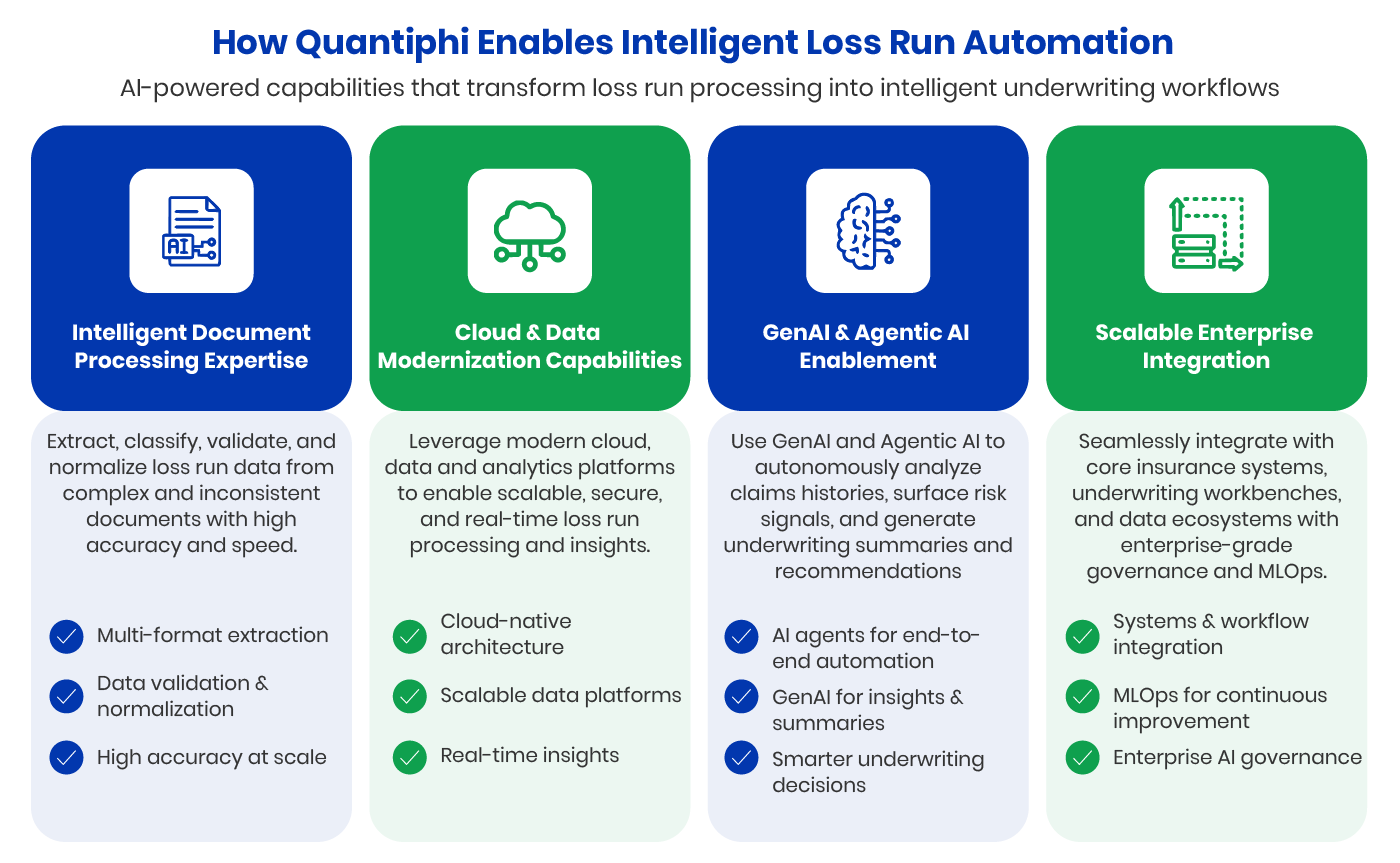
How Quantiphi Enables Intelligent Loss Run Automation
As insurers modernize underwriting operations, loss run automation requires more than document extraction capabilities. Organizations need scalable AI platforms that can process complex insurance documents, generate underwriting insights, integrate with core systems, and operate within enterprise governance frameworks. Quantiphi combines AI engineering, document intelligence, cloud modernization, and GenAI expertise to help insurers transform loss run processing into an intelligent, end-to-end underwriting workflow.
Future of Loss Run Automation
The future of loss run automation extends beyond document processing to intelligent underwriting support powered by AI, GenAI, and Agentic AI. As insurers seek faster quote-to-bind cycles and improved risk assessment, AI-driven solutions will increasingly automate data extraction, identify risk patterns, generate underwriting insights, and support decision-making.
By combining autonomous AI agents with human expertise, insurers can reduce manual effort, improve operational efficiency, and make more consistent underwriting decisions. As cloud, data, and AI technologies continue to mature, loss run automation will become a strategic capability that helps insurers scale operations, enhance customer experiences, and drive smarter business outcomes.