Healthcare AI Should Start Where People Need Help

A person walking out of a hospital after a difficult diagnosis does not care what data platform sits behind the scenes.
They care about what happens next.
Do they get a confusing bill? A poorly timed message? A generic communication that misses the reality of what they are going through? Or do they feel that someone understands the moment they are in and is ready to guide them?
That is the real test for healthcare AI.
Not whether the architecture is modern. Not whether the data estate is more scalable. Not whether the organization has adopted the latest tools.
The test is whether data and AI can help healthcare organizations show up with the right context, at the right time, in a way that earns trust.
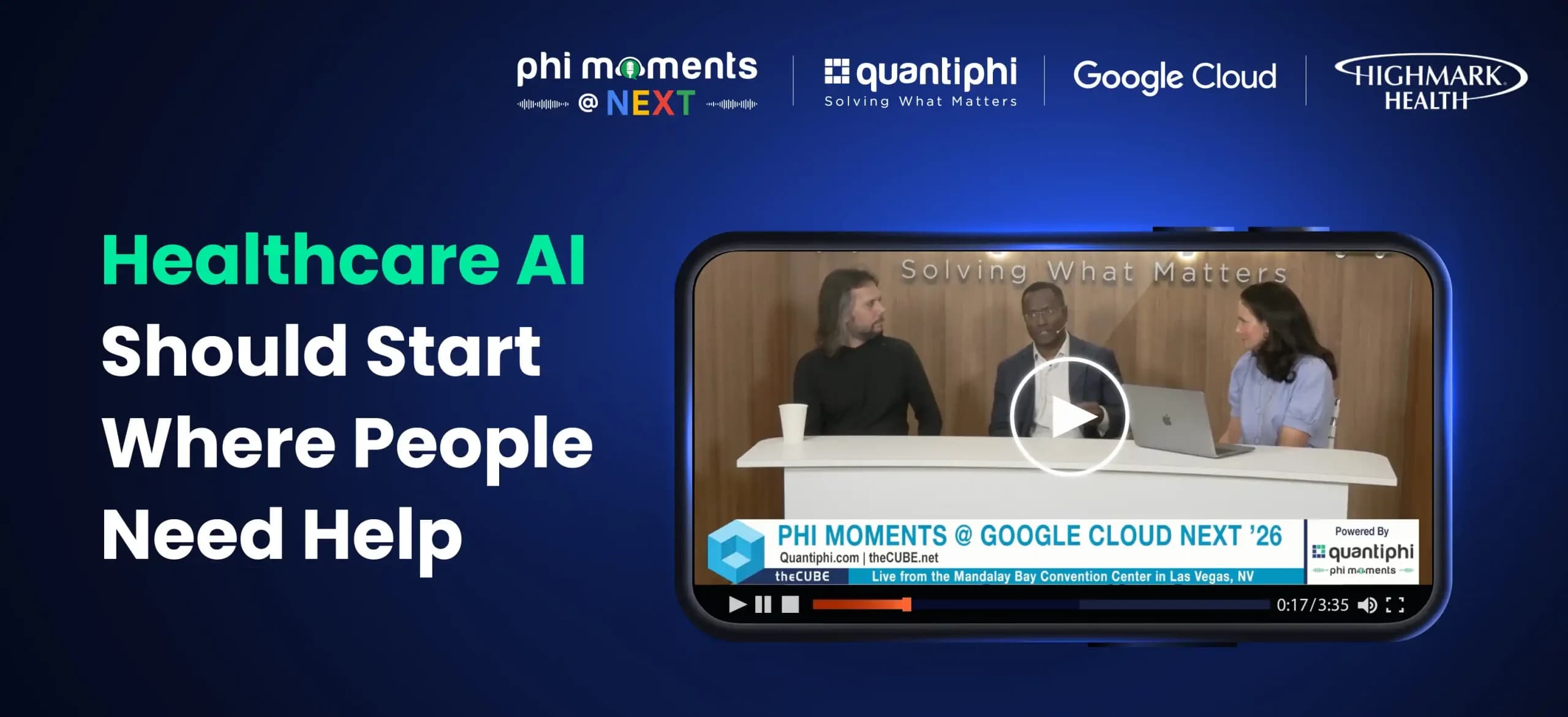
That was the clearest lesson from Highmark Health’s Phi Moments @ NEXT conversation, recorded at Google Cloud Next ’26 in April 2026. Nik Acheson, then Vice President of Data Strategy, Data Architecture and Engineering at Highmark Health, joined Dinesh Kabaleeswaran, Regional Sales Leader, North America at Quantiphi, to discuss how Highmark is rethinking its data strategy through an open lakehouse on Google Cloud.
But the conversation was never really about the lakehouse alone.
It was about what connected, usable, trusted data can make possible for members, patients, physicians, and care teams.
Note: This conversation was recorded at Google Cloud Next ’26 in April 2026. Speaker titles reflect their roles at the time of recording.
The real goal is not modernization. It is better moments.
Healthcare has no shortage of data.
Clinical records, claims, member interactions, provider data, social determinants of health, billing information, care histories, and operational signals all move across the healthcare ecosystem every day.
The harder problem is making that data useful at the moment someone needs help.
Nik framed the stakes clearly. Healthcare is expensive, fragmented, and weighed down by inefficiency. The opportunity is not simply to fund more activity or introduce more technology. It is to ask what healthcare organizations can do differently with the data and capabilities already available to them.
That requires a different way of thinking about modernization.
A lakehouse does not transform healthcare by itself. Neither does cloud migration, generative AI, or a new analytics platform.
Those are enablers.
The real measure is whether the organization can use data to improve a member’s experience, help a physician spend more time with a patient, reduce confusion in a care journey, or deliver the right message before the wrong one creates more friction.
That is why Highmark’s data strategy is not just a technology initiative.
It is an experience strategy.
Connected data only matters if it changes the experience
Highmark operates across a complex payvider ecosystem. It brings together payer, provider, dental, stop loss, and broader healthcare capabilities.
That makes interoperability more than a technical requirement. It becomes central to how the organization understands and supports people across their care journeys.
A member is not just a claim. A patient is not just a clinical record. A physician is not just a user of a system. Each person is part of a larger healthcare experience shaped by care access, cost, communication, timing, social context, and trust.
That is what makes the idea of patient 360 so important.
In other industries, customer 360 is often about personalization or growth. In healthcare, the stakes are more personal. A patient or member may be trying to understand a diagnosis, manage a bill, find transportation to care, support a family member, or decide what to do next.
Connected data only matters if it helps the organization respond to those moments with more clarity and empathy.
That is where open architecture matters. For Highmark, the move toward an open lakehouse is not about chasing a technical trend. It is about building a foundation that can support interoperability across clinical, claims, member, provider, and social context — without locking the organization into a narrow view of what healthcare data needs to become.
The goal is not to centralize data for the sake of centralization.
The goal is to make the right context available when it can change the experience.
Make the technology invisible
One of the strongest moments in the conversation came when Nik described a meeting where the team was discussing the lakehouse and the technologies around it.
His response was simple:
That line captures the shift healthcare organizations need to make.
Technology teams may care about platforms, tools, formats, and architecture. But members and patients do not experience a lakehouse. They experience whether an organization shows up in a way that feels timely, relevant, and human.
Nik gave a clear example. If someone walks out of a hospital after a serious diagnosis, the next message they receive should not feel transactional or poorly timed. It should help them feel that they have a partner in the journey.
That is not a technology metric.
It is a trust metric.
And in healthcare, trust may be the most important metric of all.
The best technology disappears into the experience. It helps the organization act with more context, communicate with more care, and support people in moments when the stakes are high.
AI needs a foundation people can trust
Generative AI is already changing how healthcare organizations think about work.
It can help summarize information, reduce documentation burden, support physicians, surface relevant research, and improve how teams interact with patients and members. But AI can only create meaningful value when the data foundation underneath it is strong enough to support the experience.
For Highmark, the focus is not AI for the sake of AI.
The focus is how AI can augment the work already happening across the organization.
That distinction matters.
Without the right foundation, AI becomes another layer on top of fragmentation. With the right foundation, it can help teams move faster, improve access to information, and serve people more effectively.
Dinesh described the complexity well. Highmark is not a greenfield transformation. It is a mature organization solving a more complex problem: building a future-ready architecture that can support unknowns, not just near-term requirements.
That is the reality most large healthcare organizations face.
They do not need technology that only solves for the next six months. They need modular, open, adaptable foundations that can support where healthcare is going next.
Work back from the person, not forward from the platform
For senior leaders, one of the clearest takeaways from the Highmark conversation is that transformation cannot start with a technology-first question.
Dinesh put it directly:
A technology-first approach asks: what tools are available, and how can we use them?
An outcome-first approach asks: what experience do we need to improve, how fast do we need to get there, and what needs to change across processes, data, architecture, and teams to make it possible?
That shift is especially important in healthcare, where the goal is not simply operational efficiency. It is better access, better guidance, better care experiences, and better support for the people delivering care.
Nik described this as working “business back.”
Start with the member. Start with the patient. Start with the physician. Start with the experience the organization needs to improve.
Then decide what the technology needs to do.
That is the right order.
Not cloud-first.
Not AI-first.
Human-first, with architecture, data, and AI in service of the outcome.
Data culture is how transformation lasts
Highmark’s transformation also highlights something many organizations underestimate: data modernization is cultural work.
Nik shared that one of the reasons transformations fail is that organizations do not bring enough people along. Highmark took a different approach by investing in every team member who raised their hand to learn, while also building data culture into the organization’s DNA.
That matters because even the best platform cannot transform an organization if people do not understand it, trust it, or know how to use it.
Data literacy, team readiness, and business alignment are not soft additions to the strategy. They are part of the transformation architecture.
For healthcare organizations, this is especially important. The people who need better data are not only analysts or engineers. They are care teams, operations leaders, physicians, member experience teams, claims teams, and business stakeholders making decisions every day.
The foundation only matters if it reaches them.
The Phi Moment: when delivery starts to move faster
Every Phi Moments conversation is about the point where transformation starts to feel real.
For Highmark, that moment showed up in the ability to move from promise to delivery.
Nik described how the organization is already seeing production timelines cut significantly. As advanced AI capabilities are layered on top of the foundation, those timelines are being compressed even further.
That is where the value of data modernization becomes tangible.
Not in a platform diagram.
Not in a technical milestone.
But in the ability to deliver faster, improve experiences sooner, and give teams the confidence to keep building.
That is what makes Highmark’s journey relevant beyond healthcare.
Every enterprise wants to move faster with AI. But the organizations that will lead are the ones that first build the foundations that make speed safe, useful, and trusted.
What healthcare leaders can take from Highmark
Highmark’s journey offers a few practical lessons for healthcare and technology leaders navigating large-scale transformation.
- Start with the outcome, not the platform.
The strongest transformation strategies begin with the experience the organization wants to improve. - Make technology invisible.
Members, patients, physicians, and care teams should feel the impact of better technology without having to understand the complexity behind it. - Build for interoperability from the beginning.
Healthcare experiences cut across payer, provider, clinical, claims, member, and social context. The data foundation has to support that reality. - Treat trust as a core metric.
In healthcare, the right message at the wrong time can damage trust. The right message at the right moment can strengthen it. - Invest in data culture.
Modern platforms only create value when teams are ready to use them. Data literacy and adoption need to be part of the strategy from day one.
Healthcare AI starts with the person being served
Highmark’s story is not just about building an open lakehouse on Google Cloud.
It is about what that foundation makes possible.
A more complete view of the patient. A better experience for the member. More support for physicians. Faster delivery for business teams. AI that can augment real work instead of sitting on top of disconnected systems.
That is the real promise of healthcare data transformation.
Not technology for its own sake.
Technology in service of trust, access, and better outcomes.
For healthcare leaders, the lesson is worth carrying forward: the future of AI in healthcare will not be defined only by the sophistication of the tools. It will be defined by how well those tools help people feel seen, supported, and guided at the moments that matter most.
Explore more
Watch the Phi Moments @ NEXT conversation
Hear Highmark Health and Quantiphi discuss open lakehouse architecture, patient 360, healthcare interoperability, and outcome-first transformation.
Explore Quantiphi + Google Cloud
Learn how Quantiphi and Google Cloud help enterprises engineer AI-native transformation.
Explore Quantiphi’s Healthcare Solutions
See how Quantiphi helps healthcare organizations improve access, experiences, operations, and outcomes with data and AI.