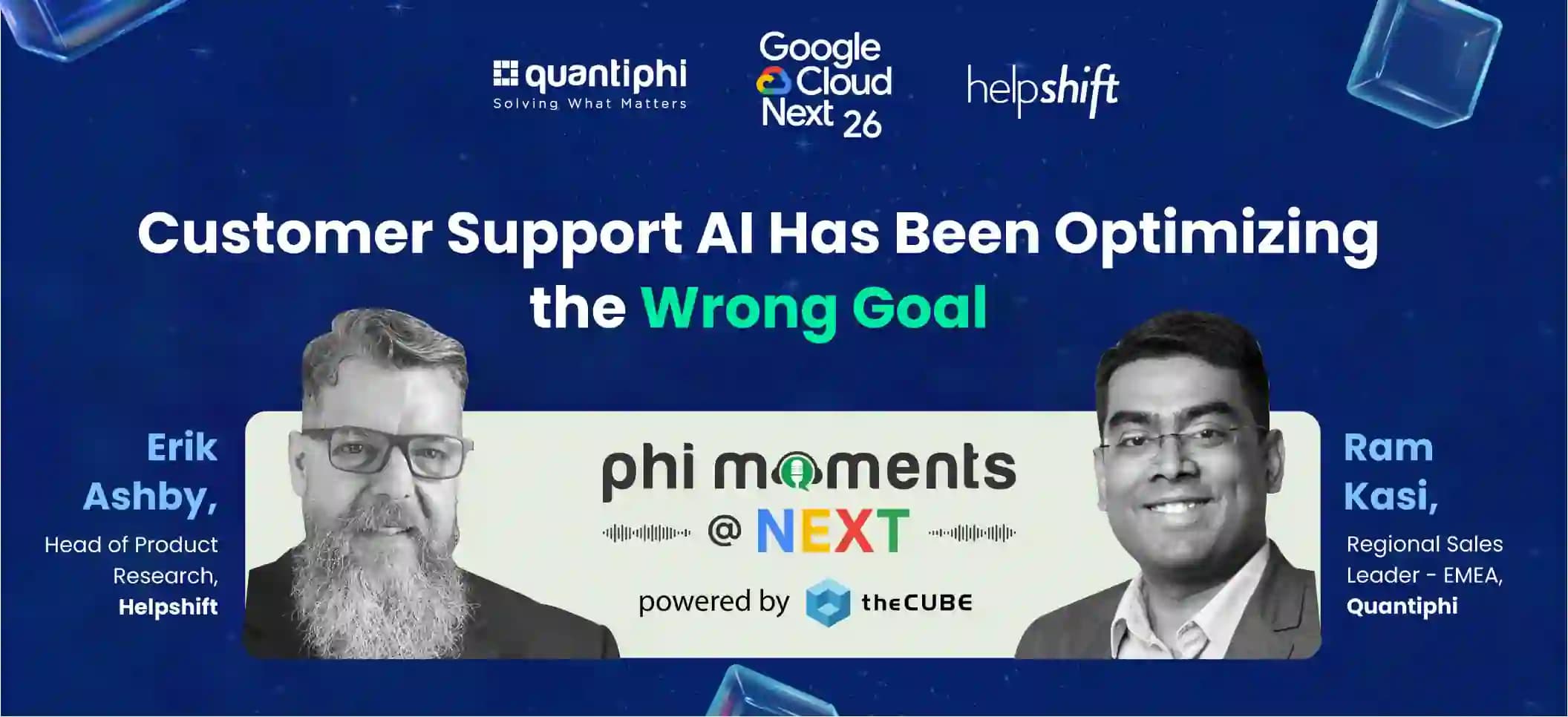
Customer Support AI Has Been Optimizing the Wrong Goal

For years, customer support has been optimized around one basic idea: make the problem go away.
Contain the interaction. Deflect the ticket. Reduce handling time. Close the case.
Those metrics have their place. But they can miss the question the customer actually cares about:
Can I get back to what I was trying to do?
In gaming, there is nowhere for that gap to hide.
A player who runs into friction does not have to sit through a bad support experience. They can close the game and open another one. The support interaction is no longer adjacent to the product experience. It is part of it.
That is what makes Helpshift’s approach to AI agents interesting well beyond gaming.
In a Phi Moments @ NEXT conversation at Google Cloud Next ’26, Erik Ashby, Senior Director and Head of Product Research at Helpshift, joined Ram Kasi, Head of the EMEA Google Cloud Business Unit at Quantiphi, to discuss how Helpshift is rethinking player support with a family of AI agents.
The breakthrough did not come from another model upgrade.
It came from changing the goal.
Instead of asking its Care AI agent to solve the support problem, Helpshift asked it to engage the player.
That shift changed how the agent behaved. It also changed the numbers: Helpshift saw higher player CSAT and an almost 2x reduction in reopen rates.
For enterprise leaders, there is a bigger lesson here.
The real value of an AI agent may have less to do with how sophisticated the model is and more to do with whether the business has encoded the right objective into the system.
Closing a ticket is not the same as winning back the customer
Traditional support technology tends to optimize around the mechanics of service.
Was the question answered? Was the conversation contained? Was the case routed correctly? Did the ticket close?
All sensible questions.
But they are not necessarily customer outcomes.
For a player, success is not a resolved support ticket. Success is getting back into the game without the support experience becoming another reason to leave.
That distinction shaped the evolution of Helpshift’s Care AI agent.
The first objective was straightforward: give the agent the ability to answer questions and solve problems.
It worked.
But, as Erik described it, it was not the transformation they were looking for.
The turning point came when Helpshift and Quantiphi changed the objective from problem resolution to player engagement.
The agent could still resolve an issue. But now it could also reason about what should happen next.
Maybe that means answering a question and taking the player back into the game. Maybe it means recognizing a frustrating experience and offering an appropriate reward. Maybe the situation calls for a human agent, with the history and context already carried forward.
The technology did not suddenly become valuable because it could do more things.
It became more valuable because those actions were aligned to a better goal.
That should matter to anyone building enterprise agents.
If you optimize an AI system around a narrow process metric, you should expect narrow process behavior.
If you give it an objective that reflects what the business and customer actually need, the system has much more room to create value.
The move from workflows to goals changes the experience
Most people have experienced the limits of scripted customer service.
Choose an option. Follow a branch. Repeat information. Reach a dead end. Start again.
The workflow may technically be functioning exactly as designed.
The experience is still broken.
AI agents offer a different model because they can work with context, interpret intent, and decide what to do next rather than force every interaction through a predetermined path.
For Helpshift, that difference is fundamental.
A traditional workflow asks:
Which path should this player follow?
A goal-driven agent can ask:
What needs to happen now to get this player back to the experience they came for?
That is a much larger shift than replacing a chatbot with a more fluent chatbot.
It changes the unit of design.
Instead of optimizing the support interaction itself, the organization begins optimizing the outcome around it.
That idea is already becoming central to how leading enterprises are approaching agentic CX: moving from fixed journeys toward systems that can make contextual decisions within clear business objectives and guardrails.
The model is not the strategic asset
There is a temptation in AI to treat model choice as the strategy.
But models are changing too quickly for that to be a durable source of differentiation.
What matters more is what the enterprise builds around them: its goals, context, decision logic, workflows, guardrails, integrations, evaluation mechanisms, and the accumulated knowledge of what works.
Those are the assets that reflect how the business actually operates.
Helpshift’s experience makes that distinction tangible.
Erik talked about the pace of change directly. New models and capabilities appear constantly. The architecture therefore had to make it possible to adapt quickly rather than assume that today’s technology choices would remain fixed.
That is where ownership becomes important.
Enterprises should be able to evolve the underlying model or infrastructure without losing the business logic they have built around it.
The goal is not to become dependent on one AI capability.
It is to build an intelligence layer that can keep getting better as the technology underneath it changes.
For senior technology leaders, that is a much more durable way to think about AI investment.
Human and AI agents work better when they share the outcome
The customer service AI debate often gets framed as automation versus people.
Helpshift’s experience suggests that framing is too simplistic.
When the AI agent was primarily there to answer questions, its role naturally overlapped with the human support agent.
Once the objective became player engagement, the relationship changed.
Both were now working toward the same result.
The AI agent could absorb routine interactions and less complex issues. When the situation needed empathy, judgment, discretion, or a more meaningful intervention, a human could step in with the context already intact.
No restart.
No asking the player to explain everything again.
No artificial boundary between an “AI interaction” and a “human interaction.”
The point is not to automate the human out of the experience.
It is to decide where each contributes the most value.
Helpshift’s results are a useful proof point. Player CSAT increased, while reopen rates fell by almost 2x.
The important metric was not simply how much work the AI absorbed.
The experience improved.
That is also why human-centered design cannot sit at the end of an AI program. It has to shape the system itself: where autonomy helps, where people need control, how context transfers, and what the customer experiences at each handoff.
One agent can be a project. A fleet of agents needs a foundation.
There is another lesson hiding inside Helpshift’s story.
Care AI agent is not intended to stand alone.
Helpshift is developing a family of agents, including capabilities supporting engagement, community, and guardrails. Human and AI agents operate on the same customer engagement platform.
That introduces a very different architectural problem.
Every agent needs some version of the same underlying capabilities: security, grounding, scalability, integrations, workflows, access controls, and evaluation.
Build those separately every time and the enterprise quickly recreates the fragmentation it was trying to eliminate.
Quantiphi’s approach was therefore platform-first.
Ram described the thinking simply: if every agent needs these foundations, why rebuild them for every individual use case?
A shared foundation makes new agents easier to build, govern, integrate, and evolve.
More importantly, it allows the intelligence created through one use case to become part of a broader enterprise capability rather than remain trapped inside another isolated application.
This is where the economics of agentic AI begin to change.
The first agent proves the use case.
The reusable foundation makes the next one faster.
And every additional agent should build on what the enterprise already owns rather than starting the meter again from zero.
Architecture has to assume the technology will change
Nobody building AI today gets the luxury of a stable technology stack.
Erik described a market where capabilities can shift in a matter of months. That makes flexibility more than an engineering preference.
It becomes a business requirement.
Trying to predict which model, tool, or technique will dominate several years from now is difficult.
Building so you can change your mind is more practical.
That means keeping architecture modular. Separating business logic from the underlying model. Building shared services once where possible. Making it easier to introduce new capabilities without redesigning the entire product around them.
It also changes the role of an engineering partner.
Helpshift did not only need capacity to execute a roadmap. It needed the experience, expertise, and scale to keep that roadmap moving while the technical ground underneath it continued to shift.
Erik called out the value of having the right architecture and partner in place because it gave the team room to change quickly.
There is an important difference between future-proofing and predicting the future.
Future-proofing is accepting that you will not predict it perfectly — and designing accordingly.
Gaming is the proving ground. The lesson travels.
Gaming makes an unusually good environment for testing new customer experience models.
Players are demanding. Friction is visible. Engagement is measurable. Switching costs can be extremely low.
But the principle behind Helpshift’s work is not gaming-specific.
A retailer ultimately does not want to resolve a support request. It wants the customer to keep shopping.
A bank does not want to answer another service question. It wants the customer to feel confident enough to continue the relationship.
A telecom provider does not want to become better at closing tickets. It wants to restore service, reduce frustration, and retain the customer.
The business goal sits beyond the support interaction.
Agentic AI creates an opportunity to design for that goal directly.
That may be one of its most important differences from earlier generations of service automation.
The system is no longer limited to answering:
How do we handle this request?
It can increasingly help answer:
What outcome should we be driving toward, given what we know right now?
The Phi Moment: when one change moved the numbers
Every Phi Moments conversation looks for the point where an idea stops being interesting and starts creating business impact.
For Helpshift, that moment was unusually clear.
They changed the goal of the agent.
Then the numbers changed.
CSAT went up.
Reopen rates went down.
The lesson is easy to miss because the technical change sounds small.
But it gets at something much bigger about enterprise AI.
The companies that create meaningful value will not necessarily be the ones deploying the largest number of agents or consuming the newest models first.
They will be the ones that know what their agents should optimize for, retain control of the business context and decision logic behind them, and connect that intelligence to outcomes the business actually values.
That is a better place to begin than asking what AI can automate.
What CX leaders can take from Helpshift
Start with the business outcome, not the agent.
“Deploy an AI agent” is an implementation decision. Define what needs to change for the customer and the business first.
Own the logic that makes your experience different.
Models will change. Your customer context, objectives, guardrails, and decision logic are what create lasting differentiation.
Give AI and humans a shared goal.
The best division of work becomes much clearer when both sides are measured against the same customer outcome.
Build shared foundations before agent sprawl sets in.
Security, grounding, integrations, orchestration, and evaluation should become reusable enterprise capabilities rather than being rebuilt for every agent.
Tie autonomy to measurable value.
For Helpshift, the proof was visible in CSAT and reopen rates. Enterprise AI should ultimately move a business or customer metric, not simply an adoption metric.
The best AI agents know what success means
Agentic AI gives customer experience teams something previous generations of automation did not.
Systems that can interpret context, make decisions, take action, and work toward a goal.
But autonomy is not strategy.
The organization still has to decide what the goal should be.
For Helpshift, the answer was not:
Close the support ticket.
It was:
Get the player back in the game.
That change shaped the behavior of the agent, the role of human teams, the architecture underneath the product, and ultimately the business results.
As enterprises build their own agentic systems, there is a useful question to ask before choosing another model or launching another pilot:
What are we asking the intelligence we build to optimize for — and is that actually what creates value?
Explore more
Explore Quantiphi’s Customer Experience capabilities
See how Quantiphi helps organizations move from reactive support toward intelligent, resolution-driven customer experiences.
Explore Quantiphi + Google Cloud
Learn how Quantiphi and Google Cloud help enterprises build and scale AI-native transformation.
Explore the Enterprise Agentic Factory on Google Cloud
See how Quantiphi helps enterprises move from individual AI agents to a shared foundation for building, governing, and scaling agentic systems around measurable business outcomes.