Insurance Fraud in the Age of Deepfakes: A New Battlefield for AI, ML & GNNs

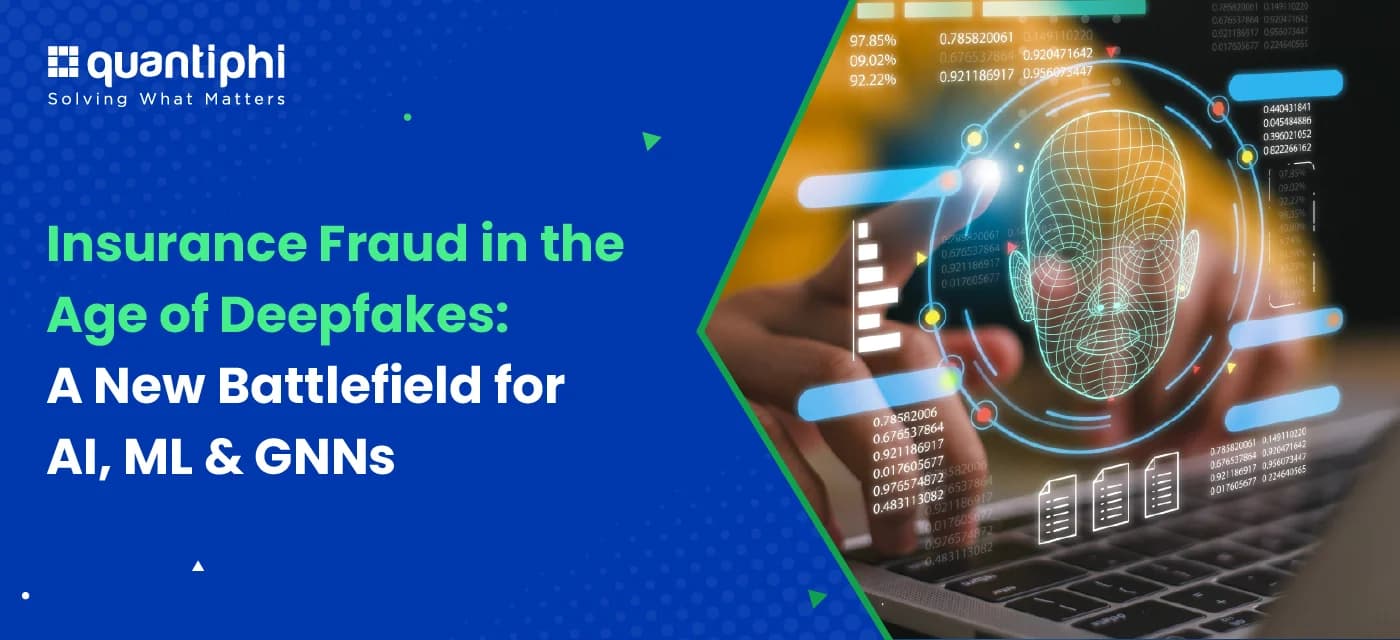
We’re no longer asking if AI will change the insurance landscape—it already has. But while the industry is busy embracing automation, intelligent underwriting, and faster claims processing, a darker side of AI is quietly taking root: deepfake-powered fraud.
Over the past few years, I’ve had the opportunity to lead Machine Learning (ML) and Generative AI (GenAI) strategies across financial services—including insurance, banking, and wealth management. One of the most pressing (and frankly, most dangerous) challenges I see emerging in insurance today is the rise of AI-powered fraud, particularly deepfake-driven document and image tampering in Proof of Loss (POL) submissions.
While traditional fraud detection systems were built to catch anomalies in text or data, today’s fraudsters are operating at an entirely different level—leveraging cutting-edge AI tools and technologies like Generative AI to generate hyper-realistic images and forged documents that can slip past both human auditors and rule-based filters. In fact, deepfake incidents in the fintech sector increased 700% in 2023 from the previous year, underscoring just how quickly this threat vector is escalating. (link)
Let’s unpack this new threat—and explore how we, as an industry, can stay ahead.
The New Fraud Paradigm: When Proof of Loss Becomes a Playground for Deepfakes
Proof of Loss (POL) is a formal statement submitted by a policyholder to the insurer, detailing the extent of damage or loss incurred—and is often accompanied by supporting evidence like images, invoices, repair estimates, and identity documents. It’s a critical piece of the claims process that determines the legitimacy and value of a payout. But increasingly, it has become a fertile ground for sophisticated fraud tactics—enabled by advances in Generative AI. Here’s how :
- Image Forgery: Damaged vehicles, burned property, or flood-affected assets are either “visually enhanced” or completely fabricated using AI image generators, inflating or inventing claims out of thin air.
- Document Tampering: Discharge summaries, repair bills, and invoices are edited using GenAI tools or image editors. Metadata is scrubbed. Digital signatures are faked. The fraud is seamless.
- Identity Deepfakes: Fraudsters generate synthetic IDs and AI-generated selfies to impersonate real policyholders—or worse, invent entirely fake ones.
What makes this dangerous is not just the occurrence—but the unprecedented realism. These are not crude Photoshop attempts. These are clean, AI-generated assets with consistent lighting, believable context, clean metadata, and OCR-compatible formatting. In many cases, they pass through basic fraud filters with ease. Deepfake incidents are bound to increase in the coming years and technologies like GenAI could enable fraud losses to reach US $40 billion in the United States by 2027—up from US $12.3 billion in 2023, representing a compound annual growth rate of 32%. For insurers, that means every year without stronger defenses could see huge losses.
Detecting the Undetectable: A Multi-Layered AI Strategy
To fight these evolving threats, we need a layered defense strategy that combines ML, GenAI, graph intelligence, and forensic techniques. Here’s what that stack looks like:
-
Metadata & Forensics Layer
Start with the basics—but do them right.
-
EXIF/Metadata Analysis: Analyze timestamps, geolocation, and camera metadata embedded in images. GenAI images often lack consistency here. Inconsistencies—like a photo claimed to be from a rural accident site but showing an iPhone 15 Pro Max captured in NYC—can raise immediate red flags.
-
Spectral & Frequency Domain Checks: Tools like Discrete Fourier Transform (DFT) or Discrete Cosine Transform (DCT) help identify unnatural patterns in the image’s frequency space—typical in GAN-generated visuals. These spectral fingerprints are often imperceptible to the human eye but detectable via AI models.
-
-
Graph-Based Document-Claim Networks
Claims don’t exist in isolation.
-
Graph Neural Networks (GNNs) help model relationships across different entities: policyholders, vendors, claims, brokers, devices, and locations.
-
Relational Anomaly Detection: Spot suspicious patterns like the same repair shop being used across unrelated claims, or multiple policyholders linked via a common IP address or phone number.
-
Temporal Graphs: Model how fraudulent behavior evolves over time—especially valuable during fraud spikes after natural disasters, when malicious actors act in bursts.
-
-
Deepfake Detection with GenAI + Vision Models
Deepfakes require deep inspection.
-
Ensemble Detection Pipelines: Combine traditional computer vision techniques with deep learning-based classifiers trained to differentiate real vs. AI-generated images.
-
Contrastive Learning Models: These flag images that seem plausible but deviate from the latent patterns seen in verified historical claims—surfacing images that may “look right” but don’t “feel right” to the model.
-
-
GenAI for Intelligent Cross-Verification
Fight fire with fire.
-
Use LLMs to cross-check extracted document data against internal databases, customer records, or third-party APIs.
-
Intelligent Q&A Agents can simulate underwriting logic, asking questions a human adjuster would—“Does the repair timeline match policy coverage?”, “Is the claimed damage consistent with the incident date?”
-
Build consistency evaluators that flag gaps across images, invoices, and narratives, all while providing explanations that can be audited.
-
Building the Right Tech Architecture
Tackling deepfake-driven fraud isn’t just about smart models—it’s about building a robust, scalable, and future-proof architecture that can ingest multiple data types, adapt to evolving fraud techniques, and deliver insights in real-time. That’s where Quantiphi steps in.
At Quantiphi, we help insurers design and deploy next-gen fraud detection architectures that combine multi-modal AI, cloud-native scalability, and enterprise-grade governance—all powered by the latest in GenAI and ML innovation.
Here’s how we do it:
-
Multi-Modal Ingestion & Processing
Fraud signals are scattered across structured claims data, unstructured documents, images, video, metadata, and logs. Quantiphi’s architecture supports ingestion across all formats:
- Seamless integration of text, images, PDFs, and handwritten documents using intelligent document processing powered by Dociphi—our proprietary AI platform.
- OCR and computer vision pipelines that extract and normalize data from photos and scanned forms.
- Support for streaming inputs for real-time alerts during claims intake.
-
Composable AI & ML Pipelines
Fraud evolves fast—so your models should be easily swappable and extensible.
- Quantiphi builds modular ML pipelines that allow plug-and-play integration of traditional ML models (e.g., XGBoost) and GenAI models (e.g., Gemini, GPT-4, Claude).
- Ensemble frameworks combine spectral forensics, image classifiers, LLMs, and graph-based anomaly detectors—all orchestrated through tools like Vertex AI Pipelines, SageMaker Pipelines, or Kubeflow.
-
Graph-Based Intelligence Layers
Quantiphi has deep experience building custom GNN architectures to track entity relationships and uncover coordinated fraud rings.
- We model real-world relationships—between claimants, vendors, agents, locations, devices—into a dynamic graph structure.
Use-case examples include:
- Detecting shared addresses across unrelated policies.
- Identifying vendor fraud clusters post-disaster events.
- Using temporal graphs to detect burst activity and behavioral shifts.
-
GenAI-Driven Cross-Verification Engines
One of Quantiphi’s biggest differentiators is our GenAI capability stack, which powers advanced cross-verification, summarization, and reasoning.
- We build LLM-powered agents that mimic human underwriters—flagging logical inconsistencies, verifying timelines, and validating contextual fit.
- Use tools like LangChain, Promptflow, and Semantic Search with embedded document repositories to perform rapid claim triage.
- Create custom claim consistency checkers, where GenAI evaluates alignment between customer narrative, image metadata, and repair documents.
-
Scalable, Cloud-Native Deployments
Quantiphi builds fraud solutions that are cloud-native from the ground up, enabling fast, secure, and scalable deployments.
- Infrastructure options include GCP (Vertex AI, BigQuery, Cloud Run), AWS (Bedrock, Lambda, SageMaker), or Azure AI—tailored to your cloud ecosystem.
- Deploy containerized detection agents that serve specific lines of business (auto, health, home) or support multi-tenant use cases.
- Real-time dashboards and alerting systems built using Looker, Power BI, or Streamlit.
-
Responsible AI & Governance
We don’t just build powerful AI—we build responsible AI.
- Every detection component includes explainability modules (e.g., SHAP, LIME) and human-in-the-loop (HITL) workflows for complex case review.
- Integrated audit trails, data versioning, and model monitoring to meet regulatory and ethical standards.
- Alignment with NAIC, GDPR, and emerging global guidelines around GenAI usage in insurance.
The Real ROI: Not Just Savings—It’s About Trust
Implementing advanced fraud detection isn’t just about reducing payouts. It’s about restoring trust in the claims process. It’s about showing your customers that you’re serious about fairness, speed, and integrity—and making it increasingly difficult for bad actors to game the system.
While implementing the above technology , you’re not just plugging in fraud tools—you’re building a resilient, AI-first defense architecture that evolves with fraud patterns, protects customer trust, and sets your organization apart as a technology-forward insurer. Whether you’re looking to modernize your existing fraud detection systems or build from the ground up, we bring the full stack: strategy, models, infrastructure, and execution.
In Conclusion
We are standing at the edge of a technological arms race. Fraudsters are evolving fast—but so are our defenses. With the right blend of GenAI, traditional ML, forensic analytics, and graph intelligence, we can build an ecosystem that doesn’t just detect fraud—but actively deters it.
Let’s build something that not only fights fraud—but redefines what’s possible with AI in Insurance. If you’re exploring solutions in this space—or just want to brainstorm ideas—let’s connect.
#GenAI #InsuranceInnovation #DeepfakeDetection #FraudTech #GraphAI #MLforGood #ResponsibleAI #FieldCTO