How Rising Rates and Demographic Shifts Are Impacting Lending
The lending industry is experiencing a profound transformation driven by three interconnected forces: shifting macroeconomic conditions, evolving borrower demographics, and accelerating digital adoption. Post-pandemic interest rate hikes— including a sharp surge of over 500 basis points in the United States between 2022 and 2023— have made borrowing significantly more expensive, naturally suppressing loan demand across markets. In Europe, the European Central Bank’s policy rate peaked at 3.75%, its highest in decades. These rate hikes have created a tighter lending market, noticeably decreasing borrower appetite.
Within this challenging economic landscape, a demographic shift is reshaping borrower profiles. Millennials and Gen Z now constitute 40% of new mortgage originations, bringing distinct digital-first expectations to financial services. This generational preference is evident in the broader market, with 60% of consumers in advanced economies preferring online financial interactions and 64% of European adults actively using internet banking. However, these younger borrowers are also facing greater financial strain, as evidenced by U.S. credit card delinquencies surpassing pre-pandemic levels, particularly affecting subprime segments struggling with the combined pressure of high interest rates and persistent inflation.
How Is the Lending Space Evolving?
In response to market shifts, the lending space is evolving rapidly. Lenders are adopting digital-first lending journeys through mobile and web platforms, reducing physical paperwork. Nearly 42% of banks rely on personalized customer journeys powered by AI, with about one-third of customer-experience budgets devoted to AI and machine learning solutions. This reflects a strategic shift toward data-driven, agile processes that can deliver the kind of tailored, on-demand service today’s borrowers seek.
As Everest Group highlights, lenders are embracing cloud computing and alternative data to revolutionize underwriting. Innovative offerings like green mortgages and Buy Now Pay Later products are gaining popularity. The lending ecosystem is becoming API-driven, enabling real-time third-party integration. This transformation spans across verticals: mortgage lenders investing in digital tools, auto lenders exploring new ownership models, and SME lenders fast-tracking platform modernization.
These changes represent a holistic transformation of the entire loan lifecycle, from marketing and sales through operations and servicing, with new tools and approaches at every stage.
Challenges in Lending Industry
Across the lending value chain, different stakeholders are voicing common pain points as they adapt to the new market reality. Here’s what CIOs, tech leads, and business leaders in sales, marketing, and operations are telling us:
- Marketing Teams: “It’s getting harder to find and engage the right borrowers.” Marketing leaders struggle to target prospects with high lifetime value under tighter credit conditions. They have lots of customer data but lack unified insights, making it hard to personalize outreach for diverse demographics — for example, attracting tech-savvy young adults while staying relevant to older customers. Strict data regulations add more complexity. They need better tools to identify credit-worthy leads, tailor messaging to segments, and convert interest into applications, all while staying compliant.
- Sales & Underwriting Teams: “Loan processing is too slow and clunky — we’re losing good customers.” Sales and underwriting teams face delays from inefficient processes, repetitive paperwork, and outdated credit models. This causes drop-offs when borrowers abandon slow applications or get misjudged by traditional scoring, especially gig workers and thin-credit-file millennials. They need faster, more accurate ways to assess risk and approve loans without cutting corners on checks and compliance.
- Operations and Servicing Teams: “Our cost per loan is too high, and back-office errors keep creeping in.” Operations leaders deal with legacy systems and manual workflows, resulting in costly data re-entry and compliance slip-ups. They want to cut operational costs, automate routine tasks, and simplify back-end processes to reduce risk.
- CIOs and IT Teams: “Our infrastructure is holding us back.” CIOs struggle with siloed data, rigid legacy systems, and slow integration of new tech. They need to upgrade IT securely, manage costs, close talent gaps, and support AI and digital tools — all while protecting customer data and “doing more with less.”
The Role of AI and ML in Lending’s Next Chapter
AI is transforming the lending value chain from top to bottom, enabling predictive intelligence, seamless customer journeys, and operational scale.
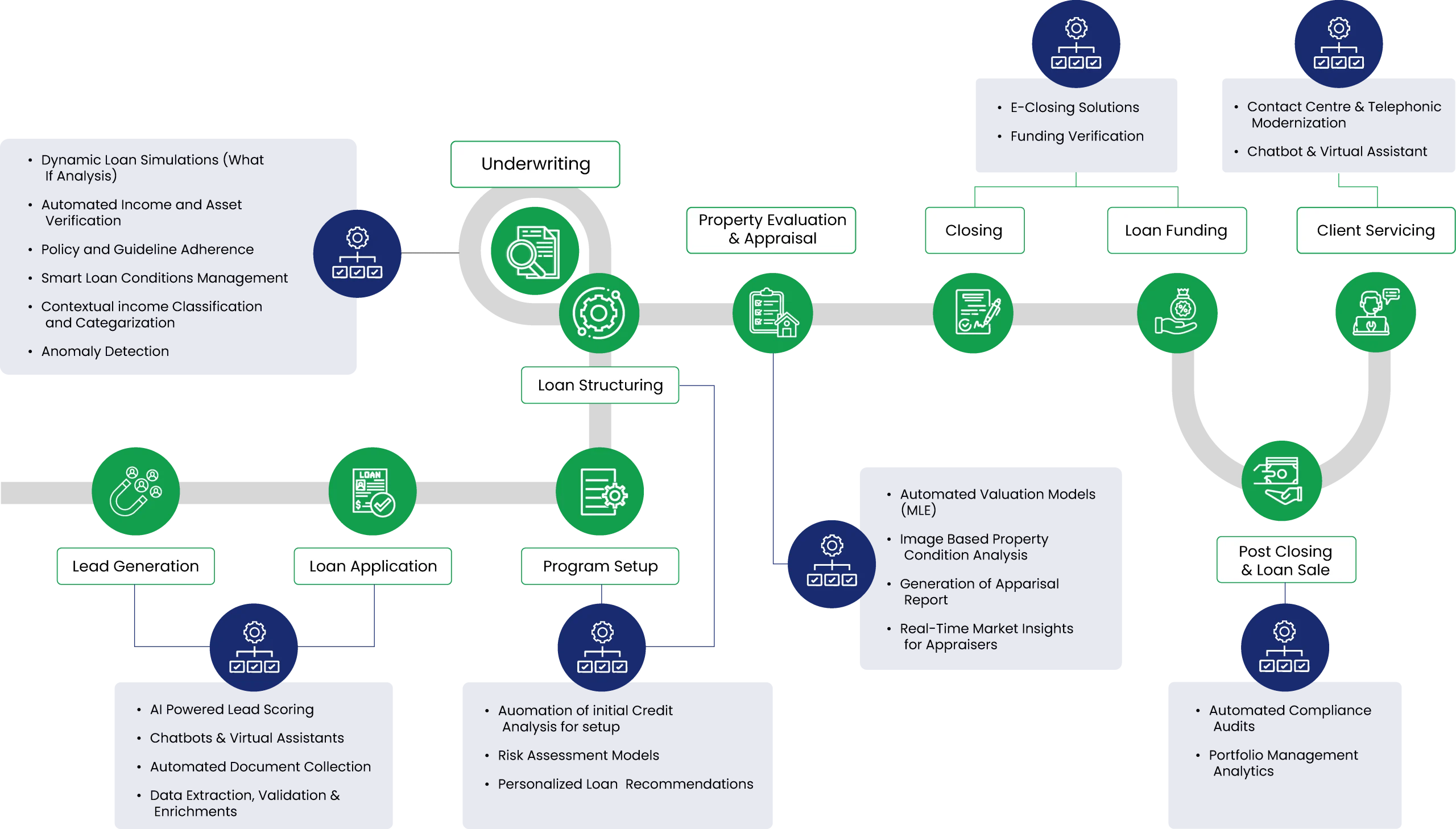
The AI/ML-powered solution landscape across the loan lifecycle
Together, these applications represent the core AI capabilities modern lenders are using to reduce friction, enhance compliance, and create better borrower experiences across the lifecycle.
When visualized across the loan journey, AI and ML clearly play a role at every stage—from targeting the right customers and enabling seamless digital applications, to streamlining underwriting, optimizing risk and pricing, automating property evaluations, and simplifying post-closing processes. These capabilities help lenders operate at greater speed and scale, reduce manual errors, ensure compliance, and offer personalized experiences that match borrower expectations in a digital-first world.
Some of Our Marquee Success Stories –
- AI-led Loan Platform for a Leading Alternative Asset Management firm in the US
Challenge: Manual, error-prone loan origination, redaction, and forecasting processes with non-standardized data intake.
Solution: Developed an AI-powered platform with portals for borrower submission, partner redaction, and client-side forecasting. Enabled automated data ingestion, rule-based PII masking, document security, and reusable forecasting models. - AI-powered Loan Insurance Tracking for a Leading U.S. Regional Bank
Challenge: Manual, error-prone tracking of loan insurance documents across varied formats, leading to compliance gaps, delayed notifications, and high operational effort.
Solution: Implemented Dociphi Loan Insurance Tracking System—an AI-powered platform that automates document ingestion, entity extraction, compliance verification, and borrower-agent notifications through a secure portal. - Mortgage Propensity Model for US Commercial Bank
Challenge: The bank’s ability to engage the right customers for mortgage products was limited by fragmented data, outdated prediction models, and inconsistent targeting across channels.
Solution: Quantiphi delivered a unified, intelligence-driven profiling solution that identified high-propensity customers with greater accuracy. By modernizing data infrastructure and enhancing model precision, the bank improved customer retention, increased marketing effectiveness, and accelerated mortgage portfolio growth. - Automated Onboarding for a leading US Mortgage Lender
Challenge: Manual income verification was time-consuming, error-prone, and inefficient due to varied document types, non-standard templates, and high data entry effort—leading to processing delays and increased operational costs.
Solution: Quantiphi implemented an AI-driven document processing solution that automated classification and data extraction from financial documents. The solution significantly accelerated income verification, reduced manual effort, and improved accuracy—enhancing customer experience and operational efficiency. - Fraud Operations Avatar for a leading Canadian Bank
Challenge: A complex, 20+ step fraud resolution workflow—spread across multiple tools—slowed down case handling and limited first-call resolution to just 15%, leading to escalations, customer dissatisfaction, and high operational effort.
Solution: Quantiphi deployed a Virtual AI Companion that supports fraud specialists by automating pre-checks, validating transactions, and guiding resolutions in real time—aligned with internal fraud policies. The solution reduced escalations, accelerated case closures, and improved both customer experience and agent efficiency.
How We Envision Lending Transformation
Across our client engagements, we’ve seen success come from a structured, four-step methodology:
-
Discovery & Strategy Alignment
To drive transformation, it’s critical to begin with a deep understanding of the current state and future aspirations. This phase focuses on:
- Conducting a gap analysis to assess data maturity, process bottlenecks, and tool readiness
- Identifying and prioritizing high-impact use cases using heatmaps and business value assessments
- Designing a future-ready data architecture—supporting both operational scale and AI enablement
- Facilitating cross-functional workshops to align stakeholders on the strategic roadmap
-
Scalable Data Infrastructure & Unified Lake Setup
Robust data infrastructure is the backbone of any AI transformation. This phase includes:
- Establishing a cloud-native foundation to enable flexible and scalable data operations
- Building secure ingestion pipelines from key systems, ensuring trust and traceability
- Creating a unified data layer to centralize access across functions
- Implementing automated validation and monitoring to ensure data quality and availability
-
AI-Enabled Predictive Intelligence
- Leverage forecasting models to anticipate trends and outcomes across any business process
- Use scoring algorithms to prioritize the most impactful opportunities—whether in sales, risk, marketing, or operations
- Integrate AI-driven insights into analytics platforms for real-time, data-driven decision-making
- Apply robust data preparation and calibration techniques to ensure consistent and reliable model performance across all functions
-
Build for Scale
- Ensure your systems can support future volume and velocity
- Automation, compliance tracking, and modular AI building blocks across functions
Conclusion
Lending isn’t just about approvals anymore—it’s about experience, intelligence, and trust. The institutions that thrive will be those that empower every role in the organization with real-time insights, seamless automation, and AI-powered foresight.
By bringing together strategy, data, and intelligence under one roof, Quantiphi is helping lenders turn transformation ambition into measurable outcomes.