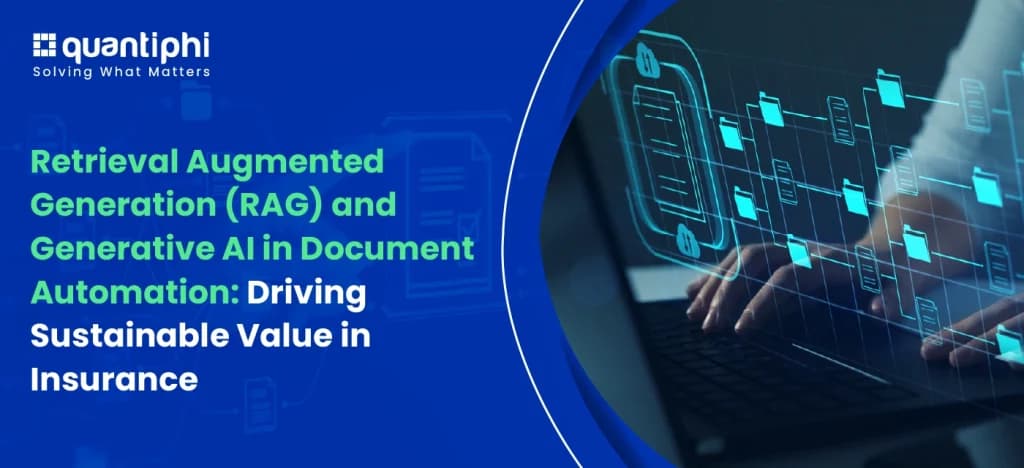
Retrieval Augmented Generation (RAG) and Generative AI in Document Automation: Driving Sustainable Value in Insurance

“AI won’t replace underwriters. But underwriters who use AI will replace those who don’t.”
The insurance industry is at a turning point. Traditional underwriting and claims workflows—once dominated by manual document checks, static data, and slow decision-making—are being rewritten by Retrieval-Augmented Generation (RAG) and Generative AI. These technologies aren’t just incremental upgrades; they’re becoming the North Star Principles guiding insurers toward accuracy, speed, and resilience.
Why RAG + Generative AI Matter for Document Automation?
To really understand their power, let’s bring these concepts into the world of insurance.
-
RAG = The Underwriter’s Reference Binder
Think of RAG as that trusted binder every underwriter leans on. It holds past slips, binders, clauses, and regulatory codes—pulling exactly what you need at the right moment. RAG grounds decisions in facts, precedent, and compliance, ensuring that nothing is left to guesswork. -
Generative AI = The Junior Analyst
Now imagine handing that binder to a sharp junior analyst. Within minutes, they turn hundreds of pages into a clean risk profile, summarize exposures, or draft an underwriting note. That’s Generative AI—it transforms grounded knowledge into usable insights, reports, and recommendations.
Together the binder keeps you right, and the analyst keeps you fast.
Now, On the claims side, the roles shift slightly:
RAG = The Claims Historian
RAG digs deep into archives of past claims, settlements, and compliance notes—surfacing the relevant precedent for today’s case.Generative AI = The Claims Narrator
GenAI takes that precedent and drafts the First Notice of Loss (FNOL) response, letters to brokers, or even a settlement recommendation in clear, client-friendly language.
Together: every claim is handled faster, more consistently, and with greater transparency.
With this combination, document-heavy processes across underwriting and claims are no longer bottlenecks. RAG ensures accuracy. Generative AI ensures acceleration.
And for insurers, that equation accuracy + acceleration = sustainable value being the real game changer.
Think of RAG as the anchor of truth.
It grounds large language models (LLMs) in real-time, relevant knowledge—whether from past binders, slips, regulatory codes, or claims histories—ensuring decisions are always accurate and explainable. Generative AI, on the other hand, is the acceleration engine. It transforms that grounded knowledge into summaries, risk profiles, claim narratives, and actionable recommendations.
Together, RAG + GenAI create a North Star framework for insurers: accuracy (RAG) + acceleration (GenAI) = sustainable value creation.
What If Underwriters Could Review Faster, Settle Claims Sooner, and Still Win More Trust From Brokers?
Picture this: an underwriter receives a 200-page casualty submission. Traditionally, this would take days of review. With RAG + GenAI, the same submission is parsed, contextualized, and summarized within minutes. RAG pulls in precedents and underwriting guidelines, while GenAI crafts a precise risk assessment—giving the underwriter time to focus on strategy, not paperwork.
On the claims side, the dreaded First Notice of Loss (FNOL) no longer means weeks of back-and-forth. GenAI drafts responses, while RAG validates them against past settlements and compliance rules. Suddenly, claims move 30–40% faster, adjusters focus on complex cases, and customers get the timely resolutions they expect.
Brokers notice, too. Faster quote-to-bind cycles and transparent, consistent outputs build trust—the kind of loyalty that keeps business flowing your way.
The Market Data Speaks
- 82% of insurers using Generative AI already see ROI (Digital Insurance, 2025).
- 50% of carriers have embedded AI in underwriting, cutting cycle times from days to just 12.4 minutes with 99.3% accuracy (RBJ, 2025).
- By 2025, AI-driven claims automation is expected to reduce processing costs by 30–40% while improving CX (Capco, 2025).
- Integration platforms like Dociphi, Amazon Bedrock make this easier, letting insurers combine proprietary knowledge with foundation models securely, without exposing sensitive data.
Clearly, insurers connecting AI to measurable outcomes, not just pilots are pulling ahead.
The Future Outlook of Insurance?
The insurance industry is entering a new era. With the combination of Retrieval-Augmented Generation (RAG) and Generative AI (GenAI), the way insurers approach underwriting, claims, compliance, and customer experience is about to change in profound ways.
Risk assessments will no longer rely only on static historical data. Instead, they will draw from real-time behavioral insights, creating highly personalized underwriting and fairer pricing models.
On the claims side, predictive modeling powered by GenAI can spot patterns of fraud even before a claim is formally submitted. This proactive approach means insurers can reduce losses while giving honest customers a smoother, more reliable experience.
The policyholder journey will feel dramatically different too. Imagine being able to report a claim by simply speaking into your phone, with GenAI instantly turning that conversation into a clean, accurate summary ready for processing. For customers, it means less paperwork and faster resolutions. For insurers, it means efficiency at scale without compromising accuracy.
What’s critical, though, is that this isn’t about replacing people with machines. If anything, it allows people to play a sharper role. AI will manage the heavy lifting—processing large volumes of documents, detecting anomalies, and structuring data—while underwriters, brokers, and claims adjusters focus on the things only humans can do: exercising judgment, showing empathy, and building lasting client relationships.
That’s why the future of insurance isn’t “AI-first.” It’s about being aligned to a bigger vision. RAG keeps decisions grounded in truth, while GenAI accelerates execution and clears away complexity. And with platforms like Dociphi orchestrating these capabilities, insurers can move from piecemeal automation to a seamless, end-to-end transformation.
For the industry, this shift goes far beyond digital transformation. It promises profitable growth, stronger broker partnerships, faster quote-to-bind cycles, improved combined ratios, and deeper customer loyalty. It also creates teams that are leaner, more effective, and empowered to focus on strategic work rather than repetitive tasks.
The BFSI sector has been talking about transformation for years, but with RAG and GenAI, it’s no longer just talk. The future of insurance is already being built—one decision, one claim, one customer interaction at a time.
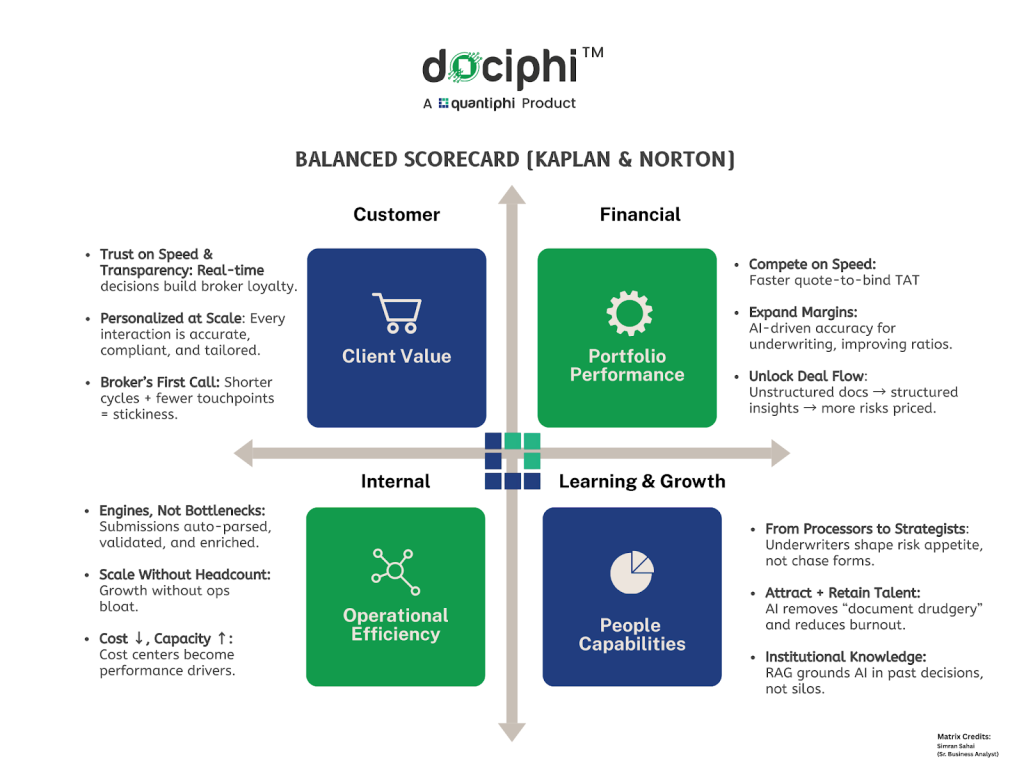
Let’s Measure How Dociphi Is Powering AI Transformation in BFSI with the Kaplan & Norton’s Balanced Scorecard Method
Client Value
With Dociphi’s RAG-powered document intelligence, brokers get near real-time underwriting transparency, submissions that once took days are turned around in hours. Claims customers experience faster resolutions, with Dociphi auto-summarizing and validating case histories.
The result is always higher trust, better broker stickiness, and improved Net Promoter Scores.
Portfolio Performance
Dociphi doesn’t just accelerate workflows, it sharpens them. By grounding GenAI in historical binders, slips, and claims data,much more, Dociphi helps underwriters price more accurately, reduce leakage, and improve combined ratios. Quote-to-bind cycles accelerate, giving insurers a tangible profitability edge.Operational Efficiency
Document-heavy processes—submissions, bordereaux, FNOL reports—are automated end-to-end in Dociphi. This means insurers cut cycle times, reduce manual rekeying, and scale capacity without proportional headcount growth. Cost per policy and cost per claim drop, while throughput increases.People Capabilities
Dociphi frees underwriters and adjusters from repetitive document tasks. With contextual insights delivered through RAG, they shift from processors to decision architects—spending more time on complex risks, portfolio steering, and client engagement. Institutional knowledge is codified into the platform, reducing dependency on tribal memory.
At the center of this matrix lies the North Star Principle: profitable growth built on trust, speed, and resilience. Dociphi doesn’t just automate documents, it transforms them into decisions, and decisions into value.!