The Critical Cost Drivers of Agentic AI Implementation

Introduction
Agentic AI is rapidly moving from boardroom curiosity to operational priority. Across industries, enterprises are piloting autonomous agents to accelerate decision-making, reduce cycle times, and reimagine the enterprise value chain entirely.
But while the drive to adopt Agentic AI is real, so is the confusion, especially around cost.
Traditional technology investments are relatively easy to model. Agentic AI is not. Its economics are shaped by a new mix of variables: inference usage, workflow orchestration, integration depth, governance requirements, and the human transformation required to embed autonomy into day-to-day operations.
For enterprise leaders, the most important question is not whether AI agents will create value, but whether your organization is prepared to calculate, govern, and scale that value without cost volatility. This blog breaks down for leaders the seven critical cost drivers that affect enterprise-grade Agentic AI implementation.
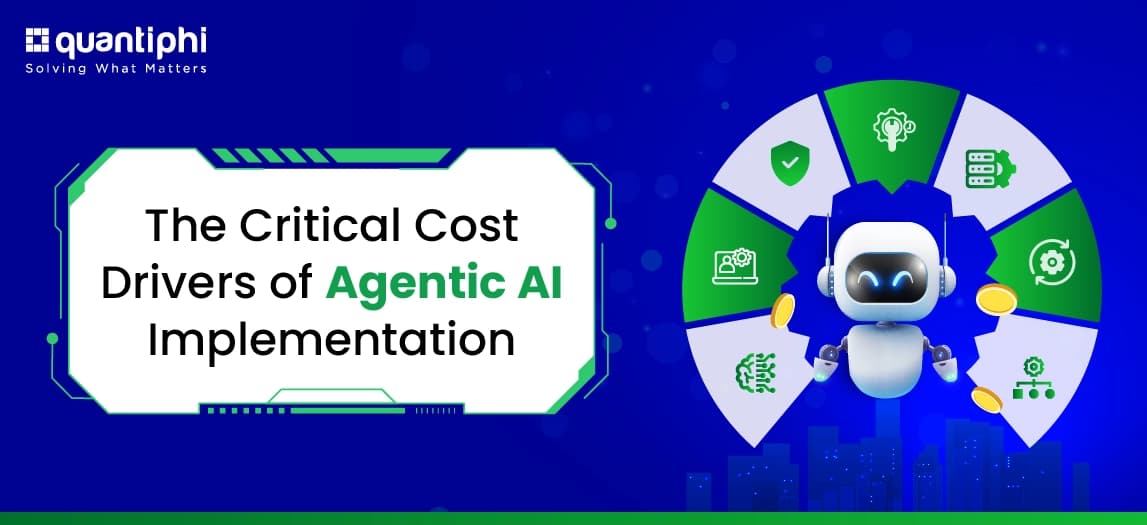
The Seven Critical Cost Drivers
-
Tech Stack and Infrastructure
Agentic AI workloads are not static. Unlike a traditional application with predictable compute demand, agents can execute multi-step workflows, trigger multiple model calls, retrieve context repeatedly, and orchestrate tools across systems. This creates a dynamic cost profile where usage, latency, and performance requirements can change dramatically as adoption grows.
Consequently, the infrastructure question is not simply “cloud vs. on-premises.” It is whether your architecture is designed for elasticity, observability, and cost control. Enterprises that treat agents like another SaaS deployment often find themselves surprised by how quickly infrastructure costs rise once agents are embedded into real workflows, especially customer-facing or mission-critical processes.
-
Integration with Existing Systems
AI agents create value when they can operate inside systems of productivity: CRM platforms, ERP systems, contact center tools, ticketing environments, core banking platforms, data warehouses, and internal knowledge bases. Every integration introduces engineering effort, security considerations, permission models, and auditability requirements.
More importantly, integration is rarely clean. Many enterprises operate in fragmented environments with overlapping tools, legacy platforms, and inconsistent data schemas. In these environments, Agentic AI becomes a forcing function: it exposes the seams in your operating architecture. The deeper the agent is expected to act, the higher the integration cost becomes.
-
Data Management and Preparation
Agentic AI is only as strong as the context it can access. That means organizations must invest in data preparation before agentic deployment: cleaning, indexing, metadata enrichment, permission-aware retrieval, and ongoing governance.
This is where many early pilots struggle. The model may be capable, but the organization’s data foundation is not. If your enterprise knowledge is scattered across documents, emails, PDFs, ticketing systems, and tribal knowledge, the agent will behave like a fast intern with unreliable information.
Data modernization and Agentic AI are deeply connected. Enterprises that already have a unified, governed data ecosystem can scale Agentic AI faster and more cost-effectively. Enterprises that don’t will spend disproportionately on knowledge engineering before they ever see ROI.
-
AI Model Complexity
Some enterprise use cases require lightweight agents that perform simple classification, summarization, or workflow routing. Others require deep reasoning, long-context retrieval, multi-agent orchestration, or domain-specific accuracy that demands stronger models and more complex scaffolding.
Model complexity drives cost in multiple ways: higher inference costs, larger context windows, more retrieval calls, and increased latency management. It also increases the cost of testing, validation, and failure handling because complex agents tend to be more difficult to govern.
For enterprise leaders, the key is choosing the right level of model complexity for the economic value of the workflow. Over-engineering early agents is one of the fastest ways to inflate cost without improving outcomes.
-
Security, Governance and Compliance
Agentic AI introduces new risk categories: hallucinated outputs, unauthorized actions, prompt injection vulnerabilities, data leakage, biased decisioning, and regulatory non-compliance. In regulated industries like banking, insurance, and healthcare, these risks are not theoretical.
Enterprise-grade Agentic AI requires governance architecture that includes policy controls, audit logs, access boundaries, human-in-the-loop mechanisms, and safety guardrails. It also requires compliance alignment across privacy standards and internal risk frameworks.
Governance is often perceived as overhead. In reality, governance is what makes scale possible. Without it, AI agents remain trapped in pilots, because leaders cannot confidently deploy autonomy into production workflows.
-
Ongoing Maintenance and Optimization
Once deployed, agents require continuous tuning and optimization to stay in lockstep with changes and evolution in business environments, policies, data sources, systems, user behavior, and even the model ecosystem.
This creates a new long-term cost driver: AI operations. Enterprises must plan for monitoring, evaluation, prompt and workflow refinement, retraining strategies (where applicable), and ongoing cost optimization. The best way for leaders to think about Agentic AI is as a living capability that needs to be managed like a high-performing digital workforce.
-
Change Management and Training
Even when the technology is ready, adoption requires a structured enablement effort. Employees need to understand what agents can do, what they cannot do, and how to collaborate with them in ways that build trust rather than skepticism.
Moreover, when AI agents begin to act across workflows, they change how work is distributed, how decisions are made, and how accountability is structured. This introduces organizational friction if not managed carefully.
Teams may resist adoption due to fear of replacement, distrust of AI outputs, or uncertainty around role evolution. Leaders may struggle to redefine KPIs when productivity is driven by hybrid human-agent execution rather than headcount.
Change management and training is often underestimated because it is not a line item like cloud spend. But it is an important predictor of Agentic AI ROI. An AI agent that is not trusted will not be used. An AI agent that is used incorrectly will create operational risk. Both outcomes are expensive.
The Opportunity Cost of Inaction
While the seven drivers above explain why Agentic AI costs can be complex, there is another cost that rarely appears in ROI models: it’s the cost of inaction. Enterprises that delay Agentic AI adoption will absorb hidden costs over time, in the form of slow decision cycles, manual coordination overhead, fragmented knowledge work, and rising operational expense while competitors begin to scale autonomy.
In a market where traditional services are compressing and AI-first operating models are accelerating, inaction carries strategic risk. It impacts speed-to-market, customer experience, employee productivity, and long-term competitiveness. In the agentic era, the question is no longer whether AI will transform your industry. It is whether you will shape that transformation, or be forced to react to it later at a higher cost.
Conclusion
For enterprise leaders, the path forward in Agentic AI implementation entails engineering cost predictability and value realization from day one. Agentic AI initiatives that are structured around clear business outcomes, governed deployment frameworks, and lifecycle cost transparency outperform those that treat agents as isolated experiments. Enterprises that succeed are those that combine infrastructure discipline, integration depth, AI governance, and operating model redesign into a single cohesive transformation strategy.
At Quantiphi, we approach Agentic AI implementation through a Tech Services as Software (TSaaS) model, where outcomes, not effort, define value. Instead of tying AI transformation to billable hours, TSaaS aligns delivery with measurable business impact, embeds cost governance into the architecture, and enables enterprises to scale AI agents with clarity around ROI.
By integrating proprietary accelerators, hyperscaler-native architectures, and enterprise-ready governance frameworks, we help organizations transition from pilot volatility to production-grade AI systems that are predictable, auditable, and scalable.
Get in touch with Quantiphi to begin your Agentic AI journey today.