Agentic AI Architecture: Blueprints for Autonomous Intelligence and Future Systems

The conversation around AI has moved beyond what language models can generate to what truly autonomous systems can achieve. Today’s AI agents are expected to plan, execute, adapt, and improve over time, often across complex, multi-step workflows. But these capabilities don’t come from models alone. They depend on how systems are designed.
Agentic AI architecture is what enables this shift, defining how memory, reasoning, and action come together to create truly autonomous intelligence. In this blog, we take a deep dive into the components that power AI agents.
What is Agentic AI Architecture?
Agentic AI architecture defines how autonomous systems are structured to perceive, reason, act, and adapt over time. Unlike traditional AI pipelines, which operate in isolated steps, agentic architectures integrate components such as memory, planning, tool use, and feedback loops into a continuous execution system.
This enables AI agents to handle multi-step tasks, respond dynamically to changing inputs, and pursue goals with minimal human intervention. As organizations move toward more autonomous and intelligent systems, agentic architecture serves as the blueprint for building AI that is not just reactive, but capable of sustained, goal-driven behavior.
How Does Agentic AI Architecture Work?
Agentic AI architecture works as a connected system in which data enters, is interpreted and orchestrated, enriched with relevant knowledge, processed by intelligent agents, governed through enterprise-ready services, and delivered as meaningful outcomes. Rather than functioning as a single model responding to prompts, this architecture enables AI to operate as a coordinated system that can support autonomy, adaptation, and continuous improvement.
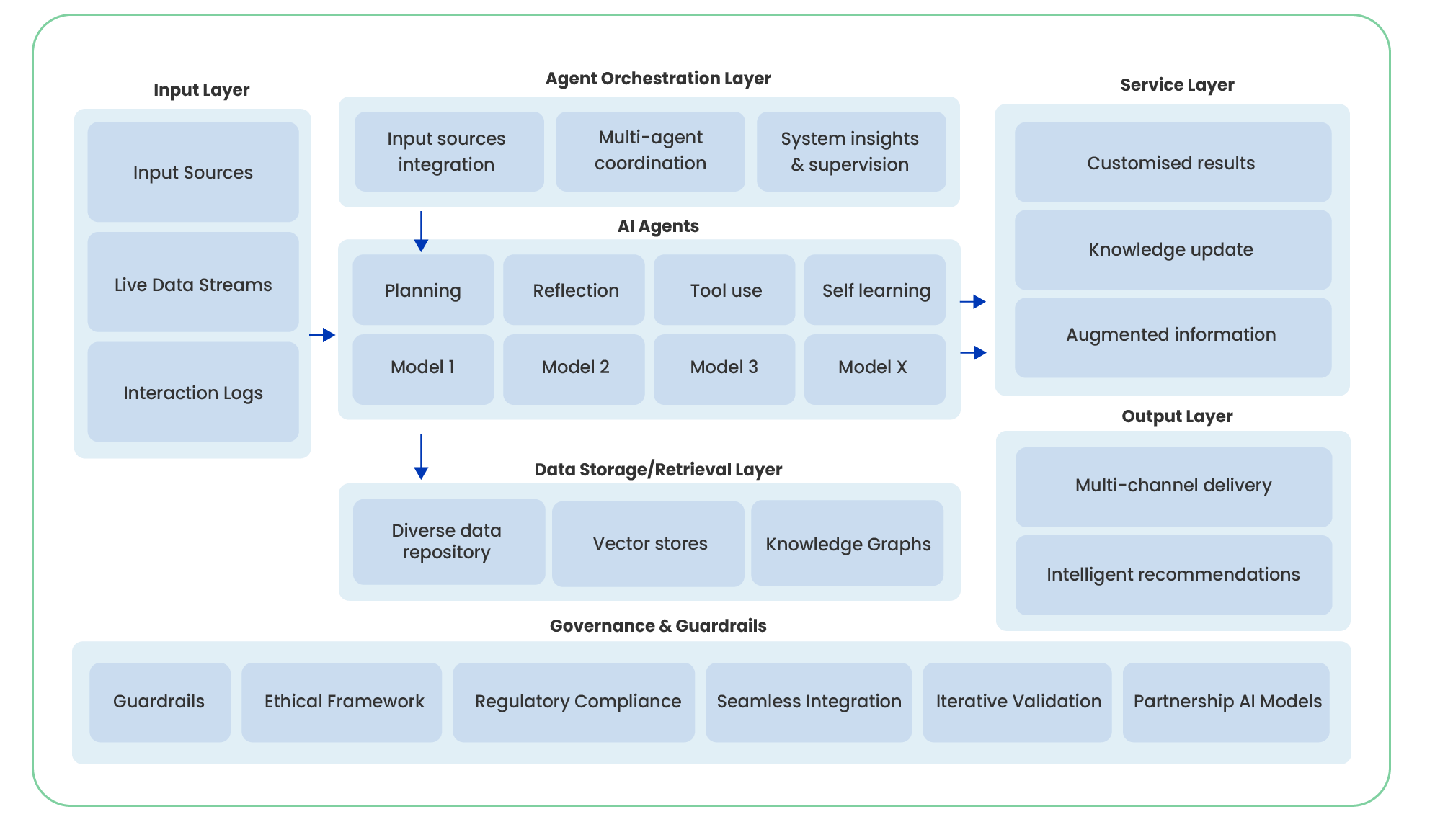
Through a layered structure consisting of an Input Layer, Agent Orchestration Layer, Data Storage/Retrieval Layer, AI Agents, Service Layer, and an Output Layer, we can turn AI from a reactive interface into an operational system for autonomous intelligence. To understand it in depth, let’s look at each component individually.
The Components of Agentic AI Architecture
Input Layer
The input layer is where the architecture begins. It captures the signals that the system needs in order to understand context, intent, and changing conditions. These signals can come from multiple sources, including structured enterprise systems, unstructured documents, user interactions, sensor feeds, APIs, and application events.
Within this layer, input sources provide the foundational data that feeds the system, live data streams bring in real-time updates that allow the architecture to respond dynamically, and interaction logs preserve records of prior exchanges, decisions, and actions. Together, these inputs give the system both immediacy and continuity.
Agent Orchestration Layer
The agent orchestration layer acts as the control center of the architecture. It connects incoming information with the right processes, agents, and services, ensuring that the system behaves in a coordinated way rather than as a collection of isolated functions.
A key role of this layer is input source integration, where data from different systems and modalities is unified into usable context. It also supports multi-agent orchestration, allowing multiple specialized agents to collaborate, delegate tasks, or operate in sequence. In addition, it provides system insights and supervision, giving visibility into performance, execution flow, and intervention points when needed.
Data Storage and Retrieval Layer
The data storage and retrieval layer provides the knowledge foundation for the system. It ensures that agents are not limited to what a model already knows, but can instead access current, relevant, and domain-specific information when making decisions.
This layer can include diverse data repositories such as enterprise databases and content systems, knowledge graphs that capture relationships between entities and concepts, and vector stores that enable semantic retrieval from large volumes of unstructured information. Together, these mechanisms allow the system to retrieve the right context at the right time.
AI Agents
The AI agents form the intelligence core of the architecture. This is where goals are interpreted, decisions are made, and actions are initiated. Rather than producing one-time responses, agents operate as active participants in a workflow.
Key capabilities within this layer include:
- Planning: Breaking down high-level goals into executable steps and sequencing them effectively.
- Tool Use: Interacting with external systems such as APIs, databases, or enterprise applications to perform actions.
- Reflection: Evaluating outputs, identifying errors, and refining responses before final execution.
- Self-Learning: Incorporating feedback and past outcomes to improve future performance without requiring full retraining.
Service Layer
The service layer ensures that agent intelligence is translated into enterprise-ready outcomes. It sits between the agents and the final output, shaping how results are delivered, controlled, and integrated into broader workflows.
This includes multi-channel delivery, so outputs can be surfaced across applications, portals, assistants, and communication channels. It also includes intelligent recommendations, helping tailor outputs to user context and business needs. Just as importantly, this layer embeds guardrails, ethical frameworks, and regulatory compliance so that autonomous behavior remains safe, responsible, and aligned with policy.
Output Layer
The output layer is the visible outcome of the architecture. It delivers the value created across the earlier layers in a form that users, systems, or downstream processes can act on.Outputs may include customized results tailored to specific users or use cases, knowledge updates that improve the system’s future responses, and augmented information that enriches human decision-making with context, recommendations, or next-best actions.
The 8 Architectural Layers of Agentic AI
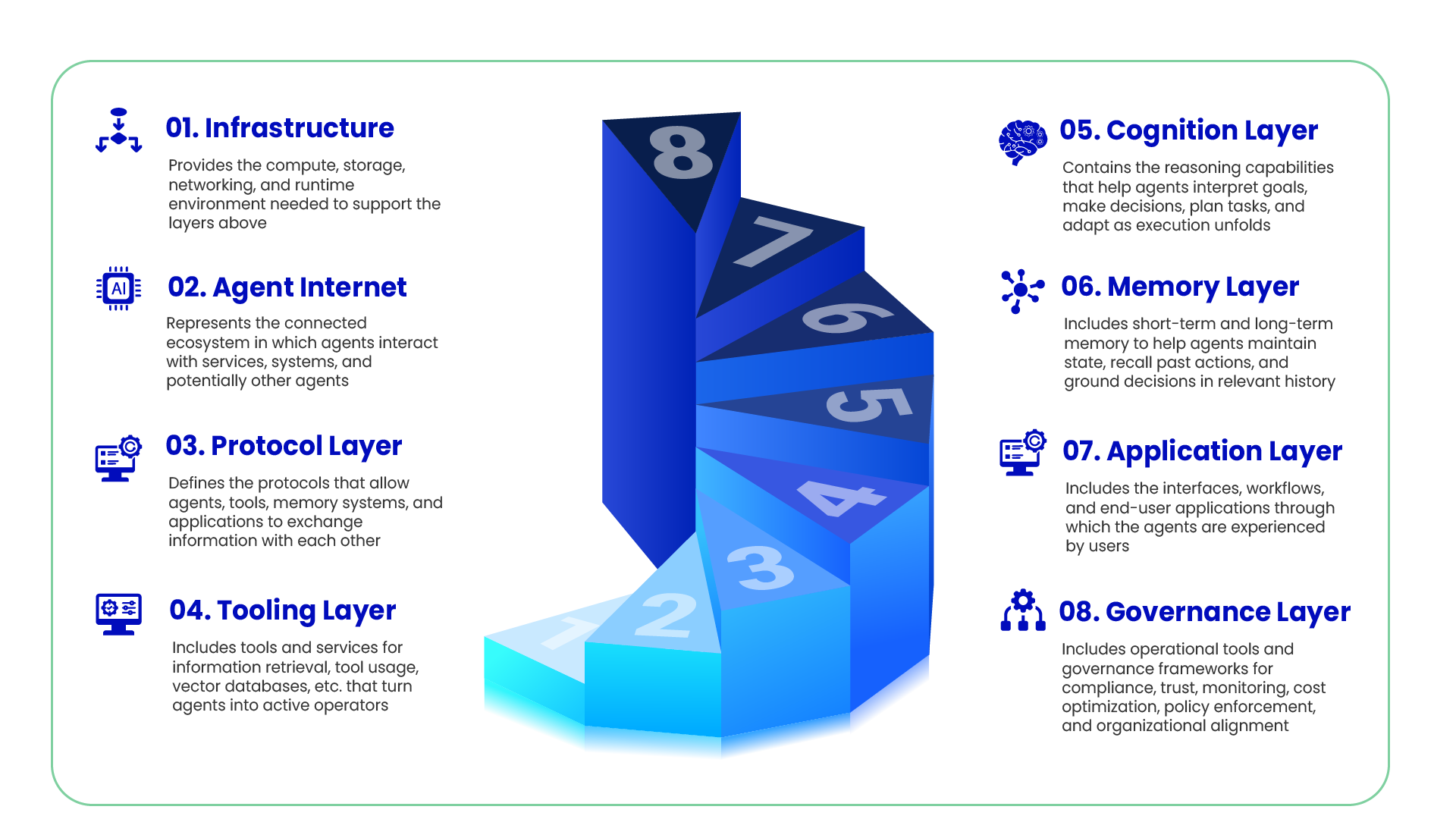
If the components explain the major building blocks of an agentic system, the architectural layers explain the broader stack that supports autonomous intelligence end to end. These layers help show how agentic AI moves from foundational infrastructure to governed business outcomes.
Infrastructure Layer
The infrastructure layer provides the compute, storage, networking, and runtime environment needed to support agentic AI systems. It underpins model execution, data processing, orchestration, retrieval, and scaling.
For agentic systems, infrastructure must support high availability, real-time processing, secure workloads, and scalable performance. It is the technical base that allows the rest of the architecture to function reliably.
Agent Internet Layer
The agent internet layer represents the connected ecosystem in which agents interact with services, systems, and potentially other agents. It enables agents to work across distributed digital environments rather than remaining confined to a single application.
This layer becomes increasingly important as enterprises move toward interoperable, cross-system autonomous workflows.
Protocol Layer
The protocol layer defines how different parts of the agentic system communicate and operate together. It includes the standards, interfaces, and communication patterns that allow agents, tools, memory systems, and applications to exchange information consistently.
Strong protocols improve interoperability, reduce integration complexity, and make the architecture easier to scale.
Tooling Layer
The tooling layer includes the functional systems and services that agents can use to take action. These may include APIs, search systems, automation platforms, enterprise applications, and analytics engines.
This layer is what turns agents into active operators. It expands what they can do beyond reasoning alone.
Cognition Layer
The cognition layer contains the reasoning capabilities that help agents interpret goals, make decisions, plan tasks, and adapt as execution unfolds. This is where intelligence becomes structured action.
A strong cognition layer enables agents to move beyond reactive responses and toward deliberate, goal-driven behavior.
Memory Layer
The memory layer stores the context that supports continuity, learning, and relevance. It includes short-term working context as well as longer-lived organizational or interaction knowledge.
This layer helps agents maintain state, recall past actions, and ground future decisions in relevant history.
Application Layer
The application layer is where agentic AI becomes usable in the real world. It includes the interfaces, workflows, and user-facing systems through which autonomous intelligence is embedded into business operations.
This is the layer where enterprises experience value, whether through copilots, assistants, workflow engines, or autonomous task systems.
Governance Layer
The governance layer ensures that agentic AI operates responsibly and within enterprise boundaries. It includes oversight for security, compliance, transparency, risk management, and ethical controls.
As autonomy increases, governance becomes even more important. It is what makes agentic systems trustworthy enough to scale.
How Does Planning Work in Agentic AI Architecture?
Planning and reasoning are at the core of how agentic systems move from intent to execution. They allow agents to interpret goals, break them down, and continuously adjust their approach based on context and outcomes.
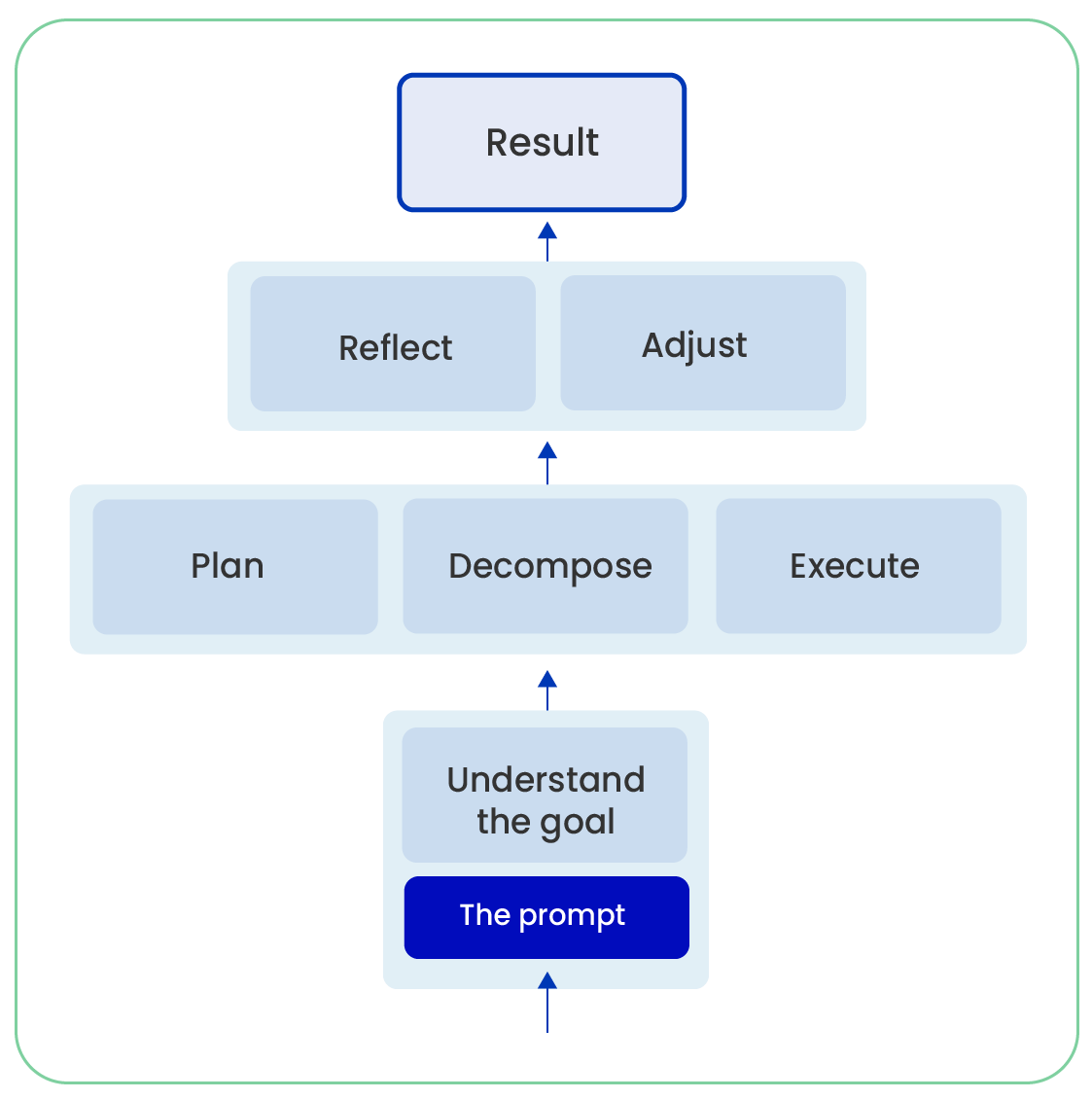
Prompt and planning
It starts with a prompt. In this phase, the AI understands the prompt and the objective of the task before forming a high-level strategy to execute it.
Task decomposition
This enables the agent to break the task into smaller, manageable subtasks. All these subtasks can be handled individually and contribute to the final objective.
Single task agent
This is the “worker bee” of the process. It takes each individual subtask and completes it using methodical reasoning patterns, sending the results back for evaluation.
Replan
In this step, the system reflects on the result of each individual subtask, and if it does not match expectations, it dynamically adjusts the strategy or plan and course-corrects.
Iterative Reasoning
The system iterates on the loop from prompt generation to replanning until a satisfactory result is reached.
How Do AI Agents Interact with Tools in the Architecture?
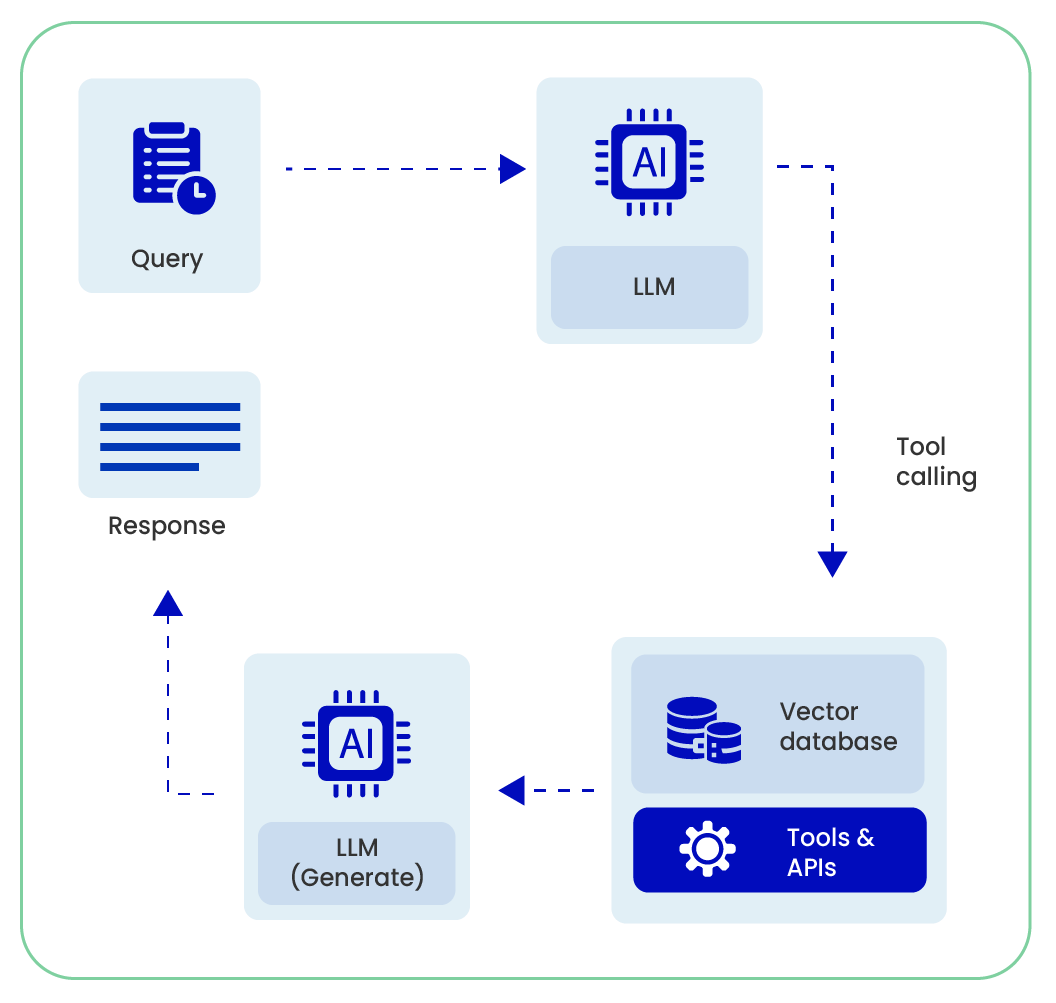
AI agents rely on tools to translate intelligence into real-world action. While models can interpret and reason, tools allow agents to interact with real systems, access external data, and execute tasks across enterprise environments.
Tool interaction typically happens through structured interfaces that allow agents to call APIs, query systems, and vector databases. The architecture ensures that these interactions are reliable, secure, and context-aware, so agents can select the right capability at the right time without human intervention.
How Does Memory Fit into Agentic AI Architecture?
Memory is what gives agentic systems continuity and depth. With it, agents can retain context, build on prior actions, and operate with a sense of progression over time. This continuity allows agents to maintain awareness of goals, past decisions, and evolving states. It reduces repetition, improves coherence, and ensures that workflows do not need to be restarted with every new input or interaction. This is achieved through a mix of short-term and long-term memory types, explained below:
Short-Term Memory
Holds the agent’s immediate working context, including current inputs, recent interactions, and intermediate reasoning steps. It enables real-time decision-making and task execution but is temporary and limited in capacity.
In practice, this includes:
- Recent user inputs and system responses
- Intermediate reasoning steps
- Current goals or instructions
Long-Term Memory
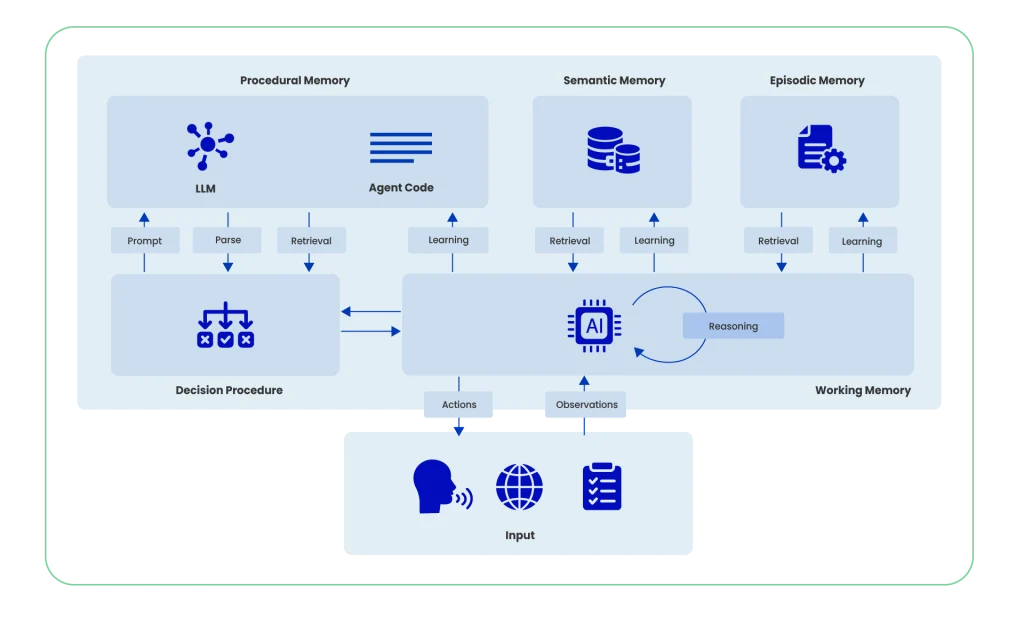
Long-term memory provides persistent storage that extends beyond a single interaction or session. It enables the agent to retain historical interactions, user preferences and states over time, providing context and domain knowledge when needed to support learning, personalization, and continuity across tasks. This memory is structured into distinct types:
Episodic Memory
Episodic memory stores past interactions, sequences of actions, and outcomes tied to specific contexts. It allows the agent to recall what happened in similar situations, helping it maintain continuity in multi-step workflows and avoid repeating mistakes.
Semantic Memory
Semantic memory captures generalized knowledge such as facts, user preferences, domain expertise, and structured information independent of specific events. It enables the agent to reason beyond individual interactions, apply learned knowledge across contexts, and deliver more accurate and personalized responses without relying on exact past scenarios.
Procedural Memory
Procedural memory represents learned strategies, workflows, and action patterns that guide task execution. It allows the agent to reuse effective approaches, improving efficiency and consistency over time. Instead of reasoning from scratch, the agent can follow optimized paths for recurring tasks, refining these patterns as it gains more experience.
Typical Flow of a Memory System:
-
Input → Short-Term Memory:
The input enters short-term memory, where it is combined with the current task state, goals, and recent interaction history to form the active working context.
-
Triggering Retrieval from Long-Term Memory:
Based on this context, the agent queries long-term memory to gather relevant information needed to proceed effectively.
-
Episodic Memory Retrieval:
The agent retrieves similar past interactions, sequences, or outcomes to understand how similar situations were handled and what worked or failed.
-
Semantic Memory Retrieval:
Relevant facts, user preferences, and domain knowledge are fetched to ground the agent’s reasoning and ensure accurate, context-aware responses.
-
Procedural Memory Retrieval:
The agent identifies applicable workflows or strategies, guiding how the task should be executed efficiently based on prior successful patterns.
-
Context Fusion in Short-Term Memory:
All retrieved information is integrated back into short-term memory, creating a richer context for planning and decision-making.
-
Decision-Making and Action:
The agent uses this combined context to decide next steps, call tools, or generate outputs, while continuously updating short-term memory with intermediate results.
-
Reflection and Evaluation:
After completing actions, the agent evaluates outcomes to determine what was useful, what failed, and what is worth retaining.
-
Memory Update (Write-back to Long-Term Memory):
Key insights are selectively stored, e.g.: events are stored into episodic memory, knowledge into semantic memory, and improved workflows into procedural memory, enabling better performance in future tasks.
What Are the Different Types of Agentic AI Architectures?
Different use cases and levels of complexity require different architectural approaches. Here are the most common types of agentic AI architectures:
Single-agent architecture
A single agent handles the entire workflow from input to output. This approach is simpler to design and works well for contained tasks, but can become limited when dealing with complex, multi-step processes.
Multi-agent architecture
Multiple specialized agents collaborate to complete tasks. Each agent focuses on a specific function, such as planning, retrieval, or execution, enabling better scalability and more efficient handling of complex workflows.
Hierarchical architecture
Agents are organized in a layered structure, where higher-level agents define goals and delegate tasks to lower-level agents. This improves coordination, control, and clarity in managing large, structured workflows.
Event-driven architecture
Agents respond dynamically to triggers or events such as data changes, user actions, or system updates. This architecture is ideal for real-time systems that require continuous monitoring and adaptive responses.
Single-Agent vs. Multi-Agent Architecture
Single-agent architectures rely on one centralized entity to handle reasoning, planning, and execution. This makes them easier to manage but can limit flexibility and scalability as tasks grow more complex. In contrast, multi-agent architectures distribute responsibilities across multiple specialized agents, allowing for parallel execution and more adaptive behavior.
From a use case perspective, single-agent systems are well-suited for focused, well-defined tasks, while multi-agent systems excel in dynamic, multi-step enterprise workflows that require coordination across functions, data sources, and decision layers.
| Aspect | Single-Agent Architecture | Multi-Agent Architecture |
| Coordination | Centralized, handled by a single agent | Distributed across multiple specialized agents |
| Complexity Handling | Limited for highly complex, multi-step workflows | Better suited for complex, dynamic, and large-scale tasks |
| Scalability | Lower scalability as workload increases | Highly scalable with parallel task execution |
| Flexibility | Less flexible, single logic path | More flexible with modular and adaptive workflows |
| Fault Tolerance | Single point of failure | More resilient due to distributed responsibilities |
| Use Cases | Chatbots, simple assistants, single-task automation | Enterprise workflows, autonomous systems, multi-step processes |
What Are Real-World Examples of Agentic AI Architectures?
Agentic AI architectures are already being applied across enterprise use cases, ranging from assistive tools to fully autonomous systems:
AI copilots (single-agent)
These systems operate as a single, centralized agent that assists users within a defined context, typically augmenting human tasks rather than executing entire workflows independently.
Example: A coding copilot embedded in a development environment helps developers write, debug, and optimize code by understanding prompts and code context in real time.
Autonomous systems (multi-agent)
These architectures involve multiple specialized agents working together to handle complex, dynamic tasks through coordination and delegation.
Example: In supply chain operations, different agents manage demand forecasting, inventory planning, and logistics, collaborating to adjust decisions in real time based on disruptions or demand shifts.
Workflow automation agents
These systems are designed to automate end-to-end business processes by orchestrating multiple steps, systems, and decisions with minimal human intervention.
Example: In customer support, an agent can process a ticket from intake to resolution by retrieving customer data, diagnosing the issue, executing actions, and updating backend systems automatically.
Industry-Specific Applications of Agentic AI Architecture
Insurance: Architecture for Automated Claims Processing
- Focus: Robust Integration with Legacy Systems (API gateway design), secure document ingestion pipelines, and mandatory human-in-the-loop validation checkpoints for high-value claims.
Explore a detailed use case and see how these agents transform operations in our piece on Agentic AI in Insurance: The Next Frontier of Autonomous Intelligence.
Banking and Finance: The High-Security Transaction Agent
- Focus: Isolated Execution Environments for sensitive data, mandatory multi-step approval protocols, and real-time integration with proprietary fraud detection systems. Given that 75% of organizations plan to increase security budgets (Source: TEKsystems Report), implementing end-to-end encryption is critical.
Dive deeper into these applications with our blog on Agentic AI in Banking: The Next Frontier for Smart Banking.
Healthcare: Architectural Compliance and Data Isolation
- Focus: Secure Enclaves for patient data, mandatory de-identification of sensitive data before input to the model, and a physical separation of the agent’s reasoning engine from the sensitive data storage layer (maintaining HIPAA compliance).
See how compliance shapes the design process in our article on Agentic AI in Healthcare
Best Practices for Designing AI Agent Architectures
A well-designed agentic AI architecture should balance autonomy with control, enabling intelligent behavior without sacrificing reliability, scalability, or trust. The following checklist can help guide stronger architectural design:
Design for modularity
Build the architecture as a set of modular components so memory, orchestration, agents, tools, and governance layers can evolve independently without disrupting the full system.
Maintain clear separation of components
Ensure that responsibilities across input handling, orchestration, retrieval, reasoning, service delivery, and output are clearly defined to improve maintainability and reduce system confusion.
Prioritize scalability and flexibility
Create systems that can support growing workloads, new agents, additional tools, and changing business requirements without requiring a complete redesign.
Integrate evaluation and monitoring from the start
Embed observability, performance tracking, and evaluation frameworks early so agent behavior, output quality, and operational health can be continuously measured and improved.
Ground agents in reliable enterprise context
Connect agents to trusted data sources, retrieval systems, and memory layers so decisions are relevant, context-aware, and less prone to hallucination.
Build governance into the architecture
Include guardrails, access controls, auditability, and escalation mechanisms as core architectural elements rather than afterthoughts.
Design for human oversight where needed
Define where humans should review, approve, or intervene, especially in high-impact or high-risk workflows.
Test across real workflow conditions
Evaluate the architecture against real-world scenarios, edge cases, and failure conditions to ensure it performs reliably outside controlled environments.
Challenges in Designing Agentic AI Architectures
Designing agentic AI architectures comes with significant technical and operational challenges, especially as systems become more autonomous and distributed:
Scalability issues
As the number of agents, tools, workflows, and data sources grows, the architecture can become harder to manage, optimize, and scale efficiently.
Latency and performance
Agentic systems often involve multiple steps such as retrieval, reasoning, orchestration, and tool execution, which can introduce delays if not carefully optimized.
Coordination complexity in multi-agent systems
When multiple agents work together, managing delegation, communication, sequencing, and conflict resolution becomes much more challenging.
Reliability and fault tolerance
Autonomous systems must be designed to handle failures gracefully, recover from errors, and avoid cascading issues across interconnected components.
Context management across long workflows
Maintaining accurate context across extended, multi-step tasks can be difficult, especially when agents must track evolving goals and intermediate states.
Governance and compliance requirements
Ensuring that agents operate within policy, security, privacy, and regulatory boundaries adds another layer of complexity to architectural design.
Evaluation difficulty
Measuring the success of agentic systems is not always straightforward, since performance depends not just on outputs, but on reasoning quality, task completion, and adaptability.
Integration with enterprise systems
Connecting agentic architectures to legacy applications, siloed data, and operational workflows can be complex and resource-intensive.
The Future of Agentic AI Architecture
Agentic AI architecture is rapidly evolving from structured systems to more dynamic, interconnected, and autonomous ecosystems. The future will be defined by greater collaboration, adaptability, and enterprise-wide integration:
Multi-agent ecosystems
Agents will operate as part of broader ecosystems, collaborating across functions, systems, and even organizations to solve complex, distributed problems.
Self-organizing architectures
Systems will increasingly adapt their own structure, dynamically forming workflows, assigning roles, and optimizing execution without predefined orchestration paths.
Real-time adaptive systems
Agentic architectures will continuously respond to live data, adjusting decisions and actions instantly as conditions change across environments.
Enterprise-scale deployment
Organizations will move from isolated use cases to fully integrated agentic systems embedded across business functions, driving end-to-end transformation.
As these capabilities mature, agentic AI will shift from experimental deployments to core enterprise infrastructure, powering intelligent operations at scale. The focus will not just be on building smarter agents, but on designing systems that can learn, collaborate, and evolve continuously within real-world business environments.
Designing Agentic AI Architectures: The Quantiphi Way
Designing agentic AI systems requires a fundamentally different approach to how enterprise systems are engineered; one that treats intelligence, data, and experience as interconnected from the outset.
At Quantiphi, this approach begins with a clear principle: agentic systems should be built as operational systems, not experimental layers. This means designing architectures where data platforms, orchestration frameworks, and intelligent agents are engineered together to support real-world workflows.
A key part of this philosophy is balancing autonomy with control. While agents are designed to plan, reason, and act independently, they are also grounded in enterprise-grade governance, observability, and human oversight where needed. This ensures that as systems scale, they remain reliable, accountable, and aligned with organizational goals.
For enterprises exploring Agentic AI investments, Quantiphi is building industry and domain-specific AI agents that are designed to think, learn, and act securely and at scale, unlocking measurable value and true ROI. Want to explore how agentic workflows can transform your enterprise? Let’s connect.