For decades, the financial services industry has been locked in a cycle of optimization through digitization. We moved paper to pixels and manual tasks to automated workflows.
Despite advanced data systems, a key gap remains: they aren’t truly autonomous. We’ve achieved data liquidity, but not decision liquidity. Skilled professionals still act as the manual bridge between risk and compliance, cross-referencing signals and navigating complex regulations. In short, while data is digitized, intelligence is still manually orchestrated.
Quantiphi started its journey in 2013 as an ‘AI-First Digital Engineering’ company that the industry desperately needed to navigate the democratization of big data, cloud, and applied ML. Today, as we stand in 2026, we are witnessing another seismic enterprise shift with the rise of agentic process automation and multi-agent ecosystems that are fundamentally rewriting the Software Development Lifecycle (SDLC) and the very nature of experience transformation.
The transition from ideation to scaled productization is no longer a multi-quarter marathon; it is becoming a continuous, economically optimized pulse.
Analysis Paralysis: Why Your Investment Strategy Feels Precarious
A common anxiety shared by many BFSI leaders I speak with is Analysis Paralysis. The pace of change is relentless. A “breakthrough” model released this month is superseded by the next. If you commit millions of dollars to a specific tech stack because of the hype, will it actually serve your unique business architecture three years from now? Every institution has a different risk appetite, a different legacy footprint, and a different customer promise.
Architecting the Agentic Ecosystem: From Intelligence to Orchestration
The real power of agentic systems in banking and insurance lies beyond simple automation. It is found in how intelligence is structured, coordinated, and economically scaled across the enterprise. At this level of maturity, the underlying agent design pattern is no longer just a technical choice, it is a strategic decision that directly dictates your cost models, governance frameworks, and regulatory resilience. Success requires treating these systems not as isolated tools, but as an architectural extension of the business itself: distributed, specialized, and rigorously governed.
We are helping institutions architect intelligence the same way they architect their business – distributed, specialized, and governed by deploying the right model for the right decision layer:
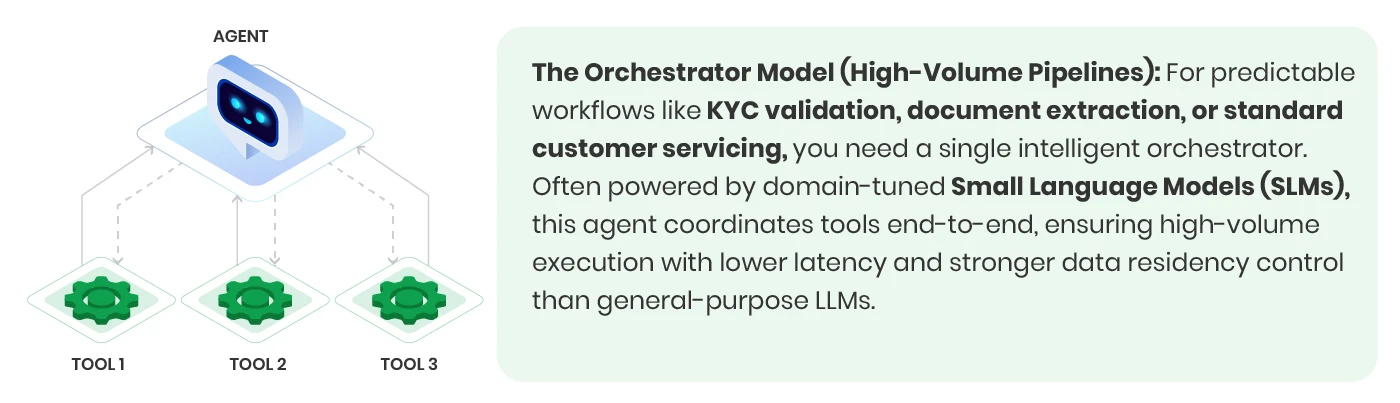
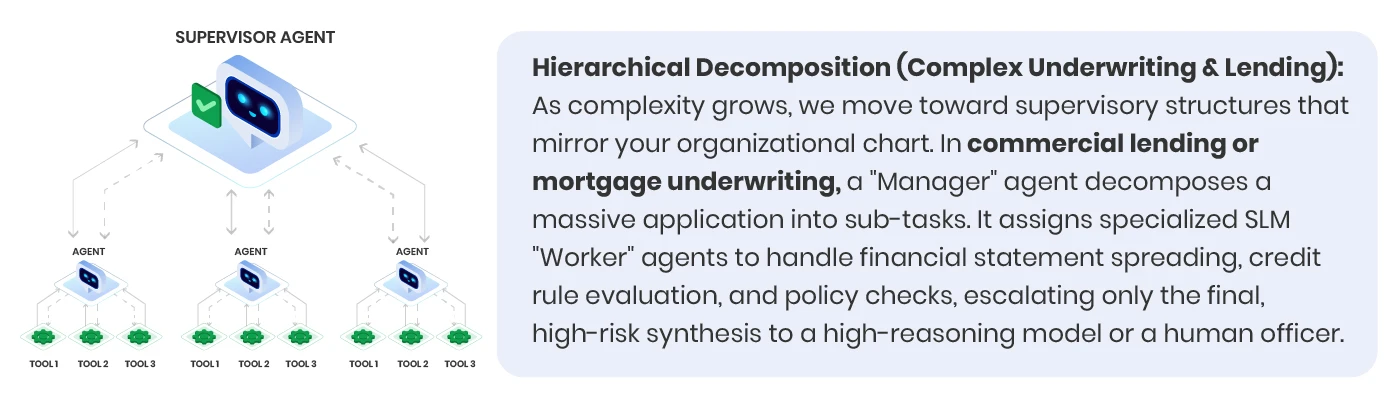
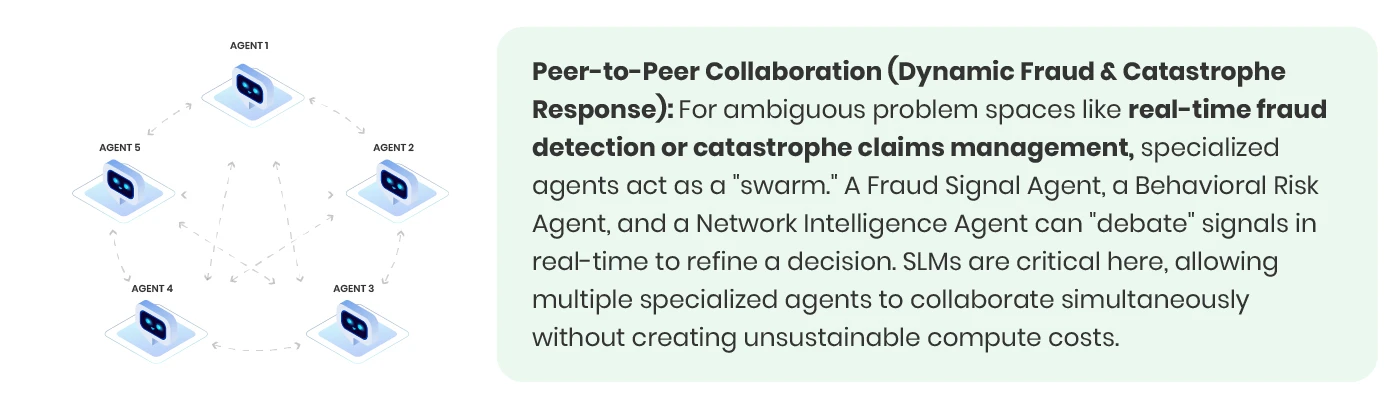
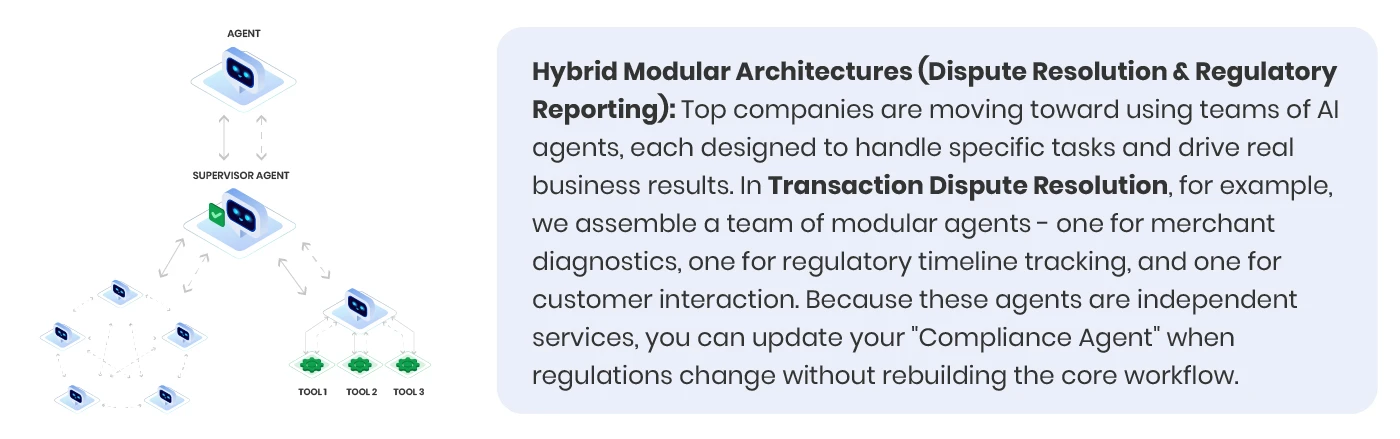
The operational breakthrough is this tiered intelligence architecture. By utilizing agentic workflow platforms, your teams are enabled to assemble these capabilities through no-code orchestration. We right-size the intelligence: SLMs handle 80–90% of operational volume, while high-reasoning models are reserved for “grey-area” exceptions.
The Functional Duo: Analyst vs. Executor Agents
Finally, to achieve agentic outcomes of verifiably excellent standards, we divide agents into two primary archetypes:
- The Analyst/Recommender Agent (The “Brain”): This agent is domain-tuned for high-reasoning and synthesis. In a commercial lending scenario, the Analyst reviews financial statements, cross-references them with market volatility signals, and evaluates the risk profile. Its output isn’t an action, but a validated recommendation.
- The Executor Agent (The “Hands”): Once a decision is reached, the Executor takes over. It specializes in tool-use: interacting with legacy APIs, updating core banking systems, or drafting regulatory-compliant correspondence. It ensures that intelligence translates into operational movement without manual intervention.
Traceability and Control Are Key to Adoption
While agents can boost your productivity, in the highly regulated world of banking and insurance, speed cannot come at the expense of oversight. The modular architecture ensures full traceability: every signal the Analyst ‘debates’ and every action the Executor takes is logged, providing a transparent audit trail for compliance.
Another key advantage of this model lies in optionality. It allows institutions to start with the ‘dial’ set to low autonomy – where agents only prepare the file for human sign-off. Over time, as confidence in the model’s accuracy grows, companies can ‘turn the dial up,’ moving to autonomous execution for high-volume, low-risk decisions while reserving human expertise for the most complex exceptions. This ensures that you are augmenting machine intelligence to increase your innovation velocity, but at the speed of your risk appetite, not just the speed of tech.
How SLM-Powered Multi-Agent Systems Work in Practice?
-
Intelligent Transaction Dispute Resolution
An autonomous system that takes the heavy burden of investigating contested charges off your team’s shoulders. By instantly coordinating merchant data, bank policies, and legal timelines, it turns a slow back-office process into a high-speed operation that protects your margins and earns deeper customer trust.
In this system, agents act as autonomous investigators that handle the complex forensic work of gathering merchant data, checking policies, and verifying regulations in seconds. By orchestrating these decisions in real-time, they resolve most disputes instantly and ensure human experts only spend time on the most difficult cases.
How the Multi-Agent Model Works
- Customer Interaction Triage Agent (SLM): Classifies dispute type and urgency
- Transaction Diagnostics Agent (SLM): Validates transaction trail, customer/merchant data, network signals
- Dispute Policy Reference Agent: Checks the dispute policy of the bank and suggests next steps
- Regulatory Compliance Agent (SLM): Checks dispute handling against regulatory timelines
- Exception Decision Agent (Higher Reasoning): Handles ambiguous or multi-jurisdiction disputes
Why SLMs Matter Here
Transaction disputes are high-volume and pattern-heavy. SLMs deliver speed and cost efficiency while maintaining regulatory consistency.Business Outcome
- Faster dispute closure timelines
- Reduced manual investigation load
- Improved regulatory audit readiness
-
Autonomous Claims Processing with “Human-over-the-Loop” (HOTL) Steering
As discussed earlier in the blog, in insurance, the goal isn’t just speed; it’s the calibrated balance between automation, precision, and control. We architect claims systems to provide you with the ‘Sliding Scale of Autonomy,’ allowing your knowledge workers to decide exactly when the AI takes the wheel.
How the Human-Centric Multi-Agent Model Works:
- The Claims Analyst Agents: Perform the forensic heavy lifting reviewing dashcam footage, estimating repair costs via computer vision, and checking policy exclusions.
- The Fraud “Swarm”: Specialized agents ‘debate’ whether the claim patterns suggest a staged accident.
- The Control Gateway (The Optionality Layer): Instead of auto-paying, the system presents a confidence score and the summary and asks the human: “I’ve done the work,
but I need your sign-off on this specific policy interpretation.”.
- The system can settle high-confidence, low value claims with one click
- For complex/high-value claims, the analyst agent purely acts as a “Staffer,” preparing the entire file for the human adjuster to make the final call.
Why SLMs Matter Here:
Claims processing is high-volume and pattern-heavy; SLMs deliver the necessary speed and cost-efficiency while offering superior data residency and security for sensitive claimant data – allowing you to scale intelligence without the unsustainable compute costs of general-purpose LLMs.Business Outcome:
- Empowered Adjusters: Humans are no longer data-gatherers; they are decision architects.
- Operational Elasticity: During a catastrophe event, a firm can ‘dial up’ agent autonomy to handle volume, then ‘dial it back’ for standard operations.
- Regulatory Resilience: Since the ‘Compliance Agent’ is modular, the human can override its logic if a new local mandate is issued overnight.
-
Intelligent Underwriting Risk Assessment with multi-agent SLM
A framework to speed up the high-stakes lending and insurance approvals by digitizing the heavy lifting of a risk committee. It uses a team of specialized agents to instantly check data, verify rules, and model risk, turning a slow manual review into a fast, consistent process that lets you price and approve policies in real-time.
How the Multi-Agent Model Works
- Application Intake Agent (SLM): Extracts structured data from applications and documents
- Policy / Credit Rule Evaluation Agent (SLM): Applies underwriting rules and eligibility checks
- External Signal Intelligence Agent (SLM): Processes bureau, telematics, or third-party data
- Risk Scenario Simulation Agent (Higher Reasoning): Handles edge risk scenarios and portfolio impact
Why SLMs Matter Here
Underwriting involves large volumes of structured decisioning – ideal for domain-tuned smaller models running at scale.Business Outcome
- Faster underwriting turnaround
- More consistent risk evaluation
- Ability to scale personalized pricing models
The Strategic Mandate: Balancing Hype with Business Pragmatism
In this era of rapid-fire innovation, true competitive advantage does not belong to those who simply deploy the largest models; it belongs to the institutions that design those that truly augment human intelligence and accelerate innovation. Quantiphi has been recognized as a leader by leading analyst firms like Gartner, Forrester, and IDC for our innovations in AI and Generative AI. As pioneers in the next frontier of applied AI, we partner with institutions to distinguish high-impact innovation from the prevailing industry noise. This “filter” is what defines our vision: we don’t just deploy AI, we help you build strategic differentiation in a world where the ‘cutting-edge’ shifts every month.