What is a Global Capability Centre (GCC)? A Complete Guide

What is a Global Capability Centre?
As global businesses shift toward digital-first and innovation-led growth, Global Capability Centres (GCCs) have become critical engines powering enterprise transformation. Today, countries like India are shaping the future of global operations through a rapidly expanding Global Capability Centre ecosystem that blends talent, technology, and scale.
Global Capability Centre vs Outsourcing: What’s the Difference?
| Feature | Traditional Outsourcing | Global Capability Centre (GCC) |
|---|---|---|
| Ownership | Third-party vendor manages the operations and staff. | Fully owned and operated by the parent multinational company. |
| Strategic Intent | Cost reduction and handling non-core transactional tasks. | Strategic growth, innovation, and high-value business capabilities. |
| Talent Model | Shared resources; high turnover is common. | Dedicated “extension of HQ”; focuses on deep domain expertise. |
| Work Nature | Standardized, repetitive, and process-driven tasks. | Complex, knowledge-driven functions (AI, Cyber, R&D). |
| Integration | Arm’s length relationship; siloed from the parent firm. | Integrated into the global culture, values, and tech stack. |
| IP & Security | Data and IP are shared with a third party. | Full control over Intellectual Property and security protocols. |
What is the Purpose of a Global Capability Centre (GCC)?
Earlier, these Centres were largely focused on cost optimization and process support. Over time, they have evolved into innovation-led hubs that contribute directly to product strategy, intellectual property creation, and next-generation technology development. Today’s Global Capability Centres often lead global transformation initiatives rather than just supporting them.
The Indian Global Capability Centre landscape has undergone a seismic shift in maturity. Today, over 50% of Centres operate as Portfolio and Transformation Hubs with full ownership of global roadmaps. This evolution is driven by a 40% CAGR in global and women leadership roles over the last five years. Currently, 90% of Global Capability Centres are multi-functional powerhouses, integrating technology, operations, and product engineering under one roof.
Why is India a Global Hub for Global Capability Centres (GCC) ?
India’s rise as a Global Capability Centre powerhouse has been accelerated by strong digital infrastructure, a large STEM workforce, and policy support from the Government of India, which continues to encourage global investments, startup partnerships, and technology ecosystem growth.
Over the last five years, India’s Global Capability Centre landscape has shifted into high gear, scaling to over 1,700 Global Capability Centres operating across nearly 3,000 distinct Centres as of FY2024. This expansion has transformed the sector into a massive economic engine, now generating an estimated $64.6 billion in annual revenue. Beyond the balance sheet, the ecosystem has become a primary driver of high-skill employment, providing a professional home to more than 1.9 million specialists nationwide.
How Does a Global Capability Centre Work?
The 5-Step GCC Evolution
- Strategic Planning: The parent company selects a location and establishes a wholly-owned legal entity aligned with global goals.
- Infrastructure Setup: Secure facilities and global IT networks are built to mirror HQ standards, ensuring data sovereignty.
- Talent Integration: Specialized experts are hired as direct employees, fully immersing them in the parent company’s culture and brand.
- Operational Maturity: Core functions (HR, Finance, IT) are stabilized, shifting from “support” to high-quality, dedicated delivery.
- Strategic Leadership: The unit matures into an Innovation Hub, owning R&D, product roadmaps, and AI initiatives that drive global growth.
What Role Do Global Capability Centres Play in Digital Transformation?
Modern Global Capability Centres have transitioned from cost Centres into digital transformation engines that own end-to-end technology roadmaps. By housing specialized Centres of Excellence (CoEs) in AI, GenAI, and Cloud, these hubs move beyond maintenance to lead enterprise transformation—architecting scalable digital platforms and driving product innovation. Today, they act as the “innovation brain” of the parent organization, leveraging data, automation, and AI to accelerate time-to-market for digital products and standardize complex tech stacks across global operations.
What Technologies are Used in Modern Global Capability Centres?
Modern Global Capability Centres rely on a “digital-first” stack, using Cloud computing and data platforms for global scalability and real-time insights. They integrate AI/ML and automation (RPA) to transition from manual tasks to intelligent workflows. This ecosystem is powered by advanced engineering platforms to accelerate product innovation, all secured by enterprise-grade cybersecurity frameworks.
What is the Global Capability Centre Setup Model?
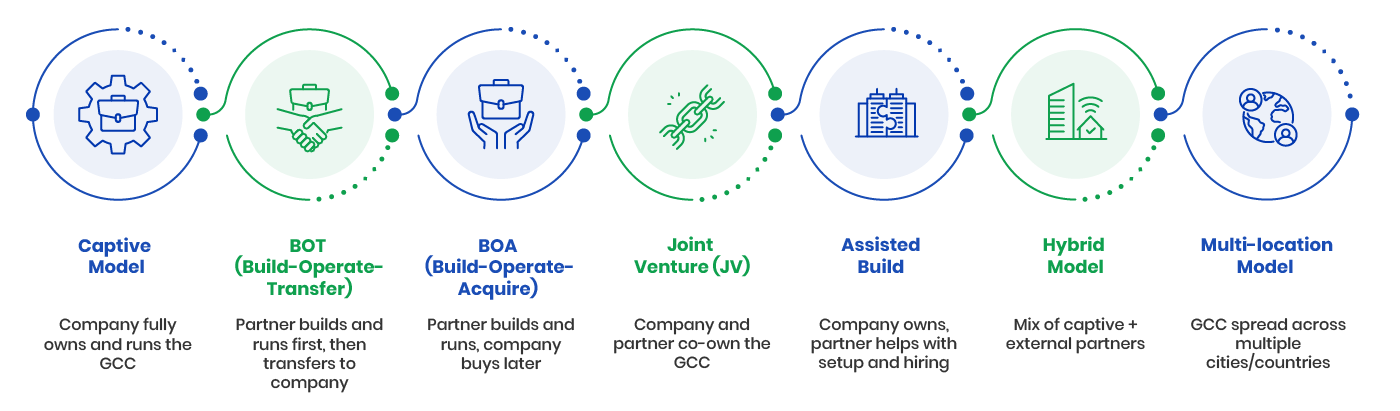
Global Capability Centres (GCCs) operate on a spectrum of ownership and risk, allowing companies to choose the right balance between internal control and external expertise. While the Captive model offers total autonomy, BOT, BOA, and Assisted Build strategies use partners to accelerate setup and navigate local complexities before a final handover. Joint Ventures and Hybrid approaches share the operational burden to increase agility, whereas Multi-location models optimize for global talent access and risk diversification. Ultimately, these models provide a roadmap for transforming a remote office into a high-value, strategic extension of the parent organization.
Types of Global Capability Centres (What work they do)
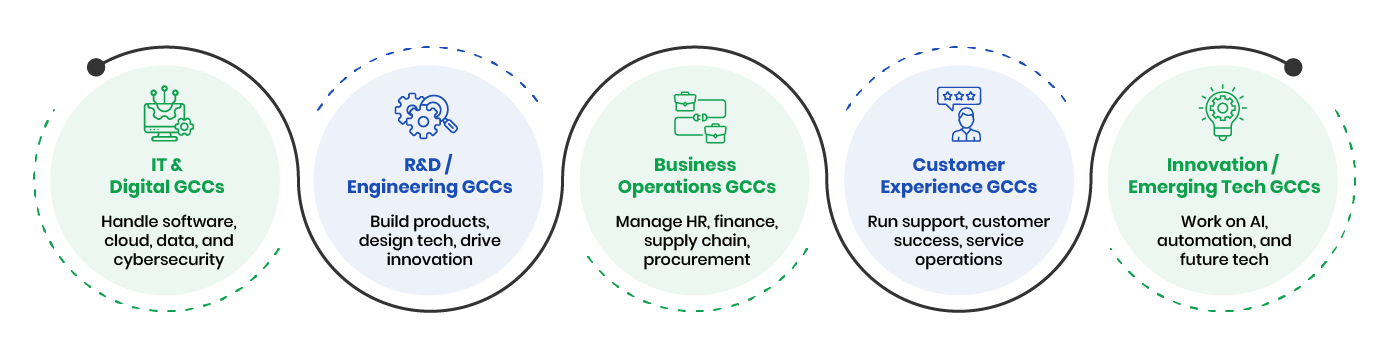
GCCs are categorized by their strategic focus, evolving from simple back-office support into specialized hubs for technical and operational excellence. While Business Operations and Customer Experience centers ensure organizational efficiency and seamless service delivery, IT, Digital, and R&D units act as the engine room for software development and product engineering. More advanced Innovation and Emerging Tech hubs focus on future-proofing the business through AI and automation, allowing these centers to transition from “delivery engines” to “value creators” that drive global competitive advantage.
Global Capability Centre Setup: A 5-Step Strategic Roadmap
- Strategic Blueprinting Define core business objectives and select the optimal operating model (e.g., Build-Operate-Transfer or Managed Services) to balance speed and control.
- Location & Compliance Identify the ideal talent hub (e.g., Bangalore, Hyderabad, or Pune) and finalize legal entity formation, tax structures, and local regulatory filings.
- Infrastructure & Talent Acquisition Establish high-security digital environments and execute a data-driven recruitment strategy to secure top-tier engineering and leadership talent.
- Launching Specialized CoEs Deploy core AI, GenAI, and ESG Centres of Excellence (CoEs), moving beyond basic operations into high-value, specialized technical ownership.
- Operational Maturity & Scaling Transition to a steady-state where the India Centre drives global product roadmaps and scales impact across the entire enterprise.
Top 5 Challenges Faced by Global Capability Centres
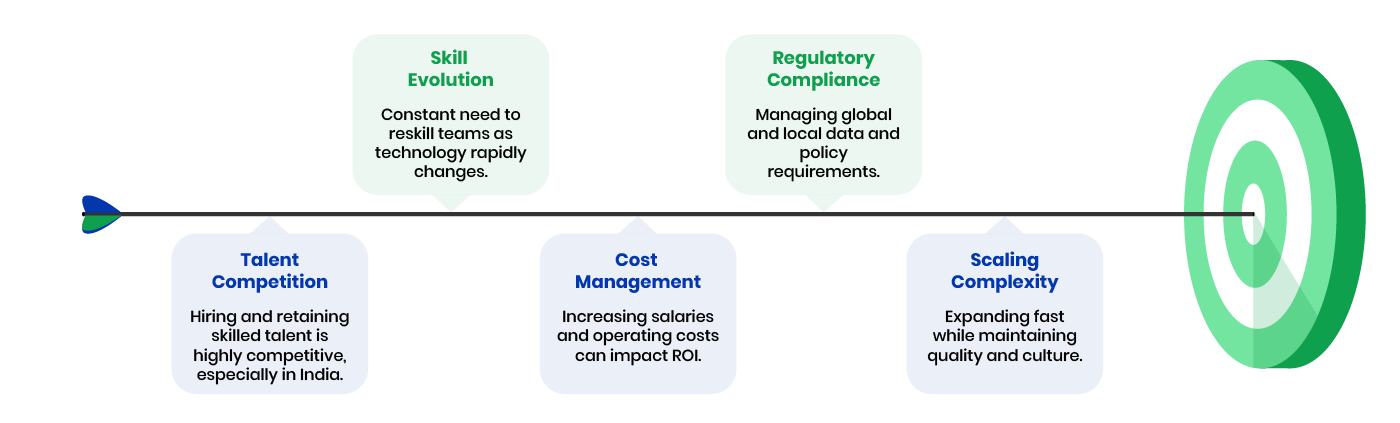
- Talent Competition: The explosive growth of the Indian ecosystem has triggered a fierce war for niche talent. Hiring and retaining skilled professionals is increasingly difficult as competition from other global hubs and high-growth startups drives up attrition.
- Skill Evolution: Technology matures faster than traditional training cycles. Global Capability Centres face a constant hurdle in reskilling teams to keep pace with GenAI, Cloud, and Hyperautomation, requiring a shift from static roles to continuous learning cultures.
- Cost Management: Rising wage inflation for premium tech talent and increasing urban operational costs can pressure the traditional “cost-arbitrage” model, requiring Centres to prove their value through ROI and innovation rather than just savings.
- Regulatory Compliance: Navigating the intersection of international data laws (GDPR) and India’s evolving DPDP Act is complex. Managing global policy requirements while ensuring seamless cross-border data flow remains a top priority.
- Scaling Complexity: Expanding rapidly while preserving the parent company’s culture and quality standards is a major challenge. Moving from a small pilot to a large-scale Centre often leads to operational bottlenecks and a loss of “startup agility.”
What are the Key Benefits of a Global Capability Centre?
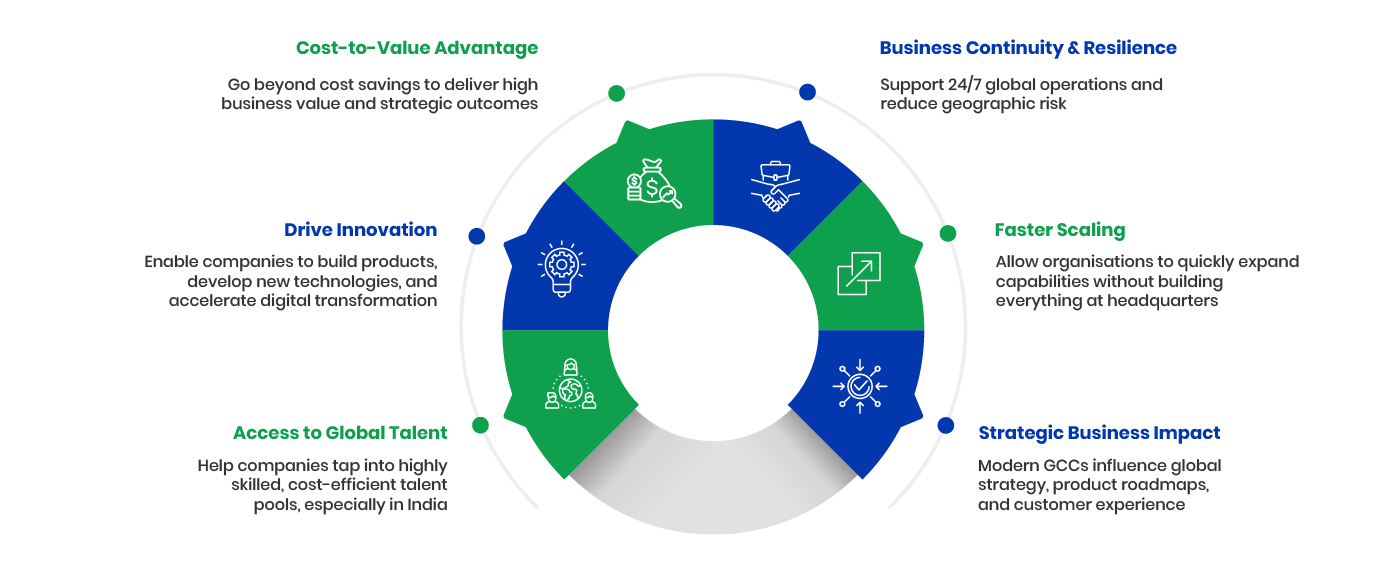
Modern GCCs have shifted from simple cost-saving hubs to strategic value drivers that enhance global agility and innovation. By providing access to elite talent pools and enabling 24/7 business resilience, these centers allow organizations to scale rapidly while diversifying geographic risk. Beyond operational efficiency, they deliver a cost-to-value advantage by directly influencing global product roadmaps and digital transformation, ensuring that the GCC acts as a core pillar of the parent company’s long-term competitive strategy.
What Functions are Handled by Global Capability Centres?

Back Office
Operational Excellence
- Finance, HR, Procurement
- Supply Chain & Shared Services
- Compliance & Reporting

Middle Office
Business
Enablement
- Data & Analytics
- Risk & Governance
- Process Optimisation
- Customer Operations & Support

Front Office
Technology & Business Impact
- IT & Digital Platforms
- Product Engineering
- Application Development
- Cybersecurity & Cloud

Innovation Layer
Future-Focused
Value Creation
- AI / ML & Automation
- Digital Transformation Programs
- R&D & Emerging Technologies
- Innovation Labs & Co-creation with global teams
What Global Capability Centres Need to Get Right to Succeed?
To evolve from operational Centres to strategic innovation hubs, Global Capability Centres must focus on five critical success pillars:
- Build a Modern, Governed & AI-Ready Data Foundation
Without clean, secure, and unified data, AI and innovation cannot scale. Global Capability Centres must modernize legacy systems, enable strong data governance, and create platforms that are cloud-native and AI-ready. - Deliver Measurable AI-Led Business Impact
AI initiatives must move beyond experimentation. Global Capability Centres need custom GenAI and Applied AI solutions that solve real business problems and deliver tangible ROI within weeks not years. - Drive Differentiation Through Applied AI
Competitive advantage will come from embedding AI deeply into products, operations, and decision-making. This is where intelligent automation and domain-driven AI create meaningful differentiation. - SLM-Driven Efficiency & Control
Small Language Models (SLMs) offer cost-efficient, secure, and customizable AI capabilities. For Global Capability Centres, SLMs enable enterprise-grade AI deployment with better data control and lower compute costs - Co-Create Industry-Defining Innovation
The most successful Global Capability Centres partner strategically to build industry-first solutions disrupting markets, enabling new business models, and shaping the enterprise’s future growth story.
What is the Future of Global Capability Centres?
The future of Global Capability Centres lies in their evolution into strategic innovation engines, moving far beyond the role of service providers to take end-to-end ownership of global product portfolios. By 2030, we expect a shift toward autonomous operations, where AI-driven hyperautomation manages routine functions, allowing for deeper business integration across all corporate layers. These Centres will no longer be satellites but the primary hubs where the next generation of global intellectual property is conceived, developed, and scaled.
How to Measure Global Capability Centre Success? (KPIs & ROI)
- Cost Savings & Efficiency: Shifting from overhead tracking to capturing 20–45% productivity gains through automation (RPA) and optimized operational workflows.
- Innovation Output: Evaluating the maturity of AI/GenAI CoEs and the volume of global patents or proprietary IP generated by the local teams.
- Time-to-Market: Measuring the reduction in product development cycles enabled by seamless enterprise transformation and 24/7 global engineering support.
- Employee Retention: Tracking the stability of niche technical talent and the internal growth of a “Global Leader” pipeline within the Indian Centre.
- Strategic ROI Frameworks: Assessing the Centre’s direct contribution to global revenue and its role in architecting the parent organization’s long-term digital roadmap.
What’s the future of Global Capability Centres in India ?
Looking ahead, the trajectory for India’s Global Capability Centre sector remains remarkably steep. By 2030, the market is projected to reach a massive $100 billion valuation, effectively doubling its current economic footprint. This growth will be mirrored by a talent surge, with the total workforce expected to cross the 2.5 million mark. This evolution underscores India’s transition from a service provider to a global headquarters for innovation, where the next generation of global products and digital platforms will be built and scaled.