Why Small Language Models Are the New Powerhouse for Banking

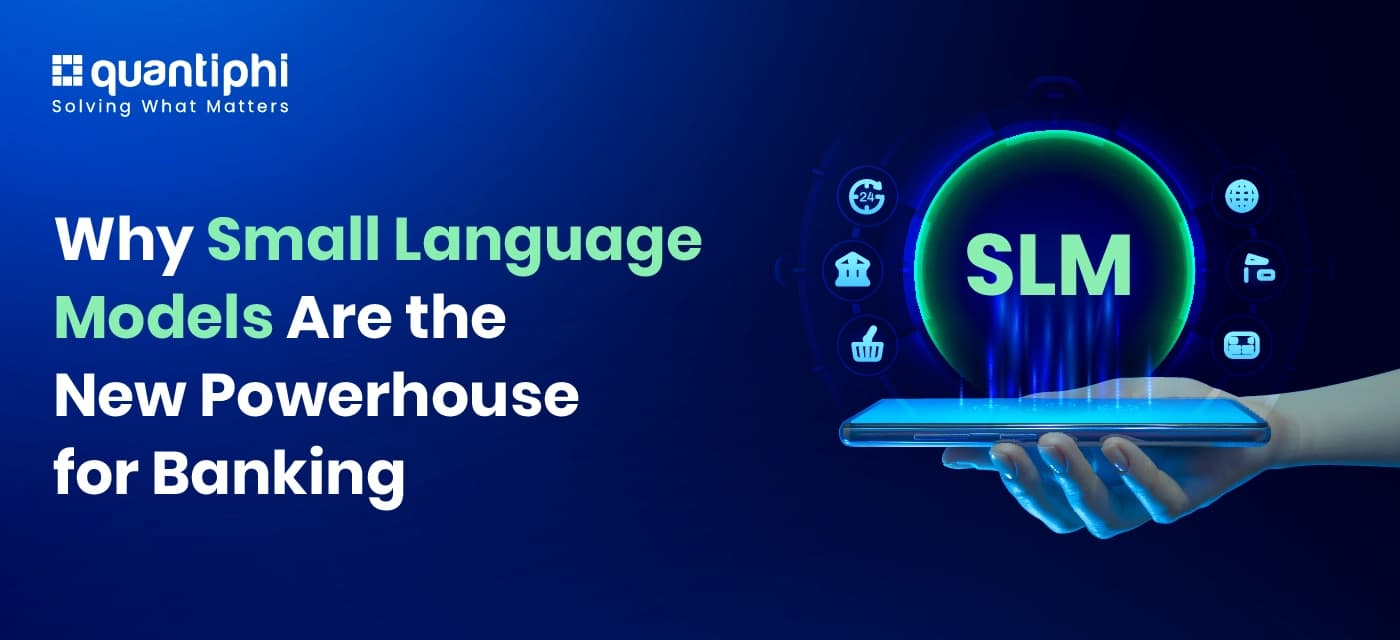
The financial services industry has embraced a powerful truth: generative AI is transforming what’s possible. Large language models have opened doors to innovation that seemed impossible just years ago.
But as banks move from experimentation to production, they’re discovering a critical insight: not every problem needs the computational power to understand the entire internet. For compliance screening, fraud detection, contract analysis, and regulatory filing—banking’s mission-critical operations—a different approach is emerging: Small language models (SLMs), trained specifically on domain data and institutional knowledge, are delivering 95%+ accuracy at a fraction of the cost, with the explainability regulators demand and the control banks require.
What Makes Small Language Models Different?
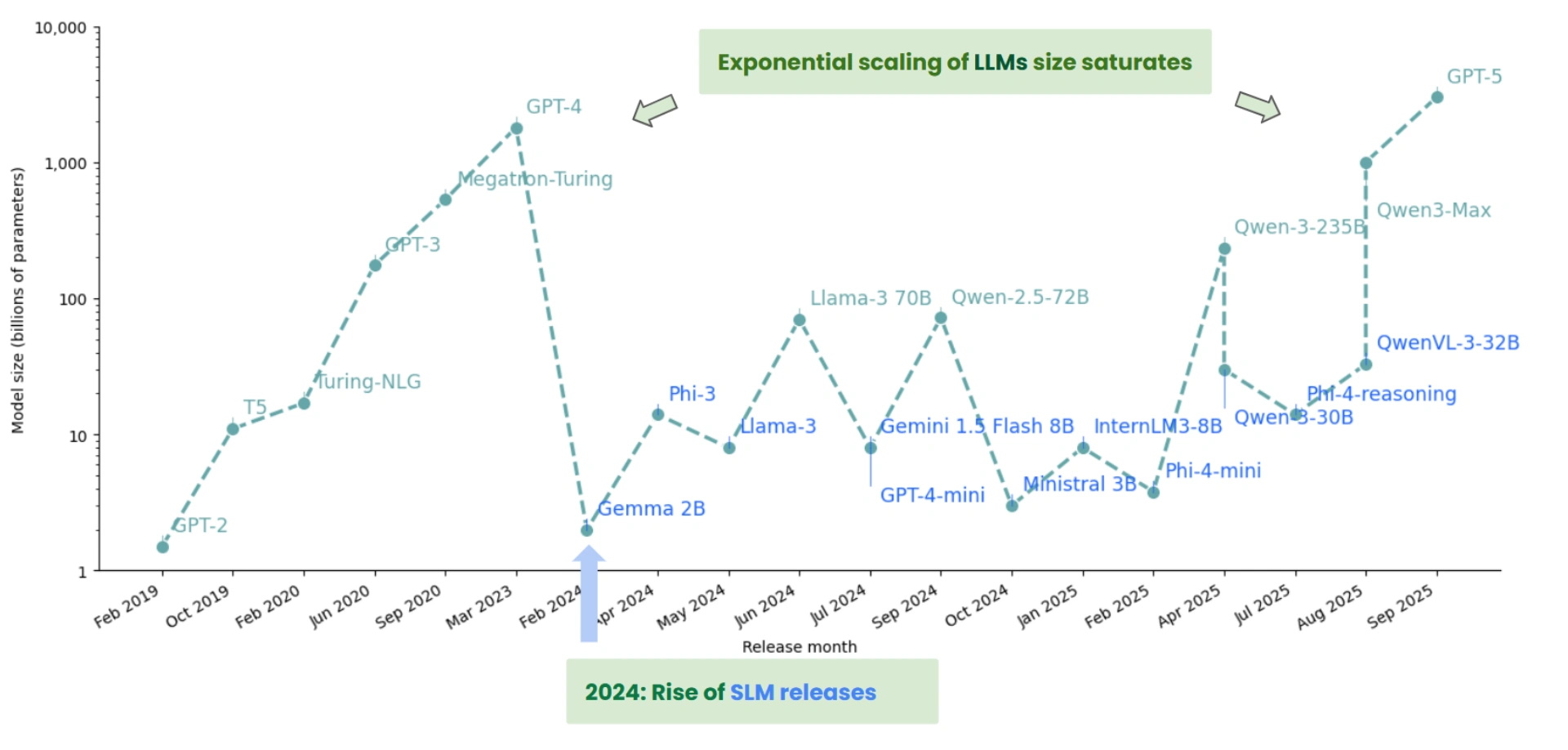
Small language models (SLMs) are a type of generative AI model that is 10 billion parameters (a configurable variable used in model training) or less.
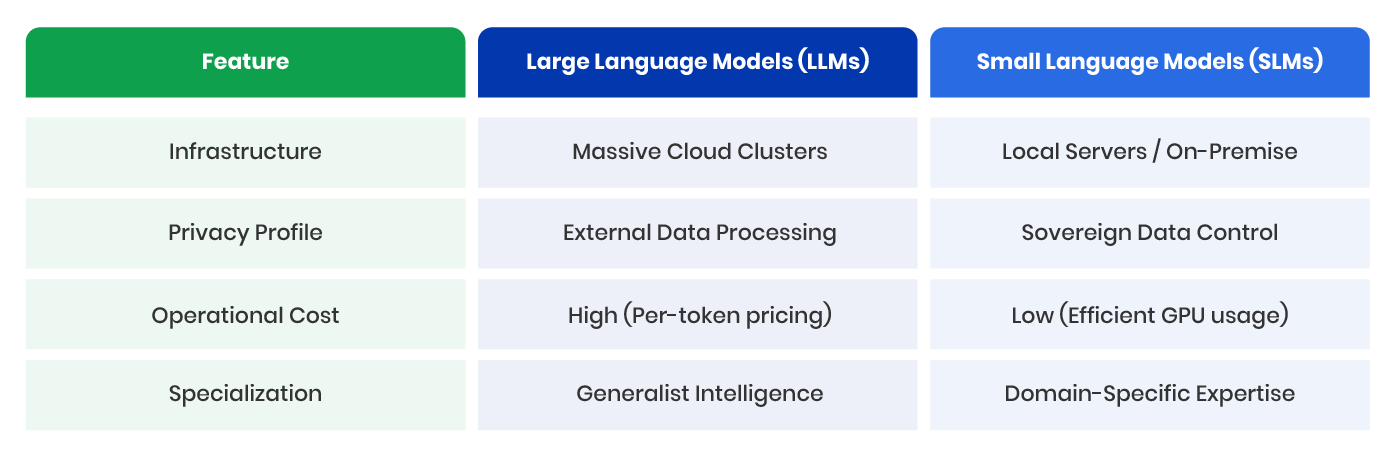
If LLMs are the vast, public libraries of the digital world, SLMs are the highly secure, specialized research vaults. They aren’t here to replace the “big” models; they are here to provide the surgical precision that banking requires. By focusing on a narrower set of high-quality data, these models achieve performance that rivals their larger counterparts in specific domains, while being significantly leaner.
“Small Language Models (SLMs) are sufficiently powerful, inherently more suitable, and necessarily more economical for many invocations in agentic systems, and are therefore the future of agentic AI.” – Belcak et al. 2025, NVIDIA Research
High-Impact Use Cases in Banking: Where SLMs Move the Needle
For a banking unit looking to scale, SLMs offer a fast track to production for several critical areas:
-
Real-Time Fraud Intelligence at the Edge
Traditional fraud detection often relies on centralized processing, creating a lag. Because SLMs can run on smaller hardware—even mobile devices—they can analyze transaction patterns in real-time at the “edge,” flagging anomalies before the “Submit” button is even pressed.
-
The “Automated Auditor” for Compliance
Regulatory landscapes are shifting daily. An SLM can be fine-tuned specifically on a bank’s internal policy documents and local regulations. It acts as a 24/7 auditor, scanning internal communications and loan applications for red flags without ever letting that sensitive data leave the bank’s private cloud.
-
Hyper-Contextual Customer Support
Generic chatbots often frustrate banking customers with vague answers. An SLM trained on your specific product suite and historical support tickets can provide deep, technical assistance—such as explaining the nuances of a specific mortgage product—with much higher accuracy and lower “hallucination” rates.
-
Back-Office Transformation: The Efficiency Engine
The “middle” and “back” offices are often the most resource-intensive areas of a bank. SLMs can be deployed to automate the extraction of data from complex, unstructured documents like mortgage applications, trade finance contracts, and legal agreements. Unlike generic models, an SLM can be fine-tuned on your bank’s specific document templates, significantly reducing error rates in data entry and reconciliation while keeping the processing entirely on-site.
Why SLMs Win for Scale, Specialization, and Latency in Banking
-
High-Volume Interactions: From Variable to Predictable Cost
When AI assistants are rolled out across contact centers, branches, and internal teams, interaction volume can reach millions of prompts per month. With third‑party LLMs that charge per token, this quickly becomes a multi‑million‑dollar annual expense.
SLMs change the economics:
- The model is deployed on‑premises or in a private cloud, inside the bank’s boundary.
- Once trained, SLMs can serve large volumes of queries without per‑token charges to an external provider.
- There is more upfront investment and need for internal skills, but serving costs become far more predictable and usually much lower at scale.
-
Organizational Language: Encoding the Bank’s DNA
Generic LLMs don’t inherently know your bank—its products, approval workflows, fee structures, and local policies. That organizational context must be re‑supplied with every interaction so the LLM can respond accurately, which:
- Increases prompt size, latency, and cost
- Raises the risk of exposing sensitive internal information externally
- Still doesn’t guarantee consistent, policy‑aligned answers
SLMs offer a different pattern:
Static organizational knowledge—product catalogs, policy manuals, org charts, risk thresholds—can be embedded directly into the SLM during training or fine‑tuning. The AI assistant interacts with a model that already “speaks the bank’s language.” The SLM answers in the correct enterprise context by default, without constantly re‑sending large chunks of internal data.
-
Low-Latency, Low-Compute Scenarios: Bringing AI to the Edge
Many high‑value banking scenarios—payments, cards, mobile banking—need instant responses and often run on compute‑constrained devices or in bandwidth‑limited environments. Serving a large LLM in those contexts is either:
- Technically infeasible (too large to run locally), or
- Dependent on constant network calls to the cloud, adding latency and creating a single point of failure.
Because SLMs are much smaller and more efficient:
- They require far fewer computational resources, so they can run on smaller servers, branch infrastructure, or even on‑device.
- They enable on‑device and edge deployments, opening up new GenAI applications that don’t rely on a network round trip.
For banks, this unlocks use cases such as real‑time transaction scoring on payment terminals, branch‑level assistants that keep working with poor connectivity, and privacy‑sensitive workloads where data cannot leave the device.
-
Task Specialization: Many Small Models Beat One Generic Giant
Another issue with generic LLMs is multitasking: asking a single model to serve many different functions—risk, finance, HR, marketing, operations—can be both expensive and error‑prone. The broader the remit, the more prompt engineering and guardrails are needed to avoid hallucinations and domain mistakes.
SLMs enable a “many small experts” strategy:
- Banks can build task‑specific SLMs for distinct domains: e.g., credit risk, AML investigation, treasury, retail product support, HR policy, finance reporting.
- Each SLM is optimized for its domain, achieving higher accuracy and robustness with lower inference cost than a single, generic model.
- An enterprise AI assistant can route each query to the right specialized SLM behind the scenes, so users still experience a single, unified interface.
This specialization model aligns neatly with how banks already operate—separate lines of business, risk functions, and control units—while keeping AI accurate, governable, and economically viable.
How Quantiphi Can Help
While the promise of small language models lies in their efficiency and specialization, building them effectively requires the ability to transfer knowledge from larger foundation models without incurring the cost and complexity of full-scale training. This is where knowledge distillation becomes a critical technique.
Quantiphi addresses this challenge through its unique distillation framework designed to simplify the creation of domain-specific small language models. The framework enables organizations to transform capabilities from larger “teacher” models into optimized “student” models that are smaller, faster, and purpose-built for enterprise tasks.
Framework in Action: Modes for Building Domain-Specific SLMs
One of the key strengths of Quantiphi’s framework is its ability to support different types of small language models depending on the complexity of the task. Rather than taking a one-size-fits-all approach, the framework enables organizations to distill targeted capabilities from large language models into smaller, specialized systems optimized for specific enterprise workflows.
-
Task-Based SLMs
Task-based SLMs are designed for clearly defined, repeatable tasks where precision and efficiency matter more than broad reasoning capability. Using distillation, these models inherit knowledge from a larger teacher model while being optimized for lightweight deployment.
By focusing only on the specific task at hand, task-based SLMs deliver high accuracy with significantly lower computational overhead, making them ideal for high-volume operational workflows.
Few Scenarios:These SLMs are particularly effective for functions such as document summarization, question answering, classification, and entity extraction. In banking environments, they can support activities like processing customer onboarding documents, summarizing loan files, categorizing support tickets, or extracting key data from regulatory reports.
-
Reasoning SLMs
Some enterprise workflows require more than simple classification or summarization—they demand structured reasoning and multi-step decision support. Reasoning SLMs address this need by distilling the reasoning capabilities of large models into smaller models optimized for analytical tasks.
These models are trained using prompting strategies such as think-before-answer, enabling them to perform multi-step reasoning while maintaining the efficiency advantages of small models.
Few Scenarios: In financial services, reasoning SLMs can assist with tasks such as fraud detection analysis, investigation support, anomaly interpretation, or root-cause analysis in operational systems. By embedding reasoning capabilities into smaller models, organizations can bring advanced analytical intelligence closer to operational workflows.
-
Agentic SLMs
As enterprises move toward AI-driven workflows and automation, there is increasing demand for models that can interact with tools, orchestrate tasks, and execute structured actions. Agentic SLMs are designed for these environments.
Through distillation, large models can transfer capabilities related to planning, tool-calling, and structured instruction following into smaller models that can act as lightweight AI agents within enterprise systems.
Few Scenarios: These models can support use cases such as workflow automation, context-aware assistants, or tool-integrated agents that retrieve information, trigger downstream processes, or coordinate across multiple systems. In banking, agentic SLMs could enable intelligent assistants for operations teams, automated investigation agents for compliance teams, or internal knowledge copilots that interact with enterprise tools.
Why This Matters
By enabling these model modes—Quantiphi’s framework provides a flexible pathway for organizations to build specialized SLMs aligned with the complexity of the problem they are solving. This layered approach allows enterprises to deploy AI systems that are not only efficient and scalable but also tailored to the specific cognitive requirements of their workflows.
The Future Belongs to Strategic Intelligence
As generative AI moves from proofs of concept to the core of banking operations, small language models offer a practical path forward: they keep data under sovereign control, deliver high accuracy on bank‑specific tasks, run efficiently at scale and at the edge, and can be specialized for everything from fraud and compliance to customer service and back‑office automation—turning AI into a strategic partner for banks.