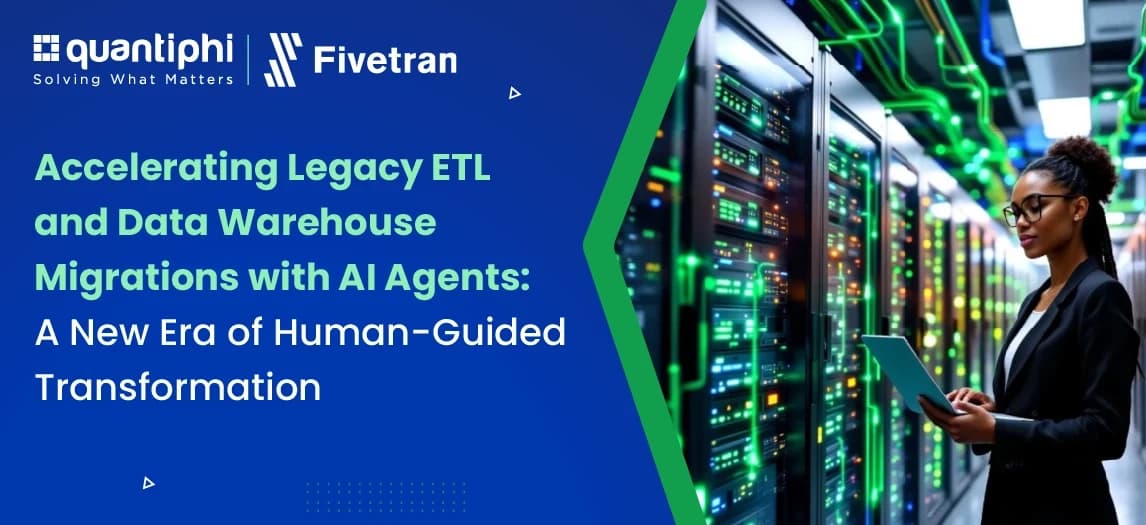
Legacy ETL (Extract, Transform, Load) and data warehouse systems have long served as the backbone of enterprise IT, preserving decades of business logic and proprietary data structures. However, as these systems near end-of-life, traditional migration methods—often requiring manual code rewrite by a dwindling pool of experts—are proving unsustainable.
While cloud modernization initiatives promise improved scalability and efficiency, they frequently introduce operational silos and security risks. Meanwhile, legacy ETL logic remains so intricate and opaque that manual code conversions can become expensive.
The urgent need is clear: an innovative, accelerated migration approach that retains business intelligence, ensures security, and minimizes costs.
The Challenge of Legacy ETL Migrations
For decades, organizations have struggled with migrating complex legacy ETL systems, which often contain:
- Proprietary, outdated code: Custom transformation logic and stored procedures written in niche languages understood by only a handful of experts.
- Error-prone manual rewrites: Introducing inconsistencies that can jeopardize data integrity.
- Security and compliance risks: Legacy systems pose increasing vulnerabilities as they near obsolescence.
- High financial costs: At $10–$20 per line, migration expenses quickly escalate to rapidly undermine business cases to modernize legacy ETL.
Without automation, enterprises miss the opportunity to leverage modern, cloud-native architectures that offer scalability, cost savings, and enhanced security.
What is an AI Agent?
An AI agent is an intelligent software system capable of autonomously performing tasks, making decisions, and learning from feedback within a specific context. In the realm of ETL migration, AI agents are often powered by large language models (LLMs) but go a step further—they combine the generative capabilities of LLMs with task-specific workflows, contextual awareness, and human oversight. While LLMs generate code or interpret logic, AI agents orchestrate this capability within a structured process, allowing for more accurate, secure, and efficient migrations.
The Promise of AI Agents in ETL Migration
AI agents are transforming enterprise data migrations by combining automation with human-guided insight. Unlike traditional migration tools, AI-powered agents:
- Accelerate Migration Timelines: Reducing multi-year projects to a matter of months.
- Cut Costs: Automation minimizes manual intervention, lowering labor expenses and reducing error remediation. Costs get significantly reduced by 80-90% and projects that took years now can get done in a few months.
- Ensure High-Fidelity Conversions: Human-in-the-loop oversight preserves critical business logic and mitigates the risks of deterministic automation.
- Enhance Security and Mitigate Risks: AI agents mitigate risks by ensuring compliance with defined security protocols and standards. When leveraging capabilities like Snowflake container services, we ensure data or IP is never exposed to the internet, where it’s safe.
This fusion of AI-driven automation with expert validation enables enterprises to execute seamless migrations while maintaining control over their intellectual property.
AI Agents vs. Traditional Code Converters
While traditional deterministic approaches rely on large language models (LLMs) to generate code, they often fail in critical areas:
- Lack of Context: Failing to fully capture the nuanced business logic embedded in legacy systems.
- Inconsistencies in Output: Struggling with proprietary constructs and edge cases, leading to unreliable conversions.
By contrast, human-guided AI agents employ an iterative approach:
- Continuous Learning and Refinement: Ongoing human feedback enhances accuracy over time.
- Contextual Awareness: Experts validate complex transformations, ensuring business rules are faithfully retained.
- Risk Mitigation: Combining automation with expert oversight reduces costly errors.
The Power of Multi-Agent Systems in Large-Scale Migrations
Given the sheer scale of legacy ETL systems, a single AI agent cannot effectively manage every aspect of migration. Instead, multi-agent AI systems optimize the process by:
- Task Specialization: Different agents focus on specific tasks, such as code translation, performance optimization, and error detection.
- Collaborative Problem-Solving: Agents share insights and coordinate efforts to ensure accurate migration.
- Scalability and Resilience: A distributed system structure accelerates migration while reducing error rates.
To achieve AI-driven productivity gains, enterprises need a migration framework that prioritizes security, compliance, and efficiency. This includes human-guided AI intelligence for preserving business rules, in-house processing to secure proprietary data, comprehensive data ownership with RBAC and audit logs, and a collaborative multi-agent system for managing complex migrations seamlessly.
Modernization Without Compromise: Impact on Industries
For highly regulated sectors such as banking, insurance, healthcare, and life sciences, legacy ETL systems form the backbone of mission-critical operations—from transaction processing and fraud detection to claims management, patient care, and clinical research. Migrating these systems through traditional methods introduces significant risks to compliance, data integrity, and business continuity. AI agents offer a transformative alternative, enabling secure, high-fidelity modernization while maintaining compliance with strict regulations. By combining automation with human oversight and in-house execution, AI-powered migration solutions empower these industries to modernize confidently, safeguard sensitive data, and accelerate innovation across their data ecosystems.
How Quantiphi and Fivetran Help Expedite Migrations?
Seamless data movement is the backbone of any successful ETL and data warehouse migration. Fivetran, an automated data movement platform, streamlines this process by enabling effortless data ingestion across systems. By automating traditionally time-consuming ETL tasks, Fivetran frees data engineers to focus on high-value initiatives such as optimizing pipelines and modernizing architectures.
Quantiphi drives seamless legacy system modernization through Codeaira, its AI-powered, human-guided agent. Designed to accelerate migration initiatives, Codeaira combines intelligent automation with expert oversight to ensure data integrity, security, and uninterrupted operations. By preserving business-critical logic, Codeaira significantly reduces migration projects’ complexity and duration, achieving acceleration of up to 70% for key tasks.
Codeaira supports modernization across a wide range of systems, including:
DataStage, Hive, Informatica, Mainframe, SAS, Azure Synapse, Control-M, MySQL, Oracle, SQL Server, Talend, Teradata, and Vertica.
Together, Quantiphi and Fivetran provide a comprehensive migration solution—automating data movement while ensuring precise, AI-driven transformation of legacy ETL logic. This partnership empowers enterprises to modernize their data infrastructure faster, more securely, and without the need for continuous team expansion, unlocking the full potential of cloud-first architectures.
Conclusion
Legacy ETL and data warehouse migrations are at a pivotal moment. The sheer complexity, cost, and risk of traditional manual approaches have made modernization an urgent yet daunting challenge for enterprises. AI-powered, human-guided agents are revolutionizing this landscape—enabling faster, more secure, and cost-effective migrations without sacrificing business-critical logic.
By combining Fivetran’s automated data movement with Quantiphi’s AI-driven Codeaira, enterprises can streamline migration efforts, ensuring smooth transitions to modern cloud architectures while maintaining full control over their data. This AI-first approach not only accelerates transformation but also sets the foundation for long-term scalability, efficiency, and innovation.
The future of data migration is here—are you ready to embrace it? Connect with our experts today to explore how AI can propel your ETL and data warehouse modernization journey.