Q‑Safe: A End-to-End Pharmacovigilance AI Automation Platform

Executive Summary
As the volume of adverse event (AE) reports grows exponentially, traditional pharmacovigilance (PV) workflows are buckling under the weight of manual data entry, fragmented systems, and delayed signal detection. This blog explores how Q-Safe Quantiphi’s generative AI-powered automation platform, modernizes the end-to-end PV lifecycle. By leveraging advanced large language models (LLMs), predictive analytics, and continuous learning (RLHF), Q-Safe completely automates complex bottlenecks like multilingual intake, causality scoring, and narrative drafting. The result? Organizations can reduce turnaround times by up to 80% and cut operational costs by 40%, freeing safety scientists from administrative gridlock so they can focus on their ultimate mission: proactively protecting patient safety.
The Problem: Safety Teams Are Drowning in Data
Every adverse event report tells a story, not just about drug safety, but about real people. PV teams carry the heavy responsibility of detecting, analyzing, and reporting those events to safeguard patients.
However, the sheer volume of data has surpassed what manual systems can handle. The FDA’s FAERS database currently holds over 30 million individual case reports, with more than a million new ones added annually. Despite this massive intake, the World Health Organization estimates that fewer than 10% of adverse drug reactions are ever reported.
Why Legacy Safety Workflows Are Breaking: According to recent industry surveys, 80% of PV professionals cite data integration as their greatest bottleneck. Even the most experienced teams struggle when faced with:
- Source Explosion: A single AE case can span PDFs, EHR extracts, emails, and social media, none of which share a consistent format.
- Manual Coding Bottlenecks: Coding free-text into MedDRA remains slow, labor-intensive, and error-prone, taking an average of 45 minutes per case.
- Delayed Signal Detection: Traditional systems rely on quarterly reviews and retrospective analyses, delaying vital interventions for emerging risks.
- Constant Regulatory Updates: Evolving regulations from the FDA, EMA, and PMDA leave teams scrambling to reconfigure legacy or homegrown tools.
The result? Highly trained safety scientists spend far too much time transcribing information, clicking through forms, and validating fields, instead of actually interpreting risk signals.
The Solution: Generative AI for End-to-End PV Automation
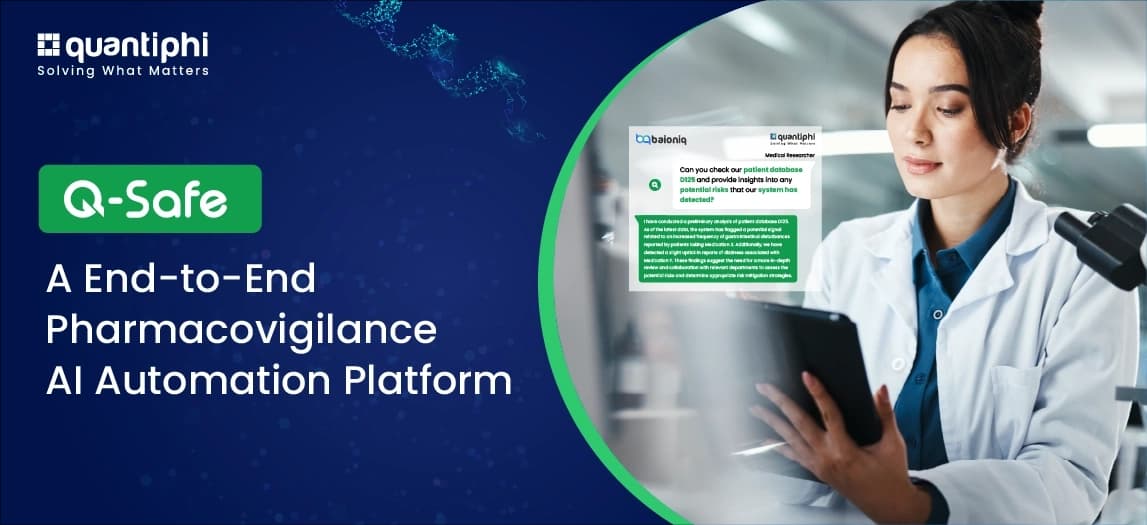
Q‑Safe is Quantiphi’s AI-native pharmacovigilance platform designed to help organizations boost patient safety while cutting operational costs by up to 40%. Built on advanced large language models (LLMs) and retrieval-augmented generation (RAG) workflows, Q‑Safe automates the detection, validation, and analysis of adverse events (AE).
Unlike legacy tools focused solely on literature surveillance, Q‑Safe manages the full intake ecosystem and integrates seamlessly with existing pharmacovigilance systems to let scientists focus on science, not administrative tasks.
How Q-Safe Transforms the PV Workflow:
- Multichannel Intake & Automated Detection: Q-Safe’s AI swiftly ingests structured and unstructured data from diverse sources, including PubMed, regulatory reports, EHRs, and social media. It also features multilingual article translation, automatically converting global articles into English for comprehensive analysis.
- Data Standardization & Quality Control: The platform automatically deduplicates cases, runs rigorous validation checks for data reliability, and integrates medical taxonomies to map terms directly to MedDRA.
- Causality & Severity Classification: Q‑Safe takes the guesswork out of triage by automatically assessing medical significance. It applies scoring across the Naranjo Algorithm, WHO-UMC scale, and CTCAE (Grades 1-5) to support fast, consistent evaluations.
- Narrative Drafting with RLHF: Generative AI drafts regulator-ready case narratives in minutes. Through Reinforcement Learning from Human Feedback (RLHF), the system continuously learns from reviewer edits to enhance accuracy and performance over time.
- Proactive Signal Management & Predictive Analytics: Moving beyond retrospective reviews, Q-Safe processes data in real-time. Its predictive analytics module identifies emerging safety risks before they escalate. High-severity cases are automatically routed to the right stakeholders via Role-Based Access Management, ensuring a critical “human-in-the-loop” for oversight.
- Automated Regulatory Submissions: Q-Safe streamlines case processing and submission workflows for global regulatory authorities like the FDA and EMA. By reducing manual reporting errors and standardizing exports (E2B, ArisG, Veeva), it accelerates compliance timelines without disrupting existing infrastructure.
A Reimagined Day in Pharmacovigilance
Before Q‑Safe: A senior safety scientist starts their day overwhelmed by a backlog of fragmented, unstructured data. They spend hours manually translating foreign medical literature, hunting for duplicate cases across emails and EHRs, and painstakingly mapping free-text narratives to MedDRA terms. Calculating causality and severity manually drains their time, leaving almost no room for actual risk analysis or strategic decision-making.
After Q‑Safe: The scientist logs into a personalized, role-based dashboard. Overnight, Q-Safe has automatically ingested, translated, and deduplicated global case reports. High-severity adverse events already pre-classified with CTCAE grades and Naranjo causality scores are instantly prioritized for review.
Generative AI has pre-drafted regulatory-ready narratives, which the scientist quickly refines and approves (with their edits instantly training the system to be even smarter via RLHF). Alerted by predictive analytics to a newly emerging safety signal, the scientist can spend the rest of their afternoon on high-value strategic work: conferring with R&D, updating risk management plans, and collaborating with the clinical team to proactively safeguard patient health.
Why Quantiphi
Quantiphi is an award-winning, AI-first digital engineering company driven by a mission to solve the most complex transformational challenges at the heart of business. For over a decade, we have been at the forefront of Healthcare and Life Sciences innovation, serving as a trusted partner to leading pharmaceutical and biopharma companies globally.
Our HCLS domain expertise spans the entire value chain from in-silico drug discovery and AI-augmented clinical trials to post-market surveillance and regulatory intelligence.
What sets Quantiphi apart in Life Sciences:
- Deep Industry & Technical Expertise: We combine disciplined cloud and data engineering with cutting-edge generative AI to deliver patient-centric solutions.
- Production-Grade Reliability: We don’t just build pilot programs; we repeatedly deliver governed, scalable AI solutions at a predictable unit cost.
- Global Compliance by Design: Every solution we deploy adheres strictly to global regulatory and data privacy standards, including GxP, HIPAA, GDPR, 21 CFR §314.80, and SOC 2.
- World-Class Ecosystem: As a premier, award-winning partner of Google Cloud, Microsoft Azure, AWS, and NVIDIA, we have successfully delivered over 2,500 enterprise-grade AI projects, helping life sciences organizations unlock the value of their data safely and responsibly.
We understand both the complex regulatory landscape of pharmacovigilance and the cutting-edge codebase required to transform it.
Ready to See Q‑Safe in Action?
Pharmacovigilance doesn’t need to be a patchwork of PDFs, spreadsheets, and missed signals. With Q‑Safe, safety teams start their day with clarity.
Run a Real-World Pilot: Deploy Q‑Safe on your safety data with our 4-week pilot offering. Quantiphi will scope, deploy, and benchmark performance—so you can evaluate results, not promises.
Book your pharmacovigilance assessmentDon’t Miss Our Webinar: Join us for a deep dive into how AI is transforming pharmacovigilance, and see Q‑Safe in action.
Watch HealthTech Qonversations