The Knowledge Bypass: Will the Human Bottleneck Burst the AI Bubble?

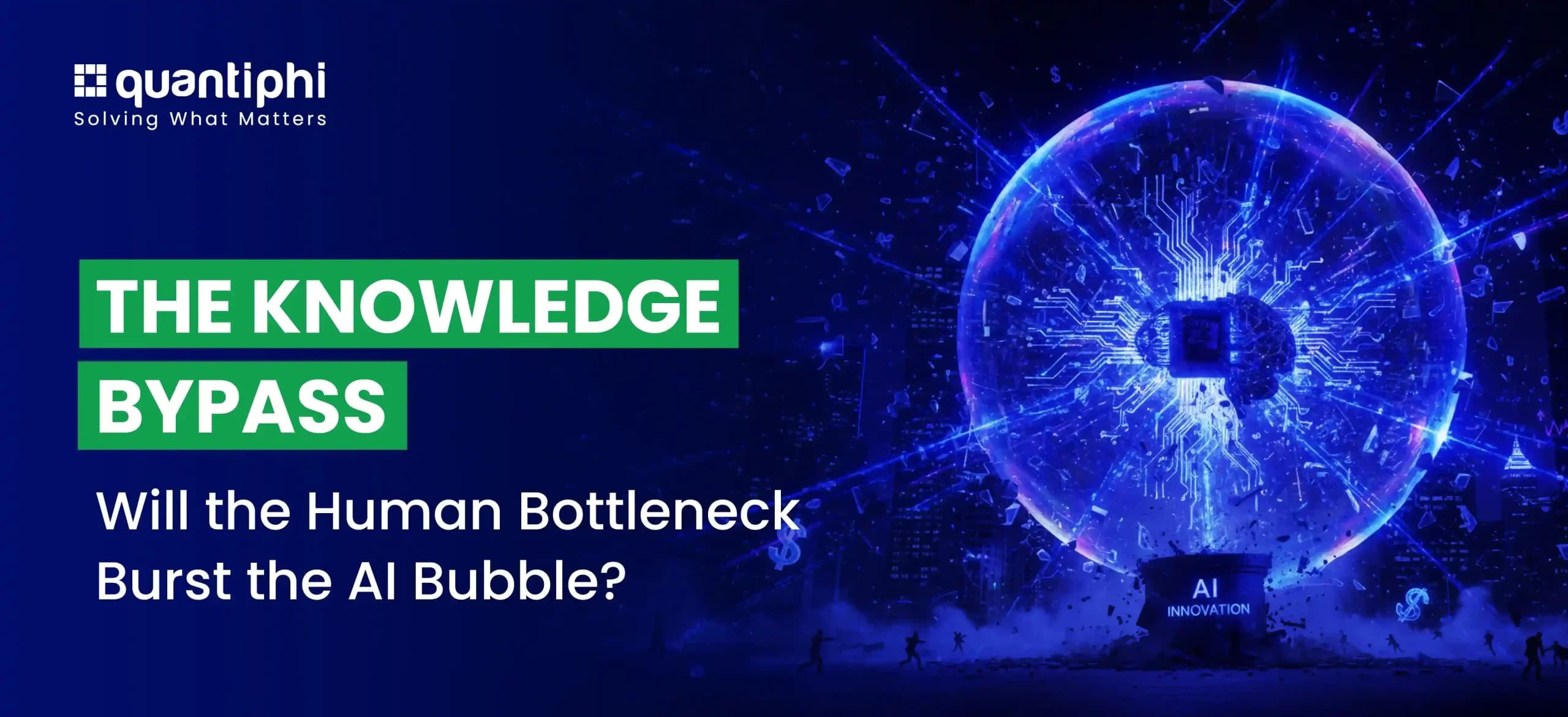
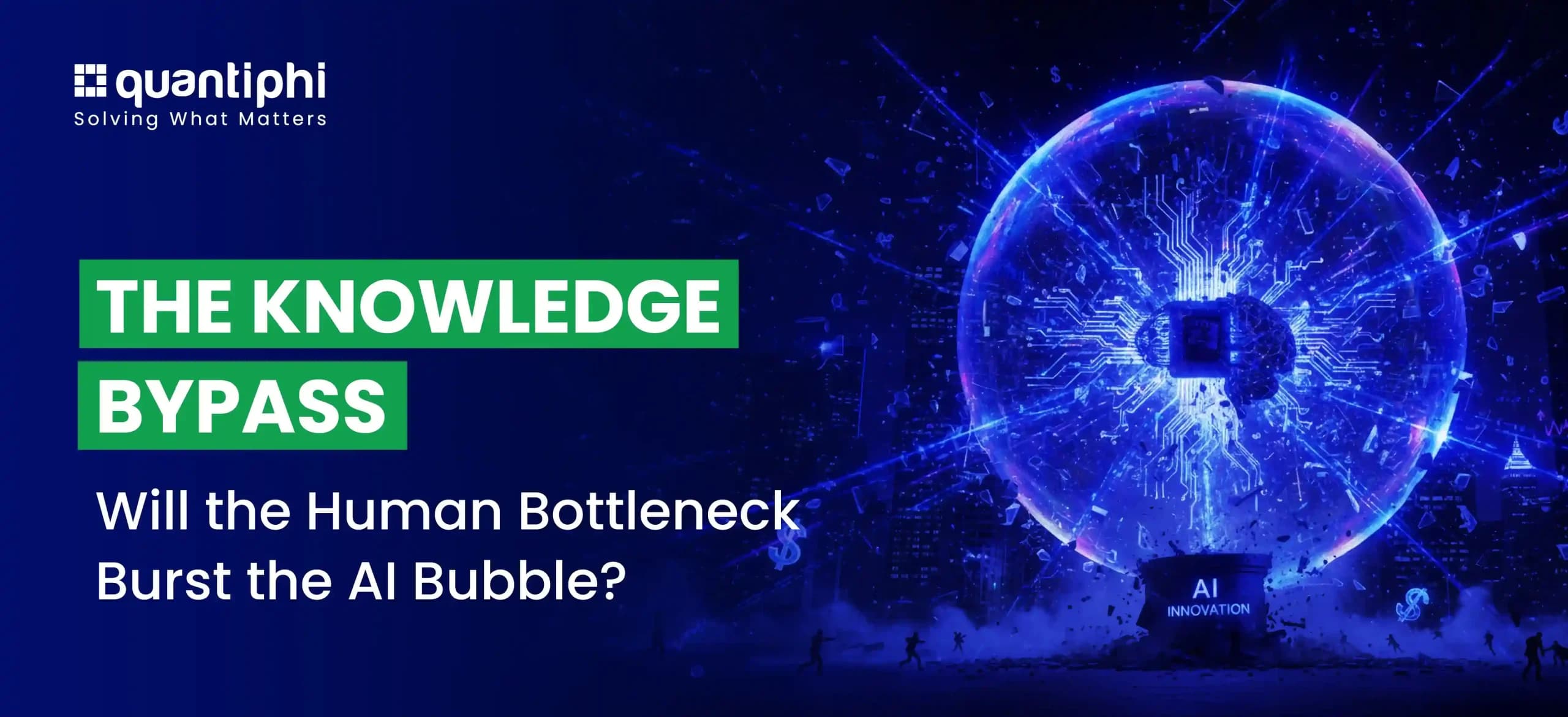
As we enter 2026, the AI economy faces a fundamental tension where exponential AI generation collides with linear human comprehension, shifting the source of the next market correction away from GPU supply constraints and toward the biological limits of human demand.
We are witnessing the greatest supply-side shock in the history of information. The marginal cost of generating text, code, and analysis has collapsed to near zero. But there’s a flaw in this equation: while we’ve uncorked the bottle of content generation, the neck of the bottle—the human brain—remains stubbornly narrow.
We are building a Ferrari-grade engine for multi-modal data generation and mounting it onto the far more modest chassis of human cognition. The result doesn’t have to be a breakdown, but it does require a fundamental shift in how we define value, effort, and trust.
Redefining Friction: The Taxonomy of Effort
There is a growing concern that AI is creating a “hollow workforce”—one that possesses the output of expertise without the intuition of experience. This fear is rooted in what can be called “soak time.”
Historically, the weeks spent compiling a report weren’t just cost; they were cognitive training. Wrestling with data built the mental models needed to defend the conclusions.
With GenAI, that same report arrives in 45 seconds. But when a VP asks a nuanced question in a strategy meeting, the analyst freezes. Why? Because the model did the thinking, not them. “Time saved” becomes “competence lost.”
To avoid this trap, we need to distinguish between two very different types of effort:
- Administrative Friction — low-value tasks like data formatting, transcription, syntax correction, and information retrieval.
- Cognitive Friction — high-value struggle: synthesizing viewpoints, forming narratives, pressure-testing logic, and identifying contradictions.
The future of the enterprise is not blanket automation. It’s the surgical removal of Administrative Friction while preserving the Cognitive Friction that actually builds expertise. We must shift employees from “compilers” to “architects,” ensuring they wrestle with the ideas rather than the documents.
The New Standard: Active Architecture and Iterative Loops
If the human mind is the bottleneck, workflows must adapt.
Today, most organizations are trapped in one of two failure modes:
- Blind Trust (Scalable Incompetence): Users treat AI as an oracle and assume outputs are correct. This leads to liabilities, as famously seen in Mata v. Avianca, where fabricated citations were submitted to a court.
- Exhaustive Auditing (The Compliance Tax): Users treat AI as a liability. Auditing a mediocre draft takes longer than writing from scratch, turning the tool into friction rather than acceleration.
The viable alternative is Iterative Co-Creation.
In this model, the human becomes an active director of intelligence. Instead of “request and receive,” the loop becomes “propose, critique, refine.” The user defines the constraints, evaluates the logic, and guides the system toward a stronger outcome.
This creates a cyborg workflow where the human stays embedded in problem-solving and retains the “Director’s Cut” understanding of the final output. Verification happens continuously, not after the fact.
The Evolution of Trust: From Predictors to Agents
For this new equation to work, the burden of verification must shift.
First-generation AI tools often feel like a Compliance Tax—users spend more time auditing outputs than they save. But this is changing rapidly as enterprises adopt Agentic Workflows.
Systems built on grounded architectures, such as Retrieval Augmented Generation (RAG), no longer guess. They show their work by citing internal sources, verifying calculations, and flagging uncertainties. This transition requires a fundamental shift in how leaders and teams’ reason with AI—moving from output validation to agentic thinking.
This shifts human responsibility from being a spell-checker to being a logic auditor. When the tool handles the “what” and “where,” the human can focus on the “why.”
In this world, the Compliance Tax becomes a Quality Dividend—teams can vet decisions with rigor previously impossible due to time constraints.
Strategic Enterprise Imperative
The AI bubble won’t burst, but the hype is undergoing a healthy correction. We are approaching a saturation point where the volume of AI-generated content could overwhelm the human capacity to use it. When the cost of filtering information exceeds the value of producing it, ROI collapses.
The limit isn’t silicon. It’s organizational design.
Realizing AI’s potential requires more than APIs; it requires restructuring how knowledge flows through a company. Leaders must aggressively eliminate Administrative Friction while fiercely protecting the Cognitive Friction that drives innovation.
This transformation cannot be outsourced to tools alone. It requires partners who can deliver outcomes—those who understand both the technical capabilities of Agentic AI workflows and the organizational dynamics that enable adoption.
The winners of the next decade won’t be the ones who simply deploy AI. They’ll be the ones who redesign the human systems around it, building a workforce that isn’t replaced by AI, but empowered by it.
To know more, get in touch.