AI WISE: The AI-Driven Workforce Intelligence & Scheduling Expert

The Unfolding Challenge of Workforce Scheduling
Getting the schedule wrong is expensive, and the bill lands in more than one place. Understaffing sends sales straight out the door: in a 2025 survey of U.S. retail associates, 77 percent said their store regularly loses sales because of poor scheduling or staffing decisions. Over-staffing is the opposite failure — payroll burned on hours the demand never justified. And the human cost compounds the financial one: in that same survey, 31 percent of frontline workers were actively considering quitting over poor scheduling or too few hours, with another 22 percent close to it — and each departure costs an estimated 50 to 200 percent of that employee’s annual salary to replace. Stepping back, the productivity drag of a disengaged, poorly-deployed workforce is staggering: Gallup puts the global cost of low engagement at $8.8 trillion, roughly 9 percent of global GDP. Good scheduling is not administrative housekeeping; it is a direct lever on revenue, cost and retention.
Yet it is deceptively simple to describe and genuinely hard to do well. For every employee and every interval of every day, someone has to decide who is working – while respecting a web of interacting rules: legal rest periods, maximum daily and weekly hours, mandatory breaks, the right skills on the floor, minimum coverage and a fair share of the unpopular shifts. The number of possible schedules explodes with the size of the team and the length of the plan.
Most organisations hit one of two walls. The first is the optimization wall: spreadsheets and rules of thumb – “add a person when it looks busy” – simply cannot weigh coverage, cost, rest, skills and fairness against one another and they offer no guarantee that the result is any good. The second is the accessibility wall: the tools that can optimize tend to demand specialists, rigid forms and configuration files, so the people who actually know the operation are shut out of the process. AI WISE was built to bring down both walls at once.
A Smarter Approach: Introducing AI WISE
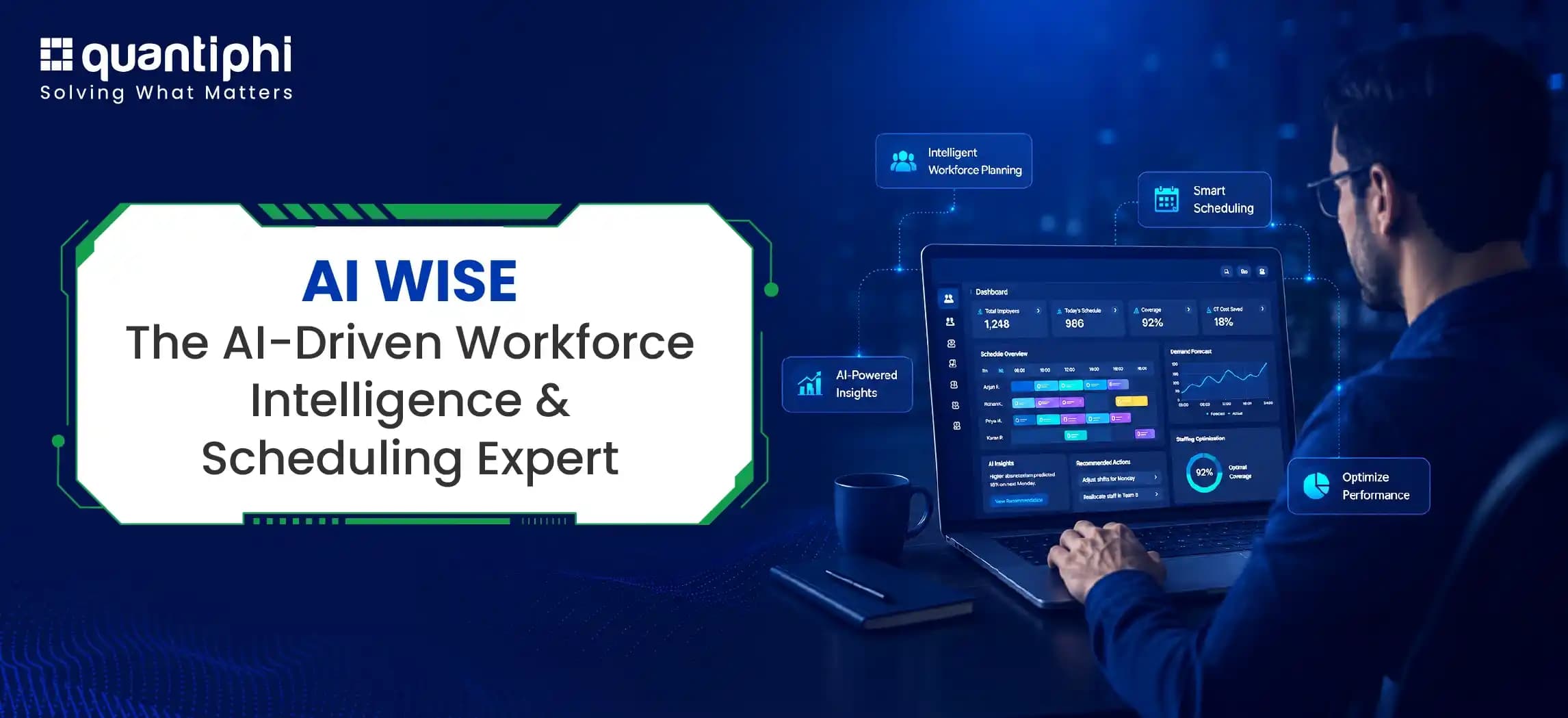
AI WISE – AI-driven Workforce Intelligence & Scheduling Expert – is a domain-agnostic scheduling platform built around a serious optimization engine, with an AI assistant as its primary interface. A planner describes the workforce and the rules in plain language; the platform produces a schedule that is demonstrably compliant, fair and cost-efficient and it explains the trade-offs it made along the way. Everything follows one clear operating model: Demand → Configuration → Optimization → Insight.
The platform establishes how much staff is required and when, lets the planner define the workforce and the rules in ordinary sentences, generates the best achievable schedule and presents the outcome with clear, explanatory metrics.
Our solution moves beyond conventional scheduling by addressing several long-standing pain points at once:
-
Plain-language control:
Rather than navigating settings screens, a planner states changes conversationally – “add two part-time cashiers with the checkout skill,” “ Emily is on leave Friday afternoon,” “set minimum rest between shifts to eleven hours.” The assistant interprets the request, updates the right record and asks for anything missing – so any planner is productive on day one, with near-zero training.
-
Provably optimal schedules:
Underneath the conversation is a proven constraint solver, Google OR-Tools CP-SAT. It selects the single best plan from an astronomically large space of possibilities and reports how close to optimal that plan is. This is the difference between producing a schedule and producing the best legally valid schedule.
-
Thirty-plus configurable rules:
The engine ships with a catalogue of more than thirty scheduling rules – rest gaps, hour limits, breaks, skills, coverage, stability and fairness – each individually toggleable. Because any rule can be switched on or off, the same engine reshapes to very different operations with no code change.
-
Explainable, never silent:
A penalty breakdown shows exactly which goals drove the final plan, so the optimizer’s reasoning is transparent and adjustable. And when the rules are collectively impossible to satisfy, the platform never fails silently: it diagnoses the specific blocker, relaxes the smallest necessary set of rules and reports precisely what it changed.
Crucially, it does not chase a single narrow objective. Instead, it balances three competing priorities simultaneously:
-
Operational Efficiency:
Minimising labour cost by aligning staffing precisely with demand, trimming over-staffing without ever dropping below the coverage floor.
-
Service Quality and Coverage:
Ensuring the right number of skilled people are present in the highest-demand periods, so service standards hold up when it matters most.
-
Employee Well-being:
Honouring stated preferences, distributing shifts fairly, keeping patterns stable and protecting rest and breaks – reducing burnout and improving retention.
The mechanism that makes this balance both safe and steerable is the split between hard and soft rules. Hard constraints – rest, hours, coverage floors, skills – are inviolable and guarantee a legally valid schedule. Soft goals carry weights and by adjusting those weights the business dials the trade-off between cost, service and fairness to match its own strategy.
Tangible Value Across Operations
Set against manual and rule-of-thumb scheduling, the shift is not incremental – it is a change in kind. Because the platform optimises every constraint together and proves how close to optimal it lands, the benefits compound across the operation:
- Lower labour cost from right-sizing staff to real demand rather than padding for safety.
- Improved service by concentrating skilled staff on the busiest periods.
- Higher retention through fairly distributed shifts, honoured preferences, stable patterns and protected rest.
- Compliance by construction, because rest, hour and break limits are hard constraints that a produced schedule simply cannot violate.
- Faster planning and full transparency, turning a task that took hours into a short guided session in which every trade-off is visible and adjustable.
Solution Spotlight: A Planning Session in Practice
The clearest way to see the difference is to follow a single planning session from start to finish. In practice it runs as a short, guided conversation.
Establishing Demand
A run begins from a demand forecast, which the platform shapes into two targets: an ideal staffing level for each time slot and a minimum coverage floor that must never be breached. Presented as a heatmap of days against time-of-day, the busy and quiet periods the schedule must accommodate become immediately legible. The platform is deliberately forecast-agnostic – the prediction can come from existing models or stack – so the optimization is decoupled from any single forecasting technique.
Configuring by Conversation
The planner then adds and edits staff, records leave and preferences and switches rules on or off – all in plain language. Each change is reflected in the underlying data straight away, so the platform’s state and the planner’s intent always agree. Nothing irreversible happens unprompted: before it solves, the assistant restates the settings that will be used and waits for explicit confirmation.
Solving and Reviewing the Schedule
On confirmation, the engine sizes its own computation time to the scale of the problem and typically returns within seconds to a few minutes. The result opens with headline indicators – coverage, utilization, hours, preferences honoured and stability – above the full schedule and a set of analytical views, including a coverage heatmap that marks comfortably-staffed periods in green and at-risk slots in red. Decision makers receive not a single rigid schedule but a transparent, tunable one they can adapt as priorities change.
Other Applications
The principles and the engine behind AI WISE are highly adaptable. Because the rules are toggleable and the planning granularity flexes from fifteen-minute blocks to full shifts, the same core serves any service-driven operation that runs on shift-based labour, including but not limited to:
- Retail: Aligning associates, cashiers and stockroom staff to customer footfall across peaks, quiet spells and seasonal swings.
- Healthcare: Matching clinical skills to fluctuating patient load while protecting mandatory rest and coverage.
- Contact Centres: Sizing agents to call volume by skill and language to keep wait times low without over-staffing.
- Logistics & Transportation: Covering throughput peaks for drivers, warehouse and dispatch teams without carrying idle headcount.
- Hospitality & Manufacturing: Staffing to occupancy, reservations or production targets across varied roles and shift patterns.
Why Quantiphi?
AI WISE reflects a simple conviction from Quantiphi’s Phi Labs: rigorous optimization and an accessible interface need not be mutually exclusive. By pairing a proven constraint solver with natural-language control and clear, explanatory metrics, we turn a difficult, time-consuming planning task into a short, transparent and repeatable process – and put that power in the hands of the people who run the operation, not just the specialists who build the models.
Partner with Quantiphi to unlock the full potential of your workforce and transform your operational efficiency. For a demonstration, a deeper technical discussion or to explore an industry-specific deployment, please contact the Phi Labs team: Vipul Patel (vipul.patel@quantiphi.com), Anirudh Deodhar (anirudh.deodhar@quantiphi.com) and Himabindu Thogaru (himabindu.thogaru@quantiphi.com).