EthiQ by Quantiphi: Pioneering Smarter, Simpler Responsible AI Deployment for Enterprises

Understanding the Importance of Responsible AI Impact Assessment
As industries like healthcare, finance, retail, government, and education increasingly rely on AI-driven decision-making, ensuring responsible implementation of AI is no longer an option—it’s a necessity. Organizations must integrate ethical considerations, governance frameworks, and stakeholder perspectives to proactively address challenges related to fairness, transparency, privacy, and accountability.
In a previous blog, we explored the fundamentals of Responsible AI Impact Assessment and how structured evaluation frameworks help organizations assess the potential effects of AI systems.
Also, the growing landscape of global AI regulations further underscores the need for robust assessments. Laws and frameworks such as the EU AI Act, OECD AI Principles, and NIST AI RMF emphasize proactive risk identification and mitigation to ensure AI systems align with ethical and regulatory standards.
Therefore to enable a systematic and scalable approach to Responsible AI impact assessment, we developed EthiQ—a tool that evaluates AI adoption through a comprehensive questionnaire, deeply aligned with Quantiphi’s Responsible AI principles and standards.
EthiQ helps organizations integrate responsible AI practices by providing structured risk analysis and ethical insights. By embedding it into the AI lifecycle, organizations can proactively address potential concerns, ensure compliance, and build trustworthy AI systems.
EthiQ: A Practical Tool to Simplify Responsible AI Deployment
EthiQ is a structured AI impact assessment tool that helps organizations efficiently assess and manage the risks of AI and machine learning (ML) projects. By automating the initiation and tracking of assessments, along with risk identification and scoring, EthiQ makes Responsible AI adoption more scalable, consistent, and actionable.
EthiQ ensures that all AI deals are systematically assessed by automatically triggering evaluations at the right stage. This structured approach removes the guesswork, standardizes the process, and provides clear, data-driven insights, enabling organizations to proactively manage AI risks and streamline compliance.
The EthiQ Framework
-
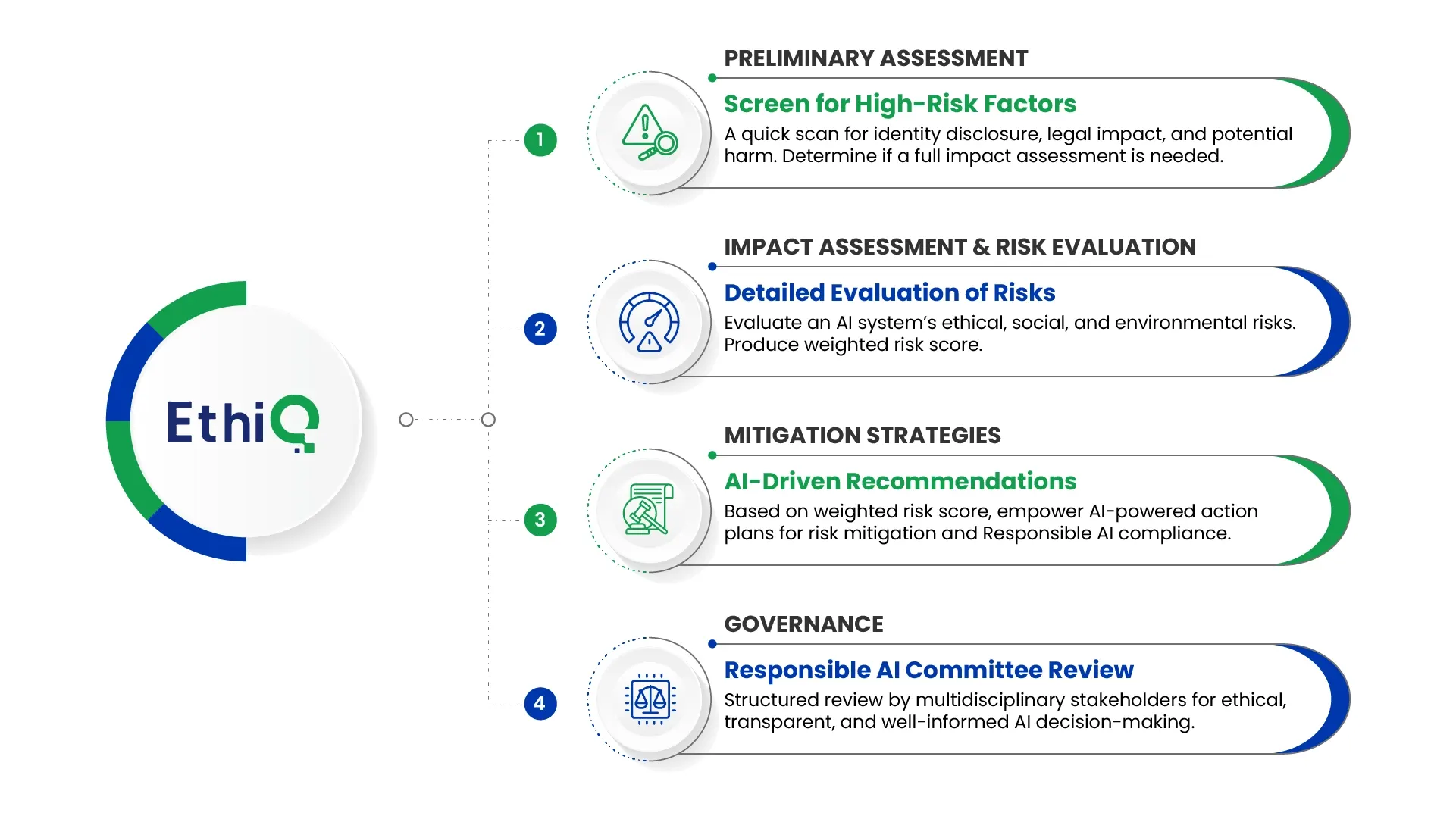
Preliminary Assessment – Sensitive Use Case Analysis
EthiQ conducts a Sensitive Use Case Analysis as part of the initial engagement phase. This preliminary assessment evaluates whether the AI system poses a potential risk under any of the four sensitive use case triggers:
-
Identity Disclosure – Risk of identifying individuals or groups through attributes like face detection, age, gender, race, rare diseases, or a combination of these factors.
-
Consequential Impact on Legal Position or Life Opportunities – Potential influence on legal rights, credit access, education, employment, healthcare, insurance, or social services, as seen in use cases like loan approvals or hiring algorithms.
-
Risk of Physical or Psychological Injury – Possibility of harm due to misinterpretation of AI outcomes or privacy data leaks.
-
Threat to Human Rights – Any restriction or infringement on fundamental rights, given AI’s ability to impact nearly every recognized human right.
Based on the submitted responses to the above triggers, if no risk is detected, the process concludes. However, if any response raises ethical concerns, the project is automatically escalated to a comprehensive assessment to further evaluate its ethical and operational implications.
-
-
Impact Assessment & Risk Evaluation
Once a project is flagged as sensitive during the Preliminary Assessment, it undergoes a comprehensive Impact Assessment, which systematically evaluates for potential risks across Quantiphi’s Responsible AI principles. This assessment examines the following aspects of the project:
- Security & Privacy – Assesses the origin, ownership, and sensitivity of the data used by the AI system. Understanding who controls the data and whether it contains personally identifiable information (PII) or protected health information (PHI) is crucial for managing privacy risks and compliance with data protection regulations.
- Transparency & Explainability – Evaluates whether the AI system’s decisions are understandable and accessible to users, ensuring stakeholders can trust and interpret its outcomes.
- Fairness – This section assesses potential risks related to biased outcomes in AI systems. It identifies disparities that may arise from skewed or incomplete data, algorithmic biases, or systemic inequities. The assessment helps uncover risks such as unfair treatment of certain user groups, unintended discrimination, and reinforcement of societal biases.
- Safety, Robustness & Reliability – Assesses the AI system’s ability to operate securely and consistently under varying conditions. This includes evaluating its resilience to adversarial attacks, potential failure points, and overall dependability to ensure safe and reliable performance across its lifecycle.
- Human Centricity – Explores the level of human involvement in the AI system’s decision-making process, assessing how automation is balanced with human oversight. It’s important to prevent automation risks by determining the extent to which humans control, oversee, or interact with the AI system, ensuring appropriate checks, balances, and accountability.
- Governance & Accountability – Ensures mechanisms are in place for monitoring, controlling, and auditing the AI system to prevent negative impacts and ensure accountability by enabling compliance with regulations, ethical oversight, and traceability of AI decision-making
For each section outlined above, the assessment taker must submit their responses. EthiQ then analyzes the submitted responses across all sections of the assessment, assigns a risk score, and generates a risk report that categorizes projects as low, medium, or high risk. This classification is essential in determining the next steps:
- Low-risk projects pose minimal ethical or operational concerns, and are cleared for progression without additional oversight. While no immediate intervention is required, proactive monitoring and adherence to best practices are encouraged to maintain compliance.
- Medium or high-risk projects necessitate immediate mitigation planning, requiring project teams to propose strategies that address identified concerns.
-
Mitigation Strategies
To enhance the risk mitigation process, EthiQ leverages Generative AI (GenAI) to support teams in identifying and addressing ethical challenges within their projects. By integrating AI-driven insights with human expertise, EthiQ ensures a comprehensive and structured approach to risk management:
-
Machine-Generated Mitigation Strategies
When a potential risk is flagged, EthiQ’s embedded LLM-powered module provides contextualized recommendations, helping teams refine their mitigation strategies. The AI-driven insights guide assessment takers in crafting effective responses to ethical concerns, ensuring risks are addressed proactively and efficiently. -
Structured Mitigation Strategies by Project Teams
Building on AI-generated recommendations, project teams develop structured action plans tailored to their specific contexts. These mitigation strategies are then submitted to the Responsible AI (RAI) committee for review, ensuring alignment with ethical principles and organizational policies. This structured approach fosters accountability and strengthens overall risk management efforts.
-
-
Governance & Decision-Making – Oversight by the Responsible AI Committee
For AI projects flagged as medium or high risk, EthiQ escalates the assessment results to the multidisciplinary Responsible AI (RAI) Committee for further review. This governance mechanism ensures that AI projects adhere to internal policies, regulatory requirements, and ethical AI principles before they are deployed.
Upon receiving a flagged AI project, the RAI Committee members provide individual expert comments and recommendations. These comments guide further decision-making and may suggest modifications to the AI system, improvements in transparency, or stricter compliance measures.
Following this, an internal deliberation process is conducted, where committee members engage in structured discussions regarding the assessment findings and proposed mitigation strategies. Based on these discussions, the committee reaches one of three possible decisions:
- Approval – The AI project is deemed compliant with Responsible AI guidelines and is cleared for development.
- Approval with Conditions – The project can proceed, but specific conditions or safeguards must be implemented to mitigate potential risks.
- Rejection – The AI project is not approved due to significant unresolved ethical concerns, requiring further modifications or justifications before reconsideration. In the case of rejection, the committee documents the explicit reasons and compliance gaps preventing the project from moving forward. The deal remains on hold until the necessary changes are made and re-evaluated.
Conclusion
EthiQ is built on a foundation of transparency, accountability, and continuous refinement, making it a powerful enabler of Responsible AI. By streamlining risk assessment, automating mitigation strategies, and ensuring governance oversight, it transforms ethical AI development from a challenge into a structured, actionable process.
With real-time feedback mechanisms, structured dashboards for clear oversight, and automated monitoring systems, EthiQ fosters trust, compliance, and long-term sustainability. By continuously evolving through user insights and proactive governance, EthiQ sets a high standard for ethical AI development, reflecting Quantiphi’s commitment to advancing Responsible AI.