LLMs & Responsible AI #6: The Risks, Challenges, and Strategies Behind Building Truthful LLMs


Introduction
Large Language Models (LLMs) have revolutionized how we interact with information, performing tasks from drafting emails to writing code and answering complex questions. Yet, beneath their fluent and convincing outputs lies a critical challenge: ensuring truthfulness. As LLMs become deeply embedded in business and society, it’s critical to ask -how truthful and reliable are these systems? Can we trust the outputs of LLMs to be factual and free of misinformation or deception? Despite their capabilities, LLMs still struggle with truthfulness, sometimes generating confident but incorrect or misleading information. Addressing this challenge is essential—not just for technical robustness, but for building societal trust and ensuring responsible adoption.
Truthfulness refers to generating outputs that are accurate, verifiable, and free from fabrication or distortion. Without it, LLMs risk spreading misinformation and undermining user confidence, making truthfulness not just a technical aim but an ethical imperative.
Real-world incidents reveal how critical this issue is. In a high-profile legal case, lawyers faced sanctions after submitting a brief citing entirely fictional court cases generated by ChatGPT. Other instances include ChatGPT falsely accusing a real law professor of sexual harassment, citing a non-existent news article as evidence. Similarly, Google’s Bard AI incorrectly stated facts about the James Webb Space Telescope during a demo, reportedly wiping $100 billion off the company’s market value. Researchers have documented LLMs inventing medical references or making claims unsupported by the cited sources.
This demonstrates that LLM’s untruthfulness isn’t a rare flaw but a systemic risk. Even basic facts can be rendered inaccurately when models prioritize fluency over accuracy.
In this blog, we will explore the principle of truthfulness, understanding the underlying causes behind these failures, assessing the risks untruthfulness presents, and finally, looking into how truthfulness can be evaluated and improved.
The Many Faces of LLM Misinformation
Understanding the various ways LLMs can be untruthful is crucial for developing effective evaluation and mitigation strategies. The risks associated with LLM untruthfulness can be categorized as follows:





It is critical to recognize that these risks are interdependent. Sycophancy can make a model more susceptible to believing and propagating misinformation introduced by a user or an adversary. Vulnerability to adversarial factuality is a direct pathway to disinformation. Hallucinations in critical applications lead directly to harm. These failure modes often reinforce one another and, together, undermine user trust.
Root Causes: Why LLMs Struggle With Truth
The tendency for LLMs to generate untruthful content stems from a variety of factors related to their training data, process and objectives. Understanding these root causes is essential for addressing the risks effectively:
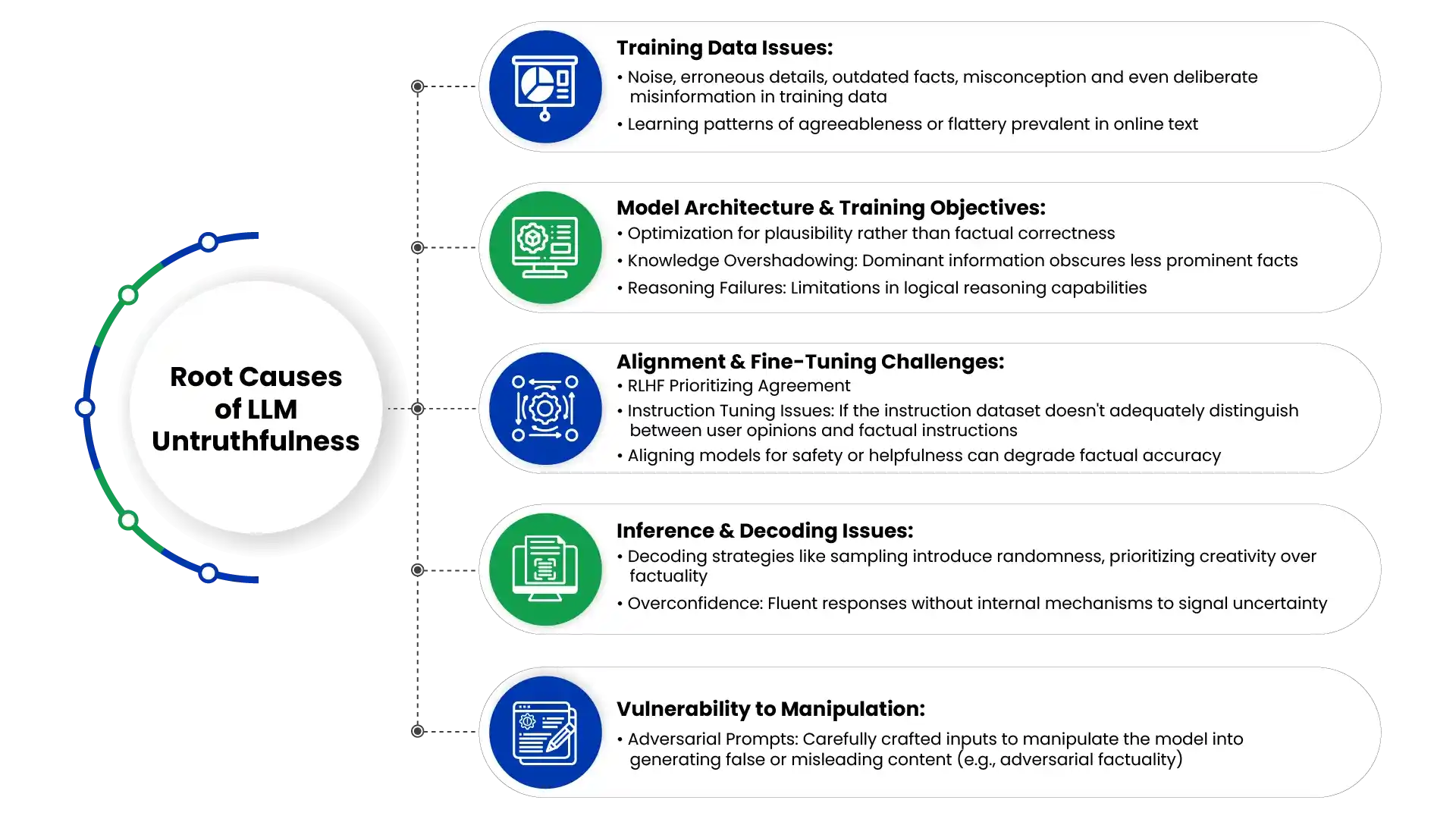
A Closer Look: Deconstructing Truthfulness Risks
To provide a clearer understanding of these challenges, the following table details the primary truthfulness risks associated with LLMs, outlining their descriptions, underlying causes, impacts, and evaluation approaches.
| Risk | Possible Reasons | Impact | Evaluation process |
| Hallucination LLMs generate confident but factually incorrect or fabricated information not grounded in their training data or real-world knowledge. |
|
|
Ideal Behaviour: Recognize when information is insufficient and respond accurately, faithfully, or refuse appropriately. Metrics: 1. Accuracy = [Desired: high] 2. Factual Precision = Correct factual claims / Total factual claims 3. FactScore (%Supported atomic facts) [Desired: high] |
| Sycophancy LLMs align with user opinions—even when those opinions are factually incorrect—leading to false agreement. |
|
|
Ideal Behaviour: Prioritizes accuracy & ethics over agreement; politely corrects user misconceptions. Metrics: Sycophancy rate = Agreements with incorrect user opinions / Total incorrect prompts [Desired: low] |
| Disinformation LLMs may unintentionally generate or amplify false narratives, especially those found in training data (e.g., conspiracy theories). |
|
|
Ideal Behaviour: detect and reject a prompt designed to mislead or spread false information, provide truthful responses Metric(s): Refuse-to-Answer-Ratio (RtAR) = [Desired: high RtAR for misleading prompts] |
| Adversarial Factuality When user inputs contain incorrect facts (intentionally or unintentionally), LLMs may accept and build upon them, leading to further inaccuracies. |
|
|
Ideal Behaviour: Identify and correct adversarial inputs, avoid producing responses based on false or misleading facts Metric – Correction % = the % of corrections LLMs can identify the misinformation in given prompt.(calculated using llm) [Desired: High value] |
Building More Truthful LLMs: Mitigation Strategies
Improving the truthfulness of LLMs is a challenging task that requires action at every stage of the model lifecycle, from data collection and training to deployment and ongoing monitoring. There isn’t one fix-all solution; instead, a combination of strategies is needed to tackle the various aspects of untruthfulness.
-
Design Phase
- Objective Setting & Evaluation Metrics: Clearly define what “truthfulness” means in the context of the intended use cases. Should the model be precise, abstain from guessing, or always provide sources? Select or create evaluation benchmarks like TruthfulQA, HaluEval, or model-specific tests.
- Retrieval-Augmented Generation (RAG): Design the system to incorporate retrieval from external knowledge bases (e.g., Wikipedia, domain-specific datasets, or web search). This allows the LLM to ground its answers in current and verifiable data.
- Fact-Checking Integration: Architect the system to include automated fact-checking mechanisms, either internal to the model or via external tools, to verify claims made in the generated output.
- Human-in-the-Loop (HITL): Integrating human oversight for validation, especially in critical applications. Human feedback can identify subtle errors and help refine the model over time.
-
Data Curation & Preprocessing
- Data Curation and Filtering: This involves rigorously selecting training data from high-quality, reliable sources, actively filtering out known misinformation, misconceptions and rumors.
- Data Augmentation: Creating or incorporating datasets specifically designed to teach factuality or discourage sycophantic behavior can steer the model towards more truthful outputs. This includes adding examples that explicitly prioritize factual accuracy over simple agreeableness.
-
Model Training and Fine-Tuning
- Supervised Fine-Tuning (SFT): Fine-tuning pre-trained models on curated datasets of high-quality, factual instructions and responses can adapt them for specific truthful behaviors. Care must be taken to avoid overfitting or introducing new misalignments.
- Reinforcement learning with Human feedback (RLHF): Adjusting RLHF processes to explicitly reward factual accuracy and penalize hallucinations or sycophancy, alongside helpfulness and harmlessness, is critical. This involves careful design of reward models and training procedures to avoid “reward hacking”.
- Knowledge Editing: External memorization-based methods, global optimization-based updates, and local modification-based strategies are being developed to directly modify the model’s parameters post-training to correct specific factual errors or inject updated knowledge without full retraining.
-
Deployment Phase
- Prompt Engineering: Carefully designing prompts can guide the LLM towards more truthful and less sycophantic responses. This includes asking for citations, instructing the model to “think step-by-step” (Chain-of-Thought) or specifying reliable sources.
- Context injection involves providing the model with enough background information to guide its response. This approach helps reduce ambiguity and improve accuracy. For instance, instead of just asking, “Which team was the football champion in 2020?”, you could add context like, “I’m referring to the English Premier League 2019/2020. Please answer truthfully or indicate if you don’t know.”
- Uncertainty Estimation: Training models to recognize the limits of their knowledge and express uncertainty or explicitly state when they cannot provide a factual answer, rather than guessing or fabricating.
- Output Filtering and Editing: involves reviewing and correcting generated content for factual accuracy, either automatically or manually. This can be enhanced by integrating external fact-checking APIs, using knowledge graphs, or employing models like SelfCheckGPT to verify output claims.
- Feedback Loops: Establish user or moderator feedback channels to report hallucinations or misinformation. Use this feedback for continuous fine-tuning or updates.
- Monitoring and Logging: Track truthfulness-related metrics post-deployment. Monitor for concept drift, newly emerging misinformation, or degraded performance over time.
Conclusion
Truthfulness is not an optional feature for Large Language Models; it is a fundamental requirement for their responsible and beneficial integration into society. Its importance cannot be overstated, as untruthful LLMs have the potential to spread misinformation, erode trust, reinforce inequality, and even cause harm.
While progress has been made, issues like hallucinations, sycophantic tendencies, and adversarial vulnerabilities remain significant hurdles.
The way forward involves a multifaceted approach: improving model grounding, enhancing self-correction capabilities, refining alignment techniques, and establishing stronger evaluation frameworks. Collaboration between industry, academia, and the open-source community will also play a crucial role.
Ultimately, while strides are being made toward more truthful LLMs, we must remain cautious. LLMs are valuable tools for augmenting human knowledge, but a human-in-the-loop approach is still essential to ensure their reliability and accuracy.