From Experiments to Enterprise Scale: Multi-Agent Systems on Amazon Bedrock AgentCore, Governed by Quantiphi Agent Manager

Key Takeways:
The enterprise AI conversation has evolved from building individual agents to orchestrating hundreds as a coordinated system. This blog explores the production architecture of multi-agent systems on AWS, covering key collaboration patterns, the managed runtime capabilities of Amazon Bedrock AgentCore, and how Quantiphi’s Agent Manager provides centralized governance, policy enforcement, onboarding, and cost visibility across the agent ecosystem.
By the end of this blog, you’ll have a clear view of the four collaboration patterns shaping production designs today, review a real-world fleet-operations case study that improved approval accuracy and compliance, and gain a practical 6 – 8 weeks roadmap for scaling a high-value workflow from pilot to enterprise deployment.
The Single-Agent Ceiling: Why Enterprises Are Hitting a Wall
Most enterprises started their generative-AI journey with a single, monolithic assistant — one large model, one prompt, one tool. It worked beautifully for demos. It quietly failed at scale. Three patterns keep showing up in the field:
-
Brittle reasoning
A single agent juggling many tools loses focus, hallucinates intermediate steps, and degrades as workflows grow longer.
-
Tool sprawl
Every team integrates the same systems (CRM, ERP, ticketing, KBs) in slightly different ways — no shared catalogue, no shared trust boundary.
-
Governance gap
Logs, prompts, and costs sit in three different places. Risk and compliance teams have no single pane of glass to ask “what did our agents do today, and was it allowed?”
The market signal is unambiguous:
- 78% of enterprises use GenAI in at least one function McKinsey, State of AI 2024
- 30% of agentic-AI POCs will be abandoned by 2027 Gartner, 2024
- 60% will fail data-governance reviews by 2027 without a control plane Gartner, 2024
The CXO question we keep hearing — “We have ten copilots in production. None of them talk to each other. How do we move from a fleet of toys to one coordinated digital workforce — without rewriting everything?”
The fix is not a smarter single model. It is a different architectural unit — the multi-agent system — paired with an enterprise control plane that makes it safe to run.
What Multi-Agent Systems Actually Are — and Why Now
A multi-agent system is a small team of specialised agents — each with a defined role, a scoped toolset, and its own working memory — coordinated by an orchestrator that decomposes a goal, routes work, gathers evidence, and produces a single answer or action. It looks less like a chatbot and more like a well-run operations team.
Three properties separate it from a single-agent assistant — and they are what make the difference between a demo and a deployed system.
- Specialisation. Each agent owns a narrow domain — policy, pricing, warranty, drafting — with only the tools, data, and prompts relevant to it. Specialisation reduces hallucination, simplifies evaluation, and makes ownership obvious.
- Coordination. Agents communicate through structured protocols — discover capabilities, delegate a task, return an artefact — not free-form chat. Structured handoffs are what make a workflow reproducible, debuggable, and safe.
- Governance. The system is governed at the team level: shared identity, shared guardrails, shared observability, shared cost ceilings, and explicit human-in-the-loop checkpoints. Governance is the substrate, not an afterthought.
Why now
Three forces have made this practical in the last twelve months:
- Models matured — Frontier models can now plan and self-correct over long horizons. Anthropic’s Claude Sonnet 4.5 reports 90.2% on SWE-Bench Verified with 15× longer agentic tool-use; AWS Strands SDK reports >0.95 task-success on multi-step orchestration benchmarks.
- Protocols crystallised — Open standards have closed the integration gap. Model Context Protocol (MCP) gives every agent a uniform way to discover and call tools. Agent-to-Agent (A2A) protocols give them a uniform way to discover and delegate to each other.
- Infrastructure landed – AWS shipped a managed runtime — Amazon Bedrock AgentCore provides the managed runtime, memory, identity, gateway, browser, and observability stack purpose-built for agents. It removed the heaviest piece of glue code teams were writing.
How Multi-Agent Systems Actually Coordinate
Picking the right collaboration pattern matters more than picking the right framework. Most enterprise designs are a combination of four — and the trade-off between control, latency, and autonomy is the design conversation that should happen before any code is written.
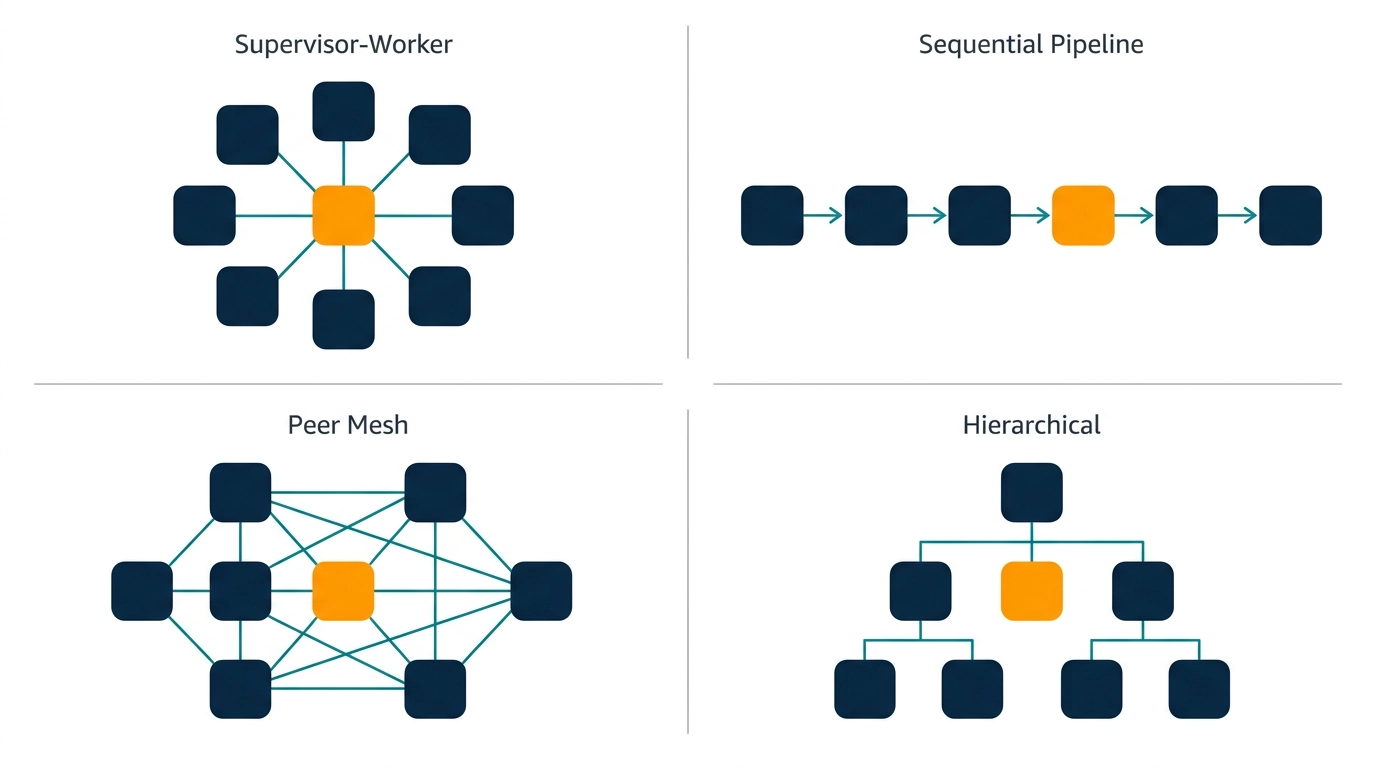
Figure 1: Four collaboration patterns: supervisor–worker, sequential, peer mesh, hierarchical.
| Pattern | When to use | Trade-off to manage | Real World Example |
| Supervisor–Worker | One coordinator decomposes a goal and routes sub-tasks to specialists. Best default. | Supervisor becomes the bottleneck if not bounded by timeouts and cost caps. | Claims supervisor routes to policy, fraud, and pricing agents. |
| Sequential Pipeline | Output of one agent strictly feeds the next. Deterministic, easy to govern. | Less flexible when inputs are noisy or steps need to be skipped. | Intake → enrichment → drafting → review for an underwriting workflow. |
| Peer Mesh (A2A) | Agents negotiate directly, no central boss. Powerful, harder to control. | Hardest to govern and cost-bound; needs strong observability and circuit breakers. | Supply-chain agents bidding on freight slots in real time. |
| Hierarchical Teams | Supervisors of supervisors. Use when the workflow itself is nested. | Needs a clear contract between layers or accountability blurs. | A research division agent overseeing marketing, technical, and legal sub-supervisors. |
The dominant production shape today — Supervisor–worker, with a sequential pipeline inside the workers, and selective A2A for research-style sub-problems. It gives the auditability enterprises need while preserving the flexibility that makes agents useful in the first place.
Amazon Bedrock AgentCore — The Substrate Production Agents Need
Amazon Bedrock AgentCore is the managed runtime for production agents on AWS. It is opinionated about the parts of an agent system that should not be rebuilt every project — memory, identity, tool access, observability — and unopinionated about the framework on top. You can run agents authored in Strands, LangGraph, CrewAI, AutoGen, or your own code on the same runtime.
The point is leverage. Teams that build directly on AgentCore stop spending sprints on session state, IAM plumbing, and trace plumbing — and start spending them on what is actually differentiated: the prompts, the tools, and the workflow.
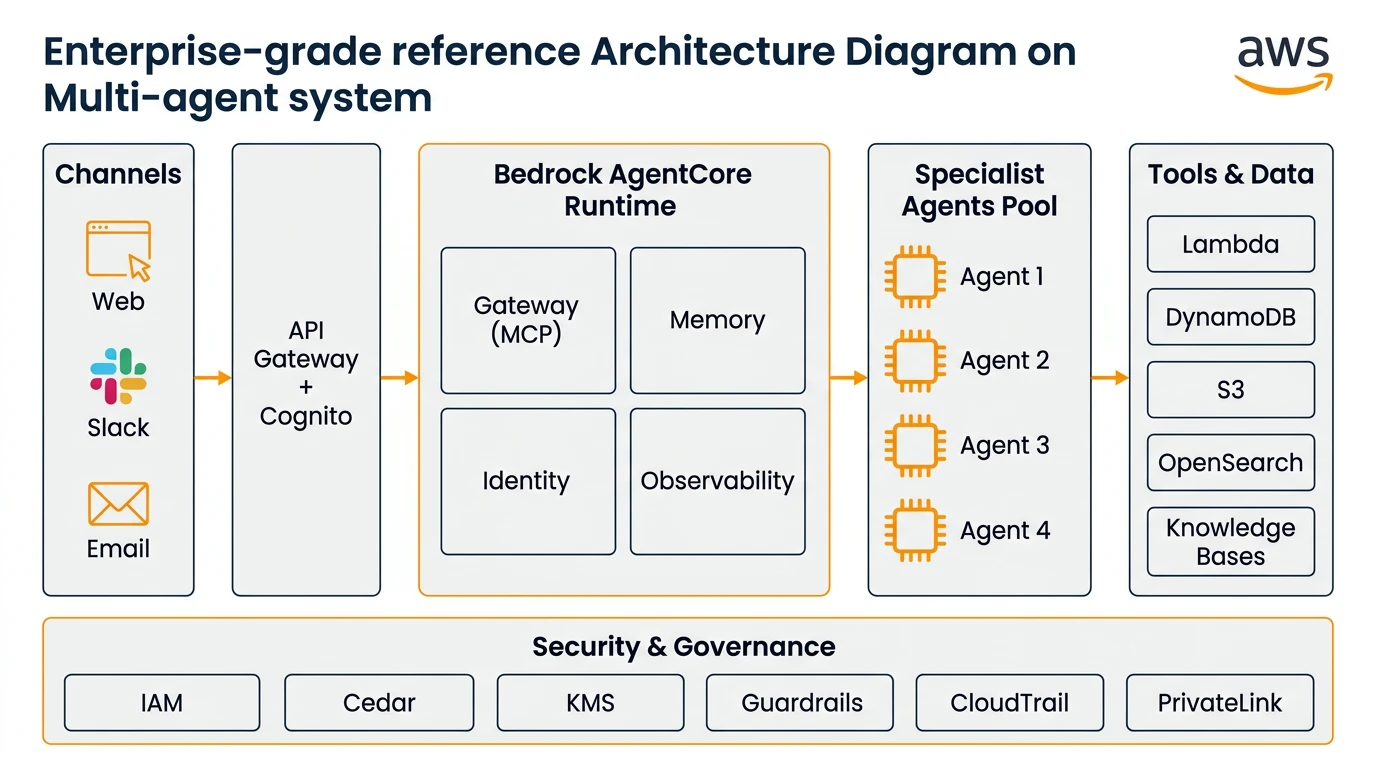
Figure 2 — Reference architecture: channels → API GW → AgentCore Runtime / Gateway / Memory / Identity / Observability
| AgentCore primitive | What it solves |
| Runtime | Managed, secure, low-latency execution for any agent framework — Strands, LangGraph, CrewAI, AutoGen, custom. |
| Memory | Short-term and long-term memory with semantic recall — eliminates bespoke vector-store plumbing per agent. |
| Gateway (MCP) | One front door to every tool and API your agents are allowed to use, with IAM, throttling, and logging built in. |
| Identity | Lets agents act as themselves or on behalf of a user, with scoped, short-lived credentials issued at call time. |
| Browser & Code Interpreter | Sandboxed web browsing and code execution — so agents do real work, not just chat. |
| Observability | OpenTelemetry traces, token-level cost, prompt and response capture — wired into Amazon CloudWatch. |
The architect’s view — pair these primitives with the wider AWS catalogue (Bedrock Guardrails, IAM, KMS, PrivateLink, Cedar, Lambda, API Gateway, Step Functions, EventBridge, OpenSearch Serverless, DynamoDB) and you have everything needed to host agents securely. But you do not yet have everything needed to operate them as a fleet. That is the gap Quantiphi closes.
Quantiphi Agent Manager — an AWS-native Control Plane
Amazon Bedrock AgentCore gives you world-class building blocks. Most enterprises, however, end up with a second problem after the first agent ships: dozens of agents from different teams, on different frameworks, calling overlapping tools, with no unified way to onboard, orchestrate, govern, or observe them.
The Quantiphi Agent Manager is an AWS-native control plane built precisely for that scale problem.
Built on AWS, Agent Manager extends the AWS foundation rather than replacing it. It provides the structure required to manage agents as enterprise systems, not as isolated experiments.
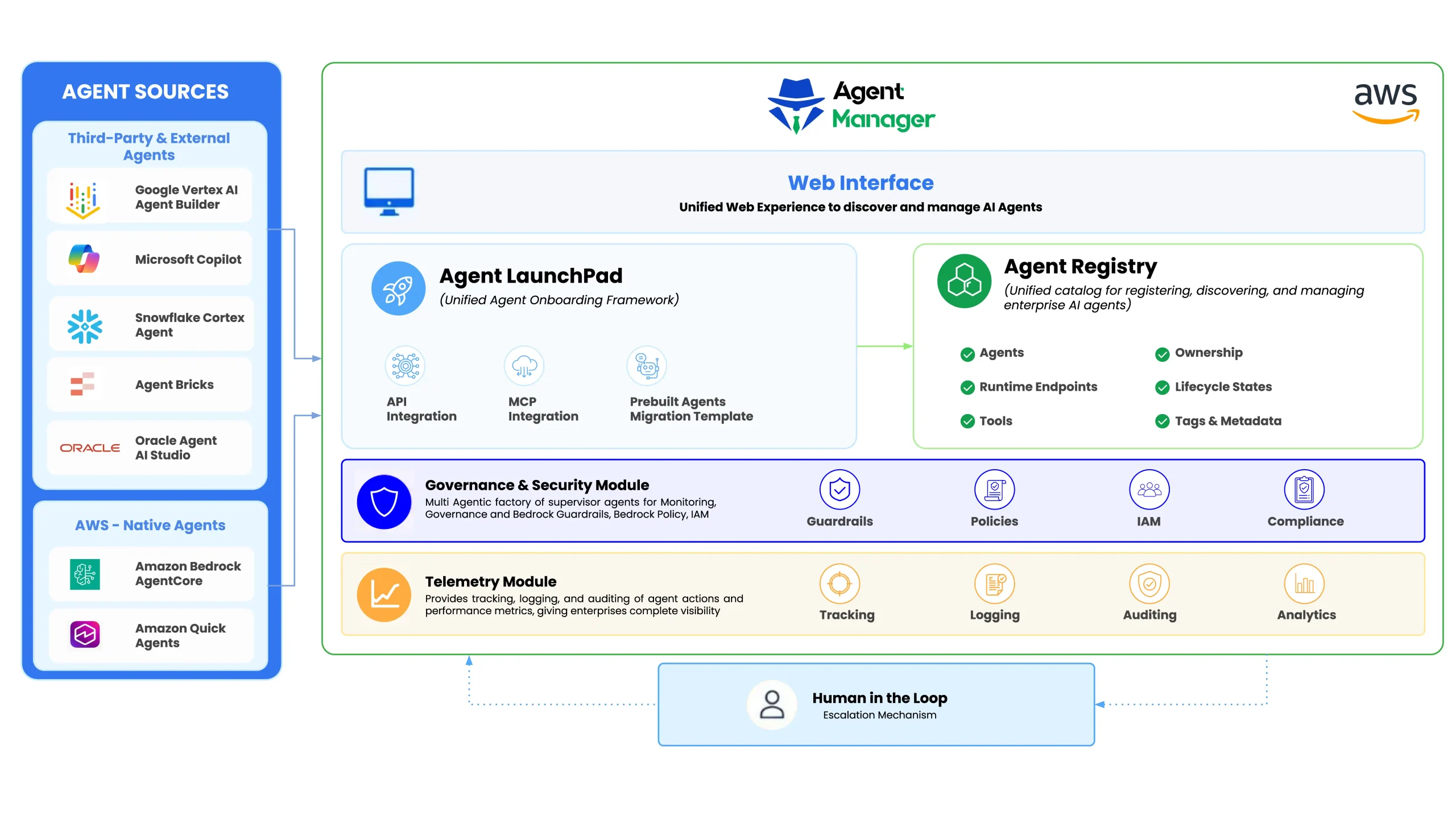
Figure 3 — The Agent Manager: a control plane sitting on the AWS substrate.
What Agent Manager provides:
-
Deployed inside your AWS Account
Runs natively in your own AWS environment — behind your VPC, firewalls and Guardrails.
-
Unified onboarding & interoperability
Onboard agents built on Amazon Bedrock AgentCore, Amazon Quick, third-party frameworks into a single ‘governed’ environment through MCP and API based Integrations.
-
Pre-Built Agentic Migration Template
Provides pre-built reusable scripts built on Python, Strands,Langchain etc that can be used to onboard, configure, and operationalize rapidly across the clouds (GCP, Azure etc).
-
Centralized Agent Registry
Provides a unified catalog for registering, discovering, and managing enterprise AI agents, runtime endpoints, tools, ownership, and lifecycle states.
-
AgentOps & observability
Deep telemetry, distributed tracing, and per-agent and per-tool cost attribution surfaced in the Agent Manager console. Every decision can be explained; every dollar can be traced.
-
Governance and Policy Enforcement
Role based access control, audit trails, Bedrock Guardrails and custom policies for all agents across the platform to ensure a responsible AI framework.
-
Human guided autonomy
Routing mechanism that automatically escalates edge cases, anomalies, or high-risk actions to human teams before completion.
-
Scalable execution
Built on AWS-native services for high concurrency, multi-tenant isolation, and enterprise-grade resilience. The same architecture that runs ten agents runs ten thousand.
In one line — Quantiphi’s Agent Manager turns agentic AI from a collection of experiments into a governed, observable, scalable enterprise capability — without re-platforming away from AWS.
Real-World Impact: How Quantiphi Automated Repair-Order Decisioning with Multi-Agent AI on AWS
Industry — Global fleet operations.
The problem — A leading global fleet operator was drowning in repair-order approvals. Every request had to be validated against complex policy frameworks, warranty conditions, and cost thresholds — under tight SLA windows. The manual workflow was slow, inconsistent, and error-prone, creating both operational drag and material financial risk.
The solution — Quantiphi designed and implemented a multi-agent decisioning system on Amazon Bedrock AgentCore, governed by the Agent Manager. A Supervisor Agent orchestrated four specialists, each owning a single, well-bounded responsibility:
- Policy Validation Agent — checks each line item against the customer’s contractual policy framework.
- Warranty Analysis Agent — determines coverage, expiry, and applicable terms for every part and labour entry.
- Pricing Check Agent — validates costs against negotiated thresholds and benchmark catalogues.
- Exception Handling Agent — routes ambiguous or out-of-policy cases for negotiation or human review.
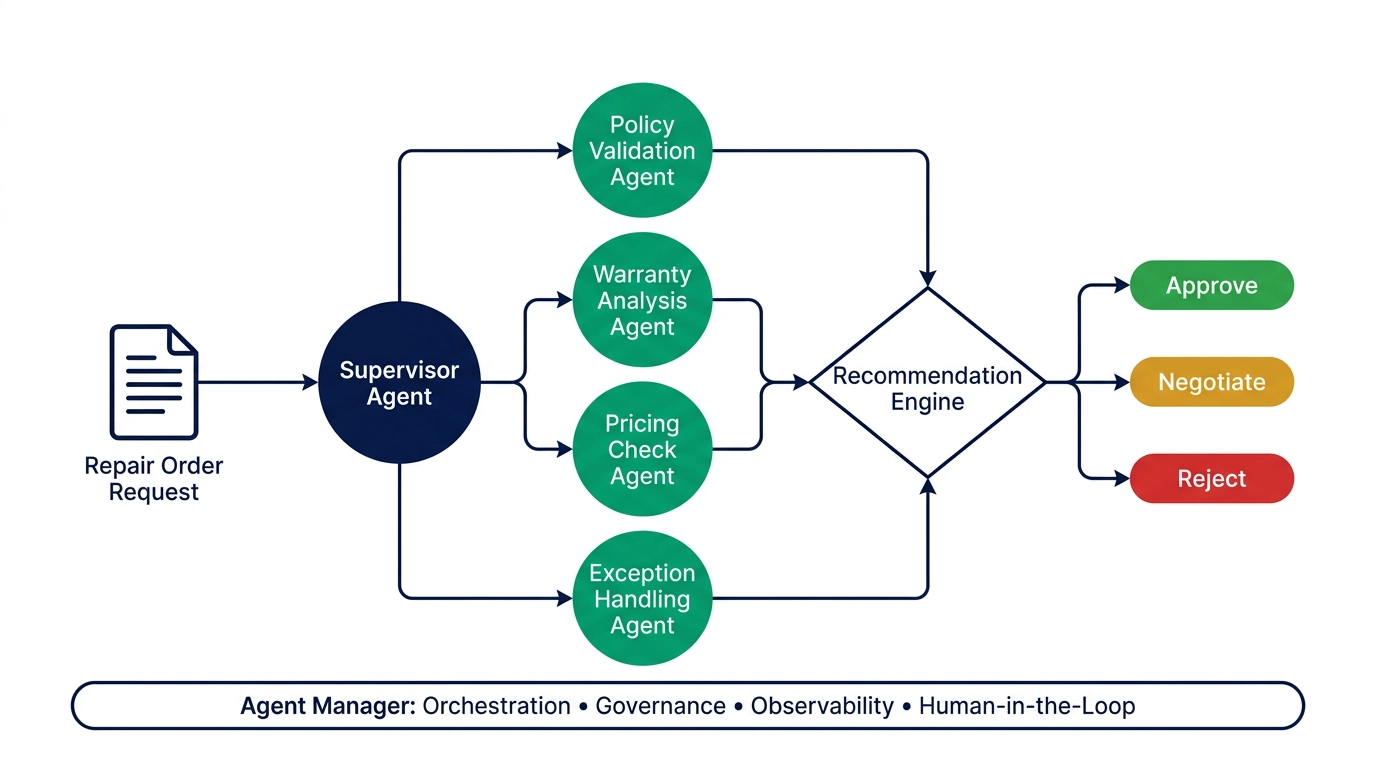
Figure 4 — Repair-order workflow: Supervisor coordinating four specialist agents, governed by Agent Manager.
Every incoming work order moves through a structured sequence of validations. Each agent contributes context-aware insight; the system evaluates compliance, surfaces discrepancies, and produces a clear recommendation — Approve, Negotiate, or Reject — with detailed reasoning the business can trust and audit.
| Outcome | Impact |
| Approval accuracy | Materially improved versus the manual baseline, with consistent reasoning across reviewers. |
| Compliance | Policy and warranty rules met consistently on every order, with a verifiable audit trail. |
| Manual effort | Significantly reduced; reviewers focus only on genuine exceptions. |
| Scalability | Architecture designed to absorb additional workflows and use cases without re-engineering. |
| Repeatability | Established a reusable enterprise pattern: multi-agent systems on AWS, governed via a centralised control plane. |
The repeatable pattern — this engagement is not a single win, it is a template. The same blueprint applies to claims, underwriting, KYC, contract review, supplier negotiation, and dozens of other decisioning workflows.
What Lies Ahead — and Where to Start
The next 24 months will reshape how enterprises buy, build, and govern AI. Four shifts are already in motion, and the organisations that prepare for them now will move first.
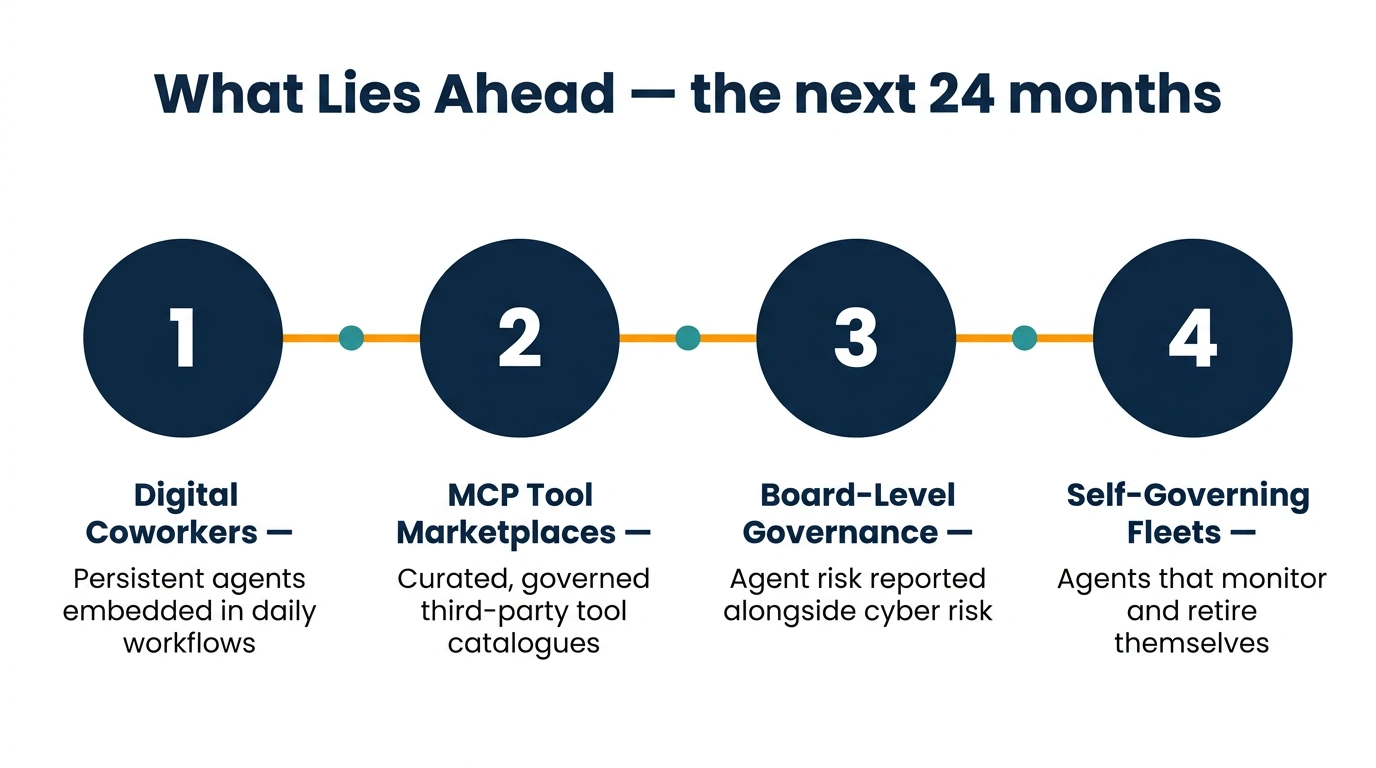
Figure 5 — The next 24 months: four shifts that will define the agentic enterprise.
- Pick one From single-vendor stacks to open agent ecosystems. MCP and A2A are doing for agents what HTTP and OpenAPI did for services. Enterprises will assemble systems from agents and tools across vendors, frameworks, and clouds — a control plane that doesn’t speak both protocols will date itself quickly.
- From per-team agents to enterprise agent platforms. Economics tip toward shared registries, shared tool catalogues, shared evaluation, shared governance. Each team still owns its agents — but on common rails.
- From compliance after-the-fact to governance by design. Identity, policy, evaluation, and audit move into the control plane. Boards will start asking the same questions about agent estates that they already ask about data.
- From assistants to digital coworkers. Agents will hold cross-session memory, manage their own backlogs, and request human approvals on cue — operating less like macros and more like teammates.
Where to start
If you are weighing your next move, the fastest path to value is not a twelve-month transformation programme. It is a single high-value workflow with three pragmatic starting points:
- Pick one decisioning workflow with high volume, clear rules, and tight SLAs.. That is your beachhead.
- Stand up a thin control plane early. Even a small Agent Manager footprint pays back from the second agent onwards.
- Run a 6 – 8 weeks proof-to-pilot with Quantiphi to harden the first multi-agent workflow, then scale-out from there.
Quantiphi – AWS Partner Spotlight
Quantiphi is an Amazon Web Services Premier Tier Services Partner and an AI-first digital engineering company focused on solving transformational business challenges. With deep expertise across cloud, data, and AI, Quantiphi helps enterprises move from pilots to production—building scalable, secure, and enterprise-grade AI systems.
Contact Quantiphi | Partner Overview | AWS Marketplace | Case Studies
Have an Agentic use case in mind? Let’s talk.