From Simulation to Autonomous Engineering: Introducing the AI Design Engineer

Introduction
Across industries, the pressure to innovate has never been greater. Whether developing next-generation aircraft, electric vehicles, energy systems, advanced materials, or industrial equipment, organizations must deliver better products faster while managing growing complexity, tighter budgets, and shorter development cycles. Yet the journey from engineering requirements to optimized designs remains largely manual. Engineers spend considerable time interpreting specifications, creating candidate designs, running simulations, analyzing results, and iterating through multiple design cycles before reaching an acceptable solution. As products become more sophisticated, these workflows become increasingly costly and difficult to scale.
At Quantiphi, we have addressed one of the biggest bottlenecks in engineering workflows: the cost and speed of physics-based simulations. Through our work on advanced Neural Operators, we demonstrated how AI can dramatically accelerate engineering simulations while maintaining high predictive fidelity, enabling engineers to explore design spaces much faster than traditional numerical solvers. (For more details, see our blog: “Engineering Made Smarter: Unlocking Simulation Efficiency with Advanced Neural Operators.”)
However, faster simulations solve only part of the problem. Engineers still need to define requirements, interpret constraints, evaluate trade-offs, and repeatedly refine designs before achieving optimal outcomes. The real challenge is accelerating the entire engineering decision-making process by transforming disconnected activities into an intelligent, continuously optimized workflow. This is where the AI Design Engineer emerges as the next evolution of engineering intelligence, building on advances in physics-informed AI simulation to autonomously guide the journey from requirements to optimized designs.
Overview of the challenges of traditional engineering workflows and the AI Design Engineer accelerates the journey from requirements to optimized designs
Beyond Engineering Copilots
Recent advances in Artificial Intelligence have introduced engineering assistants capable of answering questions, generating reports, and helping engineers navigate documentation.
While valuable, these tools remain largely passive. They can provide information, but they cannot actively participate in the engineering process itself. What engineering teams increasingly need is not another assistant, but an autonomous engineering collaborator capable of:
- Understanding design objectives
- Interpreting engineering requirements
- Generating candidate designs
- Evaluating performance
- Learning from simulation results
- Optimizing designs against multiple objectives
- Continuously refining solutions until requirements are satisfied
In other words, an AI system that can operate across the complete engineering lifecycle.
Introducing the AI Design Engineer
At Quantiphi, we have developed the AI Design Engineer, a multi-agent framework that accelerates the journey from engineering requirements to optimized designs by combining engineering knowledge, physics-informed AI, simulation intelligence, and autonomous optimization.
The AI Design Engineer acts as a collaborative engineering partner that works alongside engineers throughout the design process. Instead of manually orchestrating multiple tools and workflows, engineers interact with the system using natural language, specifying requirements, objectives, constraints, and design goals.
The framework then coordinates specialized AI agents that transform these requirements into optimized engineering solutions.
How the AI Design Engineer Works
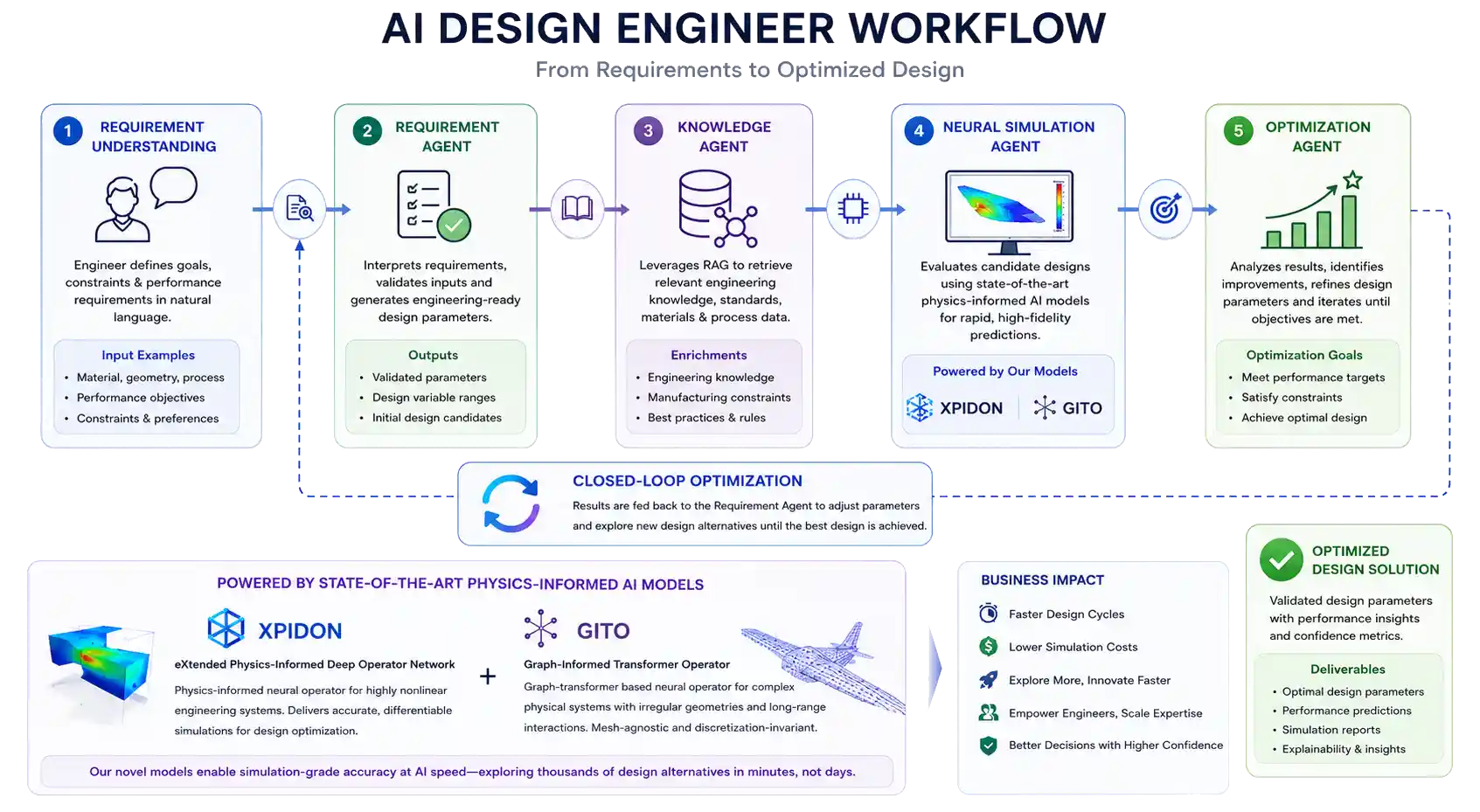
The AI Design Engineer transforms engineering requirements into optimized designs through an autonomous, closed-loop engineering workflow.
1. Requirement Understanding
The process begins with an engineer describing design objectives, constraints, performance targets, and operational requirements in natural language. Rather than requiring specialized simulation or optimization expertise, engineers simply specify what they want to achieve.
2. Requirement Agent – Converting Intent into Design Variables
The Requirement Agent interprets the engineering intent and translates it into engineering-ready design variables and parameters. It validates inputs, identifies missing information, and ensures that the problem is properly formulated before proceeding.
3. Knowledge Agent – Incorporating Engineering Intelligence
The Knowledge Agent enriches the design with relevant engineering knowledge, manufacturing constraints, material specifications, industry standards, and domain expertise. By grounding the workflow in engineering best practices, it ensures that candidate designs remain physically feasible, manufacturable, and aligned with real-world constraints.
4. Neural Simulation Agent – Predicting Performance at AI Speed
The candidate designs are evaluated using our state-of-the-art physics-informed AI simulation engine powered by XPIDON (eXtended Physics-Informed Deep Operator Network) and GITO (Graph-Informed Transformer Operator).
XPIDON is our novel physics-informed neural operator designed for highly nonlinear engineering systems and optimization workflows, while GITO combines graph neural networks and transformers to model complex physical systems with irregular geometries and long-range spatial interactions.
Together, these proprietary neural operators deliver simulation-grade predictions at AI speed, enabling rapid exploration of design alternatives that would be prohibitively expensive using traditional numerical simulations.
5. Optimization Agent – Driving Continuous Improvement
Simulation results are automatically evaluated against target objectives and constraints. The Optimization Agent identifies opportunities for improvement, refines design parameters, and generates new candidate designs.
The updated designs are then fed back into the Knowledge Agent, creating a continuous feedback loop where engineering knowledge, simulation intelligence, and optimization work together to progressively improve the solution.
This iterative process continues until the desired performance objectives, engineering constraints, and design targets are satisfied. The result is an autonomous engineering workflow that dramatically reduces the time and effort required to move from requirements to validated, optimized designs.
Business Impact
The value of the AI Design Engineer extends far beyond simulation acceleration. By automating key stages of the engineering workflow, organizations can:
- Reduce engineering design cycles from weeks to days
- Accelerate exploration of large design spaces
- Improve engineering productivity and resource utilization
- Reduce dependence on manual trial-and-error experimentation
- Lower computational costs associated with large-scale simulation studies
- Improve consistency and repeatability of engineering decisions
- Enable engineers to focus on innovation rather than repetitive analysis
Most importantly, the AI Design Engineer augments engineering teams by automating repetitive design and optimization tasks, enabling experts to focus on innovation rather than iteration.
Case Study: Designing Defect-Free Aerospace Composites
We initially developed the Q Design Engineer for composite material manufacturing, where design optimization is particularly challenging. Composite materials are critical to modern aerospace systems because they offer exceptional strength-to-weight ratios, enabling lighter and more fuel-efficient aircraft. However, manufacturing these materials requires precise control of curing processes. Small variations in process parameters such as air temperature, heat transfer conditions, cure cycles, or material properties can lead to defects that compromise structural integrity and increase manufacturing costs.
Traditionally, identifying optimal curing strategies requires extensive simulation campaigns, expert knowledge, and repeated engineering analysis. Using the AI Design Engineer, engineers simply specify:
- Material specifications
- Component geometry
- Manufacturing constraints
- Performance objectives
The framework automatically generates candidate process parameters, validates them against engineering constraints, performs rapid physics-informed simulations, evaluates performance objectives, and refines design recommendations through iterative optimization.
Instead of manually exploring thousands of potential process configurations, engineers receive optimized recommendations supported by simulation-driven evidence. The result is faster design convergence, reduced development effort, lower risk of manufacturing defects, and improved confidence in production readiness.
In the video below, see how engineers can move from design requirements to optimized solutions through AI-driven simulation and autonomous design refinement.
The AI Design Engineer in Action
Applications Across Engineering Domains
While we initially developed the AI Design Engineer for composite material manufacturing, the framework is designed to be domain-agnostic and can be applied wherever engineering design, simulation, and optimization are required.
Aerospace Engineering
Accelerate the design and optimization of lightweight structures, composite components, thermal systems, and manufacturing processes while balancing performance, safety, and cost constraints.
Automotive Engineering
Optimize vehicle components, battery systems, thermal management strategies, and manufacturing processes to improve efficiency, durability, and performance.
Energy Systems
Design and optimize renewable energy systems, battery storage solutions, power electronics, and thermal energy management systems while meeting operational and sustainability objectives.
Advanced Materials
Accelerate the discovery and optimization of material formulations, manufacturing parameters, and processing conditions to achieve targeted mechanical, thermal, or chemical properties.
Industrial Manufacturing
Optimize process parameters, production workflows, and equipment configurations to improve product quality, reduce defects, and increase operational efficiency.
Electronics and Semiconductor Design
Explore design trade-offs across thermal, mechanical, and reliability requirements while accelerating the development of next-generation electronic systems. By combining engineering knowledge, physics-informed simulation, and autonomous optimization, the AI Design Engineer provides a common framework for accelerating innovation across diverse engineering disciplines.
The Future of Engineering
The future of engineering is not simply faster simulations; it’s intelligent systems capable of understanding requirements, reasoning about constraints, evaluating alternatives, and continuously improving designs.
The AI Design Engineer represents a step toward that future, where engineers and AI collaborate to accelerate innovation, shorten development cycles, and solve increasingly complex engineering challenges. The question is no longer whether AI can assist engineering. The question is how quickly organizations can harness AI to transform the way engineering itself is performed.
If you’re interested in exploring how the AI Design Engineer can be applied to your engineering use cases, contact us at philabs@quantiphi.com to start the conversation.