Humanizing AI: Shifting from Technical Novelty to Intuitive, Human-Centric Collaboration

For years, the conversation surrounding Artificial Intelligence was dominated by raw computing metrics: parameters, token speeds, and foundational breakthroughs. However, a major paradigm shift is taking place. The industry is moving past the novelty of AI capability toward a much more critical challenge: usability.
To drive true enterprise and consumer adoption, AI must feel less like a rigid command-line system and more like an intuitive, context-aware collaborator. By evolving the user interface (UI) and user experience (UX), the technology is transforming into something that seamlessly adapts to human workflows effectively humanizing AI.
The Importance of Humanizing AI
As generative AI and agentic workflows advance into core corporate and consumer spaces, raw intelligence is no longer the main differentiator. If technology is too complex or forces users to completely change how they naturally think and work, adoption falls flat.
Humanizing AI means prioritizing empathy, clarity, and friction-free interactions within software design. It means moving away from empty prompt boxes that require complex engineering to get a good result, and instead building smart, collaborative systems that anticipate human needs, explain their reasoning clearly, and provide reliable guardrails.
The Three Pillars of Humanized AI Design
- 1. Intuitive Visualization
AI interfaces should highlight key insights, anomalies, and connections instead of overwhelming users with raw data. This helps users validate information faster, reduce review fatigue, and make confident decisions. - 2. Simplifying Complexity
Enterprise documents are often unstructured and inconsistent. Humanized AI simplifies both data extraction and user workflows by turning complex, multi-step processes into seamless, context-driven experiences. - 3. Human-in-the-Loop Collaboration
The most effective AI systems work alongside humans. Users can easily correct outputs, refine data, and provide feedback, enabling the system to continuously improve accuracy and build trust over time.
The “Human Touch” in Agentic Ecosystems
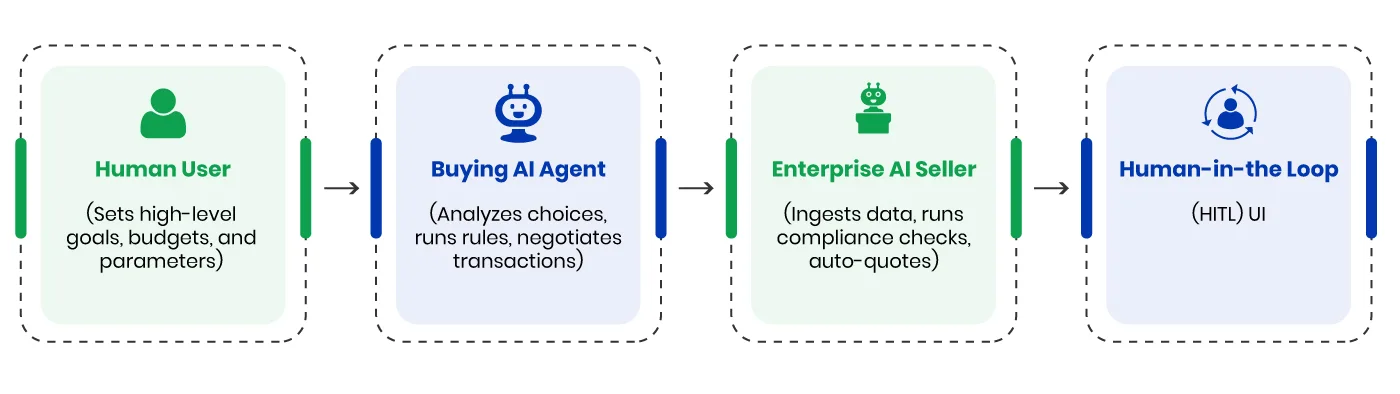
One of the most fascinating developments in human-centric AI is the rise of agent-to-agent and agent-to-human interaction, particularly the concept that autonomous AI agents can buy and transact on behalf of humans.
Imagine an ecosystem where a business or consumer specifies a high-level goal (e.g., “Find and secure the most comprehensive commercial property policy matching our risk profile”). The user’s AI agent can interface directly with an enterprise’s sales or underwriting platform, look through options, ask clarifying questions, and even complete a secure transaction within defined budget thresholds.
To prevent these autonomous systems from becoming a black box, it is vital to maintain a Human-in-the-Loop (HITL) interface. AI handles the heavy lifting, data ingestion, and initial negotiation, but presents its final decisions to humans via clear, visually intuitive dashboards for ultimate sign-off.
How Businesses Are Evolving UI to Make AI More Collaborative
A prime example of this evolution is how leading technology companies are re-engineering their platforms to integrate AI as a seamless, human-like companion. Across consumer and enterprise applications, interfaces are increasingly being designed around natural interaction rather than traditional menus and search functions.
- Conversational Experiences & Guided Interfaces: Instead of relying entirely on keyword searches and filters, modern platforms allow users to engage with AI assistants through natural conversation. Interfaces dynamically adapt and present tailored recommendations, guidance, and next steps replicating the experience of interacting with a knowledgeable advisor or service representative.
- Contextual AI Agents: Digital experiences are evolving beyond simple transactions. AI agents can proactively analyze user behavior, preferences, and historical interactions to anticipate needs, recommend personalized solutions, automate routine tasks, and maintain continuity across interactions. This shifts the user experience from a series of isolated actions to an ongoing, relationship-driven engagement.
Today, major organizations such as Google, Microsoft, Meta, Salesforce, Adobe, and OpenAI are investing heavily in human-centered AI experiences that emphasize conversation, context awareness, personalization, and collaboration. Rather than functioning as standalone tools, AI systems are increasingly being designed as digital partners that help users make decisions, complete tasks, and achieve goals more naturally and efficiently.
Why BFSI Enterprises Need Humanized AI
For BFSI enterprises, document processing is far more than an operational task,it directly influences risk management, regulatory compliance, and customer experience.
Teams handle vast volumes of complex, unstructured documents every day, including:
- Loss run reports
- Claims documents
- Financial disclosures
- Loan applications
- Policy records
- Compliance forms
When systems are cluttered or difficult to navigate, the likelihood of missed insights, delays, and manual errors increases significantly.
Humanized AI addresses these challenges by creating more intuitive and collaborative workflows. It helps teams:
- Improve workflow clarity
- Intelligently highlight exceptions and anomalies
- Simplify document reviews
- Reduce repetitive manual effort
- Accelerate decision-making with greater confidence
As banks and insurers continue scaling Generative AI across enterprise operations, human-centered AI experiences will become critical to driving both efficiency and trust.
How Dociphi and Quantiphi are Making Human-Centric AI a Reality
Quantiphi, an AI-first digital engineering company, is at the absolute forefront of this shift, turning these high-level design philosophies into practical enterprise platforms through its flagship product, Dociphi.
1. Quantiphi’s USPTO-Patent for Intuitive UI
Quantiphi recently secured a landmark design patent from the United States Patent and Trademark Office (USPTO) titled “Display Screen Or Portion Thereof With Graphical User Interface For Document Processing And Data Extraction”.
This patent protects the unique look and feel that makes Dociphi an incredibly intuitive platform. Rather than forcing underwriters or claims adjusters to decipher raw JSON outputs, Dociphi’s patented UI seamlessly connects extracted automated data side-by-side with original documents. Hovering over an extracted data point highlights its exact location on the physical file using a bounding box , bringing absolute transparency and trust to complex AI models.
2. The 3-Way Comparison and Smart Discrepancy Editing
Dociphi features a patented Comparison Screen capable of concurrently validating multiple versions of complex files (such as proposals, carrier quotes, and finalized policies). Discrepancies are highlighted in red, allowing users to fix or override content instantly via a secure Human-in-the-Loop workflow. This balances machine speed with irreplaceable human judgement.
3. Enhancing the UI Footprint through Candyspace
Quantiphi’s commitment to premium human experience was further solidified through its acquisition of Candyspace, a London-based digital product agency. By combining Quantiphi’s deep, cutting-edge applied AI research with Candyspace’s world-class capability in creating beautiful, user-centric digital experiences, the company is uniquely positioned to build next-generation applications. This partnership ensures that enterprise AI platforms are not just technically superior, but deeply meaningful and friction-free for the professionals who use them every day.
The Next Frontier: Human + AI
The future of technology will not belong to the most complex models, but to the platforms that integrate those models most seamlessly into human lives. Through patented user experiences, deliberate human-in-the-loop engineering, and a focus on design-led innovation, companies like Quantiphi and products like Dociphi are paving the way for a more collaborative, efficient, and distinctly human AI future.