Molecular Engineering with AI Synergy: Pioneering Next-Generation Drug Discovery

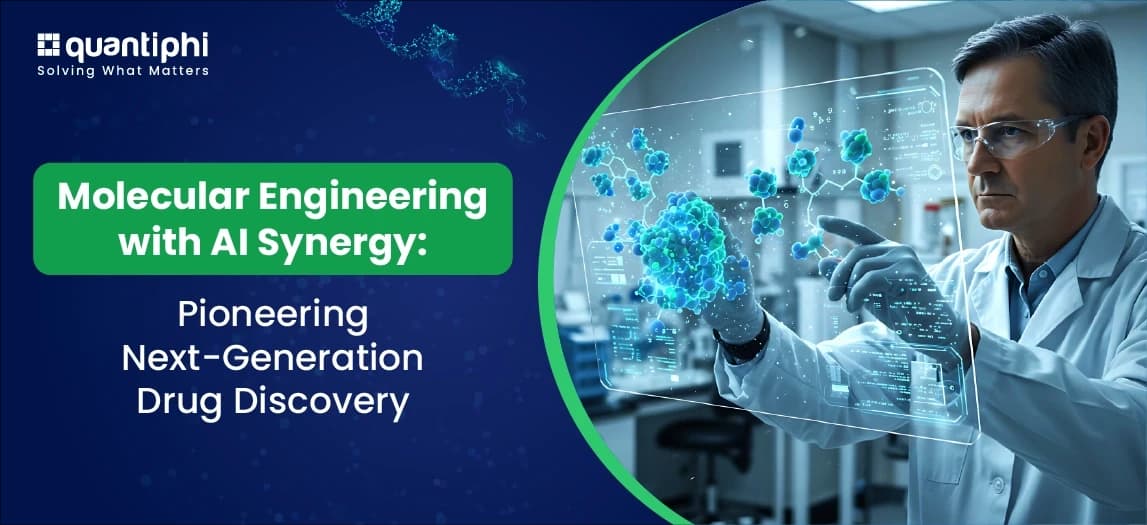
Why the fusion of molecular science and generative AI is reshaping what’s possible in therapeutic innovation.
1. Introduction: The Rise of Molecular Engineering
Drug discovery is standing at the cusp of a revolution. For decades, the process of identifying new therapeutic molecules has relied on brute-force screening, testing millions of compounds in search of a “hit.” While this approach has delivered breakthroughs, it is painfully slow, expensive, and often fails to capture the full diversity of chemical space.
The challenge is staggering: the vast chemical universe contains anywhere from 1023 to 1060 drug-like molecules. Exploring even a fraction of this space with traditional methods is not feasible. The pharmaceutical industry faces mounting costs, longer development cycles, and diminishing returns.
This is where molecular engineering in drug discovery is rewriting the rules. By merging advances in chemistry, biology, and artificial intelligence (AI), molecular engineering allows researchers to design, simulate, and optimize molecules with unprecedented precision. The result? Faster innovation, deeper exploration of chemical space, and a more strategic approach to early-stage discovery.
2. What Is Molecular Engineering?
At its core, molecular engineering is the intentional design and manipulation of molecules to achieve specific functions. It goes beyond observation—it’s about creation.
Applications span across industries, but in healthcare and biotech, its potential is transformative. Molecular engineering enables:
- Designing novel drug candidates tailored to biological targets
- Optimizing molecules for binding affinity, stability, and safety
- Generating new scaffolds that can form the basis of first-in-class therapeutics
- Exploring previously uncharted chemical regions for unique intellectual property
However, the limitations of traditional methods are clear:
- High-throughput screening burns resources without guaranteeing diversity.
- De novo design often struggles to balance novelty with drug-likeness.
- Human intuition alone cannot navigate the astronomical scale of chemical possibilities.
This is why AI in molecular engineering is emerging as a critical enabler—bringing intelligence, adaptability, and scalability to the discipline.
3. The Shift From Trial-and-Error to Smart Drug Discovery
For years, brute-force approaches dominated drug discovery: generate a massive library, test everything, and hope for a viable hit. While valuable in the past, this method is increasingly unsustainable.
Key challenges with brute-force methods:
- Costly inefficiency: Only a fraction of screened molecules ever make it to preclinical stages.
- Time drain: Years spent narrowing down leads.
- Chemical redundancy: Focused too heavily on known scaffolds, stifling innovation.
AI-driven molecular engineering transforms this paradigm by enabling precision-driven discovery. Instead of blindly searching, researchers can:
- Predict molecular behavior using machine learning models.
- Explore chemical space intelligently, targeting areas with higher potential.
- Iteratively optimize molecules in silico before committing to lab validation.
This shift saves time, reduces costs, and—most importantly—expands innovation horizons by uncovering molecules that conventional pipelines would likely overlook.
4. The Science of AI-Guided Molecular Engineering Technology
AI-guided molecular engineering is not just faster—it’s smarter. Its power lies in combining generative exploration with guided optimization:
- Generative AI Models: Tools like variational autoencoders (VAEs), diffusion models, and transformers generate novel molecules, learning patterns from chemical databases.
- Evolutionary Algorithms: Inspired by natural selection, these methods mutate and recombine molecular structures, ensuring diversity and avoiding stagnation.
- Policy Gradient Optimization: Reinforcement learning fine-tunes molecules toward specific objectives, such as potency or solubility, guided by reward signals.
The combination ensures a delicate balance: novelty without randomness, optimization without overfitting. Molecules are not only new but also drug-like, patent-eligible, and biologically relevant.
5. Real-World Impact of AI-Guided Molecular Design
Real-world research has validated the impact of AI-driven molecular engineering. Benchmarks consistently show:
- Higher Hit Rates: AI-guided discovery dramatically improves the fraction of viable molecules generated compared to baseline generative models.
- Improved Binding Affinity: Optimized molecules demonstrate stronger binding to biological targets, increasing therapeutic potential.
- Scaffold Diversity: Instead of recycling known structures, AI-driven approaches generate hundreds of unique scaffolds—broadening the landscape for intellectual property.
- Efficient Exploration: Dynamic scheduling strategies allow for both broad exploration and focused optimization, avoiding the trap of local optima.
Together, these advances prove that molecular engineering—when guided by AI—delivers measurable, scalable improvements over traditional pipelines.
6. EPOSMol: A Case Study in Intelligent Molecular Engineering
One of the most promising illustrations of AI-guided molecular engineering in practice is EPOSMol, developed by Quantiphi’s Philabs research team.
EPOSMol integrates Generative AI with Evolutionary Policy Gradient Optimization (EPGO) to create a guidance system for molecular discovery. Instead of generating random compounds, it actively steers molecule design toward structures that are novel, drug-like, and biologically promising.
Highlights from the Research:
- Evolutionary Policy Gradient Optimization (EPGO): Combines population-based search with reinforcement learning updates, ensuring both exploration and refinement.
- Dynamic Exploration Strategy: Alternates between wide exploration of chemical space and narrow optimization, preventing premature convergence.
- Quantitative Results:
- Hit rates up to 10× higher than baseline generative models
- Binding affinity improvements (down to –12.1 kcal/mol in benchmarks)
- 340+ unique scaffolds generated in case studies, expanding IP potential
- Patent-Eligibility: The molecules identified were not only diverse but also legally protectable, giving innovators a tangible edge.
Explore the full technical details in our paper on EPOSMol: advanced AI computational drug discovery.
7. Why Molecular Engineering Matters for the Future
For early-stage pipelines, where risk is highest and decisions carry the most weight, molecular engineering provides a clear advantage:
- Acceleration: Shortens discovery timelines by focusing on high-potential leads.
- Risk Mitigation: Reduces wasted effort on molecules unlikely to succeed.
- Innovation: Unlocks unexplored chemical regions, expanding therapeutic and IP possibilities.
- Strategic Insight: Provides explainable, data-driven guidance—not just black-box predictions.
The future of drug discovery will not be about sheer scale, but about intelligent scale—exploring vast chemical universes strategically, rather than blindly.
8. Why Quantiphi
At Quantiphi, we specialize in applying AI to real-world life sciences challenges—from drug discovery and preclinical testing to pharmacovigilance and manufacturing.
With 2,500+ AI projects delivered and a team of 300+ HCLS experts, we’ve proven our ability to help pharma and biotech organizations accelerate research, improve efficiency, and drive impactful breakthroughs.
Whether you’re a research lab, a pharmaceutical giant, or a biotech startup, our expertise enables you to turn complex problems into actionable outcomes—unlocking innovation where it matters most.
9. Conclusion
Molecular engineering is no longer just an academic pursuit—it is the cornerstone of modern drug discovery. With AI as its engine, it is enabling a new paradigm: one where creativity and precision work hand in hand to produce therapies that are effective, novel, and faster to develop.
EPOSMol demonstrates how these principles can be applied in practice, offering a glimpse of the future where AI-guided molecular engineering defines how we design, evaluate, and bring drugs to market.
Ready to explore how AI can accelerate your drug discovery pipeline?
Read the full EPOSMol research paper or connect with our life sciences experts at Quantiphi to transform your discovery workflows.