Rethinking Preclinical Testing: The DART Advantage

Introduction
Animal testing has long been the foundation of drug development — yet nearly 90% of drugs that pass those tests still fail in human trials. With advances in AI, stem cell science, and regulations like the FDA Modernization Act 2.0, the life sciences industry is rethinking how preclinical testing should really work.
That’s why our experts from Quantiphi and Transcell Biologics discussed DART (Digital Animal Replacement Technology) in the pilot episode of the Phi Moments podcast. They explored how DART — an AI- and stem cell–based platform — is transforming preclinical research by delivering faster, more human-relevant insights.
This blog highlights key takeaways from their conversation. Catch the full discussion below to discover how DART is shaping the future of preclinical research.
Check Out Our Latest Episode Now
Follow Phi Moments on your favorite podcast channels to uncover the breakthroughs powering the enterprise of tomorrow


The Problem with Traditional Preclinical Testing
Animal models have been the cornerstone of preclinical testing, but they bring several limitations:
- Poor human translatability – Drugs safe in animals often fail in humans.
- Ethical concerns – Growing public and regulatory pressure against animal testing.
- High costs and long timelines – Animal studies are resource-heavy and slow.
- Regulatory shifts – With the FDA phasing out animal testing requirements for biologics, the industry urgently needs scalable alternatives.
The message is clear: the future of drug discovery depends on human-relevant, non-animal testing solutions.
The Spark Behind DART
The idea for DART was born during the COVID-19 pandemic, when a global shortage of monkeys brought vaccine testing to a standstill. Dr. Subhadra Dravida, CEO of Transcell Biologics, recognized that the industry needed more than a workaround—it needed an enterprise-grade platform to replace animal models altogether.
By combining human stem cell biology with AI and ML-driven analytics, DART emerged as a digital, workstation-ready platform capable of redefining preclinical testing.
What is DART and How Does It Work?
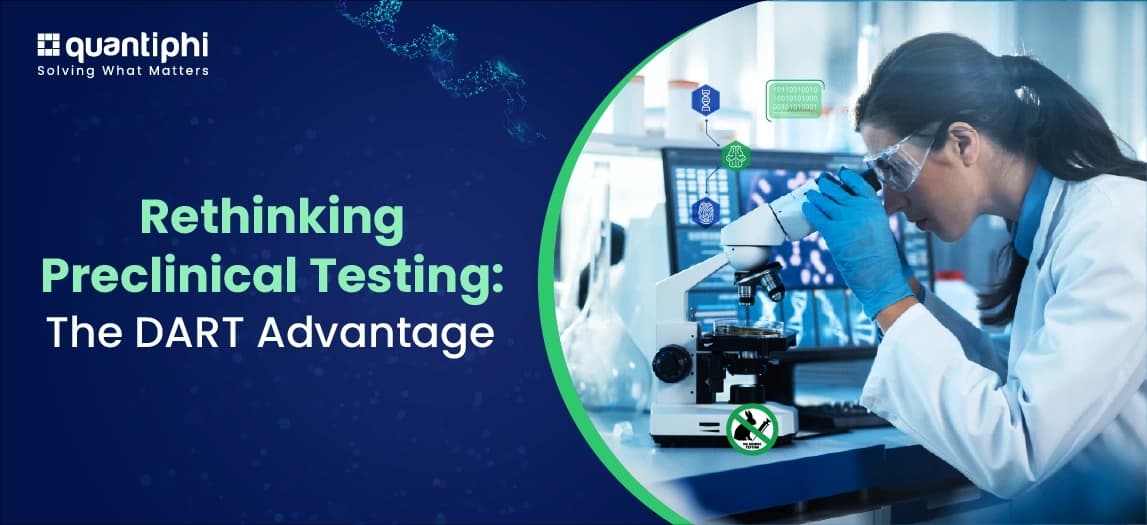
DART is built on human microphysiological systems (hMPS) derived from ethically sourced primary stem cells. These biological models are paired with Quantiphi’s AI-powered vision analytics, which can classify and score over 10 million stem cell phenotypes.
Key capabilities include:
- Real-time toxicity and potency evaluation
- Gene and protein sequence analysis
- Image analytics of drug-cell interactions
- Cloud and on-premises deployment for seamless integration
Unlike animal models, DART generates directly human-relevant data—reducing risk, cost, and development timelines.
What Makes DART Different?
DART stands apart by addressing scientific, operational, and ethical pain points in one integrated platform:
- Human-relevant insights – Based on human biology, not species approximations.
- AI-driven scalability – Deep learning ensures reproducibility and faster qualification.
- Regulator-ready design – Supports early-stage screening through IND-enabling studies.
- Modular and accessible – Deployable without additional infrastructure or data science teams.
With DART, drug developers can make smarter, faster go/no-go decisions and improve their odds of success in clinical trials.
Real-World Impact of DART
DART is already making a global impact:
- Partnered with 15+ pharma and biotech firms
- Piloted across 20+ use cases
- Secured 8 international patents
Case Highlights:
- A global vaccine manufacturer validated immune responses when legacy models failed.
- A U.S. biotech selected oncology IND candidates using patient-derived tumor models.
- One customer received FDA approval using DART-generated data—proving regulatory acceptance.
Beyond pharma, DART is expanding into cosmeceuticals and agrochemicals, industries long dependent on animal testing.
Benefits of DART for Pharma & Biotech
DART delivers value across the entire drug development pipeline:
Early-stage applications:
- Molecule library screening
- Lead prioritization
- Mechanism-of-action validation
- Biosimilarity and residual toxicity checks
- Antigenicity and immunogenicity profiling
Later-stage applications:
- IND-enabling studies
- Potency bioassays and safety pharmacology panels
- Clinical surrogate data for regulatory submissions
- Batch release readiness
Business impact:
- 30% faster early-stage screening
- Reduced R&D costs by eliminating weak candidates earlier
- Smarter cohort design and patient matching for precision medicine
Implementation: How to Get Started
Getting started with DART is simple and scalable:
- Discovery workshop (1 week) – Align on testing goals.
- Pilot program – Modular proof of concept.
- Scale-up – Integration across products and pipelines.
Deployment options:
- Insourced (on-prem/cloud workstation)
- Outsourced (testing at certified facilities)
Many customers have gone from pilot to production in under six months.
Why Quantiphi
At Quantiphi, we specialize in applying AI to real-world life sciences challenges—transforming research into impact.
- 2,500+ AI projects delivered across industries
- 300+ Healthcare and Life Sciences (HCLS) experts
- Proven expertise in drug discovery, preclinical testing, pharmacovigilance, and manufacturing
- Partnerships with leading biotech firms, enabling AI-driven innovation at scale
By co-developing DART with Transcell Biologics, Quantiphi is helping life sciences organizations move beyond animal testing toward smarter, faster, and more ethical science.
The Path Ahead
The shift away from animal models is not just inevitable—it’s already here. DART is setting the new standard for preclinical testing, delivering faster, more accurate, and regulator-aligned insights powered by AI and human stem cell biology.
At Quantiphi, we’re committed to helping R&D teams transform how they design, test, and deliver therapies.
Ready to accelerate your drug development pipeline?
Schedule a 30-minute discovery session with Quantiphi or contact us at appliedai@quantiphi.com.
At Quantiphi, we specialize in applying AI to real-world life sciences challenges—from drug discovery and preclinical testing to pharmacovigilance and manufacturing. With 2,500+ AI projects delivered and 300+ HCLS experts, we’re ready to help your team turn complex research into actionable breakthroughs.